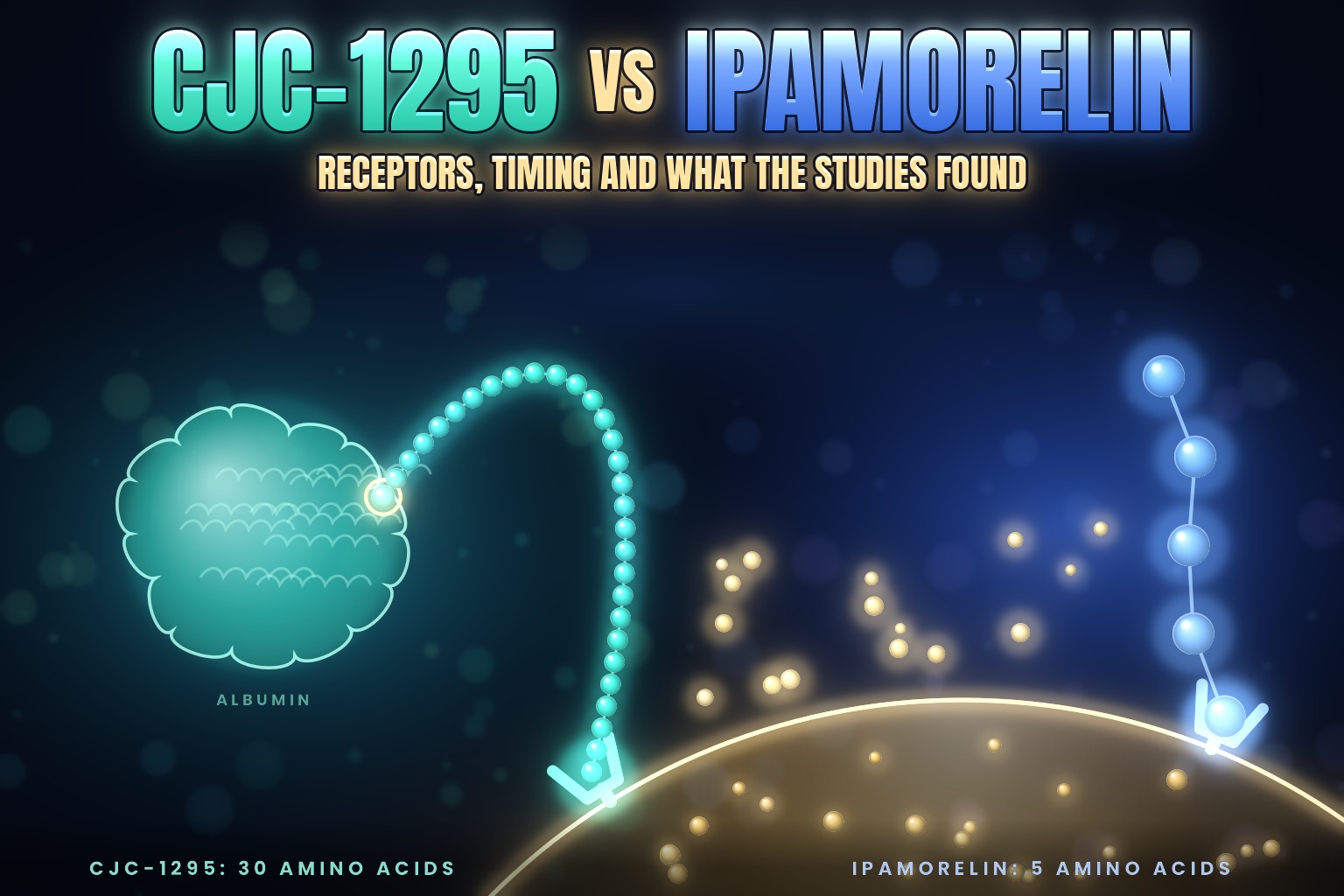
In 1998, a research team titled its paper “Ipamorelin, the first selective growth hormone secretagogue.” Eight years later, another team described CJC-1295 in its title as “a long-acting analog of GH-releasing hormone.”
Selective and long-acting. Those two words sum up how these peptides differ. Ipamorelin, which mimics the stomach hormone ghrelin, turned out in pigs to release growth hormone about as selectively as GHRH, the brain’s own growth hormone signal, and it’s cleared within hours. CJC-1295 is built from GHRH itself and keeps its signal going for days.
Here’s what that looks like in the studies: the receptor each one works through, how long each one lasts, what else each one moves, and what ipamorelin did in the gut.
Two Receptors, Two Signals
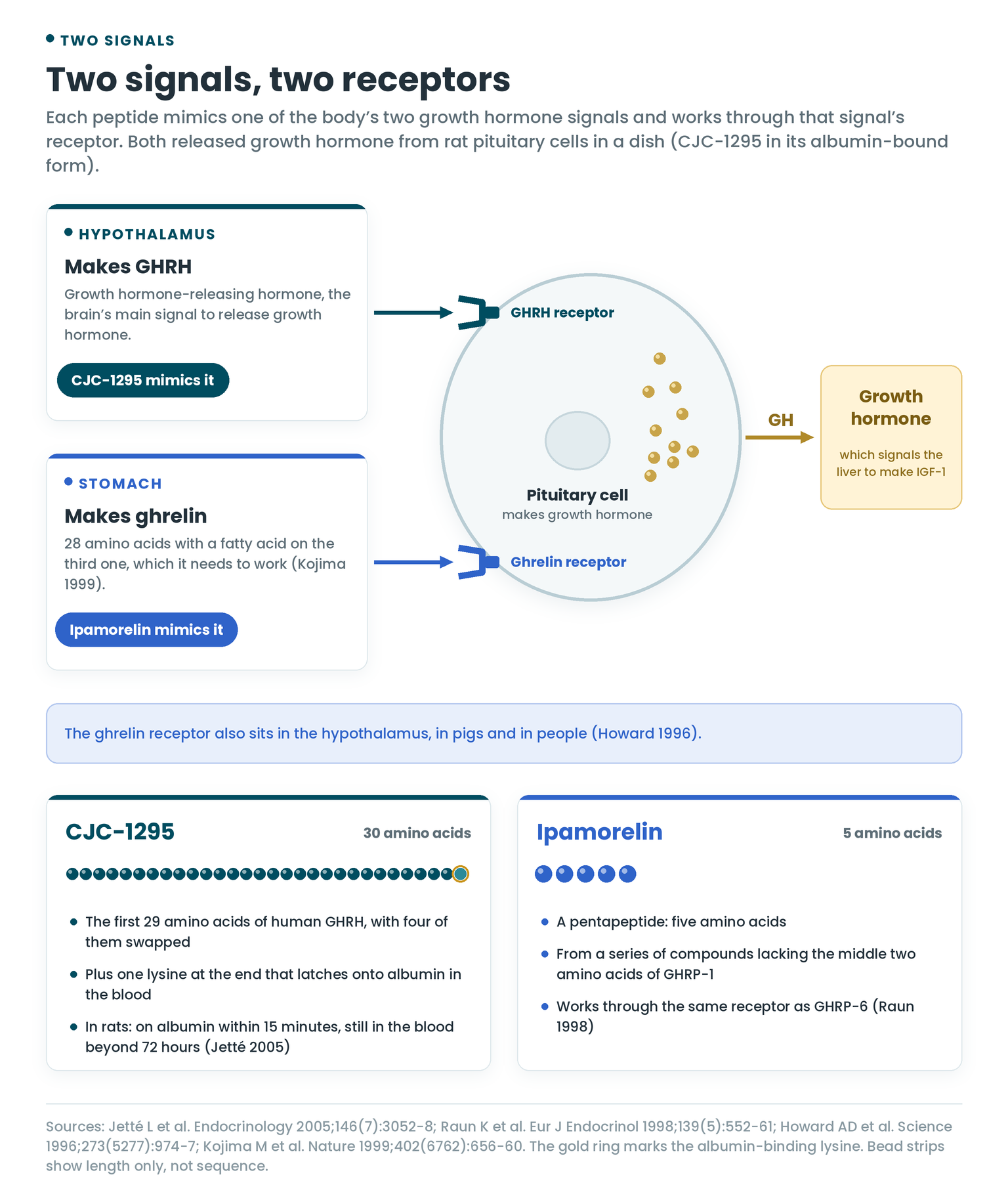
Growth hormone is made by somatotrophs, cells in the front part of the pituitary gland. Two separate signals tell the pituitary to release it, and each of these peptides mimics one of them. Both work directly on the pituitary: ipamorelin, and CJC-1295 in its albumin-bound form, each released growth hormone from rat pituitary cells in a dish.
CJC-1295 Mimics GHRH
Growth hormone-releasing hormone (GHRH) comes from the hypothalamus, just above the pituitary. CJC-1295 is built from hGRF(1-29), the first 29 amino acids of human GHRH, with four of them swapped and one extra amino acid, a lysine, added at the end. That lysine carries a reactive group that latches onto albumin, the most common protein in blood.
In the 2005 paper that picked CJC-1295 out of three candidates, Lucie Jetté and colleagues found it bound to albumin within 15 minutes of an injection in rats and still in the blood beyond 72 hours. Over the first two hours it released four times as much growth hormone as hGRF(1-29). It acts on the GHRH receptor in the pituitary, the same receptor the natural hormone uses. The four swaps are laid out in Tesamorelin vs CJC-1295.
Ipamorelin Mimics Ghrelin
Ipamorelin is a pentapeptide, five amino acids long. It came out of a large chemistry program, in a series of compounds that lack the middle two amino acids of an older growth hormone-releasing peptide, GHRP-1. When Raun and colleagues tested it against blockers of each receptor in 1998, it worked through the same receptor as GHRP-6, not the GHRH receptor.
That receptor had been cloned two years earlier, in 1996. Howard and colleagues found it in the pituitary and in the hypothalamus of pigs and humans, and suggested these synthetic drugs were copying a hormone nobody had found yet. In 1999, Kojima and colleagues found it in rat stomach: ghrelin, a 28-amino-acid peptide with a fatty acid attached to its third amino acid, which it needs to work. The name comes from “ghre”, a Proto-Indo-European root meaning grow, and human ghrelin differs from the rat version at only two amino acids. The receptor is now usually called the ghrelin receptor.
How Long Each One Lasts
Here’s where CJC-1295’s albumin anchor shows.
CJC-1295: Days
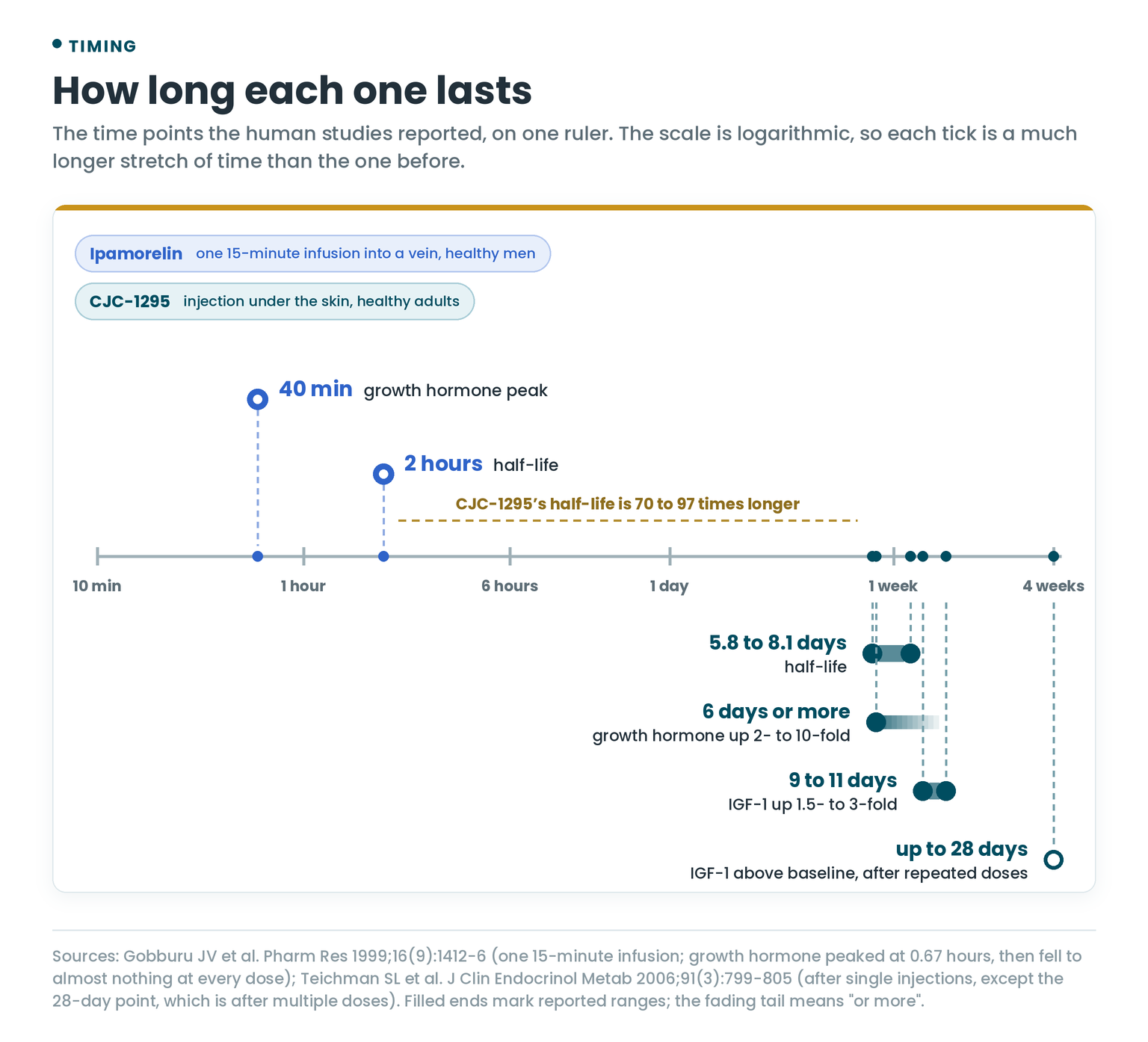
In 2006, Sam Teichman, Lawrence Frohman and colleagues ran two randomized, placebo-controlled, double-blind trials in healthy adults aged 21 to 61, lasting 28 and 49 days. After a single injection under the skin:
- Growth hormone rose 2- to 10-fold, depending on the dose, and stayed up for 6 days or more.
- IGF-1, the growth factor made mainly in the liver in response to growth hormone, rose 1.5- to 3-fold for 9 to 11 days.
- The half-life of CJC-1295 was 5.8 to 8.1 days.
With repeated doses, IGF-1 stayed above baseline for up to 28 days, and the authors saw evidence of a cumulative effect.
Later that year, Madalina Ionescu and Lawrence Frohman took blood every 20 minutes through a 12-hour night from healthy men aged 20 to 40, once before and once a week after a single injection of 60 or 90 µg/kg. The growth hormone pulses kept the same frequency and size. What changed was the floor between them: trough levels rose 7.5-fold, average growth hormone rose 46% and IGF-1 rose 45%. The two doses gave similar results, and the IGF-1 rise didn’t track any single measure of growth hormone release. How that compares with sermorelin, a short-acting GHRH copy, is covered in Sermorelin vs CJC-1295.
Ipamorelin: Hours
In 1999, Gobburu and colleagues gave healthy men 15-minute infusions of ipamorelin into a vein, at five dose levels with eight men at each. Its half-life was 2 hours. Each infusion set off a single burst of growth hormone that peaked at 0.67 hours, about 40 minutes, then fell to almost nothing at every dose. Growth hormone responses varied more from man to man than the drug levels did.
Read the Overnight Trace
Tap the peaks on a growth hormone trace, overnight before and after CJC-1295 and over the hours after an ipamorelin infusion, and see what changes between them.
Ipamorelin and the Gut
The ghrelin receptor isn’t only about growth hormone. Ghrelin and drugs that mimic it also stimulate appetite and speed up the stomach, which led researchers to test ipamorelin after bowel surgery, when the gut often stalls.
In a 2009 rat study led by Kalina Venkova and Beverley Greenwood-Van Meerveld, rats had abdominal surgery with handling of the intestines. A single dose of ipamorelin into a vein (1 mg/kg) shortened the time to the first bowel movement, though it didn’t change stool output, food intake or weight gain over 48 hours. Repeated dosing, four doses a day for two days at 0.1 or 1 mg/kg, raised all three.
In a phase 2 trial published in 2014, David Beck and colleagues tested it in people. The trial was randomized, multicenter, double-blind and placebo-controlled, in adults having part of the small or large bowel removed. Patients got ipamorelin (0.03 mg/kg) or a placebo into a vein twice a day, from the day after surgery until day 7 or discharge. Of 117 people enrolled, 114 were analyzed. The median time to the first solid meal they could tolerate was 25.3 hours on ipamorelin and 32.6 hours on placebo (p = 0.15), and none of the trial’s efficacy measures differed significantly between the groups. Adverse events of any kind occurred in 87.5% of the ipamorelin group and 94.8% of the placebo group. The authors called it well tolerated and noted the trial was small and took in patients with a wide range of conditions.
What Else Each One Moves
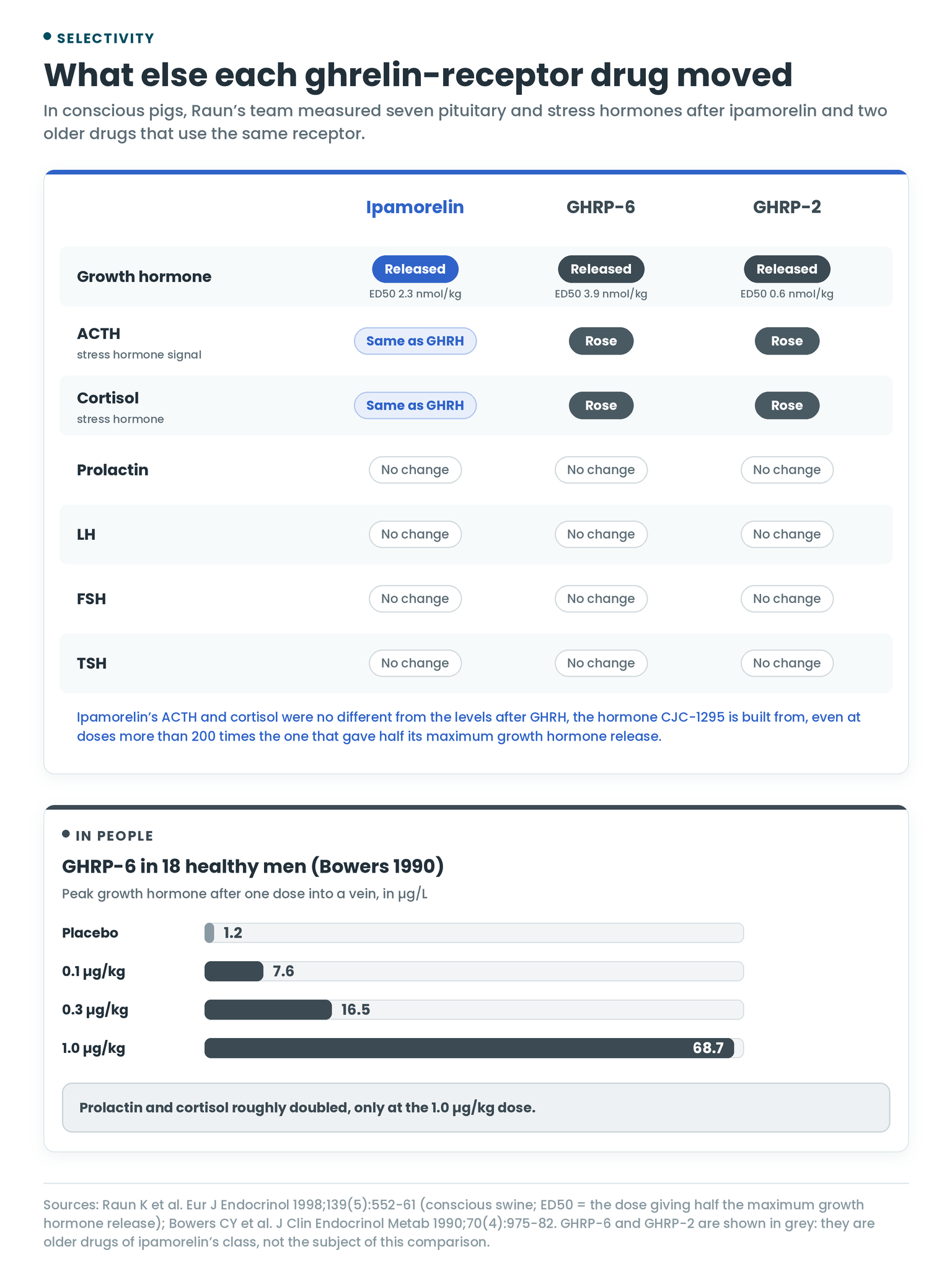
The older peptides that work through the ghrelin receptor release more than growth hormone. Ipamorelin was the exception in its first study.
In that 1998 study, Raun’s team gave pigs ipamorelin, GHRP-6 or GHRP-2 and measured other pituitary and stress hormones:
- FSH, LH, prolactin and TSH didn’t change with any of the three.
- ACTH and cortisol, the stress hormone pair, rose with GHRP-6 and GHRP-2.
- With ipamorelin, ACTH and cortisol were no different from the levels after GHRH, even at doses more than 200 times the one that gave half its maximum growth hormone release.
The yardstick in that comparison was GHRH itself, the hormone CJC-1295 is built from. The authors described ipamorelin as the first drug of its class with growth hormone selectivity similar to GHRH’s. Its growth hormone release was close to GHRP-6’s in rat pituitary cells, anesthetized rats and pigs, while in pigs GHRP-2 was more potent but released less growth hormone at its peak.
In people, GHRP-6 moved other hormones too. In 1990, Bowers and colleagues gave 18 healthy men GHRP-6 into a vein. Peak growth hormone was 7.6, 16.5 and 68.7 µg/L at 0.1, 0.3 and 1.0 µg/kg, against 1.2 µg/L on placebo. Prolactin and cortisol roughly doubled, but only at the top dose, and there were no adverse clinical effects or abnormal lab results.
On the CJC-1295 side, Teichman’s trials reported no serious adverse reactions, and the authors called it relatively well tolerated, particularly at 30 or 60 µg/kg.
Used Together
The two are often paired, and they work through separate receptors. In Bowers’ 1990 study, the two lower GHRP-6 doses given together with GHRH released growth hormone synergistically, which the authors read as a sign that the two systems act independently.
One naming note. The CJC-1295 in every study above is the version with the albumin-binding lysine, the one usually called “CJC-1295 with DAC.” The name also gets put on a 29-amino-acid version without it, usually called Mod GRF 1-29, which has no albumin anchor, so the timings above belong to the DAC version only. The CJC-1295 DAC dosage guide goes through the difference.
Which Is Better?
It depends on what you’re comparing. Here they are side by side, from the studies above:
| CJC-1295 | Ipamorelin | |
|---|---|---|
| Mimics | GHRH, from the hypothalamus | Ghrelin, from the stomach |
| Works through | The GHRH receptor in the pituitary | The ghrelin receptor, in the pituitary and hypothalamus |
| Size | 30 amino acids (29 plus the albumin-binding lysine) | 5 amino acids |
| Half-life in people | 5.8 to 8.1 days | 2 hours |
| Growth hormone after one dose | Up 2- to 10-fold for 6 days or more | One burst, peaking at about 40 minutes |
| Studied in people | Healthy adults, by injection under the skin | Healthy men and adults after bowel surgery, by infusion into a vein |
If the question is how long growth hormone stays up after one dose, CJC-1295’s numbers run in days and ipamorelin’s in hours. If it’s how cleanly a ghrelin-receptor drug releases growth hormone, that selectivity is what set ipamorelin apart in its first study. Ipamorelin is set against tesamorelin, a different GHRH-based peptide, in Tesamorelin vs Ipamorelin.
Doses Used in the Research
- CJC-1295: single injections under the skin of 60 or 90 µg/kg (Ionescu 2006); in Teichman’s trials, ascending single doses, or two or three doses given weekly or biweekly, relatively well tolerated, particularly at 30 or 60 µg/kg.
- Ipamorelin, in people: 15-minute infusions into a vein of 4.21 to 140.45 nmol/kg (Gobburu 1999); 0.03 mg/kg into a vein twice daily for up to 7 days after bowel surgery (Beck 2014).
- Ipamorelin, in rats: 0.01 to 1 mg/kg into a vein, once or four times a day for two days (Venkova 2009).
Frequently Asked Questions
Is CJC-1295 or ipamorelin better?
They work in different ways. CJC-1295 mimics GHRH and kept growth hormone raised for days after one injection, while ipamorelin mimics ghrelin and set off a single burst that peaked at about 40 minutes.
Do CJC-1295 and ipamorelin work the same way?
No. CJC-1295 works through the GHRH receptor, and ipamorelin works through the ghrelin receptor. Both release growth hormone from the pituitary, and ipamorelin’s receptor also sits in the hypothalamus.
How long does ipamorelin last?
In healthy men given 15-minute infusions, ipamorelin had a half-life of 2 hours, and the growth hormone burst it caused faded to almost nothing within hours.
How long does CJC-1295 last?
Its half-life in healthy adults was 5.8 to 8.1 days. After one injection, growth hormone stayed raised for 6 days or more and IGF-1 for 9 to 11 days.
Does ipamorelin raise cortisol?
In pigs, ipamorelin’s ACTH and cortisol levels were no different from those after GHRH, even at more than 200 times the dose that gave half its maximum growth hormone release. GHRP-6 and GHRP-2 raised both.
Why are CJC-1295 and ipamorelin used together?
They act through separate receptors. In a 1990 study of healthy men, low doses of GHRP-6, an older drug that uses ipamorelin’s receptor, released growth hormone synergistically when given with GHRH.
Stay sharp,
Joe Mars
The Peptide Report
P.S. Comparing growth hormone peptides? Swap notes with others in the Peptides & Biohacking Hub on Skool.
References
- Raun K, Hansen BS, Johansen NL, Thøgersen H, Madsen K, Ankersen M, et al. Ipamorelin, the first selective growth hormone secretagogue. Eur J Endocrinol. 1998;139(5):552-561. doi:10.1530/eje.0.1390552
- Teichman SL, Neale A, Lawrence B, Gagnon C, Castaigne JP, Frohman LA. Prolonged stimulation of growth hormone (GH) and insulin-like growth factor I secretion by CJC-1295, a long-acting analog of GH-releasing hormone, in healthy adults. J Clin Endocrinol Metab. 2006;91(3):799-805. doi:10.1210/jc.2005-1536
- Jetté L, Léger R, Thibaudeau K, Benquet C, Robitaille M, Pellerin I, et al. Human growth hormone-releasing factor (hGRF)1-29-albumin bioconjugates activate the GRF receptor on the anterior pituitary in rats: identification of CJC-1295 as a long-lasting GRF analog. Endocrinology. 2005;146(7):3052-3058. doi:10.1210/en.2004-1286
- Howard AD, Feighner SD, Cully DF, Arena JP, Liberator PA, Rosenblum CI, et al. A receptor in pituitary and hypothalamus that functions in growth hormone release. Science. 1996;273(5277):974-977. doi:10.1126/science.273.5277.974
- Kojima M, Hosoda H, Date Y, Nakazato M, Matsuo H, Kangawa K. Ghrelin is a growth-hormone-releasing acylated peptide from stomach. Nature. 1999;402(6762):656-660. doi:10.1038/45230
- Ionescu M, Frohman LA. Pulsatile secretion of growth hormone (GH) persists during continuous stimulation by CJC-1295, a long-acting GH-releasing hormone analog. J Clin Endocrinol Metab. 2006;91(12):4792-4797. doi:10.1210/jc.2006-1702
- Gobburu JV, Agersø H, Jusko WJ, Ynddal L. Pharmacokinetic-pharmacodynamic modeling of ipamorelin, a growth hormone releasing peptide, in human volunteers. Pharm Res. 1999;16(9):1412-1416. doi:10.1023/a:1018955126402
- Venkova K, Mann W, Nelson R, Greenwood-Van Meerveld B. Efficacy of ipamorelin, a novel ghrelin mimetic, in a rodent model of postoperative ileus. J Pharmacol Exp Ther. 2009;329(3):1110-1116. doi:10.1124/jpet.108.149211
- Beck DE, Sweeney WB, McCarter MD; Ipamorelin 201 Study Group. Prospective, randomized, controlled, proof-of-concept study of the ghrelin mimetic ipamorelin for the management of postoperative ileus in bowel resection patients. Int J Colorectal Dis. 2014;29(12):1527-1534. doi:10.1007/s00384-014-2030-8
- Bowers CY, Reynolds GA, Durham D, Barrera CM, Pezzoli SS, Thorner MO. Growth hormone (GH)-releasing peptide stimulates GH release in normal men and acts synergistically with GH-releasing hormone. J Clin Endocrinol Metab. 1990;70(4):975-982. doi:10.1210/jcem-70-4-975