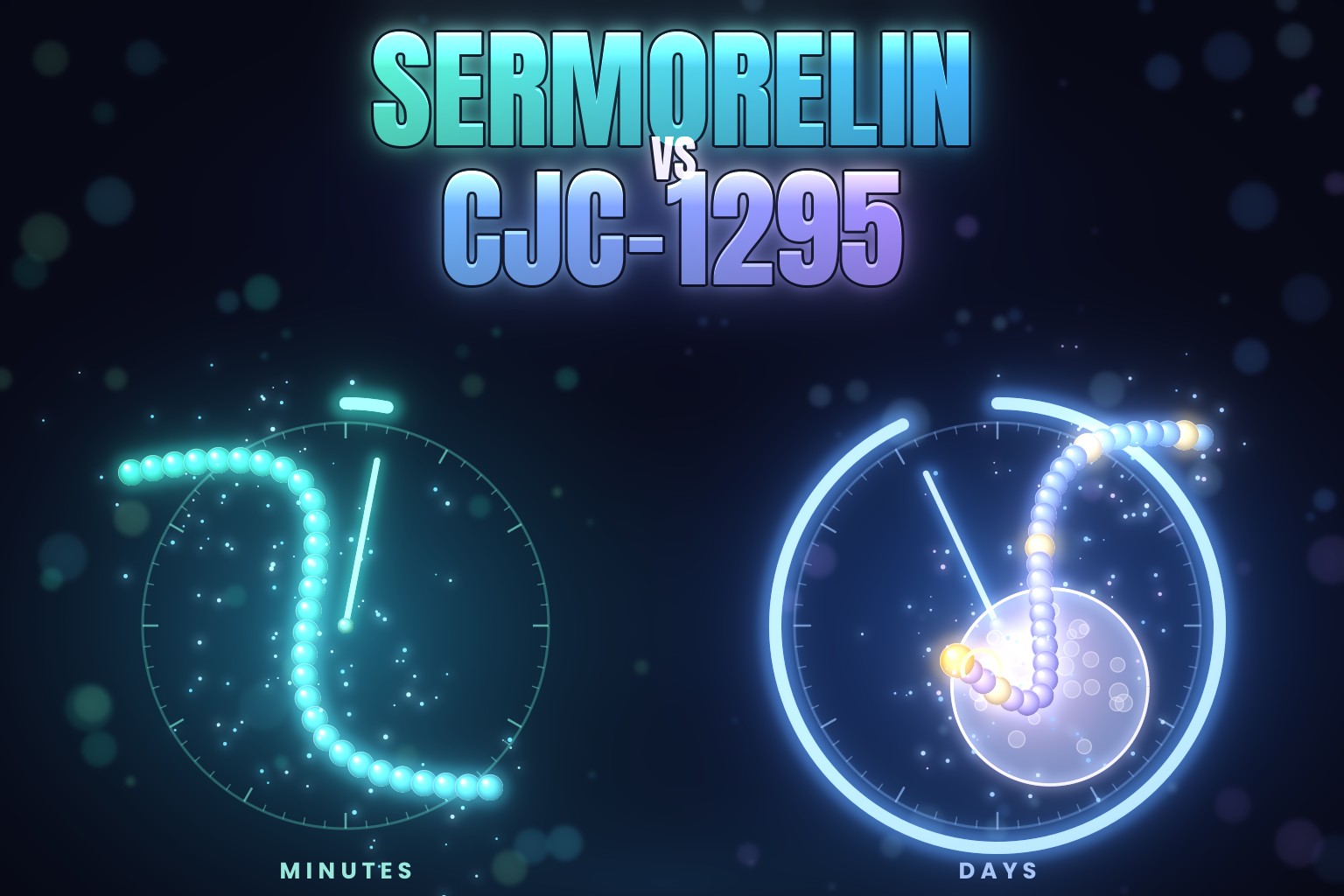
Sermorelin and CJC-1295 are built from the same 29 amino acids. What separates them is time. Sermorelin is half gone from the blood about four minutes after it arrives. CJC-1295 with DAC has a half-life of six to eight days.
That one difference decides how growth hormone comes out, what the trials were able to measure, and how often each peptide was injected in the research. Here is the comparison, number by number.
Sermorelin vs CJC-1295 at a Glance
| Sermorelin | CJC-1295 | |
|---|---|---|
| What it is | GHRH(1-29), the shortest piece of growth hormone releasing hormone that keeps full activity | The same 29-amino-acid chain with four amino acids swapped and a hook (DAC) that binds it to albumin in the blood |
| Half-life | 4.3 minutes in men after an infusion | 5.8 to 8.1 days in healthy adults |
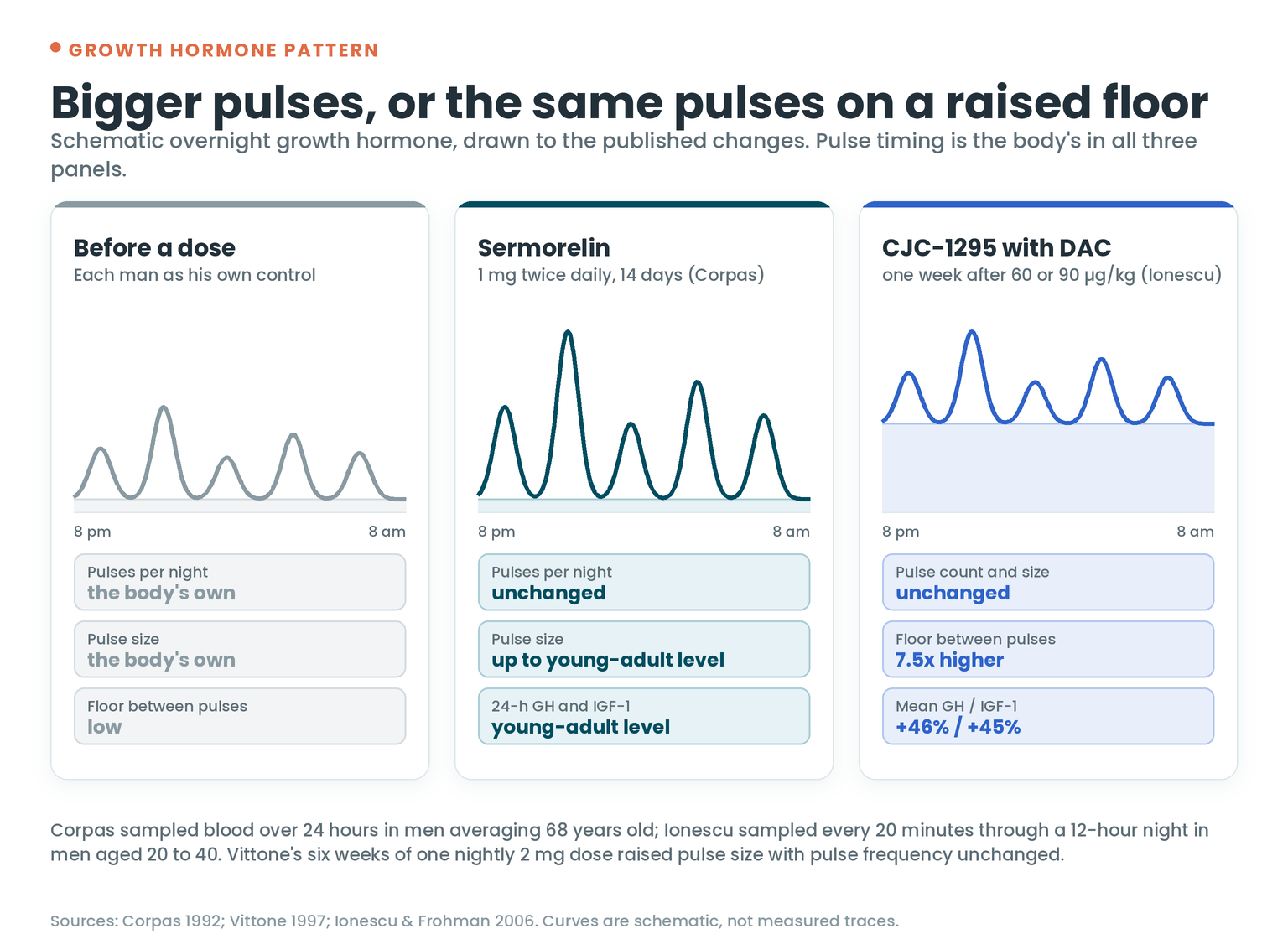
| Growth hormone pattern | Bigger pulses, same rhythm | Same pulses, with the baseline between them raised 7.5-fold |
| Human studies | Older men over 14 days and 6 weeks, healthy older adults over 6 months, 110 children over a year | Two placebo-controlled dose trials of 28 and 49 days, plus an overnight pulse study |
| Research dosing | 0.5 to 2 mg under the skin, once or twice daily in adults; 30 µg/kg nightly in children | Single doses of 30 to 250 µg/kg; repeat doses weekly or every two weeks |
| Side effects reported | Brief facial flushing and injection-site pain; mild fluid retention over 6 months | No serious adverse reactions; best tolerated at 30 and 60 µg/kg |
The Same 29 Amino Acids
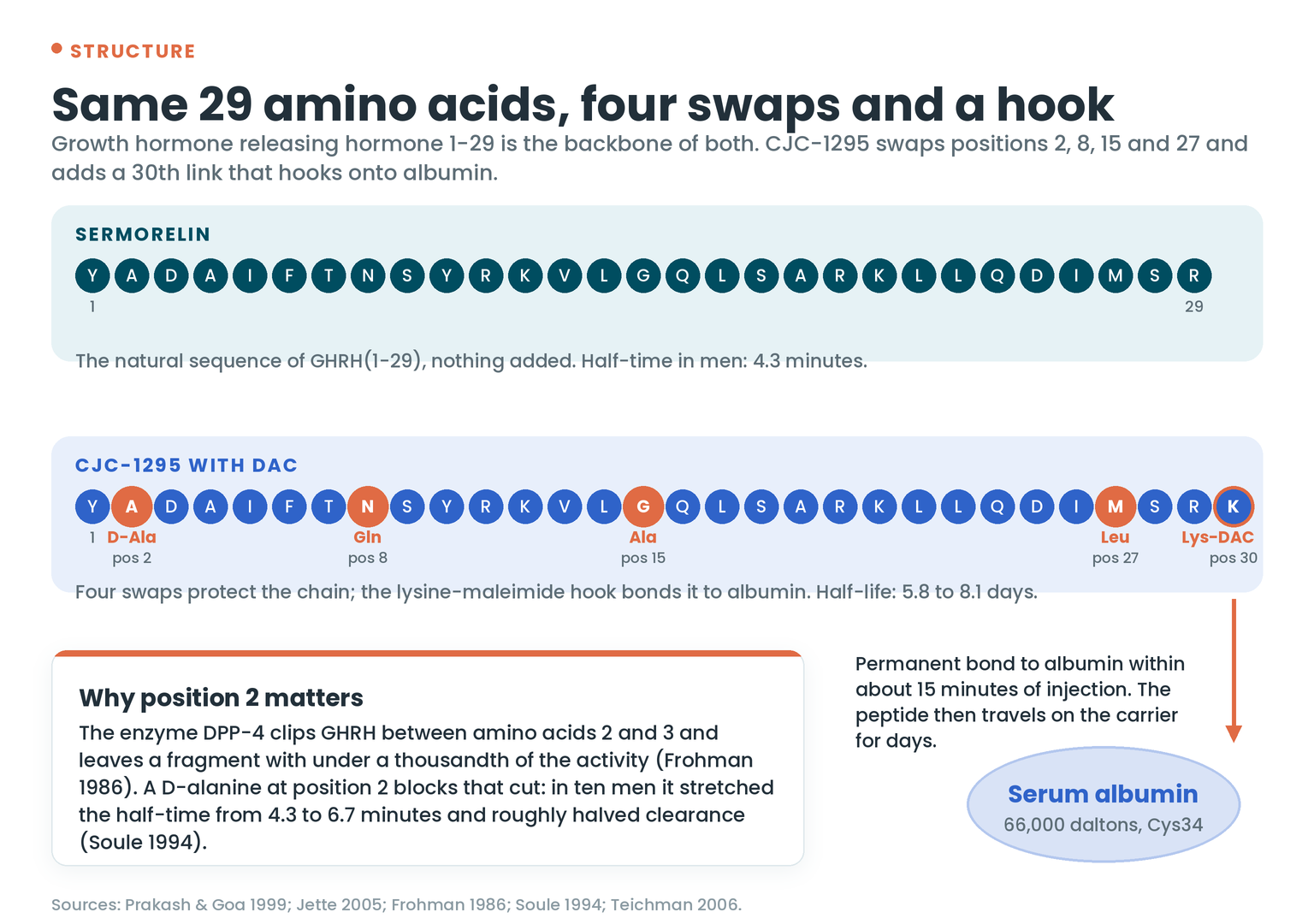
Your hypothalamus makes growth hormone releasing hormone, GHRH, as a 44-amino-acid chain. Only the first 29 are needed. GHRH(1-29) binds the receptor and releases growth hormone as well as the whole hormone does, which is why it became the working molecule. Sermorelin is that 29-amino-acid piece, made synthetically, with nothing added.
CJC-1295 starts from the same 29 amino acids and changes five things. Four amino acids are swapped: a D-alanine at position 2, a glutamine at 8, an alanine at 15 and a leucine at 27. Then a thirtieth building block goes on the end, a lysine carrying a small reactive group called a maleimide. That group is the DAC, short for drug affinity complex. Within about 15 minutes of an injection it forms a permanent bond with cysteine 34 on serum albumin, the most abundant protein in your blood, and from then on the peptide rides around on a 66,000-dalton carrier that the kidneys leave alone.
Why a Four-Minute Peptide Needed Help
GHRH is cleared fast, and the main reason is an enzyme. In 1986 Lawrence Frohman’s group showed that plasma dipeptidyl peptidase IV, DPP-4, clips the first two amino acids off GHRH and leaves a fragment with less than a thousandth of the activity. The intact hormone had a half-life of 6.8 minutes after an intravenous dose in healthy volunteers.
Sermorelin is the natural sequence, so it meets the same enzyme. When Soule’s team infused it into ten healthy men, its disappearance half-time was 4.3 minutes. Swapping the second amino acid for its mirror-image D-form, the same change CJC-1295 carries at position 2, stretched that to 6.7 minutes and cut the clearance rate roughly in half. Under the skin, the losses start before the peptide reaches the blood: in rats, about 4% of a subcutaneous dose of GHRH(1-29) made it into the circulation intact.
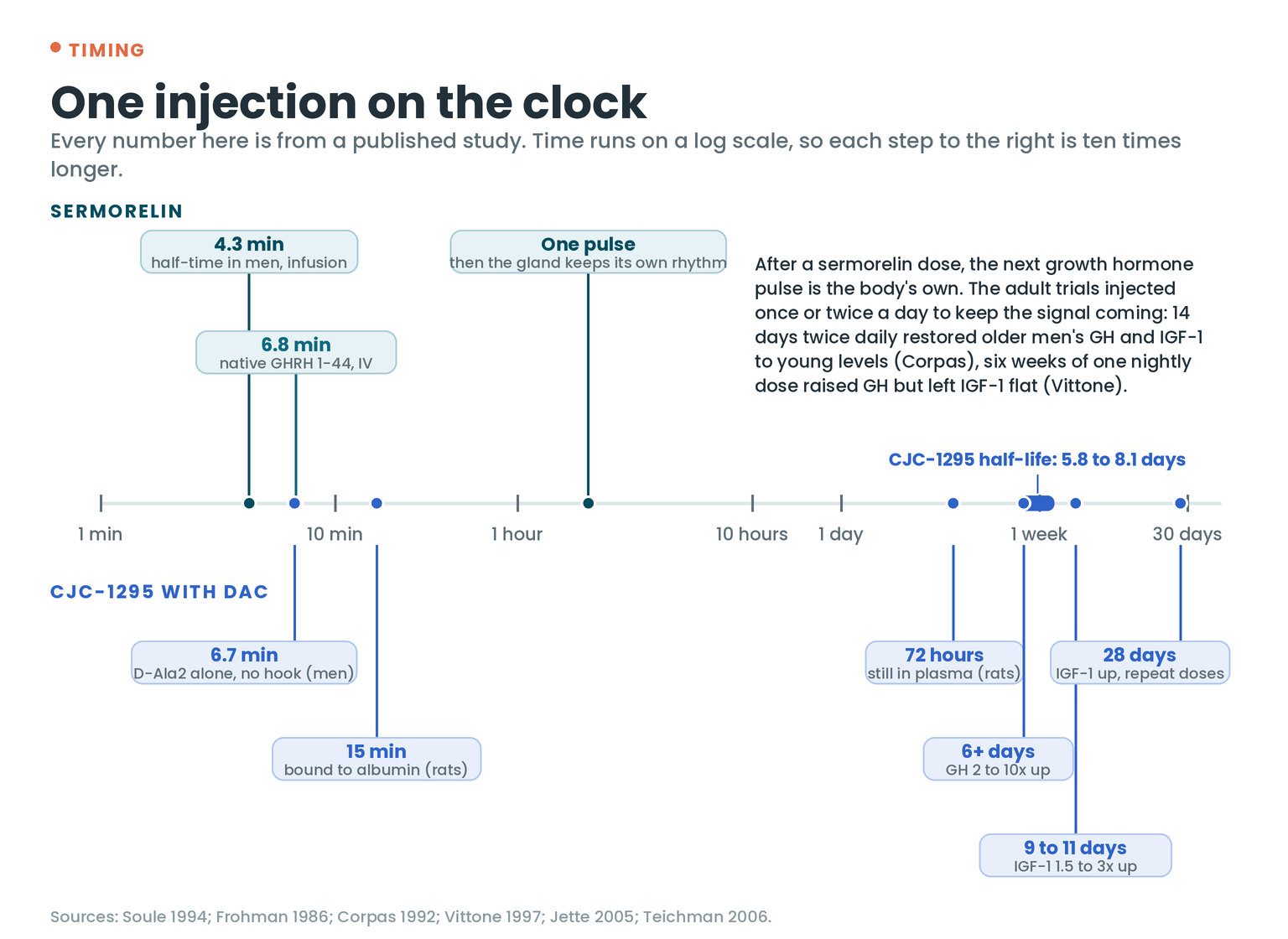
Albumin is what turns minutes into days. In Jetté’s rat work, CJC-1295 was still detectable in plasma beyond 72 hours, and in Teichman’s human trials its estimated half-life was 5.8 to 8.1 days.
How Each One Raises Growth Hormone
Both peptides bind the GHRH receptor on the somatotroph cells of your pituitary, so the first step is identical: the cell is told to make and release growth hormone. The difference is how long the instruction stays switched on.
Sermorelin delivers it as a burst. The pituitary answers with a pulse of growth hormone, the blood clears the peptide, and the gland goes back to its own rhythm. In Corpas’s old men on 1 mg twice a day, 24-hour growth hormone, the area under the peaks and the peak amplitude all rose; in Vittone’s men on 2 mg at night, the pulses got bigger while pulse frequency stayed exactly where it was. The timing belongs to the body, the size of the pulse belongs to the peptide.
CJC-1295 keeps the instruction on for days. Ionescu and Frohman sampled blood every 20 minutes through a 12-hour night in healthy men aged 20 to 40, before and one week after a single injection of 60 or 90 µg/kg. Pulse frequency and pulse size were unchanged. What changed was the floor: trough growth hormone between pulses rose 7.5-fold, which lifted mean overnight growth hormone by 46% and IGF-1 by 45%. The two doses gave the same result, and the IGF-1 rise did not track any single feature of the pulses.
How Long One Injection Keeps Working
Teichman’s two trials are where the CJC-1295 numbers come from. Healthy adults aged 21 to 61 received a single injection at 30, 60, 125 or 250 µg/kg, or placebo. Mean growth hormone rose 2- to 10-fold with the dose and stayed up for six days or more. IGF-1 rose 1.5- to 3-fold and stayed up for 9 to 11 days. In the second trial, two or three doses given weekly or every two weeks kept IGF-1 above baseline for up to 28 days, with signs that the doses were stacking on each other.
Sermorelin’s effect from one dose is over within hours, so its trials got their results by repeating it. Corpas gave healthy men with an average age of 68 either 0.5 mg or 1 mg twice a day for 14 days. On the higher dose, their 24-hour growth hormone and IGF-1 climbed until they were no longer different from men in their twenties; the lower dose moved the same numbers without reaching significance. Vittone gave 2 mg once at bedtime for six weeks to eleven men aged 64 to 76 with low IGF-1. Night-time growth hormone rose, IGF-1 did not, and the authors concluded that one nightly dose does less than several doses spread through the day.
What the Longer Trials Measured
Sermorelin: Body Fat, Strength, Cognition and Growth
The longest adult sermorelin work came from George Merriam and Michael Vitiello’s group in Seattle. In two six-month studies of healthy older women and men, nightly GHRH(1-29) injections raised IGF-1 by about 30% in men and 23% in women not taking estrogen, with women on estrogen showing a smaller response. Lean mass rose and body fat fell by 5 to 8%, with the biggest change in abdominal visceral fat. Sleep quality did not change over the six months.
The same group’s cognition study put 89 healthy adults with an average age of 68 on six months of daily GHRH or placebo. The GHRH group improved on five measures, including the performance half of the WAIS-R intelligence test and a test of processing speed, and the gains held regardless of sex, estrogen use or where people started.
Strength data come from Vittone’s six-week study. Two of six strength tests, upright row and shoulder press, improved, along with abdominal crunch endurance, while weight, body mass index, waist-to-hip ratio and DEXA measures of muscle and fat stayed where they were.
A close relative of sermorelin, GHRH(1-29) with a norleucine at position 27, was given at 10 µg/kg nightly for 16 weeks to 19 healthy older men and women by Khorram’s team. Twelve-hour growth hormone secretion rose 107% in the men and 70% in the women, IGF-1 rose 28%, and several immune cell populations expanded, including a 30% rise in B cells.
The biggest sermorelin trial was in children. Thorner’s group gave 110 growth-hormone-deficient children 30 µg/kg at bedtime for a year. Height velocity went from 4.1 cm a year to 8.0 at six months and 7.2 at twelve, 74% of the children were classed as good responders, and bone age advanced in step with height age rather than racing ahead of it.
CJC-1295: Growth Hormone, IGF-1 and the Proteins Downstream
Teichman’s trials measured peak and total growth hormone and IGF-1 over 28 and 49 days. Ionescu’s overnight study measured the shape of secretion one week after a dose. Sackmann-Sala then took serum from 11 healthy young men before and one week after a CJC-1295 injection and ran it through two-dimensional gel electrophoresis to find proteins that shift when the growth hormone axis is switched up. An apolipoprotein A1 isoform and a transthyretin isoform fell; beta-hemoglobin and two albumin fragments rose, and one of those spots tracked IGF-1 in a straight line. The aim was a better blood marker of growth hormone action than IGF-1 itself.
In mice bred without any GHRH gene, Alba’s group showed what the long half-life buys. One 2 µg injection a day for five weeks restored normal body weight, body length and femur and tibia length, and the pituitary made more growth hormone mRNA as its somatotroph cells multiplied. The same dose every 48 or 72 hours produced partial catch-up.
Sermorelin vs CJC-1295, From Five Minutes to a Year
Move along the clock. Each stop shows what the research recorded for both peptides at that time scale, with the study it comes from.
Use the arrow keys on the track to move. Your last stop is remembered in this browser.
Side Effects in the Trials
Sermorelin’s record runs across children and adults. In the review of its use in children, single intravenous doses and repeated daily injections were well tolerated, with brief facial flushing and pain at the injection site the most commonly reported events. Thorner’s year-long study found no adverse changes in blood chemistry or hormones, no change in fasting glucose and no excessive rise in IGF-1. In older adults, Corpas saw no change in fasting glucose, urinary C-peptide, blood pressure or blood counts over 14 days; Vittone saw no change in the glucose, insulin or growth hormone responses to an oral glucose load over six weeks; Merriam’s six-month studies listed mild fluid retention as the main side effect; Khorram reported no adverse effects over 16 weeks.
CJC-1295’s record is Teichman’s two trials. No serious adverse reactions occurred, and the authors described the peptide as safe and relatively well tolerated, singling out the 30 and 60 µg/kg doses. Ionescu’s men showed no difference between 60 and 90 µg/kg. The other thing to know is built into the pharmacology: because the doses stack and IGF-1 stayed above baseline for up to 28 days after repeated dosing, whatever CJC-1295 is doing carries on for weeks after the last injection.
CJC-1295 With DAC and Without
The name on a vial can mean two different molecules. In the papers, “CJC-1295” always means the hooked version, the one Jetté’s team picked out of three maleimide candidates because it gave a 4-fold larger growth hormone response than plain GHRH(1-29) over two hours in rats and then stayed in the blood for days. Teichman, Ionescu and Sackmann-Sala all used it, and every human number in this article belongs to it.
The product sold as “CJC-1295 no DAC”, or Mod GRF 1-29, is the same four-swap chain without the lysine-maleimide hook. Without albumin to ride on, its clearance is governed by the swaps alone, and the one of those that has been timed in people is the D-alanine at position 2: 6.7 minutes against sermorelin’s 4.3 in Soule’s infusion study. What that difference in duration means for sleep and for the growth hormone pattern is the subject of our piece on the DAC question.
Pairing Either One With a Ghrelin Mimic
Both peptides bring the GHRH half of a two-signal system. The other half is the ghrelin receptor, and in 1990 Cyril Bowers showed in healthy men that GHRH plus a ghrelin-type peptide released more growth hormone than either alone, with the combination larger than the sum of the parts. That finding is why sermorelin turns up next to ipamorelin and CJC-1295 turns up next to ipamorelin in the same conversations. We cover the second pairing in ipamorelin and CJC-1295, the ghrelin side in ipamorelin vs sermorelin, and the third GHRH analog in tesamorelin vs ipamorelin.
Doses Used in the Research
- Sermorelin in adults: 0.5 mg or 1 mg under the skin twice daily for 14 days (Corpas); 2 mg once at bedtime for 6 weeks (Vittone); once-nightly injections for 6 months (Merriam, Vitiello). As a diagnostic test, 1 µg/kg intravenously.
- Sermorelin in children: 30 µg/kg under the skin at bedtime for 12 months (Thorner).
- The norleucine-27 analog: 10 µg/kg nightly for 16 weeks (Khorram).
- CJC-1295 in people: single doses of 30, 60, 125 or 250 µg/kg under the skin; two or three doses one or two weeks apart (Teichman); single doses of 60 or 90 µg/kg (Ionescu).
- CJC-1295 in mice: 2 µg every 24, 48 or 72 hours for 5 weeks (Alba).
FAQ
Is CJC-1295 just a stronger sermorelin?
They hit the same receptor, so the pituitary gets the same instruction. CJC-1295 holds it on for days, which raised trough growth hormone 7.5-fold and mean growth hormone 46% in Ionescu’s study. Sermorelin at 1 mg twice a day for two weeks restored older men’s 24-hour growth hormone and IGF-1 to the levels of men in their twenties in Corpas’s study.
How long does each one last?
Sermorelin’s half-time in men was 4.3 minutes. CJC-1295 with DAC had an estimated half-life of 5.8 to 8.1 days, with growth hormone raised for six days or more and IGF-1 for 9 to 11 days after a single dose.
Does CJC-1295 stop the natural growth hormone pulses?
In the only study that measured it, pulse frequency and pulse size were unchanged a week after a dose. The pulses sat on a raised floor instead of a flat one.
What did sermorelin do for body composition?
Over six months of nightly injections in healthy older adults, body fat fell 5 to 8%, mostly from abdominal visceral fat, and lean mass rose. Over six weeks of nightly 2 mg injections, DEXA measures of muscle and fat were unchanged.
What is the difference between CJC-1295 with DAC and without?
The DAC is a lysine-maleimide hook on the end of the chain that bonds to albumin and gives the peptide its days-long half-life. The no-DAC version keeps the four amino acid swaps and drops the hook. The human trials used the DAC version.
Can either one be used alongside ipamorelin?
Both supply the GHRH signal, and GHRH plus a ghrelin-receptor peptide released more growth hormone together than apart in Bowers’ study of healthy men. Sermorelin is paired with ipamorelin on the same logic as CJC-1295.
References
- Prakash A, Goa KL. Sermorelin: a review of its use in the diagnosis and treatment of children with idiopathic growth hormone deficiency. BioDrugs. 1999;12(2):139-157. DOI
- Frohman LA, et al. Rapid enzymatic degradation of growth hormone-releasing hormone by plasma in vitro and in vivo to a biologically inactive product cleaved at the NH2 terminus. J Clin Invest. 1986;78(4):906-913. DOI
- Soule S, et al. Incorporation of D-Ala2 in growth hormone-releasing hormone-(1-29)-NH2 increases the half-life and decreases metabolic clearance in normal men. J Clin Endocrinol Metab. 1994;79(4):1208-1211. DOI
- Rafferty B, et al. Growth hormone-releasing factor analogue (hGRF1-29NH2): immunoreactive-GRF plasma levels after intravenous and subcutaneous administration. J Endocrinol. 1985;107(3):R5-R8. DOI
- Jetté L, et al. Human growth hormone-releasing factor (hGRF)1-29-albumin bioconjugates activate the GRF receptor on the anterior pituitary in rats: identification of CJC-1295 as a long-lasting GRF analog. Endocrinology. 2005;146(7):3052-3058. DOI
- Teichman SL, et al. Prolonged stimulation of growth hormone (GH) and insulin-like growth factor I secretion by CJC-1295, a long-acting analog of GH-releasing hormone, in healthy adults. J Clin Endocrinol Metab. 2006;91(3):799-805. DOI
- Ionescu M, Frohman LA. Pulsatile secretion of growth hormone (GH) persists during continuous stimulation by CJC-1295, a long-acting GH-releasing hormone analog. J Clin Endocrinol Metab. 2006;91(12):4792-4797. DOI
- Sackmann-Sala L, et al. Activation of the GH/IGF-1 axis by CJC-1295, a long-acting GHRH analog, results in serum protein profile changes in normal adult subjects. Growth Horm IGF Res. 2009;19(6):471-477. DOI
- Alba M, et al. Once-daily administration of CJC-1295, a long-acting growth hormone-releasing hormone (GHRH) analog, normalizes growth in the GHRH knockout mouse. Am J Physiol Endocrinol Metab. 2006;291(6):E1290-E1294. DOI
- Corpas E, et al. Growth hormone (GH)-releasing hormone-(1-29) twice daily reverses the decreased GH and insulin-like growth factor-I levels in old men. J Clin Endocrinol Metab. 1992;75(2):530-535. DOI
- Vittone J, et al. Effects of single nightly injections of growth hormone-releasing hormone (GHRH 1-29) in healthy elderly men. Metabolism. 1997;46(1):89-96. DOI
- Merriam GR, et al. Growth hormone releasing hormone treatment in normal aging. J Anti Aging Med. 2001;4(4):331-343. DOI
- Vitiello MV, et al. Growth hormone releasing hormone improves the cognition of healthy older adults. Neurobiol Aging. 2006;27(2):318-323. DOI
- Khorram O, et al. Effects of [norleucine27]growth hormone-releasing hormone (GHRH) (1-29)-NH2 administration on the immune system of aging men and women. J Clin Endocrinol Metab. 1997;82(11):3590-3596. DOI
- Thorner M, et al. Once daily subcutaneous growth hormone-releasing hormone therapy accelerates growth in growth hormone-deficient children during the first year of therapy. J Clin Endocrinol Metab. 1996;81(3):1189-1196. DOI
- Bowers CY, et al. Growth hormone (GH)-releasing peptide stimulates GH release in normal men and acts synergistically with GH-releasing hormone. J Clin Endocrinol Metab. 1990;70(4):975-982. DOI
Stay sharp,
Joe Mars
The Peptide Report
P.S. If you’re deciding between a peptide you inject every day and one you inject once a week, the Peptides and Biohacking Hub on Skool is where our members compare what each schedule did for them. It’s free. Come join us.