Powder vials
Store at −20 °C (−4 °F) in dry, dark conditions and keep them in the original packaging.

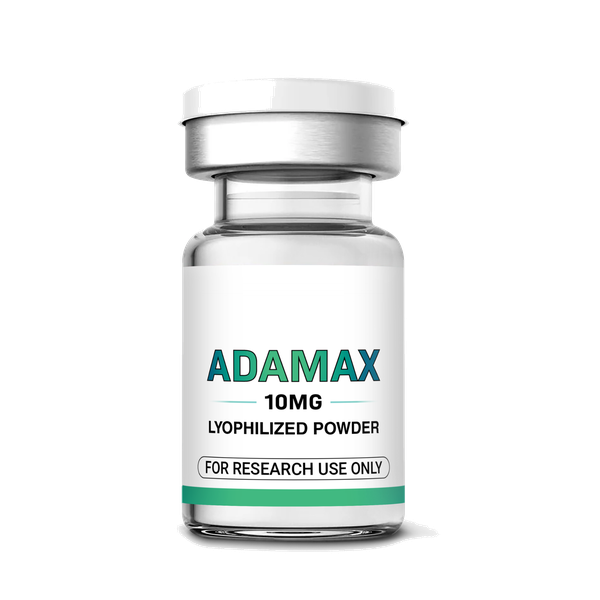
The reported range is 100 to 300 mcg of Adamax by injection over 8 to 12 weeks. With a 10 mg vial mixed with 3 mL of water, 300 mcg is 9 units on a U-100 syringe. Before you use any of that, read the next section, because sources do not agree on what molecule Adamax actually is.
The amounts in this chart come from online communities. The vial label shows the total peptide in milligrams (mg). The Amount column shows a portion of that total in micrograms (mcg). The syringe mark shows how much liquid corresponds to that amount.
Syringe marks below are based on a 10 mg vial with 3 mL of water added. Change vial size or water in the calculator
| Reported | Amount | Volume | Syringe mark (U-100) | Draws per vial |
|---|
Convert your vial to mcg, because 1 mg is the same as 1,000 mcg.
Divide by your water to see how much is in 1 mL.
Find what one unit holds. A U-100 syringe has 100 units in 1 mL.
Divide your amount by what one unit holds.
Follow one step at a time. The steps use the water amount from your calculator.
Find the mg printed on your vial and enter it in the calculator. Let a frozen vial reach room temperature first.
Clean the top of the peptide vial and the water vial with an alcohol swab. Let them dry.
Draw bacteriostatic water with a sterile syringe.
Let the water run down the inside wall of the vial. This helps prevent foaming.
Roll the vial until the powder fully dissolves. Do not shake it hard.
Write today's date on the vial and refrigerate it at 2–8 °C (35.6–46.4 °F), away from light.
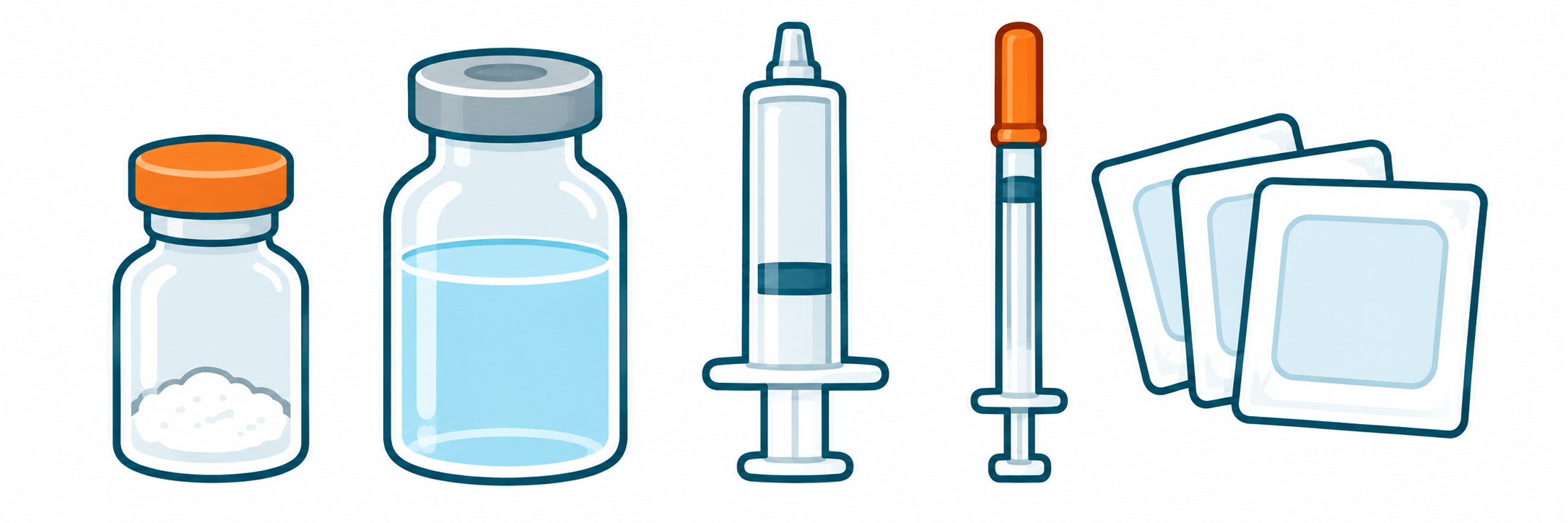
Pick how many weeks you will run it and how many shots you take each week. The list below shows everything you need.
Store at −20 °C (−4 °F) in dry, dark conditions and keep them in the original packaging.
Keep them refrigerated and away from light. How long a mixed vial lasts depends on the product, so check its stability data.
Adamax is sold as a modified Semax analog. Semax itself comes from ACTH 4-10, a fragment of adrenocorticotropic hormone, altered so the hormonal activity is gone and the nervous system activity is what remains.
The point of the modification is stability. Adding caps to the ends of a peptide blocks the enzymes that would otherwise chew it up, which is the same logic behind the amidate forms. What is not settled is exactly which modification Adamax carries.
The thread the whole Semax family sits in, and what this is marketed for.
The broader claim, theorised to run through melanocortin receptor activity and BDNF.
The actual design goal of the modification, whichever one it carries.
Early or not at all. This family acts fast rather than building up, so people notice focus and mood inside the first few days. If a week goes by and nothing has shifted, more weeks are unlikely to change that.
Sources conflict. Some describe Adamax as the common name for N-acetyl Semax amidate. Others describe an adamantyl modification, which would be a different molecule. One gives a nine-residue sequence. These cannot all be right, and no independent source settles it.
If Adamax is N-acetyl Semax amidate, then it is the same compound sold under another name, and the amounts should line up with that. If it carries an adamantane group, it is a different molecule and nothing transfers. That is not a detail, it decides what page you should be reading.
An N-terminal acetyl group blocks aminopeptidases and a C-terminal amide blocks carboxypeptidases. That is a real and well understood piece of peptide chemistry, whatever the full structure turns out to be.
Thin. The claims lean on studies of related Semax-family peptides rather than on dedicated work on this molecule. Direct comparisons between Adamax and unmodified Semax are limited. It is not approved for human use.
Quality varies a lot between sellers. I have been around research peptides for 10 years, and BioEdge is the supplier I send my readers to. Here is why.
The Peptide Report has a business relationship with BioEdge Research Labs. BioEdge sells this product for laboratory research only. BioEdge shipping policy
The comparison that matters here is against the compound it may or may not be.
| Stack | Ingredients | Why people stack them |
|---|---|---|
| Adamax vs Semax AmidateTwo vials, possibly the same molecule | Adamax in one vial. N-acetyl Semax amidate in the second. | AdamaxWorth checking before you buy both. Some sources treat these as the same compound under different names. If that is right, running them together doubles up on one thing. See the Semax Amidate dosage guide. |
Pick a tool and try it. Each one uses the numbers from your calculator.
Use the same four steps. Once you can solve these, you can work out the units for any vial you ever pick up.
Your score: 0 correct.
Each line on the syringe is a unit of liquid. A unit measures volume, so the amount of peptide in it depends on your mix.
Tap the syringe or move the slider. The numbers use the vial you entered above. Read the line at the top edge of the plunger.
More water makes the mix weaker, so the same amount takes up more units. The amount of peptide in the vial stays the same.
A draw under 5 units is harder to read accurately. Tap a row to use that water amount.
The reported range is 100 to 300 mcg per injection over 8 to 12 weeks. That comes from practice, not from a trial.
With a 10 mg vial and 3 mL of water, 300 mcg is 9 units on a U-100 syringe and 100 mcg is 3 units. Use the calculator if your mix is different.
Sources disagree. Some say yes. Others describe an adamantyl modification that would make it a different molecule. Check your certificate of analysis.
No. No dose equivalence has been demonstrated, and the Semax human figures were intranasal and in milligrams.
To stop enzymes breaking it down as fast. Capping both ends of a peptide blocks the enzymes that cut from each end.
Most charts assume one vial size and one water amount. If your mix is different, every unit number changes, so run your own numbers.