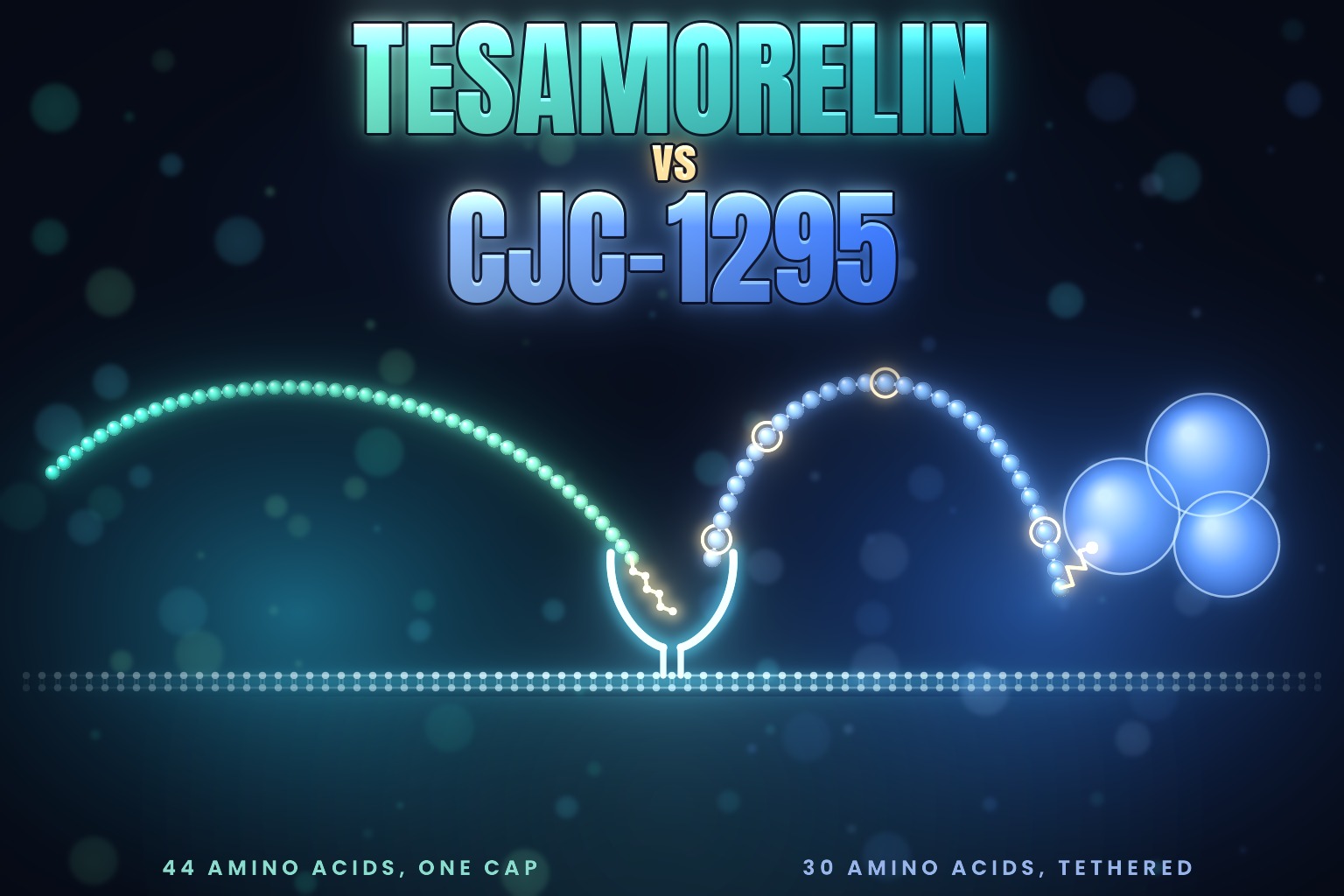
Both of these peptides start from the same hormone. What separates them is a design decision. Tesamorelin is that hormone with a single chemical group added to the front. CJC-1295 is a shorter piece of it, rewritten in four places and tethered to a blood protein so it sticks around for about a week.
Those two choices send the peptides down different roads, and they answer the “which is more effective” question in a way that depends on which outcome you’re asking about.
At a Glance
| Tesamorelin | CJC-1295 (with DAC) | |
|---|---|---|
| What it is | GHRH(1-44) with one group added to Tyr1 | GHRH(1-29) with four swaps, plus a lysine that tethers to albumin |
| Where it acts | GHRH receptor, pituitary | GHRH receptor, pituitary |
| How long it lasts | Half-life 21 to 45 minutes in dogs; given once daily in its main human trials | Estimated half-life 5.8 to 8.1 days in healthy adults |
| Growth hormone pattern | Described as raising both background and pulsed release | Floor between pulses up 7.5-fold a week after one injection; pulses unchanged |
| What the human studies measured | Visceral fat (806 patients pooled), liver fat, lipids, IGF-1 | Growth hormone and IGF-1 output, in healthy adults |
Both are analogs of growth hormone-releasing hormone, and both work on the same receptor in the pituitary, asking the gland to release its own growth hormone. The story here is what two research teams did to one short hormone to make it last.
Same Hormone, Two Ways to Rebuild It
The starting material is growth hormone-releasing hormone, GHRH. Guillemin’s group pulled the full 44-amino-acid sequence out of a pancreatic tumor in 1982. The front 29 residues turned out to be enough on their own: Prakash and Goa’s 1999 review describes sermorelin, a 29-residue GHRH analog, as the shortest synthetic peptide with the full activity of GHRH.
As a drug, though, GHRH has a problem. Lawrence Frohman showed in 1986 that human plasma clips it between residues 2 and 3, the work of a plasma dipeptidylaminopeptidase, and the clipped fragment keeps less than a thousandth of the original’s activity. Injected into a vein, it had a half-life of 6.8 minutes. Later work, including Campbell’s 1994 paper, names the enzyme as DPP-IV. Anything built from GHRH has to solve that first.
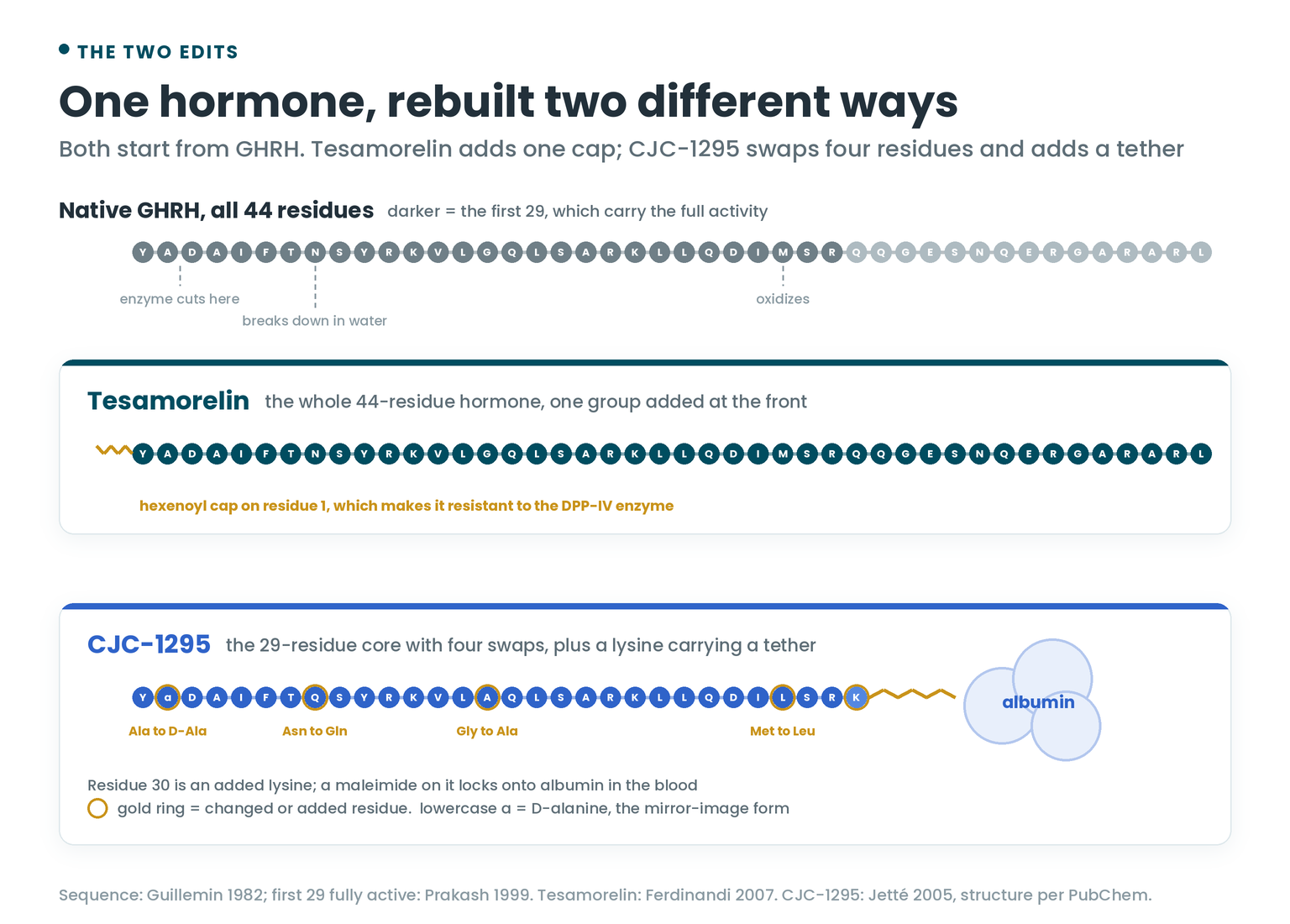
Tesamorelin solves it with a light touch. The 2007 pharmacology paper by Ferdinandi and colleagues describes it as the full 44-residue hormone “minimally modified” by a single trans-3-hexenoyl group on Tyr1, the front of the chain, and reports it resistant to DPP-IV. It slowed breakdown in rat, dog and human plasma, and daily injections raised growth hormone and IGF-1 in pigs, rats and dogs.
CJC-1295 goes the other way. Lucie Jetté’s 2005 paper that introduced it calls it a “tetrasubstituted” form of GHRH(1-29), and earlier GHRH chemistry had already mapped what each of the four swaps does:
- Position 2, alanine to D-alanine. This sits right beside the enzyme’s cut. In Soule’s infusion study in ten men, the D-alanine version of the 1-29 peptide had about half the clearance of the plain one and a longer disappearance half-time, 6.7 minutes against 4.3.
- Position 8, asparagine to glutamine. Asparagine 8 is where GHRH breaks down in water at body pH. In a closely related analog, Friedman’s group found one of the main breakdown products 400 to 500 times less potent, and Campbell’s team listed glutamine among the swaps at that spot that made analogs more stable in water.
- Position 15, glycine to alanine. In Coy’s rat pituitary cell work, the alanine-15 version was five times more potent, and Campbell’s paper describes the same swap as enhancing receptor binding.
- Position 27, methionine to leucine. Methionine 27 oxidizes in water, one of the routes Campbell’s team lists as greatly reducing GHRH’s activity. Rivier’s group had already swapped it out in 1988, for norleucine, for stability against air oxidation.
Then comes the part that defines CJC-1295. An extra lysine is added at the end carrying a reactive maleimide group, and after injection that group bonds to albumin in the blood. Jetté’s team found the drug on the albumin band in a rat’s plasma within 15 minutes, still there past 24 hours. The peptide stops being a free-floating signal and becomes a passenger on albumin.
If you’ve read our tesamorelin versus sermorelin comparison, sermorelin is the 29-residue analog from that 1999 review, the same length CJC-1295 is built on.
Residue by Residue
Tap any position to see what sits there in the natural hormone, in tesamorelin and in CJC-1295, and what earlier work found at the spots that were changed.
Natural GHRH, tesamorelin and CJC-1295, lined up
Each column is one position in the chain. Tap a column, or use the arrow keys, to see what sits there in each molecule. Scroll sideways for all 44.
The Half-Life Gulf
This is where the two stop resembling each other. Put their lifetimes on one axis and the gap spans orders of magnitude.
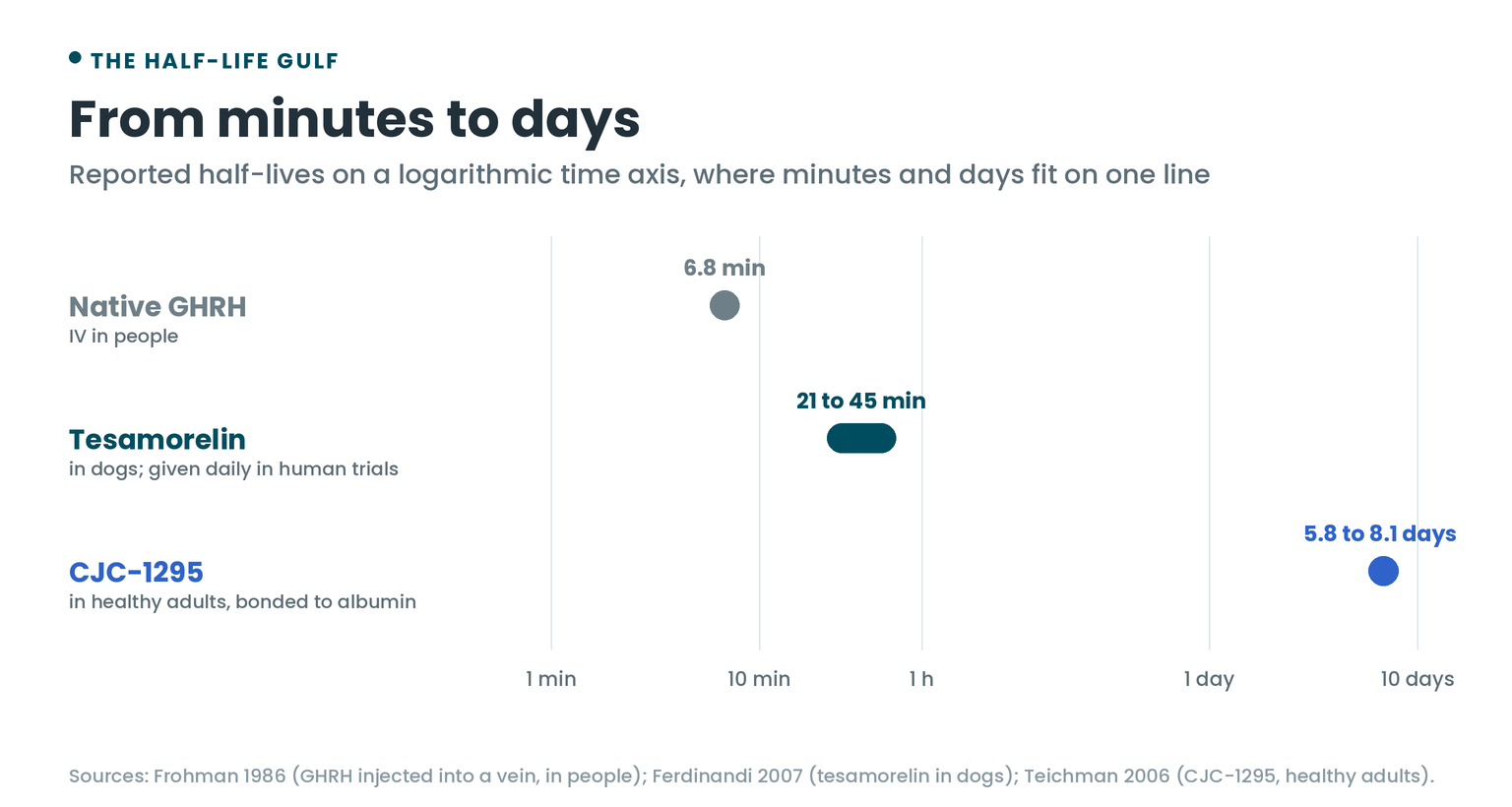
Native GHRH lasts minutes. Tesamorelin’s half-life was measured in dogs, at 21 to 45 minutes. In people, a population pharmacokinetic analysis by Mario González-Sales put its plasma clearance at about 1,060 liters an hour. Its main human trials gave it as a once-daily injection.
CJC-1295 runs on a different clock. Sam Teichman’s two randomized, placebo-controlled trials in healthy adults estimated its half-life at 5.8 to 8.1 days. A single injection produced dose-dependent rises in mean growth hormone of two- to tenfold for six days or more, and in IGF-1 of one-and-a-half- to threefold for nine to eleven days. With repeat doses, IGF-1 stayed above baseline for up to 28 days, with a cumulative effect across injections. That’s the albumin tether doing what Jetté’s team built it to do, since bonding a peptide to albumin is a way to stretch its life in plasma.
What That Does to the Growth Hormone Signal
Growth hormone is released in pulses, and as Madalina Ionescu and Frohman put it, pulsatile secretion is considered important for many of the hormone’s effects. So the question with any GHRH analog is what it does to that pattern.
For tesamorelin, the pharmacokinetic paper describes it as raising both the background level and the pulsed release of growth hormone, which in turn raises IGF-1.
Ionescu and Frohman sampled growth hormone every 20 minutes across a 12-hour night in healthy young men, before and one week after a single CJC-1295 injection. The pulses held steady, with frequency and size unchanged. What moved was the trough. Growth hormone between pulses rose 7.5-fold, the overall mean rose 46 percent, and IGF-1 rose 45 percent. The authors implicate that raised trough in the IGF-1 increase.
We walked through the same burst-versus-floor question for sermorelin versus CJC-1295, and what it means for sleep is the subject of the DAC question.
What Each One Was Measured Doing
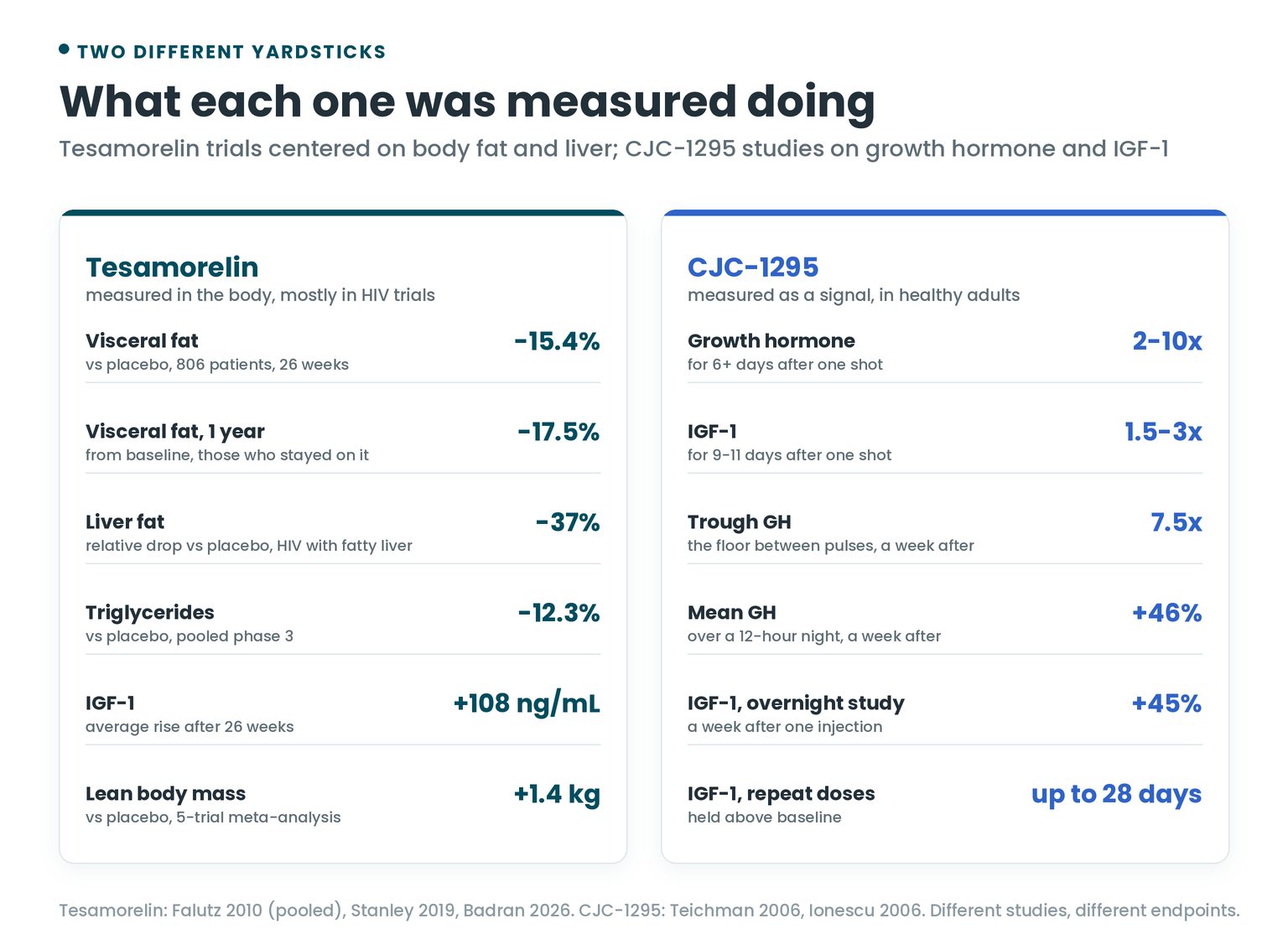
Here’s the part that answers “which is more effective”: the two were studied on two different kinds of endpoint.
Tesamorelin: Measured in the Body
Tesamorelin has been through a large clinical program, most of it in people with HIV who had built up visceral fat. Julian Falutz’s pooled analysis of two phase 3 trials covered 806 patients. Over 26 weeks, visceral fat fell with a treatment effect of 15.4 percent against placebo, while the fat just under the skin of the belly held steady. Triglycerides fell, the cholesterol-to-HDL ratio improved, and IGF-1 rose by an average of 108 ng/mL. Patients who stayed on it for a full year sat 17.5 percent below their starting visceral fat, with waists about 3.4 centimeters smaller.
Takara Stanley’s trials carried this into the liver. In a 50-person study of people with HIV, the lipid-to-water percentage in the liver fell by a net 2.9 points over six months. In a 61-person trial of people with HIV and fatty liver disease, 35 percent of the tesamorelin group ended the year below the 5 percent liver-fat cutoff, against 4 percent on placebo. Hideo Makimura’s 12-month trial took the visceral-fat effect into 60 abdominally obese adults with low growth hormone output. A 2026 meta-analysis of five HIV trials by Ahmed Badran put the drop in visceral fat at a mean difference of about 28 square centimeters against placebo, with a lean body mass gain of 1.4 kilograms.
CJC-1295: Measured in the Signal
CJC-1295’s human studies centered on the hormone signal itself, as above. One more looked downstream: Lucila Sackmann-Sala took blood from 11 healthy young men before and a week after an injection and found shifts in several serum proteins, one of which tracked IGF-1. In animal work, Maria Alba’s group gave once-daily CJC-1295 for five weeks to mice born without their own GHRH, and they reached normal body weight and length, where twice-daily injections of an earlier GHRH analog had not normalized growth.
So the comparison comes down to which outcome you mean. Visceral fat, liver fat and the metabolic markers around them: that’s tesamorelin’s data. How far and how long the growth hormone axis stays raised after an injection: that’s CJC-1295’s.
Frequently Asked Questions
Do tesamorelin and CJC-1295 work through the same receptor?
Yes. Both are analogs of growth hormone-releasing hormone, and both act on the GHRH receptor in the pituitary, prompting the gland to release its own growth hormone. What differs is how long each one lasts in the blood.
Why does CJC-1295 last so much longer?
Because of the albumin tether. An added lysine carrying a maleimide group bonds CJC-1295 to albumin after injection, and its estimated half-life in healthy adults was 5.8 to 8.1 days. Tesamorelin has a single protective cap on an otherwise natural chain.
Is CJC-1295 the same as CJC-1295 without DAC?
No. DAC is the name for the albumin-binding part, and the half-life and every CJC-1295 human number in this article come from studies of the DAC version.
Do both keep the body’s natural growth hormone pulses?
In the CJC-1295 overnight study, a week after one injection, pulse frequency and size were unchanged while the trough between pulses rose 7.5-fold. Tesamorelin’s pharmacokinetic paper describes it as raising both background and pulsed growth hormone release.
Which one raises IGF-1 more?
The studies measured it in different ways. Tesamorelin’s pooled phase 3 trials found an average rise of 108 ng/mL after 26 weeks of daily dosing. CJC-1295 raised IGF-1 one-and-a-half- to threefold for nine to eleven days after a single injection.
Stay sharp,
Joe Mars
The Peptide Report
P.S. Got a question about how these two compare, or about the burst-versus-floor idea? Bring it to the Skool community, where we dig into exactly this kind of thing.
References
- Guillemin R, Brazeau P, Böhlen P, et al. Growth hormone-releasing factor from a human pancreatic tumor that caused acromegaly. Science. 1982;218(4572):585-587. doi:10.1126/science.6812220
- Prakash A, Goa KL. Sermorelin: a review of its use in the diagnosis and treatment of children with idiopathic growth hormone deficiency. BioDrugs. 1999;12(2):139-157. doi:10.2165/00063030-199912020-00007
- Frohman LA, Downs TR, Williams TC, et al. Rapid enzymatic degradation of growth hormone-releasing hormone by plasma in vitro and in vivo to a biologically inactive product cleaved at the NH2 terminus. J Clin Invest. 1986;78(4):906-913. doi:10.1172/JCI112679
- Campbell RM, Stricker P, Miller R, et al. Enhanced stability and potency of novel growth hormone-releasing factor (GRF) analogues derived from rodent and human GRF sequences. Peptides. 1994;15(3):489-495. doi:10.1016/0196-9781(94)90211-9
- Ferdinandi ES, Brazeau P, High K, et al. Non-clinical pharmacology and safety evaluation of TH9507, a human growth hormone-releasing factor analogue. Basic Clin Pharmacol Toxicol. 2007;100(1):49-58. doi:10.1111/j.1742-7843.2007.00008.x
- Jetté L, Léger R, Thibaudeau K, et al. Human growth hormone-releasing factor (hGRF)1-29-albumin bioconjugates activate the GRF receptor on the anterior pituitary in rats: identification of CJC-1295 as a long-lasting GRF analog. Endocrinology. 2005;146(7):3052-3058. doi:10.1210/en.2004-1286
- Soule S, King JA, Millar RP. Incorporation of D-Ala2 in growth hormone-releasing hormone-(1-29)-NH2 increases the half-life and decreases metabolic clearance in normal men. J Clin Endocrinol Metab. 1994;79(4):1208-1211. doi:10.1210/jcem.79.4.7962295
- Friedman AR, Ichhpurani AK, Brown DM, et al. Degradation of growth hormone releasing factor analogs in neutral aqueous solution is related to deamidation of asparagine residues. Replacement of asparagine residues by serine stabilizes. Int J Pept Protein Res. 1991;37(1):14-20. doi:10.1111/j.1399-3011.1991.tb00727.x
- Coy DH, Hocart SJ, Murphy WA. Human growth hormone-releasing hormone analogues with much improved in vitro growth hormone-releasing potencies in rat pituitary cells. Eur J Pharmacol. 1991;204(2):179-185. doi:10.1016/0014-2999(91)90703-s
- Rivier J, Rivier C, Galyean R, et al. Potent long-acting growth hormone releasing factor analogues. Ann N Y Acad Sci. 1988;527:44-50. doi:10.1111/j.1749-6632.1988.tb26971.x
- González-Sales M, Barrière O, Tremblay PO, et al. Population pharmacokinetic analysis of tesamorelin in HIV-infected patients and healthy subjects. Clin Pharmacokinet. 2015;54(3):285-294. doi:10.1007/s40262-014-0202-x
- Teichman SL, Neale A, Lawrence B, et al. Prolonged stimulation of growth hormone (GH) and insulin-like growth factor I secretion by CJC-1295, a long-acting analog of GH-releasing hormone, in healthy adults. J Clin Endocrinol Metab. 2006;91(3):799-805. doi:10.1210/jc.2005-1536
- Ionescu M, Frohman LA. Pulsatile secretion of growth hormone (GH) persists during continuous stimulation by CJC-1295, a long-acting GH-releasing hormone analog. J Clin Endocrinol Metab. 2006;91(12):4792-4797. doi:10.1210/jc.2006-1702
- Falutz J, Mamputu JC, Potvin D, et al. Effects of tesamorelin (TH9507), a growth hormone-releasing factor analog, in human immunodeficiency virus-infected patients with excess abdominal fat: a pooled analysis of two multicenter, double-blind placebo-controlled phase 3 trials with safety extension data. J Clin Endocrinol Metab. 2010;95(9):4291-4304. doi:10.1210/jc.2010-0490
- Stanley TL, Feldpausch MN, Oh J, et al. Effect of tesamorelin on visceral fat and liver fat in HIV-infected patients with abdominal fat accumulation: a randomized clinical trial. JAMA. 2014;312(4):380-389. doi:10.1001/jama.2014.8334
- Stanley TL, Fourman LT, Feldpausch MN, et al. Effects of tesamorelin on non-alcoholic fatty liver disease in HIV: a randomised, double-blind, multicentre trial. Lancet HIV. 2019;6(12):e821-e830. doi:10.1016/S2352-3018(19)30338-8
- Makimura H, Feldpausch MN, Rope AM, et al. Metabolic effects of a growth hormone-releasing factor in obese subjects with reduced growth hormone secretion: a randomized controlled trial. J Clin Endocrinol Metab. 2012;97(12):4769-4779. doi:10.1210/jc.2012-2794
- Badran AS, Helal A, Shata KS, Ayesh H. Body composition, hepatic fat, metabolic, and safety outcomes of tesamorelin, a GHRH analogue, in HIV-associated lipodystrophy: a meta-analysis of randomized controlled trials. Obes Res Clin Pract. 2026;20(1):2-12. doi:10.1016/j.orcp.2026.01.002
- Sackmann-Sala L, Ding J, Frohman LA, Kopchick JJ. Activation of the GH/IGF-1 axis by CJC-1295, a long-acting GHRH analog, results in serum protein profile changes in normal adult subjects. Growth Horm IGF Res. 2009;19(6):471-477. doi:10.1016/j.ghir.2009.03.001
- Alba M, Fintini D, Sagazio A, et al. Once-daily administration of CJC-1295, a long-acting growth hormone-releasing hormone (GHRH) analog, normalizes growth in the GHRH knockout mouse. Am J Physiol Endocrinol Metab. 2006;291(6):E1290-E1294. doi:10.1152/ajpendo.00201.2006