Powder vials
Store at −20 °C (−4 °F) in dry, dark conditions and keep them in the original packaging.


The reported schedule is 250 mcg of DSIP by subcutaneous injection, 1 to 3 hours before bed, five nights on and two nights off. With a 10 mg vial mixed with 2 mL of water, 250 mcg is 5 units on a U-100 syringe. The reported cycle is eight weeks, then eight weeks off. This is a community schedule, not a validated clinical regimen.
The amounts in this chart come from online communities. The vial label shows the total peptide in milligrams (mg). The Amount column shows a portion of that total in micrograms (mcg). The syringe mark shows how much liquid corresponds to that amount.
Syringe marks below are based on a 10 mg vial with 2 mL of water added. Change vial size or water in the calculator
| Reported | Amount | Volume | Syringe mark (U-100) | Draws per vial |
|---|
Convert your vial to mcg, because 1 mg is the same as 1,000 mcg.
Divide by your water to see how much is in 1 mL.
Find what one unit holds. A U-100 syringe has 100 units in 1 mL.
Divide your amount by what one unit holds.
One to three hours before bed. That is the window the source protocol describes. It is not a proven onset time, and it is not a promise that sleep improves inside that window.
Five nights on and two nights off. Other guides describe nightly use, often closer to bedtime. The disagreement tells you there is no agreed standard.
Eight weeks, then eight weeks off. Nothing in the clinical literature establishes that this break prevents tolerance or strikes the best balance.
Time to fall asleep, waking in the night, and next-day alertness are different things. One good night does not tell you what caused it, especially if bedtime, caffeine, alcohol or stress changed too.
Follow one step at a time. The steps use the water amount from your calculator.
Find the mg printed on your vial and enter it in the calculator. Let a frozen vial reach room temperature first.
Clean the top of the peptide vial and the water vial with an alcohol swab. Let them dry.
Draw bacteriostatic water with a sterile syringe.
Let the water run down the inside wall of the vial. This helps prevent foaming.
Roll the vial until the powder fully dissolves. Do not shake it hard.
Write today's date on the vial and refrigerate it at 2–8 °C (35.6–46.4 °F), away from light.
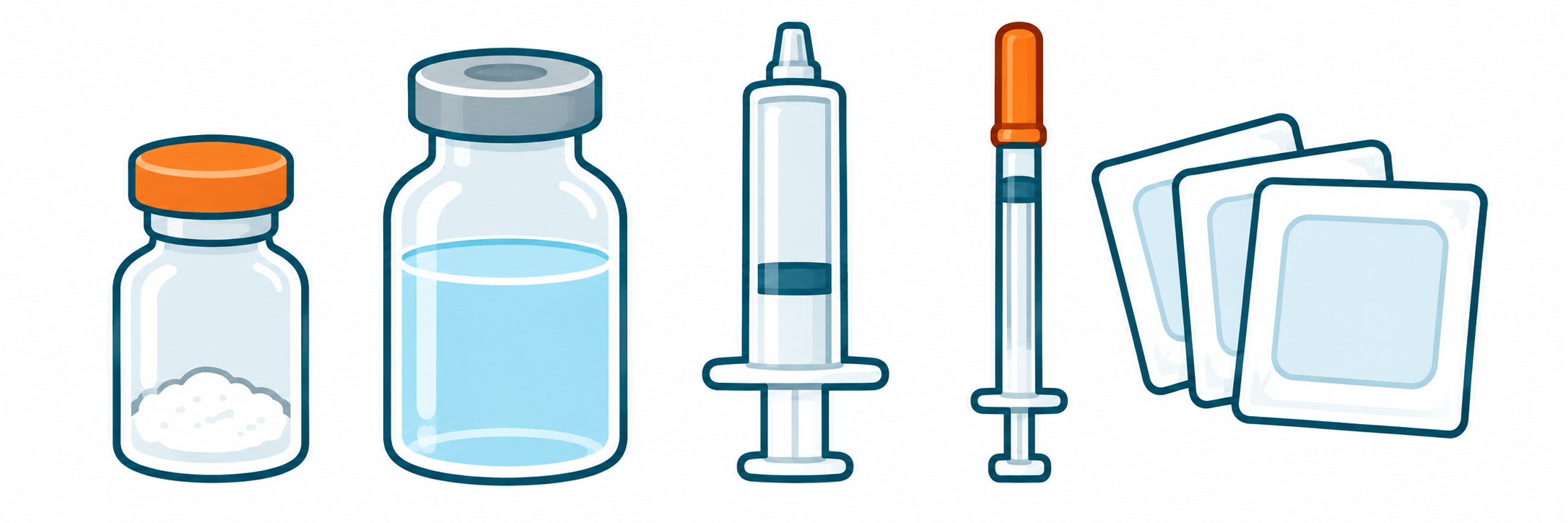
Pick how many weeks you will run it and how many shots you take each week. The list below shows everything you need.
Store at −20 °C (−4 °F) in dry, dark conditions and keep them in the original packaging.
Keep them refrigerated and away from light. How long a mixed vial lasts depends on the product, so check its stability data.
DSIP stands for delta sleep-inducing peptide. It is a nine amino acid peptide studied in relation to sleep and a few other processes. You may also see it called emideltide.
The name sounds more settled than the research is. DSIP has an interesting history, but the available studies do not establish a reliable subcutaneous treatment for insomnia. That makes the route, the study design and the actual outcomes worth checking before you accept broad claims about deep sleep.
This is what people are after. The honest version is that the studies behind the name used a different route from the injection schedule people run.
Time to fall asleep is one of the things worth tracking, and it is a different measure from staying asleep.
Waking in the night is a separate measure again. Pooling them into a vague sense of better sleep hides what actually changed.
There is no reliable answer. The one to three hour window is the timing in the source protocol, not a measured onset. Tracking your own numbers tells you more than any published timeline here would.
Pick a topic to see what has been studied.
Small human studies from the earlier DSIP research program explored sleep-related outcomes. A six-volunteer study reported changes in sleep after administration, including later nighttime measures. A controlled chronic-insomnia study is part of that record too.
Those experiments used a different administration route from the subcutaneous schedule people run. A positive result in one experiment does not establish the same effect across routes, populations and schedules.
The question that matters is whether the exact regimen being described was ever tested. For this community injection schedule, that link has not been established. No intravenous amount or conversion was used in the calculations here.
The source protocol gives 250 mcg five nights a week. Other guides give 100 to 300 mcg nightly, closer to bedtime. That spread does not prove more is better, or that a longer cycle helps. It shows there is no settled standard.
The FDA's assessment of emideltide raised concerns about insufficient safety information, peptide impurities, and possible immune reactions. Its review did not find adequate evidence of effectiveness for the sleep disorders it evaluated. Any claim that DSIP is harmless, or has a proven wide safety margin for repeated subcutaneous use, goes further than that assessment supports.
Concentration math assumes the stated amount and final volume are correct. Appearance alone cannot confirm identity, potency, purity, or sterility, and the number of draws a vial yields is not a shelf-life guarantee. Follow the documentation for the exact material and preparation rather than a generic statement about keeping peptides in the fridge.
Quality varies a lot between sellers. I have been around research peptides for 10 years, and BioEdge is the supplier I send my readers to. Here is why.
The Peptide Report has a business relationship with BioEdge Research Labs. BioEdge sells this product for laboratory research only. BioEdge shipping policy
Pick a tool and try it. Each one uses the numbers from your calculator.
Use the same four steps. Once you can solve these, you can work out the units for any vial you ever pick up.
Your score: 0 correct.
Each line on the syringe is a unit of liquid. A unit measures volume, so the amount of peptide in it depends on your mix.
Tap the syringe or move the slider. The numbers use the vial you entered above. Read the line at the top edge of the plunger.
More water makes the mix weaker, so the same amount takes up more units. The amount of peptide in the vial stays the same.
A draw under 5 units is harder to read accurately. Tap a row to use that water amount.
The reported protocol is 250 mcg by subcutaneous injection, 1 to 3 hours before bed, five nights on and two off, for eight weeks followed by eight weeks off. Other guides describe 100 to 300 mcg nightly.
With a 10 mg vial and 2 mL of water, 250 mcg is 5 units on a U-100 syringe. With 3 mL it is 7.5 units, and with a 5 mg vial in 2 mL it is 10 units. Use the calculator for your own mix.
2 mL makes 5 mg per mL and puts 250 mcg at 5 units. 3 mL makes 3.33 mg per mL and puts it at 7.5 units, and not every syringe has half-unit markings.
No, and this catches people out. A 10 mg vial holds 10,000 mcg in total. It is ten doses only if each one is 1 mg. At 250 mcg it holds forty.
The source protocol says one to three hours before bed. Treat that as the reported timing, not as a proven onset window.
No. The small human studies behind the name used a different route from the injection schedule people run, and the exact regimen described here has not been tested.
Because there is no agreed subcutaneous standard. Some describe nightly use, others include days off, an earlier window, or a break between cycles.
Yes. One milligram is 1,000 micrograms, so 250 mcg is 0.25 mg. That is the amount of peptide, which is separate from the volume of liquid needed to hold it.
Vial size changes how much is in the vial and, depending on your water, the concentration. It does not by itself establish a different amount or cycle. The calculator shows why the same 250 mcg can land on different syringe markings.
Combining compounds makes it harder to tell what caused an effect or a bad reaction. Nothing reviewed establishes the safety or effectiveness of a DSIP sleep stack, and separate evidence about two ingredients does not prove the combination.
Most charts assume one vial size and one water amount. If your mix is different, every unit number changes, so run your own numbers.