Powder vials
Store at −20 °C (−4 °F) in dry, dark conditions and keep them in the original packaging.


Most people use 1 to 2 mg of GHK-Cu a day, starting at 1 mg and working up over 4 to 8 weeks. With a 50 mg vial mixed with 3 mL of water, 1 mg is 6 units on a U-100 syringe. Most people run it for 8 to 12 weeks.
The amounts in this chart come from online communities. The vial label shows the total peptide in milligrams (mg). The Amount column shows a portion of that total in micrograms (mcg). The syringe mark shows how much liquid corresponds to that amount.
Syringe marks below are based on a 50 mg vial with 3 mL of water added. Change vial size or water in the calculator
| Reported | Amount | Volume | Syringe mark (U-100) | Draws per vial |
|---|
Convert your vial to mcg, because 1 mg is the same as 1,000 mcg.
Divide by your water to see how much is in 1 mL.
Find what one unit holds. A U-100 syringe has 100 units in 1 mL.
Divide your amount by what one unit holds.
Start at 1 mg a day for the first four weeks, 1.5 mg for weeks 5 to 8, and 2 mg from week 9. Plenty of people just hold at 2 mg once they get there because it keeps the math simple.
Once a day at a consistent time. Rotate your injection sites rather than using the same spot.
8 to 12 weeks is the usual range. Some people run it to 16 weeks.
GHK-Cu carries copper, which is why the solution is blue. That is expected, not a sign something is wrong. It also means the usual cautions about copper apply.
Follow one step at a time. The steps use the water amount from your calculator.
Find the mg printed on your vial and enter it in the calculator. Let a frozen vial reach room temperature first.
Clean the top of the peptide vial and the water vial with an alcohol swab. Let them dry.
Draw bacteriostatic water with a sterile syringe.
Let the water run down the inside wall of the vial. This helps prevent foaming.
Roll the vial until the powder fully dissolves. Do not shake it hard.
Write today's date on the vial and refrigerate it at 2–8 °C (35.6–46.4 °F), away from light.
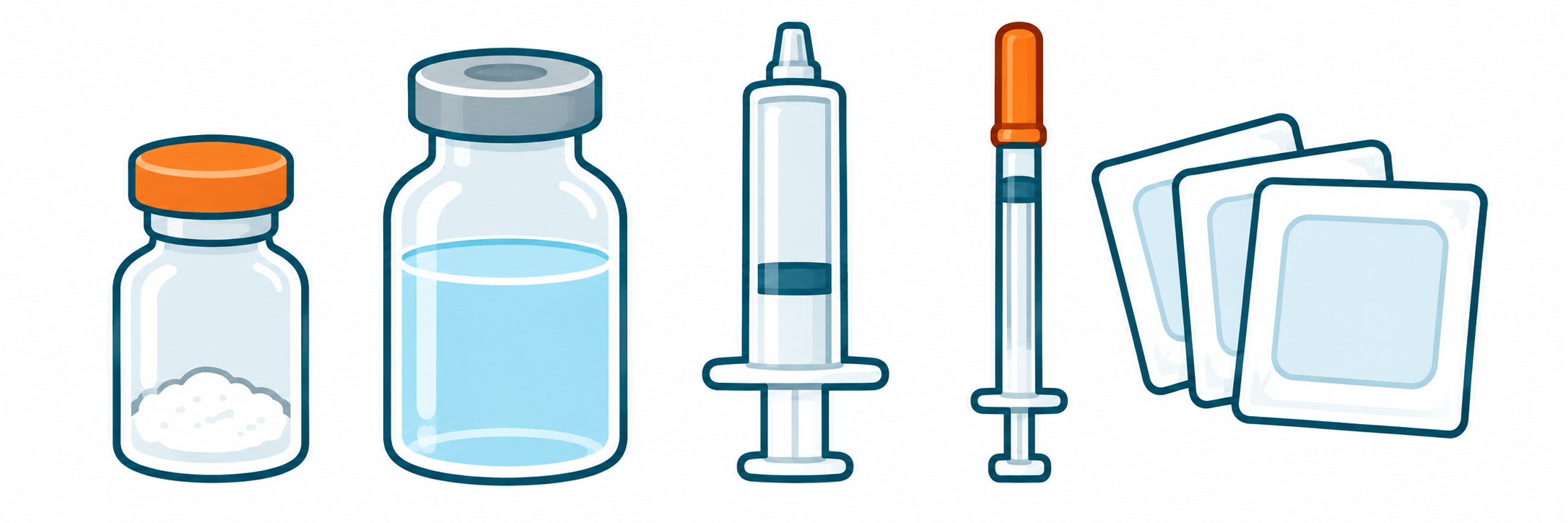
Pick how many weeks you will run it and how many shots you take each week. The list below shows everything you need.
Store at −20 °C (−4 °F) in dry, dark conditions and keep them in the original packaging.
Keep them refrigerated and away from light. How long a mixed vial lasts depends on the product, so check its stability data.
GHK-Cu is a copper peptide. The full name is glycyl-L-histidyl-L-lysine bound to copper. Your body makes it, and levels drop as you get older, which is a large part of why it draws interest.
The research looks at tissue repair, extracellular matrix remodeling, and skin. More specifically it looks at gene expression connected to collagen production, oxidative stress response, and inflammatory signaling. Most of that work is in cells and animals rather than in people given injections.
This is the main reason people use it. The research interest is in gene expression tied to collagen production.
Copper peptides come up constantly in hair conversations. Most of that work is topical rather than injected.
Extracellular matrix remodeling is one of the studied pathways, which is why it gets paired with the recovery peptides.
Your own GHK-Cu levels fall with age, and that drop is what put it in the longevity conversation.
Skin changes are slow by nature, so most people are looking at the back half of an 8 to 12 week run rather than the first few weeks.
Pick a topic to see what has been studied.
A 1993 rat wound-chamber study found increased accumulation of collagen and other extracellular matrix material. It tested GHK-Cu locally in that model, which is a different setting from a subcutaneous injection in a person.
The published work explores gene expression connected to collagen production, oxidative stress response, and inflammatory signaling. Those are mechanisms, not measured outcomes in healthy people.
GHK-Cu is something your body makes, and the amount falls as you age. That decline is the reason it gets framed as replacing something rather than adding something.
GHK-Cu is sold as a vial, as capsules, and in topical products at various percentages. Those are not interchangeable, and an amount reported for one form says nothing reliable about another.
Quality varies a lot between sellers. I have been around research peptides for 10 years, and BioEdge is the supplier I send my readers to. Here is why.
The Peptide Report has a business relationship with BioEdge Research Labs. BioEdge sells this product for laboratory research only. BioEdge shipping policy
GHK-Cu is sold on its own and as the largest component of two blends. Here is how they compare.
| Stack | Ingredients | Why people stack them |
|---|---|---|
| GHK-Cu + BPC-157Two vials | GHK-Cu in one vial. BPC-157 in the second. | Skin plus tissue repairGHK-Cu is the collagen and skin side. BPC-157 is the tendon and gut side. Running them separately lets you set each amount on its own, which a blend does not. See the BPC-157 dosage guide. |
| GLOWOne vial, 70 mg | GHK-Cu 50 mg, BPC-157 10 mg, and the TB component 10 mg in one vial | The same three in one drawGLOW is GHK-Cu plus BPC-157 and TB-500 premixed. A 15-unit draw holds 2.5 mg of GHK-Cu, which lands in the same range as a standalone 2 mg. The trade is that you cannot adjust one component. See the GLOW dosage guide. |
| KLOWOne vial, 80 mg | The GLOW three plus KPV 10 mg | Adds gut inflammationKLOW is GLOW with KPV added. Same GHK-Cu content per draw. People pick it when gut inflammation is also on the list. See the KLOW dosage guide. |
Pick a tool and try it. Each one uses the numbers from your calculator.
Use the same four steps. Once you can solve these, you can work out the units for any vial you ever pick up.
Your score: 0 correct.
Each line on the syringe is a unit of liquid. A unit measures volume, so the amount of peptide in it depends on your mix.
Tap the syringe or move the slider. The numbers use the vial you entered above. Read the line at the top edge of the plunger.
More water makes the mix weaker, so the same amount takes up more units. The amount of peptide in the vial stays the same.
A draw under 5 units is harder to read accurately. Tap a row to use that water amount.
Most people use 1 to 2 mg a day. A common pattern is 1 mg for the first four weeks, 1.5 mg for weeks 5 to 8, then 2 mg.
With a 50 mg vial and 3 mL of water, 1 mg is 6 units on a U-100 syringe. 1.5 mg is 9 units and 2 mg is 12 units. Use the calculator if your mix is different.
3 mL is the common choice, which makes 16.67 mg per mL and puts 1 mg at 6 units.
The copper. GHK-Cu is a peptide bound to copper, and that is what gives it the color. A blue solution is expected here, not a warning sign.
8 to 12 weeks is the usual range, and some protocols go to 16. Copper is the reason not to simply run it forever.
No. Injected, oral, and topical GHK-Cu are different routes, and an amount from one tells you nothing reliable about another. Every number on this page is for the vial.
Yes, and it is the largest component of both. A 15-unit draw of either blend holds 2.5 mg of GHK-Cu, which is in the same range as a standalone run.
Most charts assume one vial size and one water amount. If your mix is different, every unit number changes, so run your own numbers.