Powder vials
Store at −20 °C (−4 °F) in dry, dark conditions and keep them in the original packaging.

The published recommendation starts at 20 to 40 mcg a day for a novice, split across two or three administrations, rising by 10 to 20 mcg a week to a ceiling of 80 to 100 mcg a day. With a 1 mg vial mixed with 2 mL of water, 50 mcg is 10 units on a U-100 syringe. The cycle is 4 to 6 weeks on with 2 to 4 weeks off.
The amounts in this chart come from online communities. The vial label shows the total peptide in milligrams (mg). The Amount column shows a portion of that total in micrograms (mcg). The syringe mark shows how much liquid corresponds to that amount.
Syringe marks below are based on a 1 mg vial with 2 mL of water added. Change vial size or water in the calculator
| Reported | Amount | Volume | Syringe mark (U-100) | Draws per vial |
|---|
Convert your vial to mcg, because 1 mg is the same as 1,000 mcg.
Divide by your water to see how much is in 1 mL.
Find what one unit holds. A U-100 syringe has 100 units in 1 mL.
Divide your amount by what one unit holds.
Follow one step at a time. The steps use the water amount from your calculator.
Find the mg printed on your vial and enter it in the calculator. Let a frozen vial reach room temperature first.
Clean the top of the peptide vial and the water vial with an alcohol swab. Let them dry.
Draw bacteriostatic water with a sterile syringe.
Let the water run down the inside wall of the vial. This helps prevent foaming.
Roll the vial until the powder fully dissolves. Do not shake it hard.
Write today's date on the vial and refrigerate it at 2–8 °C (35.6–46.4 °F), away from light.

Pick how many weeks you will run it and how many shots you take each week. The list below shows everything you need.
Store at −20 °C (−4 °F) in dry, dark conditions and keep them in the original packaging.
Keep them refrigerated and away from light. How long a mixed vial lasts depends on the product, so check its stability data.
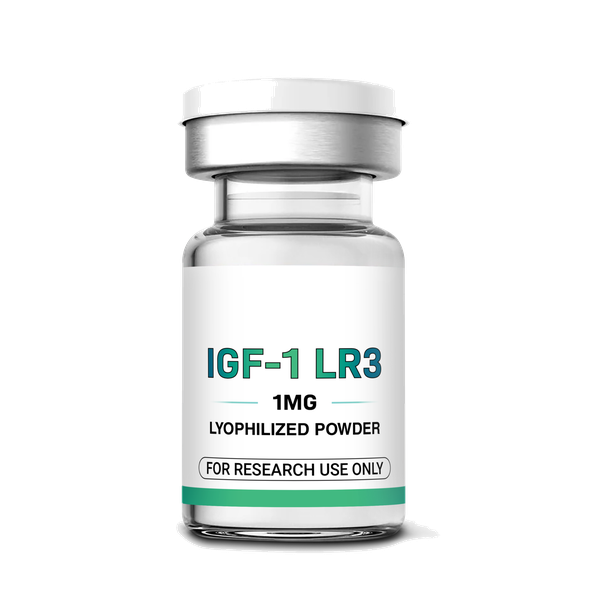
IGF-1 LR3 is a modified version of insulin-like growth factor 1. The LR3 part means it is lengthened and altered so it binds far less to the binding proteins that would normally mop it up, which makes it last much longer in circulation.
That is the whole point and also the whole problem. A growth factor that stays active longer does more, and the things it does are not confined to muscle.
The main reason people use it, through the PI3K and Akt pathway, glucose transport and protein synthesis.
The secondary claim, and the one with less behind it.
Blood sugar. Hypoglycemia is on the article's own list of more serious effects, and it is the thing that goes wrong fastest.
The cycle is 4 to 6 weeks, which is the timescale the figures are built around.
Standard IGF-1 is largely bound up by binding proteins in circulation. The LR3 modification reduces that binding, so more stays active and for longer. That is the entire design rationale.
The article describes the PI3K and Akt pathway, glucose transport and protein synthesis, which is the standard account of how IGF-1 signalling drives growth.
Worth saying plainly. The article refers to extensive research by the National Institutes of Health and to a study in the Journal of Strength and Conditioning Research, but names no study, author or year for either. There is no citation on this page to go and check.
Dividing the daily amount into two or three administrations is standard practice with this compound, though nothing published establishes that it is better than one.
IGF-1 has insulin-like activity, which is where the name comes from. That is the mechanism behind the hypoglycemia risk, not an unrelated side effect.
Quality varies a lot between sellers. I have been around research peptides for 10 years, and BioEdge is the supplier I send my readers to. Here is why.
The Peptide Report has a business relationship with BioEdge Research Labs. BioEdge sells this product for laboratory research only. BioEdge shipping policy
Pick a tool and try it. Each one uses the numbers from your calculator.
Use the same four steps. Once you can solve these, you can work out the units for any vial you ever pick up.
Your score: 0 correct.
Each line on the syringe is a unit of liquid. A unit measures volume, so the amount of peptide in it depends on your mix.
Tap the syringe or move the slider. The numbers use the vial you entered above. Read the line at the top edge of the plunger.
More water makes the mix weaker, so the same amount takes up more units. The amount of peptide in the vial stays the same.
A draw under 5 units is harder to read accurately. Tap a row to use that water amount.
A novice starts at 20 to 40 mcg a day split into two or three administrations, rising 10 to 20 mcg weekly to a ceiling of 80 to 100 mcg. The experienced schedule starts at 40 to 60 mcg rising to 100 to 120 mcg.
With a 1 mg vial and 2 mL of water, 50 mcg is 10 units on a U-100 syringe and 20 mcg is 4 units. Use the calculator if your mix is different.
4 to 6 weeks on, 2 to 4 weeks off. Note that the source also describes an 8 to 12 week experienced cycle without reconciling the two.
Two or three administrations a day is the standard practice, though nothing published establishes it is better than one.
The source advises liver enzymes, blood sugar and IGF-1 levels, under medical supervision.
No. MGF is a splice variant of IGF-1, a short piece of it. They are different molecules and amounts do not transfer.
Most charts assume one vial size and one water amount. If your mix is different, every unit number changes, so run your own numbers.