Powder vials
Store at −20 °C (−4 °F) in dry, dark conditions and keep them in the original packaging.

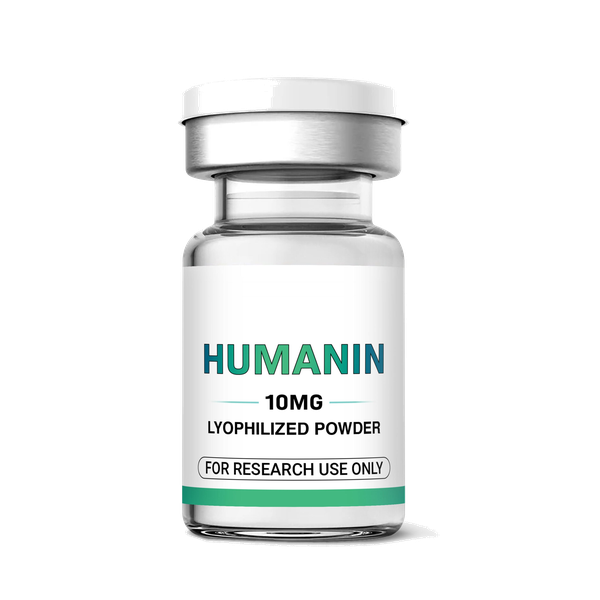
Most people start around 100 mcg of Humanin to see how they respond, then settle at 250 to 500 mcg per dose, 2 to 3 times a week by subcutaneous injection. With a 10 mg vial mixed with 2 mL of water, 500 mcg is 10 units on a U-100 syringe. Run it in 4 to 8 week blocks, then take a break. Read the next section before you use any number, because the milligram figures you will find elsewhere are for a different form of this peptide.
The amounts in this chart come from online communities. The vial label shows the total peptide in milligrams (mg). The Amount column shows a portion of that total in micrograms (mcg). The syringe mark shows how much liquid corresponds to that amount.
Syringe marks below are based on a 10 mg vial with 2 mL of water added. Change vial size or water in the calculator
| Reported | Amount | Volume | Syringe mark (U-100) | Draws per vial |
|---|
Convert your vial to mcg, because 1 mg is the same as 1,000 mcg.
Divide by your water to see how much is in 1 mL.
Find what one unit holds. A U-100 syringe has 100 units in 1 mL.
Divide your amount by what one unit holds.
Follow one step at a time. The steps use the water amount from your calculator.
Find the mg printed on your vial and enter it in the calculator. Let a frozen vial reach room temperature first.
Clean the top of the peptide vial and the water vial with an alcohol swab. Let them dry.
Draw bacteriostatic water with a sterile syringe.
Let the water run down the inside wall of the vial. This helps prevent foaming.
Roll the vial until the powder fully dissolves. Do not shake it hard.
Write today's date on the vial and refrigerate it at 2–8 °C (35.6–46.4 °F), away from light.
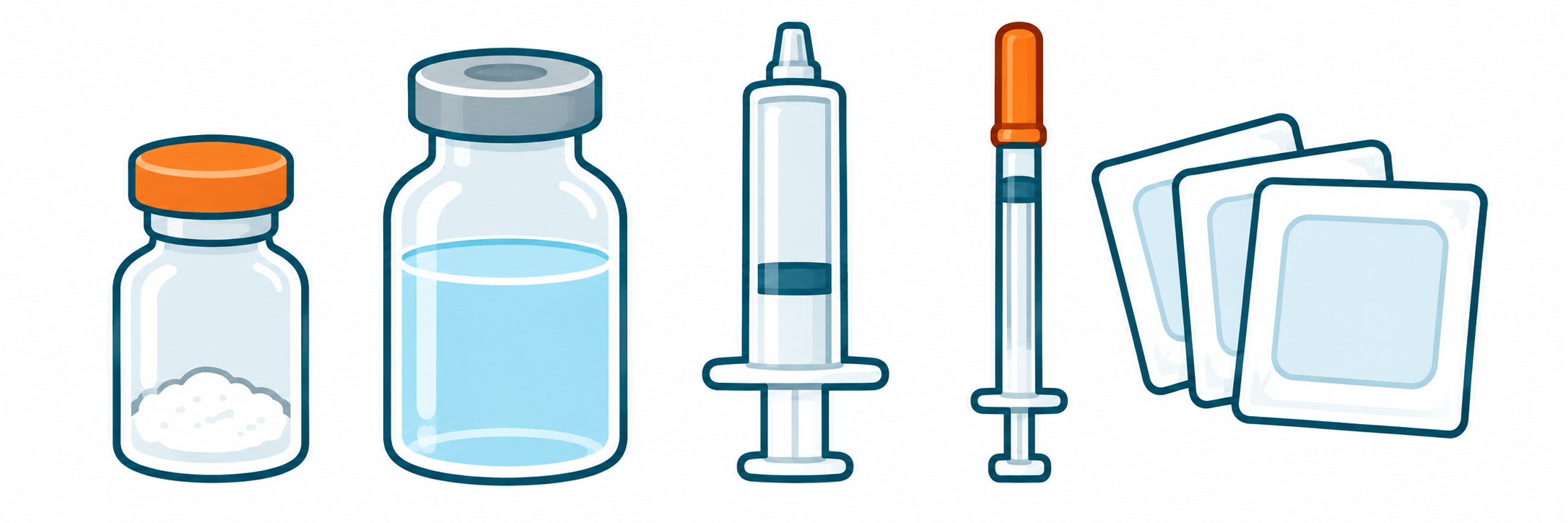
Pick how many weeks you will run it and how many shots you take each week. The list below shows everything you need.
Store at −20 °C (−4 °F) in dry, dark conditions and keep them in the original packaging.
Keep them refrigerated and away from light. How long a mixed vial lasts depends on the product, so check its stability data.
Humanin was the first mitochondrial-derived peptide anyone found, back in 2001, and it turned up during Alzheimer's research. It is encoded in the mitochondrial genome rather than in the nucleus, in the 16S rRNA gene, which was a genuine surprise at the time.
It runs 24 amino acids long in the cell body and 21 inside the mitochondria. Its half-life is around 30 minutes. Almost every vial sold is the synthetic HNG analog rather than the natural sequence, and that is the single most important thing to know before you work out a dose.
The oldest thread, since it was found during Alzheimer's research. Animal work shows improved memory and cognition in aged mice, and lower levels in people track with faster cognitive aging.
In animal models of heart attack and reperfusion injury, Humanin analogs cut infarct size. Lower circulating levels track with worse coronary function.
Levels are lower in people with type 2 diabetes. In diabetic animals it improved insulin sensitivity in both liver and muscle.
Naked mole rats hold their levels steady, and children of centenarians have higher levels. One study reported that raising Humanin was enough on its own to extend lifespan in a model.
Give it weeks, not days. Mitochondrial peptides build quietly. The win looks like not crashing at three in the afternoon for a month, not a jolt on day one.
HNG is the synthetic analog with one amino acid swapped, and it is described as roughly a thousand times more potent than the natural version. That is why one is dosed in milligrams and the other in micrograms. A figure reported for one does not transfer to the other, and almost everything sold is HNG.
Found in 2001, the first mitochondrial-derived peptide identified. It is encoded in the mitochondrial 16S rRNA gene, which is unusual: most peptides are nuclear.
It binds Bax, a protein in the BCL-2 family that drives cell death. In cardiac cell studies under oxidative stress it preserved membrane potential, ATP levels and mitochondrial structure, and lowered reactive oxygen species. It is described as acting through JAK/STAT3, PI3K/Akt and AMPK, and through cell surface receptors including FPRL1.
In animal models it shielded normal cells from nerve damage, cognitive effects and fertility loss caused by chemotherapy.
Some animal work has suggested that systemic Humanin could help certain tumors, including breast cancer, grow and resist chemotherapy. That cuts against the protective framing and it belongs in the same conversation as the benefits.
There are no completed human clinical trials on Humanin. Everything above is preclinical. The dosing figures on this page come from practice rather than from a trial, and there is no published study to check them against.
Quality varies a lot between sellers. I have been around research peptides for 10 years, and BioEdge is the supplier I send my readers to. Here is why.
The Peptide Report has a business relationship with BioEdge Research Labs. BioEdge sells this product for laboratory research only. BioEdge shipping policy
Humanin is one of three mitochondrial compounds people run together. Here is how the stack fits.
| Stack | Ingredients | Why people stack them |
|---|---|---|
| Humanin + NAD+ + MOTS-cThree vials, dosed in the morning | Humanin in one vial. NAD+ in the second. MOTS-c in the third. | The mitochondrial stackThese three come at mitochondrial function from different directions, which is why they get run together rather than in place of each other. Humanin goes in 2 to 3 mornings a week alongside the other two. See the NAD+ dosage guide and the MOTS-c dosage guide. |
| Humanin + MOTS-cTwo vials | Humanin in one vial. MOTS-c in the second. | Two mitochondrial-derived peptidesBoth are encoded in mitochondrial DNA rather than in the nucleus, which makes them an unusual pair. Humanin was the first one ever found. Running the two without NAD+ is the simpler version of the stack. See the MOTS-c dosage guide. |
Pick a tool and try it. Each one uses the numbers from your calculator.
Use the same four steps. Once you can solve these, you can work out the units for any vial you ever pick up.
Your score: 0 correct.
Each line on the syringe is a unit of liquid. A unit measures volume, so the amount of peptide in it depends on your mix.
Tap the syringe or move the slider. The numbers use the vial you entered above. Read the line at the top edge of the plunger.
More water makes the mix weaker, so the same amount takes up more units. The amount of peptide in the vial stays the same.
A draw under 5 units is harder to read accurately. Tap a row to use that water amount.
Most people start around 100 mcg, then settle at 250 to 500 mcg per dose, 2 to 3 times a week by subcutaneous injection, in 4 to 8 week blocks.
With a 10 mg vial and 2 mL of water, 500 mcg is 10 units on a U-100 syringe, 250 mcg is 5 units and 100 mcg is 2 units. Use the calculator if your mix is different.
Those figures are for the natural form of the peptide. The vials being sold are the synthetic HNG analog, which is far more potent and dosed in micrograms. Check which form your vial holds before you use any number.
No. HNG has one amino acid swapped to make it more stable, and it is described as roughly a thousand times more potent. Most product on the market is the synthetic form.
No. Stomach acid destroys it. Subcutaneous injection is the route.
4 to 8 weeks, then a break.
NAD+ and MOTS-c are the usual pair, dosed in the morning. All three come at mitochondrial function from different directions.
Most charts assume one vial size and one water amount. If your mix is different, every unit number changes, so run your own numbers.