If you’ve been hearing about ARA-290 and wondering what all the talk is about, you’re in the right place. ARA-290 is a small peptide made from a piece of EPO, the hormone that tells your body to make red blood cells. In human trials, 4mg a day for 28 days improved HbA1c, lowered triglycerides, and actually helped damaged nerve fibers grow back.
The part I love is that the man who built it, Anthony Cerami, is the same scientist credited with inventing the HbA1c test. In this article I’ll walk you through how ARA-290 works, what the trials found, the dosage protocols people are running, how to mix it without ruining a vial, and what to stack it with.
ARA-290 Quick Facts
| Question | Answer |
|---|---|
| Other name | Cibinetide |
| What it is | An 11-amino-acid peptide built from part of EPO |
| How it works | It switches on the innate repair receptor, which calms inflammation and starts tissue repair |
| Main human research | Small nerve fiber damage in sarcoidosis and type 2 diabetes, plus blood sugar |
| Trial dose | 4mg injected under the skin once a day for 28 days |
| Time in the blood | About 2 minutes |
| Does it raise red blood cells? | No. Red blood cell levels stayed stable in the human trials. |
| FDA status | Not approved. It has orphan drug status for sarcoidosis. |
Who Created ARA-290?
This story starts somewhere you wouldn’t expect, with sick cattle in Kenya back in the 1970s. A parasite was killing them, and the animals were wasting away. Anthony Cerami had a hunch the parasite wasn’t doing most of the damage. He thought the cows’ own bodies were overreacting and making a molecule that caused the wasting.
It turns out he was right. His team named the molecule cachectin, and it was later found to be TNF, one of the biggest drivers of inflammation in the human body. The drugs that block TNF went on to become some of the best-selling biotech medicines ever made.
On top of that, Cerami is credited with inventing the HbA1c test, the blood sugar test millions of people get at their checkups. Years later, he and his colleague Michael Brines built a peptide to calm inflammation, and in a human trial it improved HbA1c, the same number his own test measures. I think that’s a pretty wild full-circle moment. That peptide is ARA-290.
What Is ARA-290?
The easiest way to think about ARA-290 is that it keeps the good part of EPO and leaves the risky part behind. To make sense of that, you need to know a little about EPO first.
EPO, short for erythropoietin, is a hormone your kidneys make to tell your body to build red blood cells. A drug version has been used for anemia for decades. You might also know it as the drug that blew up pro cycling, since more red blood cells means more oxygen getting to the muscles.
In 2000, Cerami’s team figured out that EPO has a second job. It pushes back against inflammatory signals like TNF. In animal studies, EPO protected tissue after strokes and spinal cord injuries, and it protected the heart, kidneys, and eyes when their blood flow was cut off and then restored.
The problem was the red blood cell side. EPO thickens your blood, and thicker blood clots more easily. In a 2007 ICU trial, EPO cut deaths in trauma patients in half but raised blood clots by about 40%. In the 2009 TREAT trial, it roughly doubled the risk of stroke.
So EPO saved lives in the ICU, but the clot and stroke risk made it a tough sell as a drug for protecting tissue.
That’s where Cerami and Brines got clever. They found that EPO protects tissue through a completely different receptor than the one it uses to make red blood cells, and they named it the innate repair receptor. Then they built a tiny peptide, just 11 amino acids long, from the piece of EPO that talks to that repair receptor. That peptide is ARA-290, which you’ll also see called cibinetide.
| EPO | ARA-290 | |
|---|---|---|
| Size | A full hormone of 165 amino acids | 11 amino acids |
| Protects tissue | Yes | Yes |
| Raises red blood cells | Yes | No |
| Clot and stroke risk | Raised in trials | Red blood cell levels stayed stable in trials |
| Time in the blood | Hours | About 2 minutes |
That 2-minute number throws a lot of people off. It’s enough time to flip the repair receptor on, and the signals it starts inside the cell keep going for hours after the peptide is gone.
How Does ARA-290 Work?
In short, ARA-290 flips on your body’s own off switch for inflammation. Once you understand that, it makes sense why the research covers nerves, blood sugar, and the heart.
Inflammation is your body’s emergency response. When you get hurt or sick, it sends immune cells and signals like TNF to fight the problem and start fixing things. That’s a good thing when it turns on, does its job, and turns back off.
The trouble starts when it never fully shuts off. Low-grade inflammation that hangs around for years slowly wears down your nerves, your blood vessels, your heart, and the cells in your pancreas that make insulin.
Your body has its own way of dealing with this. When tissue gets damaged or stressed, cells put out more of the innate repair receptor. When ARA-290 locks onto that receptor, it basically tells the cell three things:
- Stop self-destructing.
- Quiet the inflammatory signals.
- Start repairing.
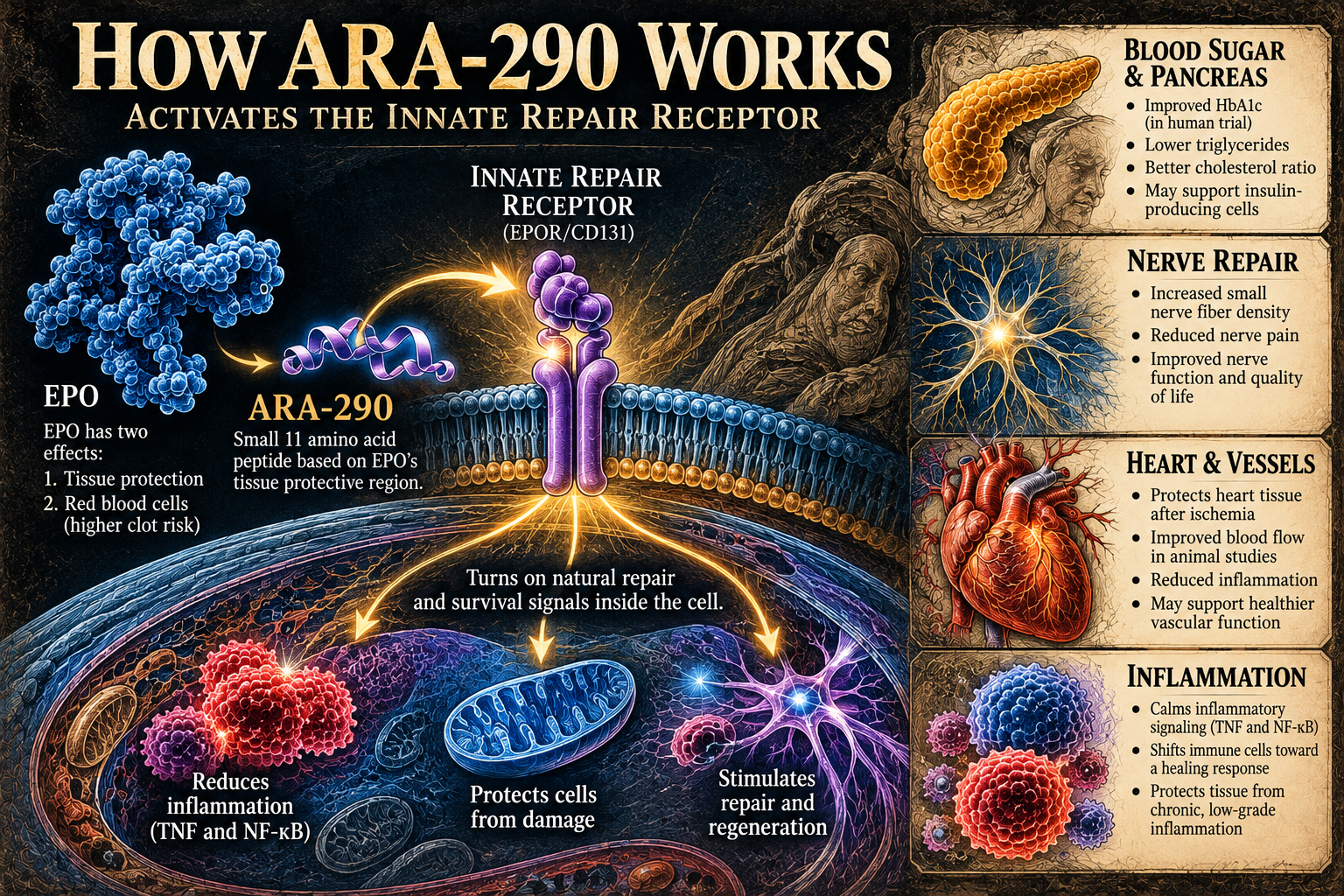
The same inflammation hits tissue all over the body, so the same receptor shows up all over the body too. That’s why one peptide has research in so many different areas.
I want to be upfront about one thing. The human trials measured nerve fibers and blood sugar, not inflammation markers in the blood, so most of the inflammation evidence comes from how ARA-290 works and from animal studies. In one aging rat study, it lowered NF-κB in the heart, which is one of the master switches that turns inflammation on.
ARA-290 Benefits for Blood Sugar and HbA1c
This is where the Cerami story comes full circle. In a 28-day human trial, ARA-290 improved HbA1c, the same blood sugar test he invented.
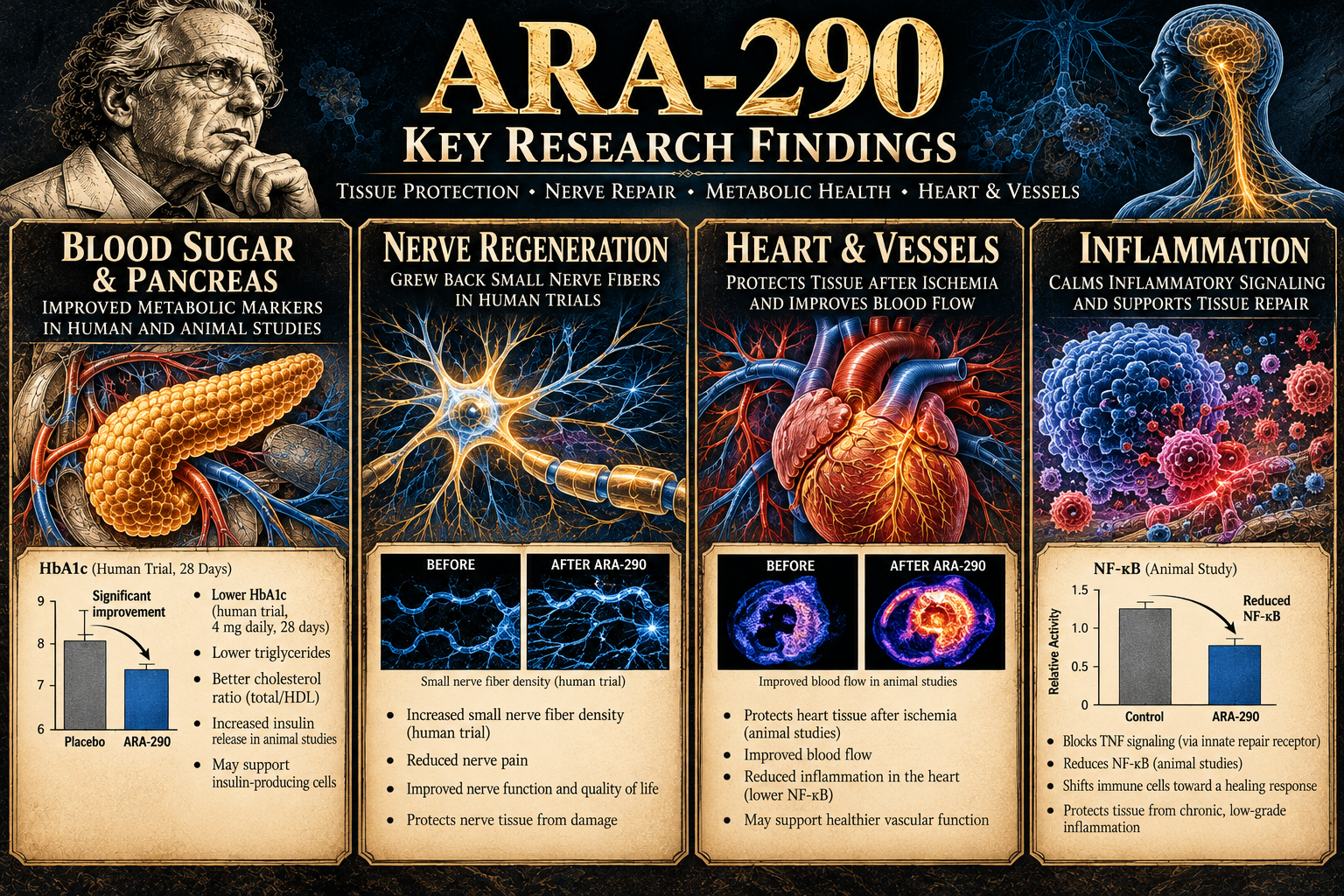
The trial came out in Molecular Medicine in 2015. It had 49 people with type 2 diabetes and nerve pain, and each one injected either 4mg of ARA-290 or a placebo every day for 28 days. Then the researchers kept watching them for another month after they stopped.
HbA1c got better in the ARA-290 group. Triglycerides came down, and the ratio of total cholesterol to HDL improved too. Those improvements stuck around for the whole 56 days.
To put that in perspective, HbA1c reflects your average blood sugar over about three months, so seeing it move in 28 days is really fast. To be fair, these were secondary results from a small trial, and bigger studies still need to confirm them. Even so, the direction is hard to ignore.
A 2015 study in diabetic rats gives us a good idea of how it might be working. After 4 weeks, the treated rats’ HbA1c dropped about 20%, and they released almost twice as much insulin after sugar as the placebo group. Their insulin sensitivity and fasting blood sugar didn’t change.
What that means is ARA-290 seems to help your pancreas respond when sugar comes in after a meal. It gave the insulin-making cells more energy to do their job, but it didn’t make the body more sensitive to insulin. That quick insulin response after a meal is usually one of the first things to slip as blood sugar control starts to go.
ARA-290 for Neuropathy and Nerve Pain
In my opinion, this is the most impressive part of the research. Most nerve pain drugs just turn down the pain signal, but with ARA-290, damaged nerve fibers actually grew back in human trials.
Small nerve fibers are the thin nerves that carry pain, temperature, and signals to your organs. When they get damaged, you feel it as burning, tingling, numbness, or pins and needles, and it usually starts in the feet. High blood sugar and long-term inflammation are two of the most common reasons it happens.
Most of the nerve research was done in people with sarcoidosis, an inflammatory disease that often damages these small nerves. Researchers like to look at the nerves in the cornea of the eye, because it’s one of the only places they can actually see small nerves directly.
| Year | Who was studied | People | Dose and length | What happened |
|---|---|---|---|---|
| 2012 | Sarcoidosis with nerve pain | 22 | By IV, 3 times a week for 4 weeks | Nerve symptoms improved |
| 2013 | Sarcoidosis with nerve fiber loss | Small group | Under the skin daily for 28 days | Symptoms improved and nerve fiber density in the cornea went up |
| 2015 | Type 2 diabetes with nerve pain | 49 | 4mg daily for 28 days | Nerve symptoms improved and cornea nerve density went up, while placebo stayed flat |
| 2017 | Sarcoidosis with nerve fiber loss | 64 | 1mg, 4mg, or 8mg daily for 28 days | 4mg regrew the most nerve fiber in the cornea and skin |
The 2017 trial is the biggest one so far, and it’s the only one that tested different doses side by side. The results are pretty clear.
The people whose nerves grew back the most also did the best on a six-minute walking test. Pain went down across all the groups, but the pain result by itself didn’t reach statistical significance, so the stronger evidence is the nerve regrowth.
Part of the pain relief may also come from a second effect. ARA-290 blocks TRPV1, a channel on small nerve fibers that cranks up pain signals and drives nerve-related inflammation.
ARA-290 and Heart Health
The heart research is still animal-only, but it’s some of the most interesting work on ARA-290. In aging rats, it slowed the loss of heart strength and kept them less frail, although it didn’t help them live longer.
The study was published in Frontiers in Cardiovascular Medicine in 2023. The rats got ARA-290 three times a week starting at 18 months old, which is middle age for a rat, and the researchers kept it going for 15 months into old age.
In the untreated rats, heart pumping strength dropped about 14% with age, and it dropped less in the rats on ARA-290. The treated rats also had fewer inflammatory immune cells and less NF-κB in their hearts, their blood pressure climbed less, and they were much less frail in old age.
They also lost less weight late in life, but they lived about as long as the untreated rats. The real difference was how well their hearts and bodies held up along the way.
ARA-290 Dosage: The Protocols People Use
For a focused reference to study regimens, vial concentrations, and U-100 unit conversions, use the ARA-290 dosage and vial-math guide. The discussion below explains how the research relates to common protocol claims.
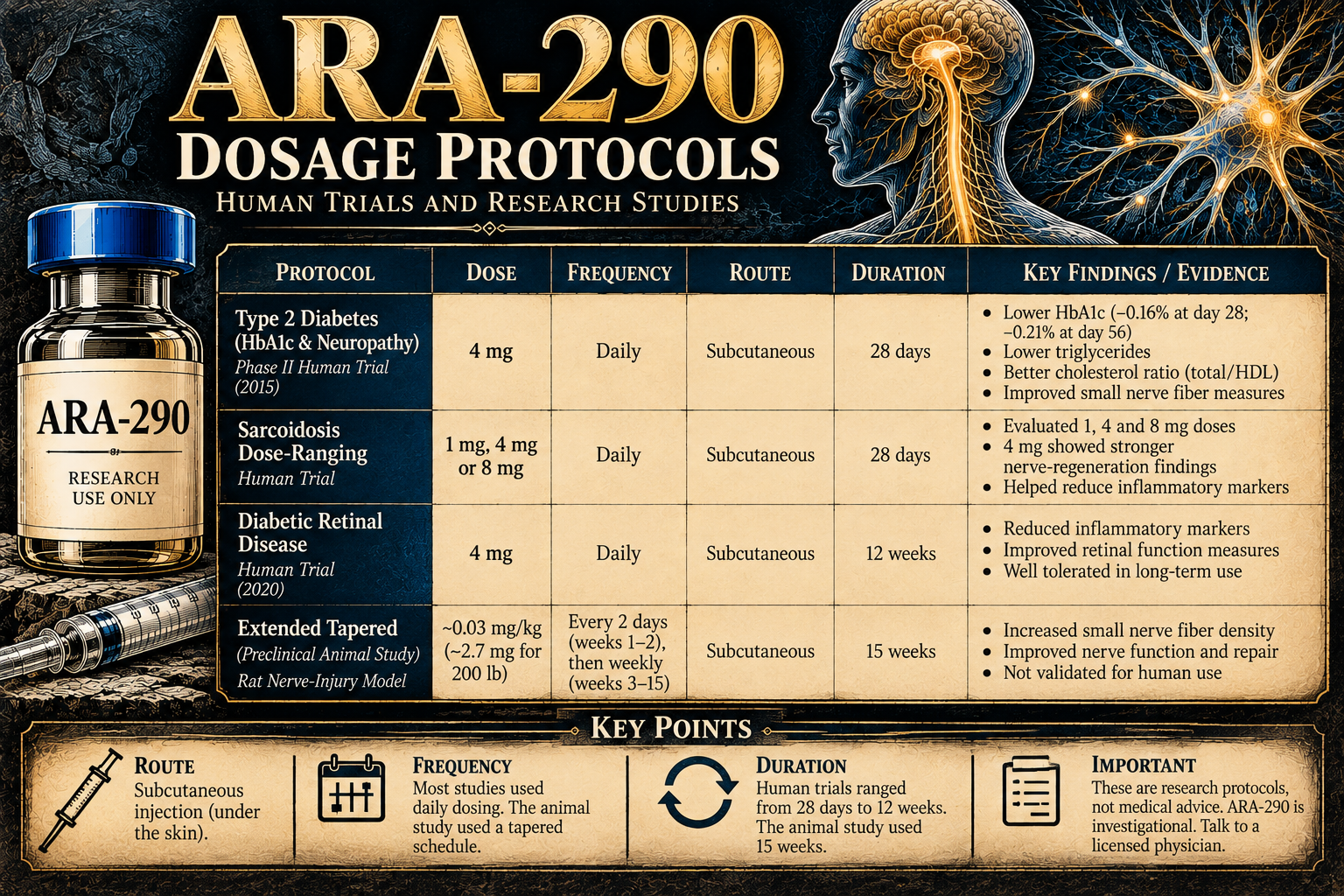
This is the question most of you came here for. The ARA-290 dosage with real human data behind it is 4mg injected under the skin once a day for 28 days, and everything past that is an educated guess. Keep in mind this is what’s out there, not a prescription.
That 4mg dose comes straight from the human trials. In the 2017 trial it also beat both 1mg and 8mg for nerve regrowth, so more definitely wasn’t better.
How long to take off between ARA-290 cycles
This is where the research gets thin. Every human trial ran one course and stopped, so nobody has tested how long to wait before a second run. What the trials do show is what happened after the last injection, and the two main results point in different directions.
In the 2017 nerve trial, the new nerve fiber area had drifted back toward where it started about a month after the last dose, and the authors said 28 days probably wasn’t long enough to see the full effect. In the 2015 diabetes trial, the HbA1c and cholesterol gains held for the whole month after people stopped.
The schedule most people share is 28 days on and 4 to 12 weeks off, but that gap comes from habit, not data. If nerves are your focus, the 2017 trial points to a shorter break or a longer run. If blood sugar is your focus, a 4-week break lines up with what was actually measured.
Lower dose or longer run?
A lot of people with blood sugar goals ask whether a lower dose for a longer stretch beats the standard 28 days. No human trial has tested that, and every metabolic result so far came from 4mg a day. The one data point we have on lower doses isn’t great either, since 1mg a day did nothing measurable for nerve fibers in 2017.
Going longer at 4mg has better support. A 2020 trial in people with diabetic swelling in the retina ran 4mg a day for 12 weeks straight with no serious side effects, and nobody’s immune system made antibodies against the peptide. Some of those people saw their blood sugar control improve, but two of the eight saw their HbA1c get worse. The authors also pointed out that a fixed 4mg dose may have been too low for people with obesity.
So if blood sugar is your goal, a longer run at the trial dose is what the research points to. A lower-dose run is just a guess.
What time of day to take ARA-290
Because ARA-290 clears your blood in minutes and works by flipping on a signal, the time of day doesn’t matter much. Staying consistent matters more, so pick a time that works for you and stick with it.
Where I Source My ARA-290
I source all my peptides from BioEdge Research Labs. Every lot is third-party tested, and the COA is on the product page.
Use code MARS15 at checkout.
How to Reconstitute and Store ARA-290
Heads up, ARA-290 trips people up at the mixing step more than most peptides. In plain bacteriostatic water, some vials turn cloudy or even gel up, and PBS is usually the fix.
It really comes down to how the powder was made. Some batches are buffered and mix fine in bacteriostatic water, and others aren’t, which is where the trouble starts. A gelled vial is hard to draw from and even harder to measure.
| Bacteriostatic water | PBS (phosphate-buffered saline) | |
|---|---|---|
| Preservative | Yes, benzyl alcohol keeps bacteria from growing | None |
| pH | Not buffered | Held steady around 7.4, close to the body’s pH |
| How ARA-290 behaves | Some vials cloud up or gel | Tends to stay dissolved |
| Best for | Batches that mix clear | Batches that cloud up in bacteriostatic water |
| Trade-off | None for clear batches | Mix smaller amounts and use the vial faster |
Whichever one you use, let the liquid run slowly down the inside wall of the vial instead of spraying it right onto the powder. Swirl it gently instead of shaking it, and keep it in the fridge once it’s mixed.
Is cloudy ARA-290 safe to use?
A vial that’s cloudy right after you mix it usually just means the peptide didn’t fully dissolve, not that it’s bad. You still don’t want to inject it until it clears up.
| What you see | What it means | What to do |
|---|---|---|
| Cloudy or gel right after mixing | The peptide clumped and didn’t fully dissolve | Let it reach room temperature and swirl gently for a few minutes |
| Turns fully clear after swirling | It dissolved | It’s fine to use |
| Still cloudy or thick after swirling | It won’t dissolve in that liquid | Don’t inject it. Use PBS for the next vial. |
| Clear at first, then cloudy days later | It may be contaminated or breaking down | Throw it out |
| Floating specks or a color change | It may be contaminated or breaking down | Throw it out |
You can’t pull an even dose out of a gel, and clumped peptide is more likely to irritate the injection site. That’s why a vial that stays cloudy goes in the trash.
ARA-290 Side Effects and Bloodwork
The good news is that side effects in the trials were mostly mild. In the 2017 trial, the most common ones were injection-site pain, headache, fatigue, nausea, and diarrhea, and they didn’t get worse at higher doses.
Just keep in mind the human data is still small. Each trial had a few dozen people at most, and none of the published human trials went longer than 12 weeks.
Since ARA-290 comes from EPO, bloodwork before and after a run makes a lot of sense. It’ll also tell you way more than how you feel.
- Everyone: Get a CBC (complete blood count) to confirm your red blood cells stay steady, like they did in the trials.
- Inflammation: Check hsCRP and IL-6 to see whether your inflammation markers moved.
- Blood sugar: Check HbA1c and fasting insulin to see whether your blood sugar control changed.
ARA-290 Stack: What to Pair It With
ARA-290 makes a great anchor for a stack because it works on one specific system, the innate repair receptor. That leaves room for other compounds to cover what it doesn’t. Each one below works through a different pathway, so they add to each other instead of stepping on each other.
Here are the protocols in circulation for each piece. Same as the ARA-290 dosage above, this is what’s out there, not a prescription.
| Compound | Job in the stack | Protocol in circulation | Cycle |
|---|---|---|---|
| ARA-290 | Inflammation and nerve repair | 4mg under the skin once a day | 28 days on, then 4 to 12 weeks off |
| KLOW (BPC-157, TB-500, GHK-Cu, KPV) | Tissue repair | Dosed by its BPC-157 content. About 400mcg of BPC-157 a day, which also delivers about 400mcg TB-500, 400mcg KPV, and 2mg GHK-Cu. | 12 weeks, once or twice a year as needed |
| MOTS-c | Blood sugar and energy | 5mg three times a week | 12 weeks, two or three times a year |
| NAD+ | Energy for nerves | 50 to 100mg under the skin, two or three times a week [JOE TO CONFIRM] | No cycling needed |
ARA-290 runs on a shorter clock than the others. A simple way to line them up is to start your 28-day ARA-290 run at the same time as the rest, then keep the others going after ARA-290 is done.
ARA-290 and KLOW
KLOW is a blend of four peptides. BPC-157 has been studied in animal models for tendons, ligaments, muscle, and gut tissue. TB-500 helps cells move into an injured area and helps new blood vessels form. GHK-Cu is a copper peptide studied for collagen and skin repair, and KPV is a small piece of alpha-MSH studied for calming inflammation, mostly in the gut.
ARA-290 handles the nerves and the inflammatory signals, and KLOW covers the structural stuff around them, like tendons, joints, and connective tissue. KPV also adds a second anti-inflammatory angle that works differently than ARA-290.
ARA-290 and MOTS-c
MOTS-c is a peptide your own mitochondria make. Researchers first described it in 2015, and in mouse studies it improved insulin sensitivity and protected against the blood sugar problems that come with a high-fat diet.
This one fits the blood sugar side of ARA-290 really well. The 2015 rat study suggests ARA-290 helps the pancreas release insulin when sugar comes in, but it didn’t make the body more sensitive to insulin. MOTS-c works on that second piece, which is how your muscles and other tissue respond once the insulin shows up. It’s usually run at 5mg three times a week.
ARA-290 and NAD+
Your nerves need more energy than most cells, because some of them run all the way from your spine to your toes. That’s part of why nerve problems usually start in the feet, where the nerves are longest. ARA-290 supports the repair, and NAD+ supports the energy systems that repair runs on. NAD+ also doesn’t need to be cycled.
Which pairing fits which goal
| Your main goal | Pairing people use |
|---|---|
| Blood sugar | ARA-290 and MOTS-c |
| Nerve symptoms after an injury | ARA-290 and KLOW |
| Tingling or numbness in the feet | ARA-290 and NAD+ |
| Inflammation and aging well | ARA-290 alone, or with KLOW |
You don’t need all four. No study has tested them together, so treat these as pairings that make sense based on how each one works.
Who Is ARA-290 For?
ARA-290 makes the most sense if blood sugar, nerve symptoms, or inflammation that won’t go away is your main concern.
That includes people whose HbA1c creeps up a little at every checkup, and people dealing with tingling, burning, or numbness in their feet or hands. It also includes people who train hard and carry that nagging inflammation that never fully clears.
It’s also a good fit if you’re focused on aging well and want to keep inflammation low before it turns into a bigger problem.
On the other hand, if your blood sugar is steady, your nerves feel normal, and you bounce back quickly, ARA-290 probably isn’t the first peptide you need.
I source my ARA-290 from BioEdge Research Labs. Use code MARS15 at checkout.
ARA-290 FAQ
Is ARA-290 the same as cibinetide?
Yes. Cibinetide is the official drug name for ARA-290.
What is ARA-290 used for?
ARA-290 has been studied in humans for small nerve fiber damage in sarcoidosis and type 2 diabetes. Those trials also tracked blood sugar and cholesterol. Animal research covers the aging heart and wound healing.
What is the standard ARA-290 dose?
The human trials used 4mg injected under the skin once a day for 28 days. In the 2017 trial, 4mg did better for nerve regrowth than both 1mg and 8mg.
Does ARA-290 raise red blood cells like EPO?
No. ARA-290 was built from the tissue-protecting part of EPO, and red blood cell levels stayed stable in the human trials.
How long does ARA-290 take to work?
The trials measured results at 28 days. HbA1c improved and nerve fibers grew back within that window.
Can you run ARA-290 longer than 28 days?
A 2020 trial ran 4mg a day for 12 weeks with no serious side effects and no antibodies against the peptide. No human trial has gone longer than that.
Why does my ARA-290 turn cloudy?
Some batches don’t dissolve well in bacteriostatic water and clump into a cloudy gel. Switching to PBS usually solves it. A vial that turns cloudy days after it was clear should be thrown out.
Is ARA-290 FDA approved?
No. The FDA gave it orphan drug status for sarcoidosis, but it hasn’t been approved for any use.
The Bottom Line on ARA-290
If you take one thing away from this, it’s that 4mg a day for 28 days is the ARA-290 protocol with real human data behind it. Everything past that is still an educated guess.
The trials are small and short, but they all point the same way. In just 28 days, people saw more nerve fibers, better HbA1c, and lower triglycerides. For a peptide most people have never heard of, that’s a pretty strong start.
I go through protocols and answer questions in my Skool community, the Peptides and Biohacking Hub. You can join here: https://www.skool.com/peptides-biohacking-hub
Studies Mentioned
- 2000: EPO crosses into the brain and protects it from injury (PNAS, animal study)
- 2007: EPO in ICU and trauma patients (New England Journal of Medicine)
- 2009: TREAT trial of an EPO-type drug in diabetes and kidney disease (American College of Cardiology summary)
- 2012: ARA-290 pilot trial in 22 sarcoidosis patients (Molecular Medicine)
- 2013: ARA-290 28-day trial in sarcoidosis with nerve fiber loss (Molecular Medicine)
- 2013: Review covering the 15-week rat dosing schedule (Expert Opinion on Orphan Drugs)
- 2015: ARA-290 trial in 49 people with type 2 diabetes and nerve pain (Molecular Medicine)
- 2015: ARA-290 in diabetic rats (Molecular Medicine)
- 2015: Discovery of MOTS-c (Cell Metabolism, mouse study)
- 2017: ARA-290 phase 2b trial in 64 people with sarcoidosis-related nerve loss (Investigative Ophthalmology & Visual Science)
- 2020: ARA-290 12-week trial in diabetic retina swelling (Journal of Clinical Medicine)
- 2023: ARA-290 in aging rats’ hearts (Frontiers in Cardiovascular Medicine)