Powder vials
Store at −20 °C (−4 °F) in dry, dark conditions and keep them in the original packaging.


Most people use 250 to 450 mcg of N-acetyl Selank Amidate once daily. With a 10 mg vial mixed with 3 mL of water, 300 mcg is 9 units on a U-100 syringe. The usual pattern is 4 weeks on and 4 weeks off.
The amounts in this chart come from online communities. The vial label shows the total peptide in milligrams (mg). The Amount column shows a portion of that total in micrograms (mcg). The syringe mark shows how much liquid corresponds to that amount.
Syringe marks below are based on a 10 mg vial with 3 mL of water added. Change vial size or water in the calculator
| Reported | Amount | Volume | Syringe mark (U-100) | Draws per vial |
|---|
Convert your vial to mcg, because 1 mg is the same as 1,000 mcg.
Divide by your water to see how much is in 1 mL.
Find what one unit holds. A U-100 syringe has 100 units in 1 mL.
Divide your amount by what one unit holds.
Most people start at 300 mcg once daily and hold it there for the first week or two before deciding whether to move up.
Once a day at a consistent time. Evening is the common choice. Rotate your injection sites rather than using the same spot.
Daily is the usual pattern. Some people run 5 days on and 2 days off instead.
4 weeks on and 4 weeks off. This is the one to pay attention to on this peptide. Running it past that invites tachyphylaxis, where the response fades as your body adapts.
Follow one step at a time. The steps use the water amount from your calculator.
Find the mg printed on your vial and enter it in the calculator. Let a frozen vial reach room temperature first.
Clean the top of the peptide vial and the water vial with an alcohol swab. Let them dry.
Draw bacteriostatic water with a sterile syringe.
Let the water run down the inside wall of the vial. This helps prevent foaming.
Roll the vial until the powder fully dissolves. Do not shake it hard.
Write today's date on the vial and refrigerate it at 2–8 °C (35.6–46.4 °F), away from light.
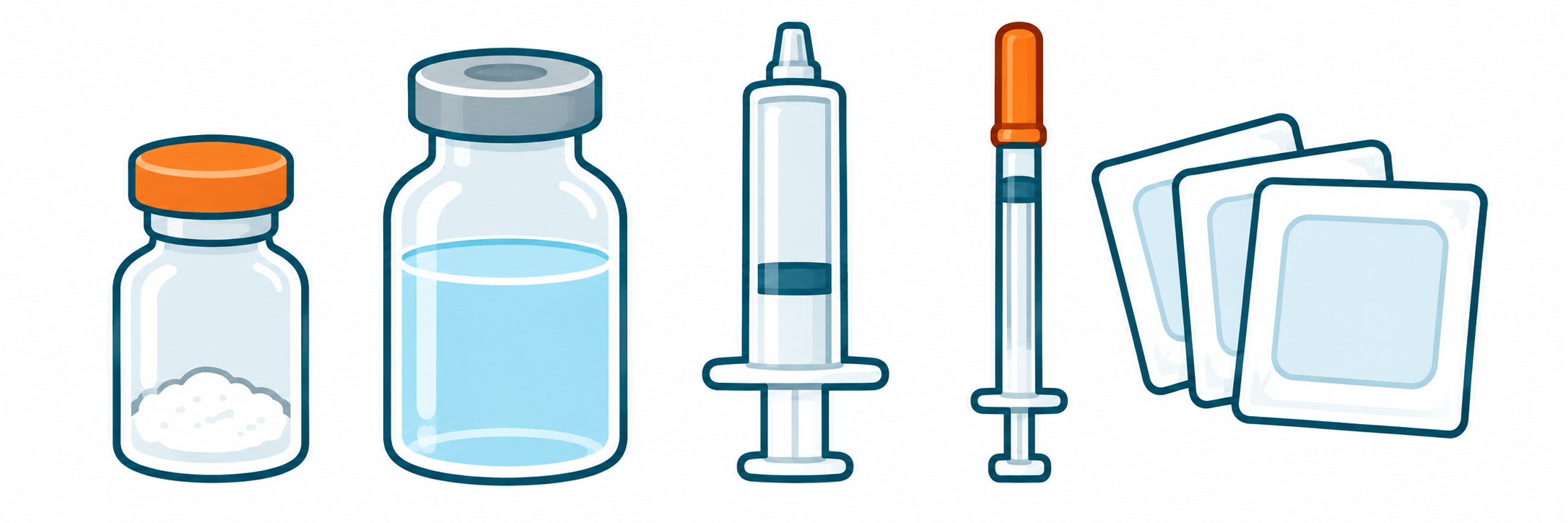
Pick how many weeks you will run it and how many shots you take each week. The list below shows everything you need.
Store at −20 °C (−4 °F) in dry, dark conditions and keep them in the original packaging.
Keep them refrigerated and away from light. How long a mixed vial lasts depends on the product, so check its stability data.
Selank comes from Tuftsin, a peptide your own body makes that has links to immune signaling and to neurological signaling. Selank Amidate is the modified version, built to resist being broken down as quickly, which is meant to give a steadier interaction with those pathways.
The research interest sits with the central nervous system, and with more than one pathway at once. GABA signaling comes up most, along with stress and anxiety response, mental clarity, and emotional steadiness under pressure. It is not described as a stimulant or a sedative.
This is the main reason people look at it. The research interest is in a balanced stress and anxiety response rather than sedation.
People use it for sustained mental clarity, which is why it gets grouped with the nootropic peptides.
Regulation of emotional stability under cognitive or environmental stress is one of the pathways described in the research.
GABA is the brain's main inhibitory neurotransmitter, and modulating it is the mechanism that comes up most often.
People generally report noticing something within the first week or two, which is why the common pattern holds the starting amount for that long before changing it.
Pick a topic to see what has been studied.
Selank is a synthetic version built on Tuftsin, a naturally occurring peptide with established links to immune and neurological signaling.
The amidated version is engineered to resist rapid degradation. The intent is a more consistent and sustained interaction with neural pathways than the unmodified peptide gives.
The research interest centers on several mechanisms at once rather than a single target. GABA modulation is the one named most often, alongside stress response, focus, and emotional regulation.
Selank and N-acetyl Selank Amidate are not the same substance, and the amounts reported for one should not be assumed to carry across to the other. Check what the vial label and batch documentation actually say.
Quality varies a lot between sellers. I have been around research peptides for 10 years, and BioEdge is the supplier I send my readers to. Here is why.
The Peptide Report has a business relationship with BioEdge Research Labs. BioEdge sells this product for laboratory research only. BioEdge shipping policy
Pick a tool and try it. Each one uses the numbers from your calculator.
Use the same four steps. Once you can solve these, you can work out the units for any vial you ever pick up.
Your score: 0 correct.
Each line on the syringe is a unit of liquid. A unit measures volume, so the amount of peptide in it depends on your mix.
Tap the syringe or move the slider. The numbers use the vial you entered above. Read the line at the top edge of the plunger.
More water makes the mix weaker, so the same amount takes up more units. The amount of peptide in the vial stays the same.
A draw under 5 units is harder to read accurately. Tap a row to use that water amount.
Most people use 250 to 450 mcg once daily. A common approach is to start at 300 mcg and hold it there for the first week or two.
With a 10 mg vial and 3 mL of water, 300 mcg is 9 units on a U-100 syringe. 500 mcg from that same mix is 15 units. Use the calculator if your mix is different.
4 weeks on and 4 weeks off. Going past that invites tachyphylaxis, where the response fades as your body adapts to it.
Once a day at a consistent time. Evening is the common choice. Rotate injection sites instead of using the same spot.
No. The amidate form is modified to resist being broken down as fast. Amounts reported for one form should not be assumed to apply to the other, so check what your vial actually says.
It is not described as a sedative or a stimulant. The research interest is in how it interacts with signaling pathways, not in knocking you out or winding you up.
3 mL is the common choice, which makes 3.33 mg per mL and puts 300 mcg at 9 units.
Most charts assume one vial size and one water amount. If your mix is different, every unit number changes, so run your own numbers.