Powder vials
Store at −20 °C (−4 °F) in dry, dark conditions and keep them in the original packaging.

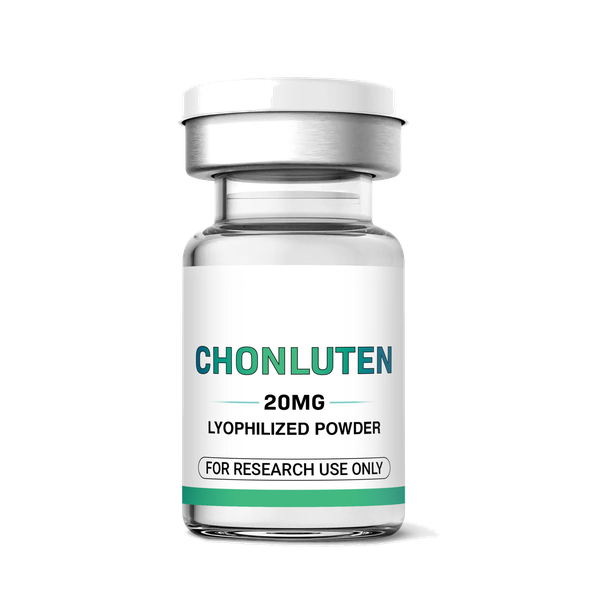
The research protocol people follow is 1 to 2 mg of Chonluten a day by subcutaneous injection for 10 to 20 days, then a break. With a 20 mg vial mixed with 1 mL of water, 2 mg is 10 units on a U-100 syringe. People repeat the course two to three times a year rather than running it continuously.
The amounts in this chart come from online communities. The vial label shows the total peptide in milligrams (mg). The Amount column shows a portion of that total in micrograms (mcg). The syringe mark shows how much liquid corresponds to that amount.
Syringe marks below are based on a 20 mg vial with 1 mL of water added. Change vial size or water in the calculator
| Reported | Amount | Volume | Syringe mark (U-100) | Draws per vial |
|---|
Convert your vial to mcg, because 1 mg is the same as 1,000 mcg.
Divide by your water to see how much is in 1 mL.
Find what one unit holds. A U-100 syringe has 100 units in 1 mL.
Divide your amount by what one unit holds.
Follow one step at a time. The steps use the water amount from your calculator.
Find the mg printed on your vial and enter it in the calculator. Let a frozen vial reach room temperature first.
Clean the top of the peptide vial and the water vial with an alcohol swab. Let them dry.
Draw bacteriostatic water with a sterile syringe.
Let the water run down the inside wall of the vial. This helps prevent foaming.
Roll the vial until the powder fully dissolves. Do not shake it hard.
Write today's date on the vial and refrigerate it at 2–8 °C (35.6–46.4 °F), away from light.
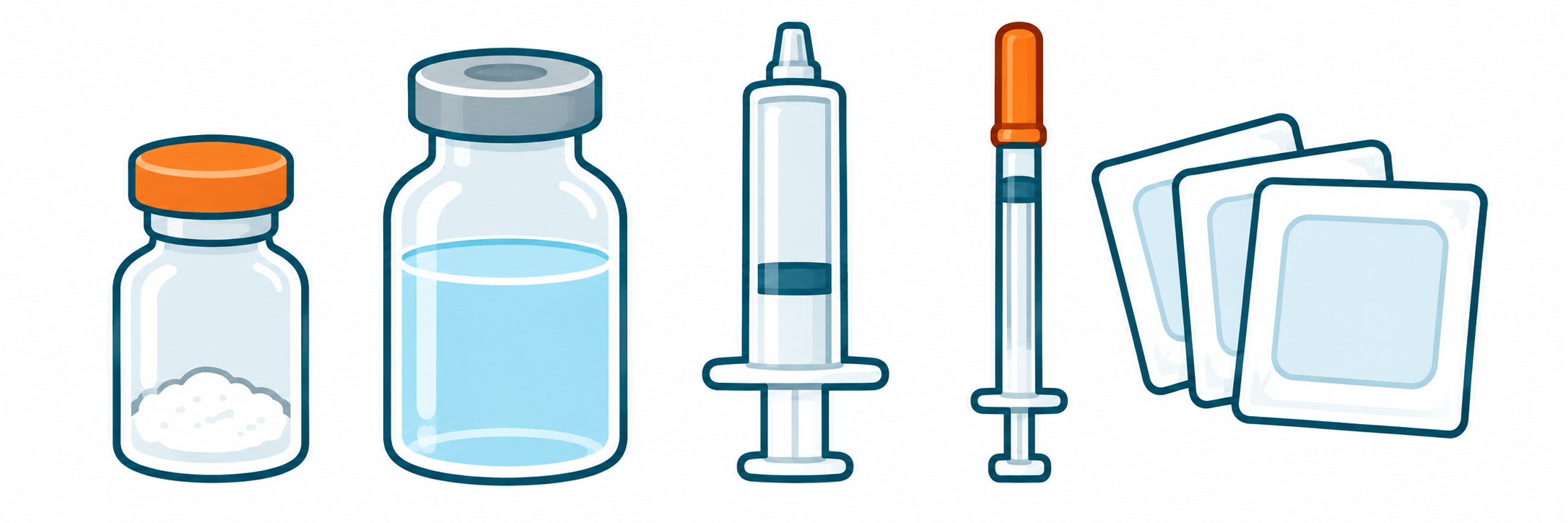
Pick how many weeks you will run it and how many shots you take each week. The list below shows everything you need.
Store at −20 °C (−4 °F) in dry, dark conditions and keep them in the original packaging.
Keep them refrigerated and away from light. How long a mixed vial lasts depends on the product, so check its stability data.
Chonluten is a three amino acid peptide, Glu-Asp-Gly, written EDG. It is the lung and bronchial peptide in the Russian bioregulator family.
Bioregulators come out of a different research tradition from most of the peptides on this site. The protocols are short courses repeated a few times a year rather than long continuous cycles, and most of the published work is Russian. That is worth knowing before you compare one with something like BPC-157, which is run very differently.
The tissue the compound is associated with, and the reason people look it up.
The one experimental paper indexed for it is about inflammatory signaling rather than about lung tissue.
A few weeks a year rather than a standing daily routine.
The cumulative model means this is not a peptide where you watch the first week. The protocol is built around repeating a short course over months.
The protocol carried in the Russian literature for this family is a short daily course by subcutaneous injection, 10 to 20 days per cycle, followed by a real break before the next one. For this peptide the reported amount is 1 to 2 mg a day.
A tripeptide, EDG. Some vendor pages give Thr-Glu-Asp instead. EDG is what most sources carry, but your certificate of analysis is the thing that settles it for your vial.
There is exactly one indexed experimental paper on this peptide, by Avolio and colleagues in 2022, and it was run in a monocyte cell line rather than in lung tissue. After a bacterial challenge it reported less TNF and IL-6 production and less monocyte sticking to endothelial cells. Khavinson, whose institute originated the bioregulator concept, is a co-author.
One cell line paper, co-authored by the originator, in a tissue that is not the lung. That is the whole experimental base. No clinical trial of this peptide is registered or published anywhere.
One vendor page claims it cuts inflammatory cytokines up to sixfold and works by binding a specific DNA sequence. I found no primary study behind either figure.
These peptides are usually described as binding DNA directly and switching tissue-specific genes on. That idea comes from the same group that developed them. It is a hypothesis, and it is not how mainstream molecular biology explains how short peptides work. Anyone telling you the mechanism is settled is overselling it.
Quality varies a lot between sellers. I have been around research peptides for 10 years, and BioEdge is the supplier I send my readers to. Here is why.
The Peptide Report has a business relationship with BioEdge Research Labs. BioEdge sells this product for laboratory research only. BioEdge shipping policy
Pick a tool and try it. Each one uses the numbers from your calculator.
Use the same four steps. Once you can solve these, you can work out the units for any vial you ever pick up.
Your score: 0 correct.
Each line on the syringe is a unit of liquid. A unit measures volume, so the amount of peptide in it depends on your mix.
Tap the syringe or move the slider. The numbers use the vial you entered above. Read the line at the top edge of the plunger.
More water makes the mix weaker, so the same amount takes up more units. The amount of peptide in the vial stays the same.
A draw under 5 units is harder to read accurately. Tap a row to use that water amount.
The reported protocol is 1 to 2 mg a day by subcutaneous injection for 10 to 20 days, then a break before repeating two to three times a year.
With a 20 mg vial and 1 mL of water, 2 mg is 10 units on a U-100 syringe and 1 mg is 5 units. Use the calculator if your mix is different.
10 to 20 days. This is not a 12-week cycle.
Two to three times a year is what the protocol describes. The model is cumulative rather than continuous.
Thinner than the numbers make it look. Almost all of it comes from one research group, most of it is in Russian, and there are no independent controlled human trials.
1 mL is the usual choice, which makes 20 mg per mL and puts 2 mg at 10 units.
Most charts assume one vial size and one water amount. If your mix is different, every unit number changes, so run your own numbers.