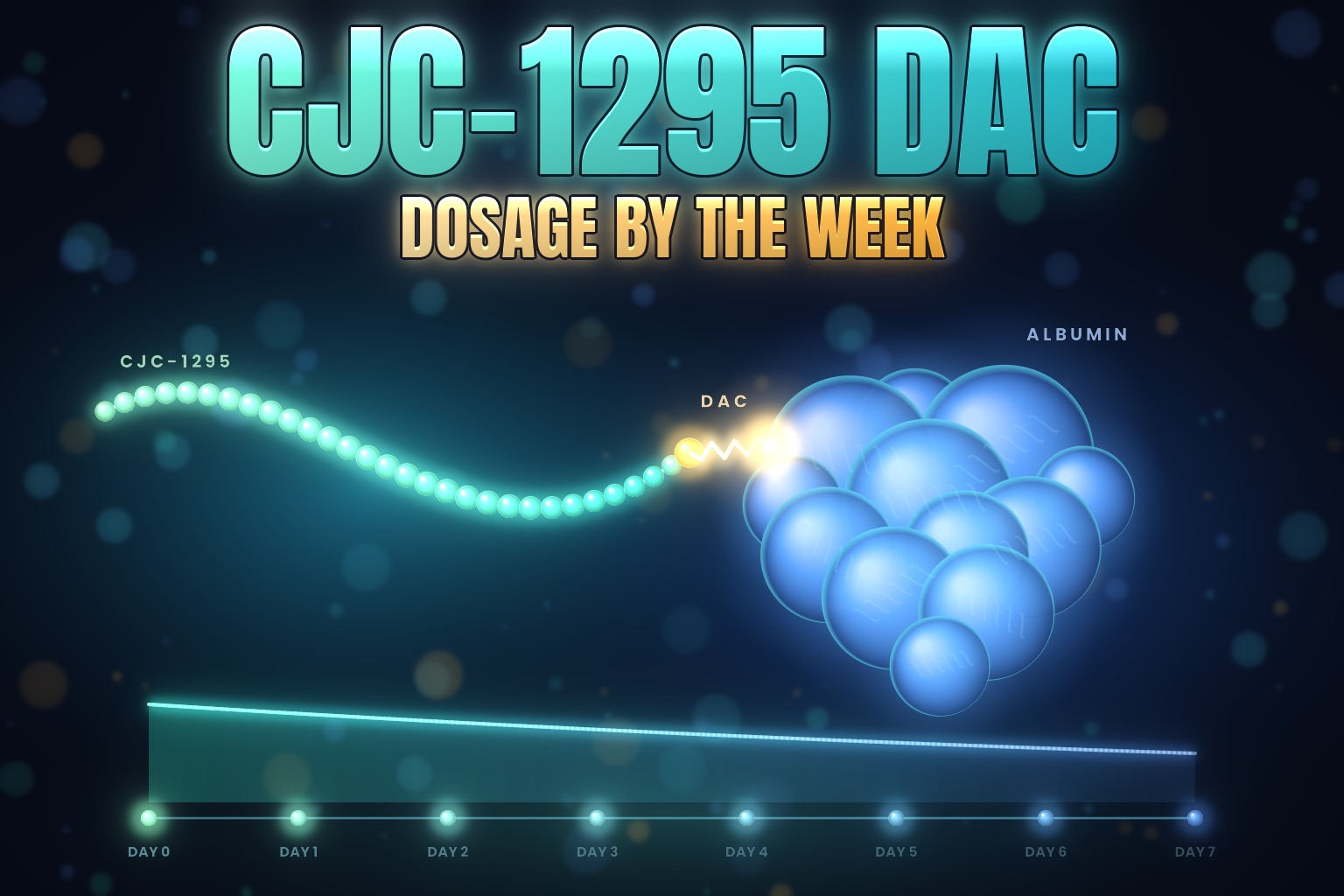
In 2006, two groups of healthy adults aged 21 to 61 signed up to test a long-acting version of growth hormone-releasing hormone. Each got CJC-1295 or a placebo as an injection under the skin, and the two trials ran for 28 and 49 days. That’s a long time to follow a peptide based on a hormone that normally clears from the blood in minutes.
That stretch of time is the whole story of dosing CJC-1295 with DAC. It runs on a calendar instead of a clock, and every dose and schedule in the research follows from it.
Below: how the DAC stretches the timing, what one dose did in people, how often the studies gave it, and the doses they used.
What the DAC Adds
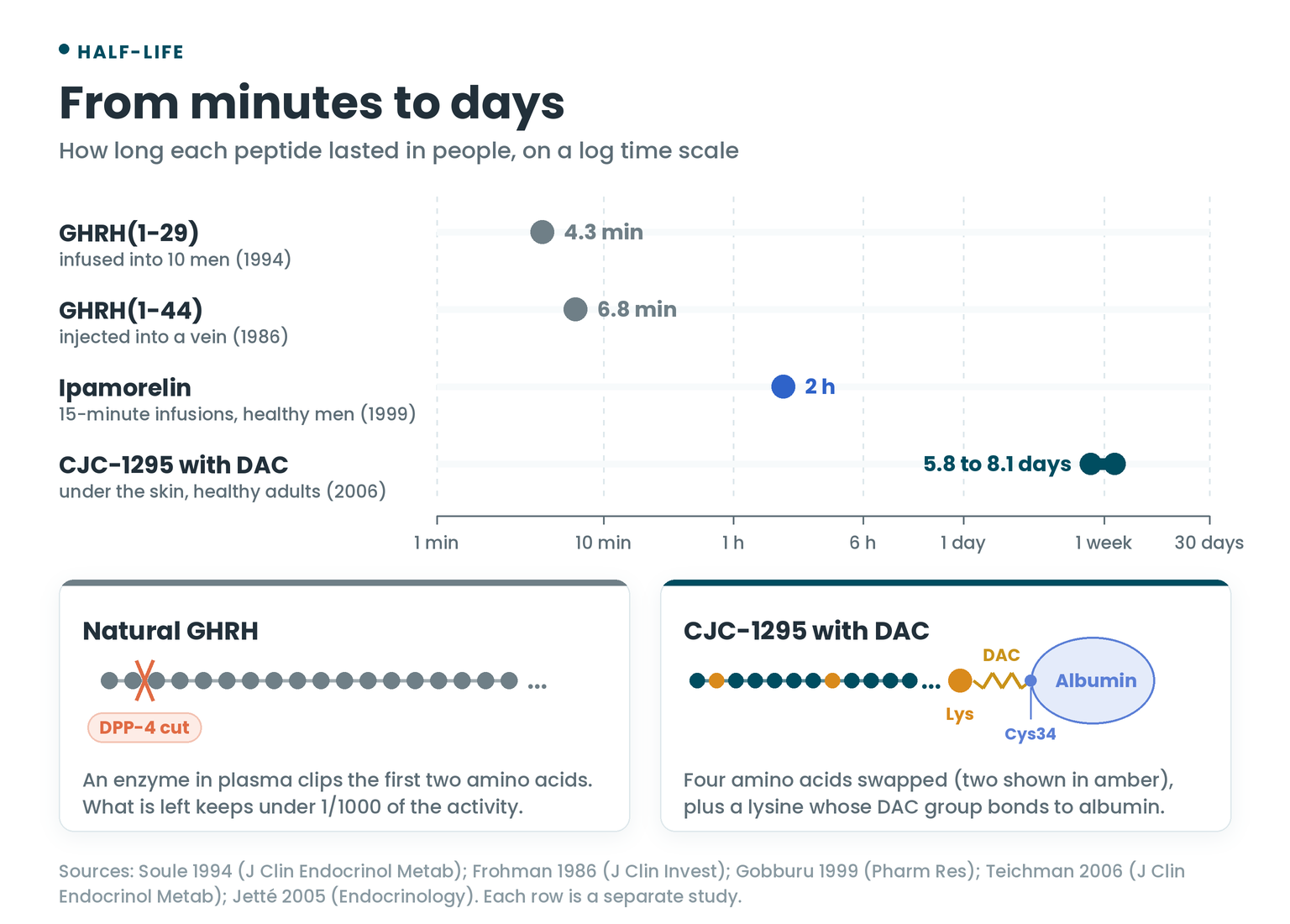
CJC-1295 starts from GHRH(1-29), the first 29 amino acids of growth hormone-releasing hormone and the shortest piece that still does the full job. The team that built it in 2005 swapped four of those amino acids so enzymes have a harder time cutting the chain, then added a lysine at the end carrying a reactive maleimidopropionamide group. That group is the DAC, short for Drug Affinity Complex.
Once injected, the DAC bonds to albumin, the most common protein in blood, at a free thiol on a spot called Cys34. In rats, a blood sample showed CJC-1295 sitting on the albumin band 15 minutes after the injection and still there past 24 hours, and the peptide was measurable in plasma beyond 72 hours. Of the three albumin-binding versions the team made, it came out best, with four times the growth hormone area under the curve of plain GHRH(1-29) over two hours.
The reason for all this engineering is how fast the natural hormone disappears. An enzyme in plasma, dipeptidyl peptidase-4, clips the first two amino acids off growth hormone-releasing hormone, and the clipped chain keeps less than a thousandth of the activity. In a 1986 study, the full 44-amino-acid hormone injected into a vein in people had a half-life of 6.8 minutes. The 29-amino-acid version, infused into ten men in 1994, disappeared with a half-time of 4.3 minutes. In the 2006 trials, CJC-1295’s estimated half-life was 5.8 to 8.1 days.
Two peptides sold under one name
The CJC-1295 name also gets put on the 29-amino-acid peptide without the DAC lysine, usually called Mod GRF 1-29. When a Norwegian lab analyzed an unlabeled preparation in 2009, it found a 29-amino-acid peptide with an amidated end, matching a sequence being sold as CJC-1295. That version has no albumin anchor, so the timings and doses in this article belong to the DAC version only. The other one has its own write-up: CJC No DAC: A Closer Look.
One Injection, Two Weeks of Signal
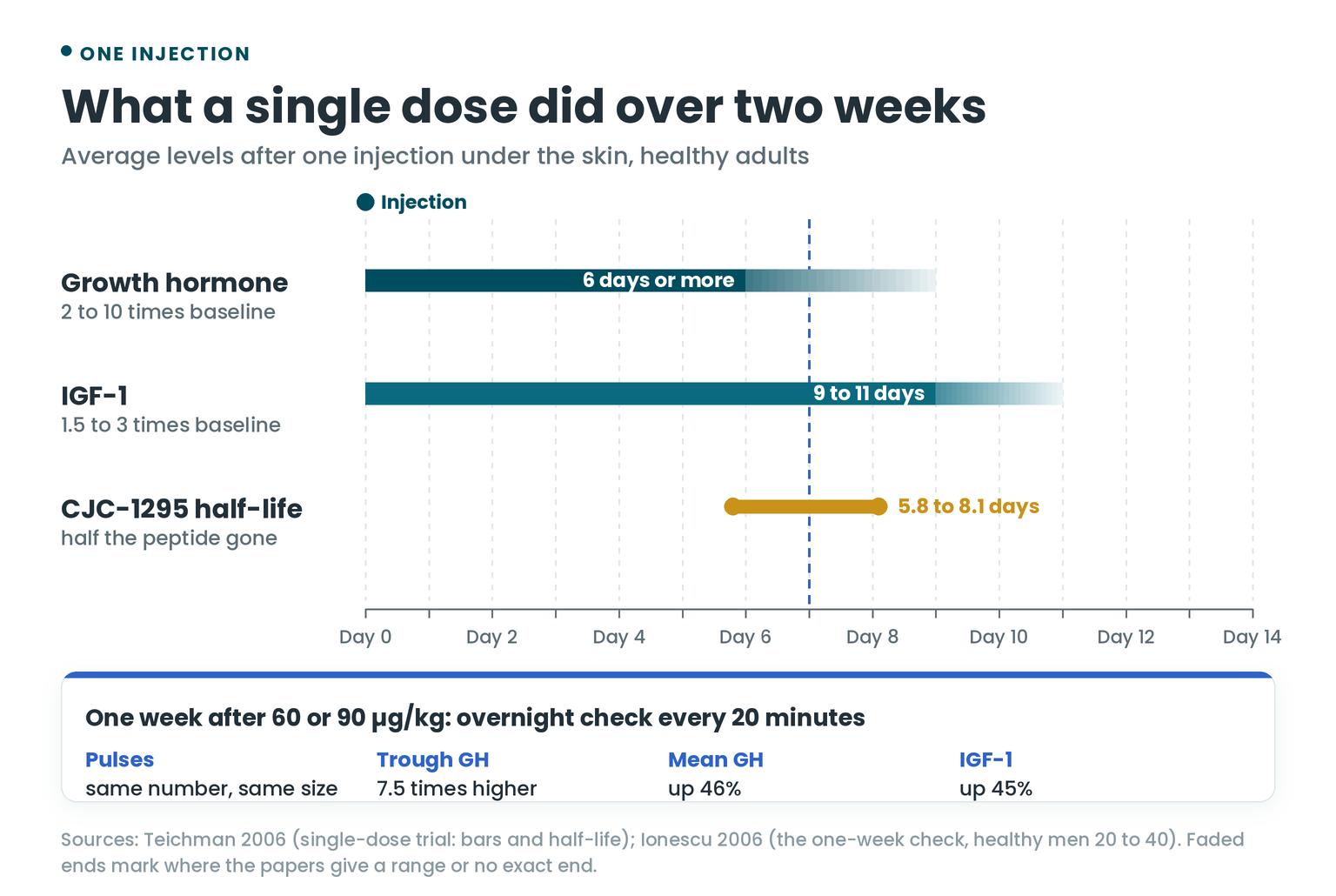
The 2006 trials, run by Teichman and colleagues, were double-blind, with the dose stepped up from group to group. In the first, each person got one of four single doses. After that one injection, average growth hormone rose two- to tenfold and stayed up for six days or more, and average IGF-1 rose 1.5- to threefold for nine to eleven days. The bigger the dose, the bigger the rise.
A second 2006 study looked at the shape of that raised growth hormone. Ionescu and Frohman drew blood every 20 minutes through a 12-hour night in healthy men aged 20 to 40, once before and once a week after a single injection of 60 or 90 µg/kg.
- The pulses held. Growth hormone still came in bursts, at the same frequency and the same size as before.
- The floor rose. Trough growth hormone, the level between bursts, was 7.5 times higher.
- The totals moved. Mean growth hormone went up 46% and IGF-1 went up 45%.
- 60 and 90 matched. The two doses gave results that weren’t significantly different.
The IGF-1 rise didn’t line up with any single measure of growth hormone secretion. And the intact pulses fit what continuous GHRH infusions, run for anything from 24 hours to 14 days, had already shown: the bursts keep coming because somatostatin from the hypothalamus sets their timing. I went further into the pulse question in Growth Hormone, Sleep and Recovery: The DAC Question.
Other proteins that shifted
A 2009 study mapped the blood proteins of 11 healthy young men before and a week after a CJC-1295 injection. Two fell: a form of apolipoprotein A1, the main protein in HDL, and a form of transthyretin. Three rose: beta-hemoglobin, a fragment of albumin, and a spot holding another albumin fragment mixed with an antibody fragment. That last spot rose in a straight line with IGF-1.
Side Effects in the Trials
The 2006 trials reported no serious adverse reactions, and the authors called CJC-1295 safe and relatively well tolerated. Beyond that, the effects to know about come from what raising growth hormone does in general.
- Flushing. In a 1990 study, growth hormone-releasing hormone given into a vein flushed the face for one to three minutes in 16 of 18 men.
- Fluid and joints. Across 54 randomized trials of growth hormone in adults who lacked it, edema was about six times more common than on placebo and joint stiffness about four times.
- Blood sugar. Growth hormone works against insulin in the liver and other tissues, partly by raising free fatty acids.
- Across the class. A 2026 review of growth hormone-axis peptides lists appetite changes, blood sugar shifts, fluid retention, muscle and joint aches and injection-site reactions, with prolactin and cortisol rises mostly tied to the older GHRPs.
IGF-1 that stays high for years raises its own questions, and the acromegaly and population data are laid out in Sermorelin Side Effects and Cancer Risk.
Pairing It With Ipamorelin
Ipamorelin works through a different receptor, the ghrelin receptor. In healthy men given 15-minute infusions, it had a half-life of 2 hours and set off a single burst of growth hormone that peaked at about 40 minutes and dropped back to almost nothing at every dose tested.
The case for combining the two classes goes back to 1990. Bowers and colleagues gave 18 healthy men a growth hormone-releasing peptide, the hexapeptide now called GHRP-6, alongside growth hormone-releasing hormone. At low doses the pair released more growth hormone than the sum of the two given separately, which suggested the peptides work through separate systems.
On forums, the CJC-1295 paired with ipamorelin is usually the no-DAC version, according to the 2026 review’s survey of online protocols, with the no-DAC peptide taken once or twice a day and ipamorelin two or three times. The combination has its own article: The Synergistic Effects of Ipamorelin and CJC 1295.
How Often It Was Given
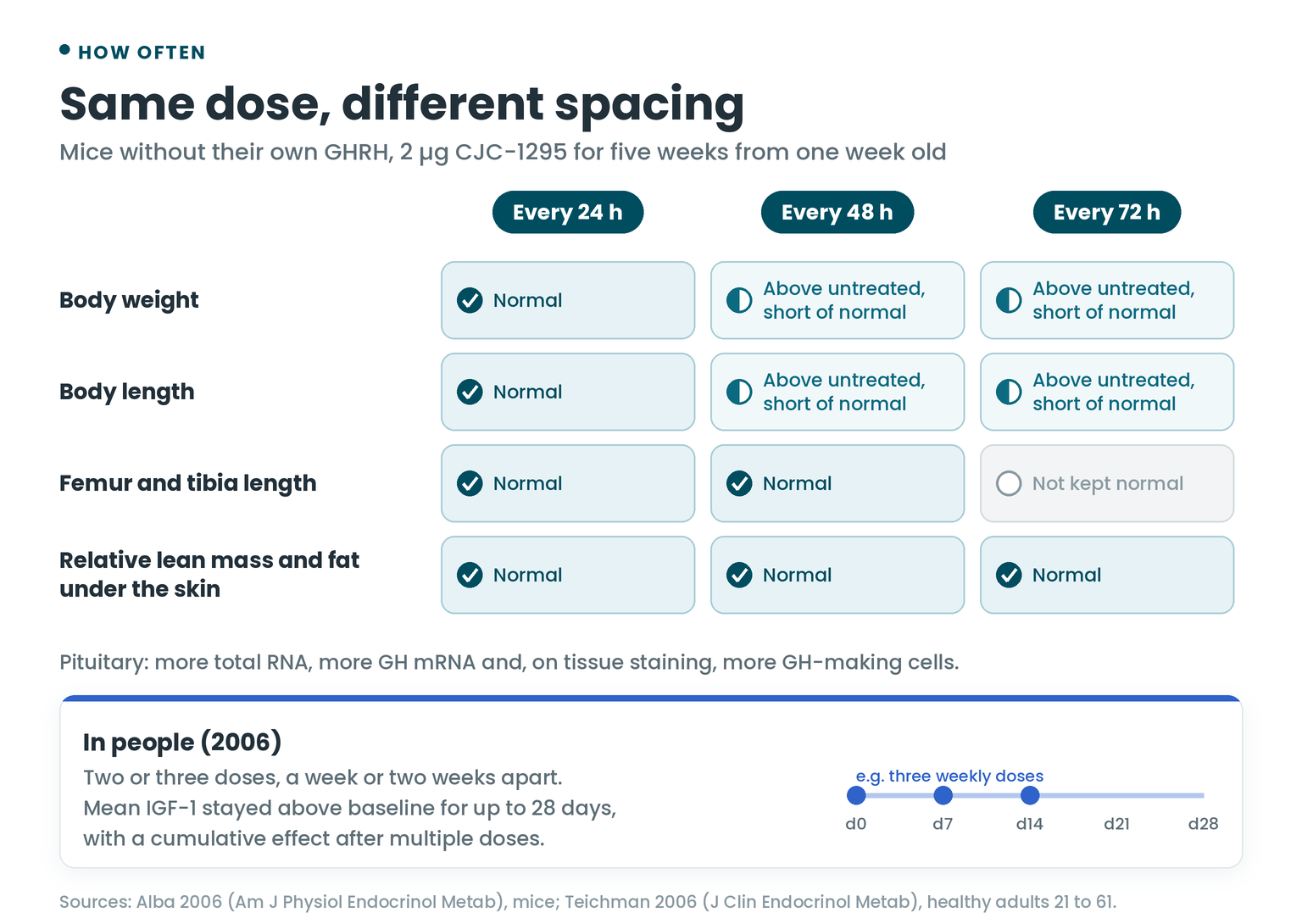
In the second 2006 trial, people got two or three doses spaced a week or two weeks apart. Mean IGF-1 stayed above baseline for up to 28 days, and the authors saw evidence of a cumulative effect after multiple doses.
The clearest test of spacing comes from mice. Alba and colleagues worked with mice bred without their own GHRH, which grow poorly, and they had already shown that even twice-daily injections of a GHRH analog couldn’t bring them up to normal. Starting at one week old, three groups got the same 2 µg of CJC-1295 every 24, 48 or 72 hours for five weeks.
- Every 24 hours: normal body weight and length.
- Every 48 or 72 hours: heavier and longer than untreated knockout mice, but short of normal.
- Bones: femur and tibia length stayed normal on the 24- and 48-hour schedules.
- Body composition: relative lean mass and fat under the skin were normal in every treated group.
Their pituitaries carried more total RNA and more growth hormone mRNA, and tissue staining confirmed more growth hormone-making cells. The authors’ summary was that the same dose works less well every 48 or 72 hours. These mice had no GHRH of their own, while the adults in the human trials did.
CJC-1295 DAC Doses Used in the Research
| Study | Participants | Dose and schedule | What it measured |
|---|---|---|---|
| Teichman 2006, first trial | Healthy adults, 21 to 61 | One of four single doses, stepped up by group | Growth hormone, IGF-1, half-life |
| Teichman 2006, second trial | Healthy adults, 21 to 61 | Two or three doses, a week or two weeks apart | IGF-1 over up to 28 days |
| Ionescu 2006 | Healthy men, 20 to 40 | One dose of 60 or 90 µg/kg | Overnight pulses and IGF-1 a week later |
| Sackmann-Sala 2009 | 11 healthy young men | One injection | Blood proteins a week later |
| Alba 2006 | Mice without their own GHRH | 2 µg every 24, 48 or 72 hours for 5 weeks | Growth, bones, body composition, pituitary |
| Jetté 2005 | Rats | One injection | Growth hormone release, time in plasma |
The trial authors singled out 30 and 60 µg/kg as the best-tolerated doses. Those are per kilogram of body weight, so for a 70 kg adult they come to 2.1 mg and 4.2 mg in one injection.
The pattern on bodybuilding forums, as collected in the 2026 review, is 1 to 2 mg a week in one or two injections, run for 8 to 12 or 12 to 16 weeks with 4 to 6 weeks off. A 2016 study of women’s forum threads found CJC-1295 used for fat loss, muscle, skin, sleep and injury healing, with users unsure how to set a dose given that women’s growth hormone pulses differ from men’s.
Test Yourself
Eight setups from the CJC-1295 studies. Pick what you think happened, then see what the researchers found.
FAQ
What dose of CJC-1295 DAC did the human trials use?
Single doses stepped up from group to group, then two or three doses a week or two weeks apart. The authors named 30 and 60 µg/kg as best tolerated, and the overnight pulse study used 60 or 90 µg/kg.
How long does one CJC-1295 DAC injection last?
Its half-life in people was close to a week. After one dose, growth hormone stayed raised for six days or more and IGF-1 for nine to eleven days.
How often was CJC-1295 DAC given in studies?
Weekly or every two weeks in people. In mice lacking their own GHRH, the same dose every day did better than every second or third day.
Does CJC-1295 DAC stop natural growth hormone pulses?
No. A week after one injection, pulses kept their frequency and size, and the level between them rose.
What’s the difference between CJC-1295 with and without DAC?
The DAC is a reactive group on an added lysine that anchors the peptide to albumin. The version without it is the same 29-amino-acid chain with no anchor, and the human trials were run on the DAC version.
Can CJC-1295 DAC be combined with ipamorelin?
The combination is common online, usually with the no-DAC form. The rationale comes from a 1990 study in which a GHRP and GHRH together released more growth hormone than the two added up separately.
References
- Jetté L, et al. Human growth hormone-releasing factor (hGRF)1-29-albumin bioconjugates activate the GRF receptor on the anterior pituitary in rats: identification of CJC-1295 as a long-lasting GRF analog. Endocrinology. 2005;146(7):3052-3058. DOI
- Teichman SL, et al. Prolonged stimulation of growth hormone (GH) and insulin-like growth factor I secretion by CJC-1295, a long-acting analog of GH-releasing hormone, in healthy adults. J Clin Endocrinol Metab. 2006;91(3):799-805. DOI
- Ionescu M, Frohman LA. Pulsatile secretion of growth hormone (GH) persists during continuous stimulation by CJC-1295, a long-acting GH-releasing hormone analog. J Clin Endocrinol Metab. 2006;91(12):4792-4797. DOI
- Alba M, et al. Once-daily administration of CJC-1295, a long-acting growth hormone-releasing hormone (GHRH) analog, normalizes growth in the GHRH knockout mouse. Am J Physiol Endocrinol Metab. 2006;291(6):E1290-E1294. DOI
- Sackmann-Sala L, et al. Activation of the GH/IGF-1 axis by CJC-1295, a long-acting GHRH analog, results in serum protein profile changes in normal adult subjects. Growth Horm IGF Res. 2009;19(6):471-477. DOI
- Henninge J, et al. Identification of CJC-1295, a growth-hormone-releasing peptide, in an unknown pharmaceutical preparation. Drug Test Anal. 2010;2(11-12):647-650. DOI
- Frohman LA, et al. Rapid enzymatic degradation of growth hormone-releasing hormone by plasma in vitro and in vivo to a biologically inactive product cleaved at the NH2 terminus. J Clin Invest. 1986;78(4):906-913. DOI
- Soule S, King JA, Millar RP. Incorporation of D-Ala2 in growth hormone-releasing hormone-(1-29)-NH2 increases the half-life and decreases metabolic clearance in normal men. J Clin Endocrinol Metab. 1994;79(4):1208-1211. DOI
- Thorner MO, et al. Physiological role of somatostatin on growth hormone regulation in humans. Metabolism. 1990;39(9 Suppl 2):40-42. DOI
- Bowers CY, et al. Growth hormone (GH)-releasing peptide stimulates GH release in normal men and acts synergistically with GH-releasing hormone. J Clin Endocrinol Metab. 1990;70(4):975-982. DOI
- Gobburu JV, et al. Pharmacokinetic-pharmacodynamic modeling of ipamorelin, a growth hormone releasing peptide, in human volunteers. Pharm Res. 1999;16(9):1412-1416. DOI
- Hazem A, et al. Body composition and quality of life in adults treated with GH therapy: a systematic review and meta-analysis. Eur J Endocrinol. 2012;166(1):13-20. DOI
- Møller N, Jørgensen JO. Effects of growth hormone on glucose, lipid, and protein metabolism in human subjects. Endocr Rev. 2009;30(2):152-177. DOI
- Dominikowski A, et al. The emerging landscape of performance-enhancing peptides modulating GH-IGF1 axis: bridging the gap between clinical evidence and patient self-administration. Front Endocrinol. 2026;17:1822475. DOI
- Van Hout MC, Hearne E. Netnography of female use of the synthetic growth hormone CJC-1295: pulses and potions. Subst Use Misuse. 2016;51(1):73-84. DOI
Stay sharp,
Joe Mars
The Peptide Report
P.S. Working through a dosing paper and want a second pair of eyes on it? Bring it to the Peptides and Biohacking Hub on Skool, where we take studies like these apart. Find us here.