Powder vials
Store at −20 °C (−4 °F) in dry, dark conditions and keep them in the original packaging.


A common starting point is 100 to 200 mcg of kisspeptin per injection, once a day or every other day. With a 5 mg vial mixed with 2 mL of water, 200 mcg is 8 units on a U-100 syringe. Most people run it for 4 to 8 weeks, then take a break.
The amounts in this chart come from online communities. The vial label shows the total peptide in milligrams (mg). The Amount column shows a portion of that total in micrograms (mcg). The syringe mark shows how much liquid corresponds to that amount.
Syringe marks below are based on a 5 mg vial with 2 mL of water added. Change vial size or water in the calculator
| Reported | Amount | Volume | Syringe mark (U-100) | Draws per vial |
|---|
Convert your vial to mcg, because 1 mg is the same as 1,000 mcg.
Divide by your water to see how much is in 1 mL.
Find what one unit holds. A U-100 syringe has 100 units in 1 mL.
Divide your amount by what one unit holds.
100 to 200 mcg per injection is the usual starting point. Give it a week or two before deciding whether to change anything. People do report working up to 500 to 1000 mcg, but that is a long way from where most start.
Once a day is typical. Some protocols use every other day instead, to avoid the receptor getting desensitized.
Under the skin, in the belly, thigh, or upper arm. A fine insulin syringe, 29 or 30 gauge. Clean the site, pinch the skin, go in at about 45 degrees, and inject slowly. Rotate sites.
4 to 8 weeks, then a break. The break is there to stop your body getting desensitized and to let your own hormone production settle.
Follow one step at a time. The steps use the water amount from your calculator.
Find the mg printed on your vial and enter it in the calculator. Let a frozen vial reach room temperature first.
Clean the top of the peptide vial and the water vial with an alcohol swab. Let them dry.
Draw bacteriostatic water with a sterile syringe.
Let the water run down the inside wall of the vial. This helps prevent foaming.
Roll the vial until the powder fully dissolves. Do not shake it hard.
Write today's date on the vial and refrigerate it at 2–8 °C (35.6–46.4 °F), away from light.
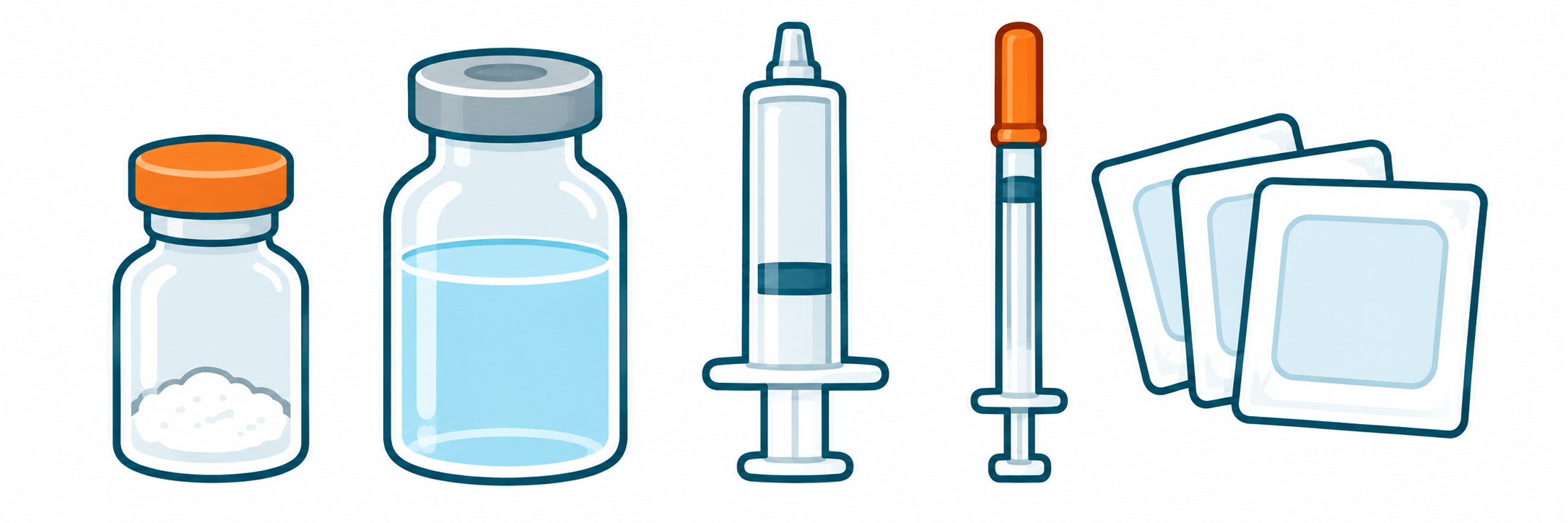
Pick how many weeks you will run it and how many shots you take each week. The list below shows everything you need.
Store at −20 °C (−4 °F) in dry, dark conditions and keep them in the original packaging.
Keep them refrigerated and away from light. How long a mixed vial lasts depends on the product, so check its stability data.
Kisspeptin is a peptide your body makes that plays a major part in regulating reproductive hormones. It acts on the hypothalamus and triggers the release of GnRH, which sets off a chain leading to more LH and FSH.
Put simply, it tells your brain to tell your body to make more sex hormones. In men that means testosterone production. In women it plays into estrogen, progesterone and ovulation. It is a signal rather than a replacement, which is the thing that makes it different from TRT.
People use it to support their own LH and FSH, which drive testosterone or estrogen, without shutting down their own system the way TRT does.
It has been studied for its part in fertility. It helps regulate ovulation and plays into sperm production. Some fertility clinics use it in IVF protocols to trigger ovulation more naturally than the traditional drugs.
Because it acts on the brain's reproductive centers, some people notice a change in libido. This works upstream, by supporting the hormones that drive libido, rather than acting on arousal pathways directly.
Worth saying plainly: this is a specific peptide for specific problems. It is not like BPC-157, where most people with an injury have a reason to look at it.
Most people give it a week or two before judging anything, which is also why the common advice is to hold the starting amount for that long rather than moving up early.
Pick a topic to see what has been studied.
Kisspeptin acts on the hypothalamus and triggers GnRH release. That leads to more LH and FSH, which in turn drive testosterone in men and estrogen, progesterone and ovulation in women.
Studies use a wide range, roughly 0.24 to 6.4 nmol per kilogram of body weight. For a 90 kg person that works out to something like 50 to 1,500 mcg per dose depending on which form of kisspeptin was used. That spread is why the practical advice is to start at the bottom.
Kisspeptin-10 and kisspeptin-54 are not the same, and amounts reported for one should not be assumed to apply to the other. Check what your vial actually says before you use any number from a study.
The 4 to 8 week limit is about receptor desensitization. Running it continuously risks the response fading, and the break gives your own hormone production a chance to stabilize.
Quality varies a lot between sellers. I have been around research peptides for 10 years, and BioEdge is the supplier I send my readers to. Here is why.
The Peptide Report has a business relationship with BioEdge Research Labs. BioEdge sells this product for laboratory research only. BioEdge shipping policy
Pick a tool and try it. Each one uses the numbers from your calculator.
Use the same four steps. Once you can solve these, you can work out the units for any vial you ever pick up.
Your score: 0 correct.
Each line on the syringe is a unit of liquid. A unit measures volume, so the amount of peptide in it depends on your mix.
Tap the syringe or move the slider. The numbers use the vial you entered above. Read the line at the top edge of the plunger.
More water makes the mix weaker, so the same amount takes up more units. The amount of peptide in the vial stays the same.
A draw under 5 units is harder to read accurately. Tap a row to use that water amount.
A common starting point is 100 to 200 mcg per injection, once a day or every other day, for 4 to 8 weeks before a break. People report working up to 500 to 1000 mcg, but that is well above where most start.
With a 5 mg vial and 2 mL of water, 200 mcg is 8 units on a U-100 syringe and 100 mcg is 4 units. Use the calculator if your mix is different.
Both are used. Every other day is the choice people make to avoid receptor desensitization.
4 to 8 weeks, then a break. The break stops your body getting desensitized and lets your own hormone production stabilize.
No. TRT replaces the hormone directly. Kisspeptin is a signal that acts upstream, so your own system is still the one producing. That is exactly why people looking to avoid shutting down their own production are interested in it.
No. They are different forms, and an amount reported for one does not transfer to the other. Check your vial.
PT-141 acts directly on arousal pathways. Kisspeptin works upstream, by supporting the hormones that drive libido in the first place.
Most charts assume one vial size and one water amount. If your mix is different, every unit number changes, so run your own numbers.