Powder vials
Store at −20 °C (−4 °F) in dry, dark conditions and keep them in the original packaging.


The reported approach is 50 to 200 mg of NAD+ a day for the first 7 to 10 days, then 50 to 200 mg on 2 to 3 mornings a week after that. With a 500 mg vial mixed with 5 mL of water, 100 mg is 100 units on a U-100 syringe, which is one full insulin syringe.
The amounts in this chart come from online communities. The vial label shows the total peptide in milligrams (mg). The Amount column shows a portion of that total in micrograms (mcg). The syringe mark shows how much liquid corresponds to that amount.
Syringe marks below are based on a 500 mg vial with 5 mL of water added. Change vial size or water in the calculator
| Reported | Amount | Volume | Syringe mark (U-100) | Draws per vial |
|---|
Convert your vial to mcg, because 1 mg is the same as 1,000 mcg.
Divide by your water to see how much is in 1 mL.
Find what one unit holds. A U-100 syringe has 100 units in 1 mL.
Divide your amount by what one unit holds.
50 to 200 mg a day for the first 7 to 10 days. This is the reported loading approach, not a schedule established by a trial.
50 to 200 mg on 2 to 3 mornings a week. The source describes this as ongoing maintenance with no fixed end date.
This one takes real volume compared with other peptides. From a 500 mg vial in 5 mL, 100 mg fills a 1 mL insulin syringe completely. 200 mg takes two full syringes, so plan for that before you mix.
NAD+ has a reputation for stinging and for a flushing sensation if it goes in fast. Reports consistently say to push it slowly.
Follow one step at a time. The steps use the water amount from your calculator.
Find the mg printed on your vial and enter it in the calculator. Let a frozen vial reach room temperature first.
Clean the top of the peptide vial and the water vial with an alcohol swab. Let them dry.
Draw bacteriostatic water with a sterile syringe.
Let the water run down the inside wall of the vial. This helps prevent foaming.
Roll the vial until the powder fully dissolves. Do not shake it hard.
Write today's date on the vial and refrigerate it at 2–8 °C (35.6–46.4 °F), away from light.
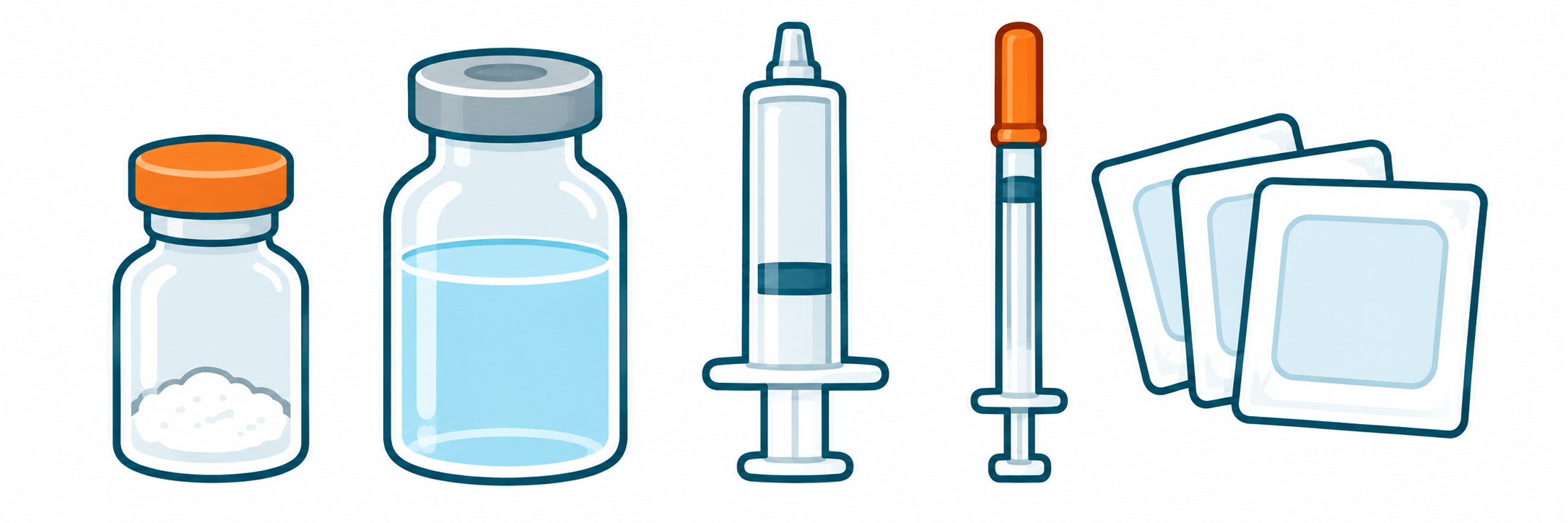
Pick how many weeks you will run it and how many shots you take each week. The list below shows everything you need.
Store at −20 °C (−4 °F) in dry, dark conditions and keep them in the original packaging.
Keep them refrigerated and away from light. How long a mixed vial lasts depends on the product, so check its stability data.
NAD+ is a coenzyme your cells use in energy metabolism. It also takes part in processes involving sirtuins and PARP enzymes, which is a large part of why it gets discussed alongside aging.
Those biological roles are real. What they do not establish is that an injection restores mitochondrial function or changes how a person feels. That gap is worth keeping in view rather than tucking into a disclaimer at the bottom.
NAD+ is directly involved in energy metabolism, which is the reason most people are looking at it.
The sirtuin and PARP connection is what put NAD+ in the longevity conversation.
People run it for recovery and for afternoon energy. Worth saying plainly: fatigue and slow recovery have many causes and do not diagnose anything about NAD+ levels.
No reliable week-by-week timeline exists for this. The reviewed research cannot support a promise that afternoon crashes go away or that recovery improves by a particular week.
Pick a topic to see what has been studied.
A small 2019 human pilot tracked NAD+ and related metabolites during an intravenous infusion. It did not test a subcutaneous schedule, and it did not establish improvements in energy, sleep, exercise recovery, or longevity.
NAD+, NMN, and NR are different compounds taken by different routes. Being biologically related does not establish that injectable NAD+ produces better outcomes than an oral precursor. That comparison needs trials measuring things people actually care about.
The sources reviewed do not validate a universal subcutaneous loading phase, a required morning schedule, a maximum safe amount, or indefinite maintenance. An intravenous study cannot supply instructions for a different route.
Feeling tired or hitting an afternoon dip cannot show that NAD+ levels are depleted or that an amount should go up. Persistent symptoms deserve an actual assessment rather than an assumption about aging.
Giving two compounds on the same day does not prove they are compatible, necessary, or more effective together. Mixing two products in one syringe is a separate question again, and mechanism studies say nothing about whether a mixture stays stable or sterile.
Quality varies a lot between sellers. I have been around research peptides for 10 years, and BioEdge is the supplier I send my readers to. Here is why.
The Peptide Report has a business relationship with BioEdge Research Labs. BioEdge sells this product for laboratory research only. BioEdge shipping policy
This is the pairing NAD+ comes up in most often, and what the evidence does and does not say about it.
| Stack | Ingredients | Why people stack them |
|---|---|---|
| NAD+ + MOTS-cTwo vials | NAD+ in one vial. MOTS-c in the second. | Mitochondrial interestThe pairing has a rationale behind it. NAD+ takes part in energy metabolism, and MOTS-c is studied for metabolic signaling. That makes the combination a research question rather than a proven stack. No study reviewed shows the pair works better than either one alone in people. See the MOTS-c dosage guide. |
Pick a tool and try it. Each one uses the numbers from your calculator.
Use the same four steps. Once you can solve these, you can work out the units for any vial you ever pick up.
Your score: 0 correct.
Each line on the syringe is a unit of liquid. A unit measures volume, so the amount of peptide in it depends on your mix.
Tap the syringe or move the slider. The numbers use the vial you entered above. Read the line at the top edge of the plunger.
More water makes the mix weaker, so the same amount takes up more units. The amount of peptide in the vial stays the same.
A draw under 5 units is harder to read accurately. Tap a row to use that water amount.
The reported approach is 50 to 200 mg a day for the first 7 to 10 days, then 50 to 200 mg on 2 to 3 mornings a week. No controlled trial has established that schedule for subcutaneous injection.
With a 500 mg vial and 5 mL of water, 100 mg is 100 units, which fills a 1 mL insulin syringe completely. 50 mg is 50 units. Use the calculator if your mix is different.
5 mL is the common choice, which makes 100 mg per mL. More water means a larger volume per draw, and you are already near the capacity of a 1 mL syringe at 100 mg.
Stinging and flushing are the two things people report most, and both are associated with injecting quickly. The usual advice is to push it slowly.
No study reviewed establishes that. They are different compounds taken by different routes, and being biologically related is not the same as being proven better.
The reported approach includes one, but the sources reviewed do not validate a universal loading phase, a required morning schedule, or indefinite maintenance.
That is a different question from running both on the same day, and nothing reviewed addresses it. Mechanism studies do not establish whether a mixture stays stable or sterile.
Most charts assume one vial size and one water amount. If your mix is different, every unit number changes, so run your own numbers.