Powder vials
Store at −20 °C (−4 °F) in dry, dark conditions and keep them in the original packaging.

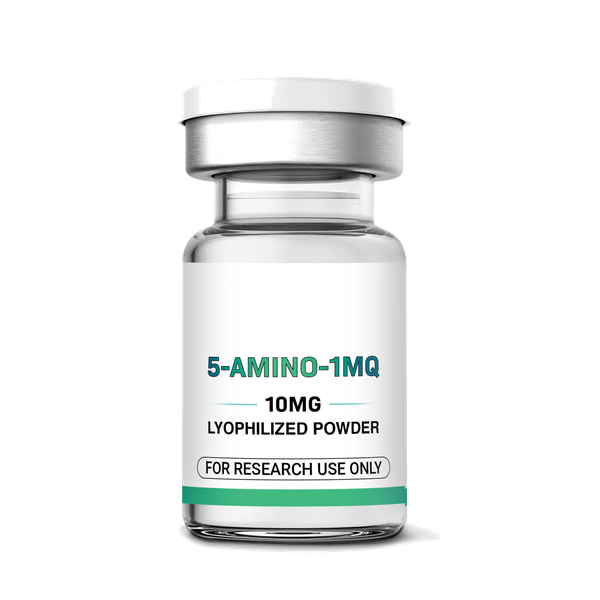
The reported range is 1 to 5 mg of 5-Amino-1MQ daily over a 12 week cycle. With a 10 mg vial mixed with 1 mL of water, 1 mg is 10 units and 5 mg is 50 units on a U-100 syringe. Two things to know first: this is not a peptide, and no human dose has ever been tested or published. Every efficacy result came from injections in mice.
The amounts in this chart come from online communities. The vial label shows the total peptide in milligrams (mg). The Amount column shows a portion of that total in micrograms (mcg). The syringe mark shows how much liquid corresponds to that amount.
Syringe marks below are based on a 10 mg vial with 1 mL of water added. Change vial size or water in the calculator
| Reported | Amount | Volume | Syringe mark (U-100) | Draws per vial |
|---|
Convert your vial to mcg, because 1 mg is the same as 1,000 mcg.
Divide by your water to see how much is in 1 mL.
Find what one unit holds. A U-100 syringe has 100 units in 1 mL.
Divide your amount by what one unit holds.
Follow one step at a time. The steps use the water amount from your calculator.
Find the mg printed on your vial and enter it in the calculator. Let a frozen vial reach room temperature first.
Clean the top of the peptide vial and the water vial with an alcohol swab. Let them dry.
Draw bacteriostatic water with a sterile syringe.
Let the water run down the inside wall of the vial. This helps prevent foaming.
Roll the vial until the powder fully dissolves. Do not shake it hard.
Write today's date on the vial and refrigerate it at 2–8 °C (35.6–46.4 °F), away from light.
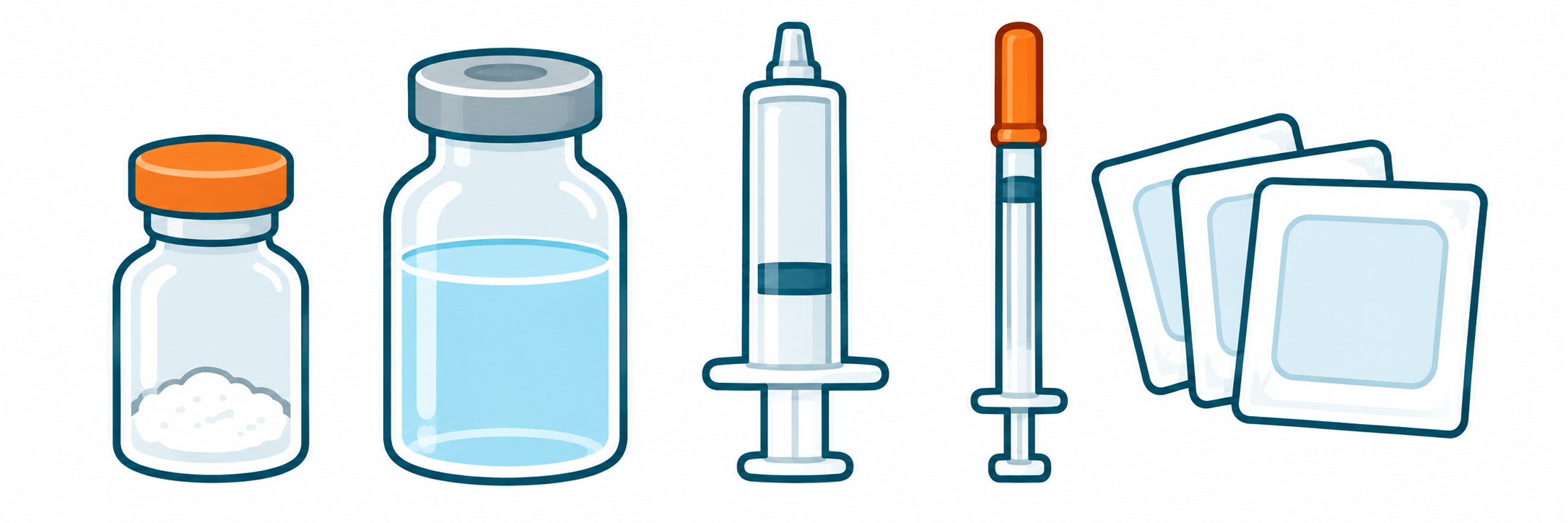
Pick how many weeks you will run it and how many shots you take each week. The list below shows everything you need.
Store at −20 °C (−4 °F) in dry, dark conditions and keep them in the original packaging.
Keep them refrigerated and away from light. How long a mixed vial lasts depends on the product, so check its stability data.
5-Amino-1MQ is not a peptide, which surprises people who meet it on a peptide site. It is a small methylated quinolinium molecule, 5-amino-1-methylquinolinium.
It inhibits NNMT, nicotinamide N-methyltransferase. NNMT methylates nicotinamide, which then leaves the body in urine as 1-MNA. NNMT runs high in obese fat tissue, and blocking it is the whole idea behind the compound.
The main thread, from mouse work. One study reported 29.3 percent fat mass loss against 2.9 percent on a lean diet alone.
A 2024 study in 22 month old mice reported grip strength about 40 percent above untreated sedentary mice, and 60 percent with a weighted-wheel exercise program.
A 2019 study in 24 month old mice with an injured leg muscle reported regenerating fibres 1.8 times control cross-sectional area at the higher dose, with peak torque about 70 percent higher.
Weeks, not days. This one works on a metabolic enzyme, so what changes is body composition over a cycle rather than how you feel in week one. The mouse studies ran 11 days to about 7 weeks before fat mass moved.
It methylates nicotinamide, which is then lost as 1-MNA in urine. NNMT runs high in obese fat tissue, so inhibiting it is meant to keep more nicotinamide in circulation.
Neelakantan et al., Journal of Medicinal Chemistry 2017, from a screen in Galveston, Texas. A 2018 follow-up found the amino-substituted versions were membrane permeable, which is what made them usable.
Kraus et al., Nature 2014, found that knocking down NNMT protected high-fat-fed mice from obesity. Kannt et al. 2015 found NNMT in fat biopsies from 199 surgical patients was about two-fold higher in type 2 diabetes.
All in mg per kg, all by injection: 10 mg/kg daily for 28 days or 8 weeks, 5 or 10 mg/kg twice daily for 2 to 4 weeks, 32 mg/kg daily for 28 days, 20 mg/kg three times daily for 11 days, and 40 mg/kg daily for about 7 weeks. These do not convert into a human amount.
Hong et al., Nature Medicine 2015, found that 1-MNA, the product NNMT makes, stabilises SIRT1 in the liver. So the thing being blocked also produces something useful. That is not a settled story.
In lean mice, a subcutaneous 25 mg/kg dose peaked at 7,010 ng/mL about 15 minutes in, falling to 5,130 ng/mL after five daily doses, with a terminal half-life around 13 hours. A muscle paper gives about 7 hours.
Quality varies a lot between sellers. I have been around research peptides for 10 years, and BioEdge is the supplier I send my readers to. Here is why.
The Peptide Report has a business relationship with BioEdge Research Labs. BioEdge sells this product for laboratory research only. BioEdge shipping policy
Pick a tool and try it. Each one uses the numbers from your calculator.
Use the same four steps. Once you can solve these, you can work out the units for any vial you ever pick up.
Your score: 0 correct.
Each line on the syringe is a unit of liquid. A unit measures volume, so the amount of peptide in it depends on your mix.
Tap the syringe or move the slider. The numbers use the vial you entered above. Read the line at the top edge of the plunger.
More water makes the mix weaker, so the same amount takes up more units. The amount of peptide in the vial stays the same.
A draw under 5 units is harder to read accurately. Tap a row to use that water amount.
The reported range is 1 to 5 mg daily over a 12 week cycle. No human dose has been tested or published, so that figure comes from practice rather than research.
With a 10 mg vial and 1 mL of water, 1 mg is 10 units on a U-100 syringe and 5 mg is 50 units. A 10 mg vial is only two doses at 5 mg, so a 50 mg vial is the practical one for a long run. Use the calculator if your mix is different.
No. It is a small methylated quinolinium molecule. It gets sold alongside peptides but it is a different kind of compound.
No. Oral bioavailability was 3.5 percent in mice, and the oral peak was a tiny fraction of the injected one. The amounts are not interchangeable.
It inhibits NNMT, an enzyme that methylates nicotinamide. NNMT runs high in obese fat tissue.
None. Every efficacy result came from injections in mice.
Most charts assume one vial size and one water amount. If your mix is different, every unit number changes, so run your own numbers.