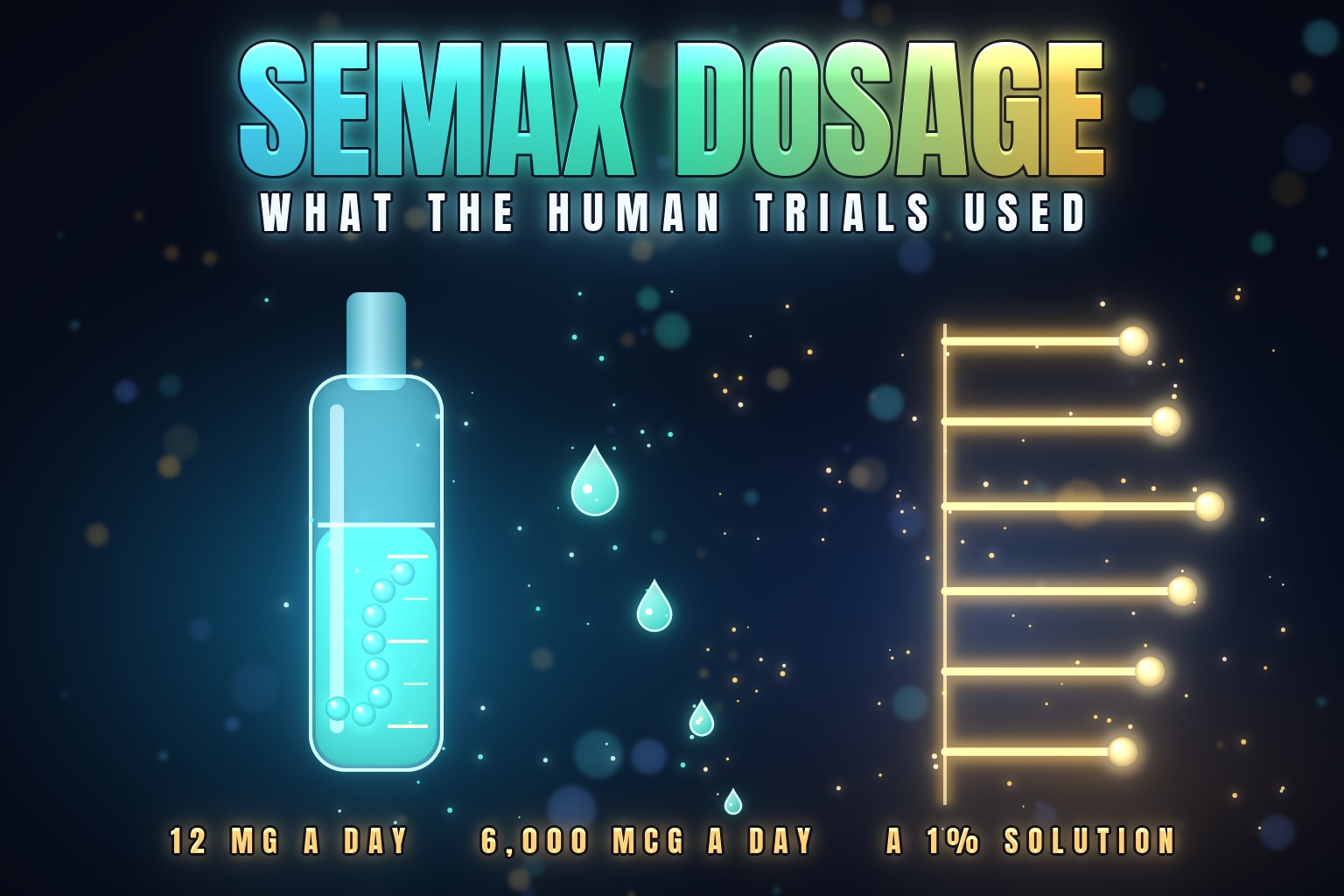
Three numbers sit in the published record for Semax, and they do not look like each other at all. One trial reports 12 mg a day. Another reports 6,000 micrograms a day. A third reports two to four drops of a 1% solution, three times a day.
Two of those are the same kind of number written differently. The third cannot be lined up with either until you know how big a drop is. Here is the whole human dose record, what each amount was paired with, and the thing that surprised me most about it.
The Number That Comes Back
In 1997, Gusev and colleagues published a trial in 30 people in the acute period of hemispheric ischemic stroke, against 80 patients matched for severity and lesion location who received conventional therapy. They reported that the most effective daily amounts were 12 mg for moderate strokes and 18 mg for severe ones, given in courses of five and ten days.
Ten years later, Serdiuk and colleagues ran a randomized controlled trial in 27 people with motor neuron disease. The daily amount was 12 mg, as a 1% solution, intranasally, in two ten-day courses with a two-week break between them.
Different decade, different condition, different measurement. Same 12 mg a day. And two names appear on both papers: Miasoedov and Skvortsova.
That is worth noticing, because it tells you something about where a dosage number comes from. It is not always the output of a dose-finding study. Sometimes it is a house protocol that a research group carries from one question to the next, and the number stays put while everything around it changes.
The Human Dose Record, Trial by Trial
Here is every human study I could verify that states an amount, a concentration or a route, in the order the amounts were reported.
| Study | Who | What was given | What was measured |
|---|---|---|---|
| Gusev, 1997 | 30 people in acute ischemic stroke, 80 comparison patients | 12 mg a day (moderate strokes), 18 mg a day (severe), courses of 5 and 10 days | Clinical rating scales, EEG with mapping, somatosensory evoked potentials |
| Ivanikov, 2002 | People with refractory peptic ulcers, alongside standard treatment | 1% solution, 2 to 4 drops three times a day for 10 days, intranasally | Ulcer healing at day 14 |
| Serdiuk, 2007 | 27 people with motor neuron disease | 1% solution, 12 mg a day, intranasally, two 10-day courses with a 2-week break | Needle EMG, Norris ALS, ALSFRS, ALSAQ-40 quality of life |
| Lebedeva, 2018 | 24 healthy volunteers, average age 43.9 | 1% solution, intranasally, single administration | Resting-state fMRI before, 5 min after and 20 min after |
| Gusev, 2018 | 110 people after ischemic stroke | 6,000 mcg a day, two 10-day courses, 20-day interval | Plasma BDNF, MRC motor scale, Barthel index |
| Panikratova, 2020 | 52 healthy participants | Single administration, placebo-controlled against Selank | Resting-state fMRI before, 5 min after and 20 min after |
Three more human studies describe populations and outcomes without stating an amount in the abstract: Gusev and colleagues in 2005 followed 187 people across different stages of cerebrovascular insufficiency; Alekseeva and colleagues in 1999 followed 73 people with posthypoxic encephalopathy; Kurysheva and colleagues in 2001 treated glaucomatous optic neuropathy in people whose eye pressure had already been normalized. They belong in the record as populations, not as dosage sources.
Three Notations, One Record
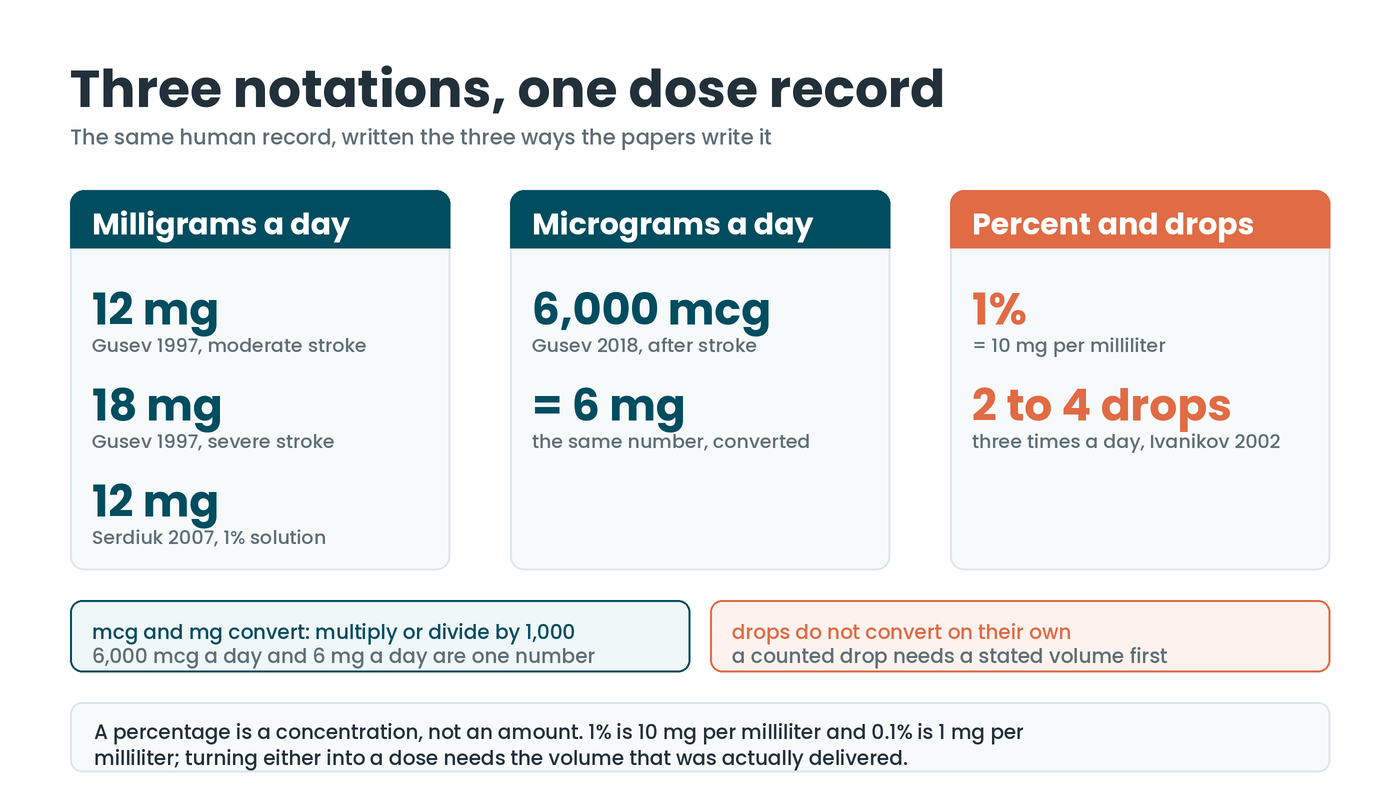
The record writes its amounts in three notations, and only two of them convert into each other cleanly.
Milligrams and micrograms are the easy pair. One milligram is 1,000 micrograms, so Gusev’s 6,000 mcg a day in 2018 is 6 mg a day, and it sits at half of the 12 mg a day in the 1997 and 2007 trials. Written in the same unit, those two numbers are clearly related. Written in different units, they look like they come from different worlds.
A percentage is a different kind of statement. For a solution measured as weight per volume, 1% means 10 mg per milliliter and 0.1% means 1 mg per milliliter. That is a concentration, not an amount. To get from a concentration to an amount you need the volume that was actually delivered.
Serdiuk’s trial gives you both halves, which makes it the most completely specified protocol in the human record: a 1% solution and 12 mg a day. Run the arithmetic and 12 mg at 10 mg per milliliter is 1.2 mL of liquid a day. That multiplication is mine, not the paper’s, but it follows from the two numbers the paper states; how that volume was divided across the day is not something the abstract sets out.
Ivanikov’s ulcer trial gives you the concentration and the count: a 1% solution, two to four drops, three times a day. What it does not state is the volume of a drop, and drop size is a property of the dropper and the liquid rather than a fixed unit. Without that volume the daily milligram figure stays open, which is why this protocol sits in the record as a schedule rather than as a dose you can compare with Serdiuk’s.
The Shape That Repeats: Ten Days
Look past the amounts and a second pattern shows up in the schedules. Ten days is the recurring unit.
Gusev’s 1997 stroke trial used courses of five and ten days. Ivanikov’s ulcer protocol ran for ten days. Serdiuk’s motor neuron disease trial used two ten-day courses with a two-week break. Gusev’s 2018 rehabilitation study used two ten-day courses with a twenty-day interval. Four trials, three conditions, and the same block of time.
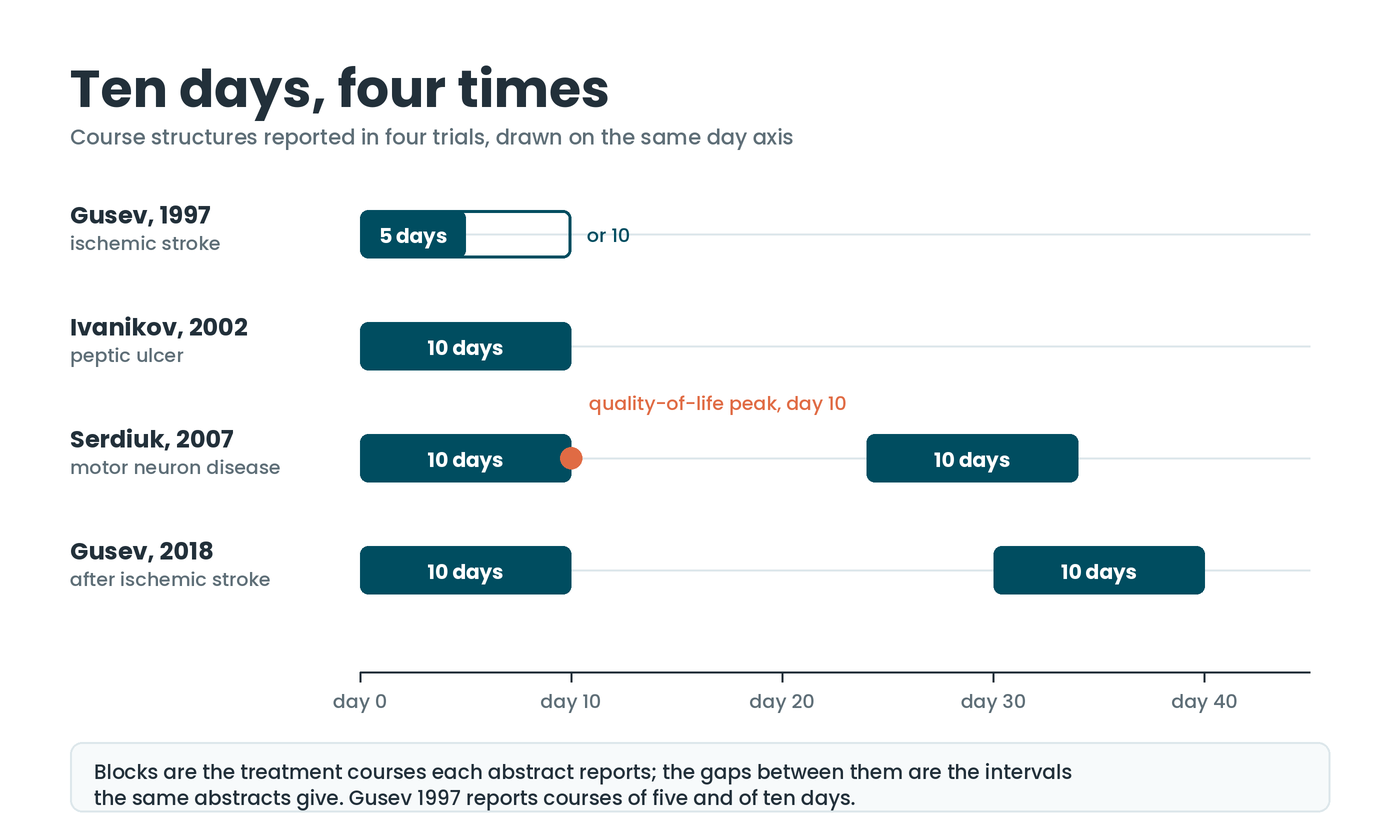
Serdiuk’s trial is the one that measured what happened inside that block. People were assessed 60 days before enrollment and then on days 1, 10, 24, 34 and 48. The total quality-of-life score improved, through the emotional state and motivation items, and the largest effect landed on day 10, the last day of the first course. The needle EMG measure of chronic partial denervation and the clinical rating scales did not move with treatment, and the authors concluded that denervation fluctuates back and forth rather than progressing in one direction, which makes short-interval repeat EMG a poor way to track a drug.
That is a useful thing to know when reading any ten-day course: the trial that looked hardest at the inside of one found its peak on the final day of it.
What a Dose-Response Actually Looked Like
The dose record above tells you what was given. It does not tell you what happens when you change the amount, because none of those trials compared doses against each other. The dose-response work was done on the parent fragment, ACTH 4-10, and it was done in people.
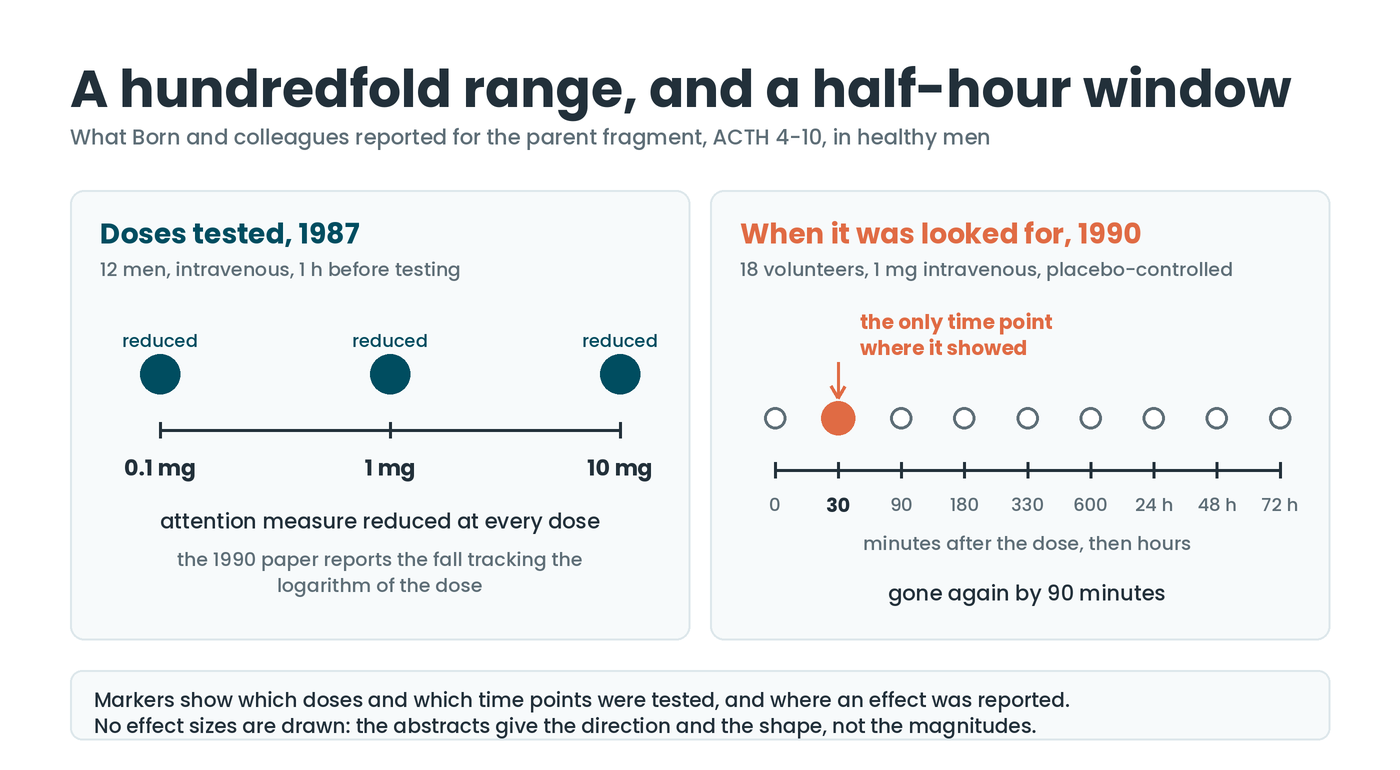
Born and colleagues tested 12 men on a dichotic listening task after 0, 0.1, 1.0 and 10 mg of ACTH 4-10 given intravenously an hour before testing, in a double-blind latin-square design. The attention measure they tracked was the Nd, the amplitude difference between brain responses to sounds the subject was attending to and the same sounds when ignored. It was reduced after every dose, across a hundredfold range. Mismatch processing, an automatic rather than controlled measure, was untouched. The reduced Nd came from unattended sounds being processed more and attended sounds less.
Their 1990 paper states the shape of that relationship directly: the Nd decreased in amplitude linearly with logarithmically increasing doses. A tenfold step in the amount bought one step of effect, which is a very different thing from a dose you can double for twice the result.
For Semax itself, the comparable work is in animals. Ivanova and colleagues put Semax and ACTH 4-10 through the same pain models and found that ACTH 4-10 reduced nociception at 0.5 mg/kg while lower amounts of it did nothing, whereas Semax reduced pain sensitivity across its whole tested range of 0.015 to 0.500 mg/kg. Swapping three amino acid residues at one end of the chain for a proline-containing tail widened the range over which the peptide did something.
Sandman and colleagues had reached the attention question a decade earlier from the other side, infusing 11 healthy men with the parent fragment against a control solution in a crossed and balanced design. They reported a raised perceptual threshold for simple stimuli, better integration of patterned information, improved discrimination of relevant information from irrelevant, and a larger heart-rate deceleration when something novel appeared. Their paper describes the effect without stating the amount, which is why it sits in this article as a result rather than as a dose.
Our post on nootropic peptides and what the human studies measured goes further into the attention work on this family.
The Route Is Part of the Dose
A number of milligrams only means something once you know how it went in, and in this family the route changes more than the amount that arrives.
Manchenko and colleagues gave rats Semax by two routes at several amounts and tested two things: learning, in a passive avoidance task, and pain sensitivity, in a paw-withdrawal test. By intraperitoneal injection the peptide did both, and the two effects had different dose-response curves. Given intranasally it was more potent than injection for learning, and it did not affect pain sensitivity at all. Same compound, same animals, and the route decided which of the two effects appeared.
Kamenskii and colleagues, reviewing route dependence across several peptides, place ACTH 4-10 in the group whose intranasal effects match what invasive administration produces, and note that of the two standard ways to protect a peptide from proteases, adding proline-rich sequences worked better than building in mirror-image amino acids.
Polunin’s optic nerve trial is the one clinical study that put routes side by side. Patients were split into three groups: one received Semax as intranasal drops, one by endonasal electrophoresis, and one served as control, with visual acuity, total visual field, the electrical sensitivity and conductivity of the optic nerve, and color vision as the readouts.
And for the parent fragment there is a measured number. Bickel and colleagues gave eight healthy men ACTH 4-10 at 125 mcg per kilogram as an intravenous bolus, as an infusion, and as a nasal spray, with a radioimmunoassay to read plasma levels. Intranasal absorption of the intact peptide was low and variable, with a maximal bioavailability of 7.6%. The infusion held plasma between 0.74 and 5.06 ng/mL.
Two Clocks, One Compound
The strangest thing about this dose record is that it runs on two clocks at once, and the gap between them is about four orders of magnitude.
The fast clock belongs to the molecule. Shevchenko and colleagues made a tritium-labeled Semax and gave it intranasally to rats at 50 mcg per kilogram in 20 microliters of solution. Two minutes later, 0.093% of the introduced radioactivity per gram was in the brain, and 80% of that was still intact peptide rather than fragments. Two minutes is the measurement, and the peptide was already there.
It does not linger in that form. Potaman and colleagues traced its breakdown in rat blood and serum and attributed a third to a half of the degrading activity to a bestatin-sensitive aminopeptidase that clips the first two residues off the front, leaving intermediates stable enough that they may contribute to the effects of the intact peptide. Zolotarev and colleagues followed the same process against rat forebrain plasma membranes and against glial and neuronal cell cultures, and found losses from both ends and pentapeptide formation dominating, with glial and neuronal cultures producing different patterns of fragments.
Dolotov and colleagues measured the other half of that picture: binding to plasma membranes from the basal nuclei of the rat forebrain was specific, reversible and calcium-dependent, with a dissociation constant of 2.41 nanomolar, and in the presence of those membranes the peptide’s half-life ran longer than an hour. The same work identified dipeptidylaminopeptidases as the main enzymes behind its breakdown, cutting it stepwise down to a pentapeptide and then a tripeptide.
Now the human measurements, laid on the same axis. The two brain-imaging studies read their scans at 5 and 20 minutes after a single administration. Lebedeva and colleagues scanned 24 healthy volunteers, average age 43.9, and found a larger rostral subcomponent of the resting-state default mode network, in the medial frontal cortex, in the Semax group compared with controls. Panikratova and colleagues scanned 52 healthy participants with amygdala and dorsolateral prefrontal cortex as regions of interest, against both Selank and placebo, and reported differences in connectivity between the right amygdala and right temporal cortex.
One more human marker sits between those. Wellhöner and colleagues gave 10 healthy normal-weight men 10 mg of the parent fragment intranasally or placebo in a double-blind crossover, and measured glycerol release in abdominal fat and in forearm muscle by microdialysis. Fat glycerol was up 53.4% on baseline at 45 minutes and stayed above placebo for the rest of the session, while muscle glycerol did not move significantly.
For the parent fragment there is also a full time course. Born and colleagues tested 18 healthy volunteers after 1 mg of ACTH 4-10 intravenously or placebo, at 0, 30, 90, 180, 330 and 600 minutes and at 24, 48 and 72 hours, each person tested on four of those occasions by a random schedule. The attention effect appeared at 30 minutes and at none of the other time points. Their conclusion was that it takes about half an hour to develop and does not outlast 90 minutes.
The slow clock belongs to the clinic. Ivanikov’s ulcer readout was healing at day 14, with 89.5% of the people on intranasal Semax healed against 30.8% of controls. Serdiuk’s quality-of-life peak was day 10, in a study that ran to day 48. Gusev’s 2018 rehabilitation study tracked plasma BDNF, motor performance and the Barthel index across two ten-day courses separated by twenty days, and reported that BDNF levels rose and stayed high for the whole study period.
Both clocks are real, and a dosage number means a different thing on each. On the fast clock the amount is the thing that reaches tissue in the next few minutes. On the slow clock the amount is one input into a course of treatment whose result is read weeks later, next to rehabilitation timing, other medicines and the condition’s own trajectory. Gusev’s 2018 study is explicit about that last point: it compared early rehabilitation at 89 days after stroke against late rehabilitation at 214 days, and the timing of rehabilitation modified the relationship between BDNF and outcome. Our post on peptides in stroke recovery covers that wider picture.
Per Kilogram, or Per Person
One thing the human record is consistent about: it reports fixed daily amounts. Twelve milligrams a day. Eighteen milligrams a day. Six thousand micrograms a day. Nobody in these trials multiplied by body weight.
The per-kilogram figures all come from somewhere else. Miasoedova and colleagues, summarizing the experimental groundwork behind their clinical study, give 100 to 150 mcg/kg as the range where angioprotective, antihypoxic and neurotrophic activity showed up. Shevchenko’s kinetics used 50 mcg/kg in rats of 200 to 250 grams. Ivanova’s pain work ran from 0.015 to 0.500 mg/kg. Bickel’s human pharmacokinetics used 125 mcg/kg, and that was the parent fragment, given to eight men by three routes.
Those two kinds of number answer different questions. A per-kilogram figure is how an experiment is standardized across animals of different sizes. A fixed daily amount is what a clinical protocol specifies. Converting between them means crossing species, and the one place in this literature where a human per-kilogram amount exists, it was chosen for a pharmacokinetic measurement rather than for an effect.
The formulation has to match as well, because the names in this family are not interchangeable. The acetylated and amidated versions are different preparations with their own research records, which our posts on N-Acetyl Semax against standard Semax and N-Acetyl Semax Amidate go through in detail. A dosage number carries its formulation with it.
Doses Used in the Research
Every amount on this list is what a published study administered, with the population it was given to.
Frequently Asked Questions
What dose of Semax did human trials actually use?
The amounts that appear in the published human record are 12 mg a day, 18 mg a day for severe strokes, and 6,000 mcg a day. Two further trials describe a 1% solution, one of them as 12 mg a day and the other as two to four drops three times daily.
How much is 6,000 mcg in milligrams?
Six milligrams, since one milligram is 1,000 micrograms. Written that way it is half the 12 mg a day used in the 1997 stroke trial and the 2007 motor neuron disease trial.
What does a 1% Semax solution mean?
For a solution measured by weight per volume, 1% is 10 mg per milliliter, and 0.1% is 1 mg per milliliter. That is a concentration rather than an amount, so it needs a delivered volume before it becomes a dose.
How many milligrams are in a drop?
The studies that counted drops did not state a drop volume, and drop size depends on the dropper and the liquid rather than being a fixed unit. That is why Ivanikov’s protocol can be read as a schedule but not lined up in milligrams against Serdiuk’s.
Were the doses scaled to body weight?
Not in the human trials, which all specify fixed daily amounts. The per-kilogram figures in this literature come from animal experiments, and the one human per-kilogram amount, 125 mcg/kg, was used in a pharmacokinetic study of the parent fragment.
How long were the courses?
Ten days is the recurring block. Gusev’s 1997 trial used courses of five and ten days, Ivanikov’s ran ten days, and both Serdiuk’s and Gusev’s 2018 protocols used two ten-day courses separated by a break of two to three weeks.
How fast did anything change after a dose?
On the fast clock, tritium-labeled Semax was measurable in rat brain two minutes after intranasal administration, and the human imaging studies read their scans at 5 and 20 minutes. For the parent fragment, the attention effect appeared at 30 minutes and had gone by 90.
Can a nasal amount be compared with an injected one?
Not directly. In rats the two routes produced different effects from the same compound, and for the parent fragment in people the maximum bioavailability measured for a nasal spray was 7.6%.
Reading this record end to end, what strikes me is how much of a dosage number lives outside the number itself. Twelve milligrams a day meant one thing in a stroke ward in 1997 and another thing in a motor neuron disease trial in 2007, and the research that looked hardest at changing the amount found a line that climbs with the logarithm of the dose rather than the dose. If you want the other half of the picture, the readouts that were tracked alongside these amounts, our Dangers of Semax review goes through them.
Stay sharp,
Joe Mars
The Peptide Report
P.S. If you want to talk any of this through with people who read the same papers, come and find us at the Peptides & Biohacking Hub.
References
- Gusev, Skvortsova, Miasoedov and colleagues (1997). Effectiveness of semax in acute period of hemispheric ischemic stroke (a clinical and electrophysiological study). Zh Nevrol Psikhiatr Im S S Korsakova, 97(6), 26-34.
- Gusev, Martynov, Kostenko and colleagues (2018). The efficacy of semax in the treatment of patients at different stages of ischemic stroke. Zh Nevrol Psikhiatr Im S S Korsakova, 118(3, Vyp. 2), 61-68.
- Miasoedova, Skvortsova, Nasonov and colleagues (1999). Investigation of mechanisms of neuro-protective effect of semax in acute period of ischemic stroke. Zh Nevrol Psikhiatr Im S S Korsakova, 99(5), 15-19.
- Gusev, Skvortsova and Chukanova (2005). Semax in prevention of disease progress and development of exacerbations in patients with cerebrovascular insufficiency. Zh Nevrol Psikhiatr Im S S Korsakova, 105(2), 35-40.
- Alekseeva, Bottaev and Goroshkova (1999). Use of semax at a follow-up of patients with posthypoxic encephalopathy. Anesteziologiia i Reanimatologiia, (1), 40-43.
- Polunin, Nurieva, Baiandin, Sheremet and Andreeva (2000). Evaluation of therapeutic effect of new Russian drug semax in optic nerve disease. Vestnik Oftalmologii, 116(1), 15-18.
- Kurysheva, Shpak, Ioileva and colleagues (2001). Semax in the treatment of glaucomatous optic neuropathy in patients with normalized ophthalmic tone. Vestnik Oftalmologii, 117(4), 5-8.
- Serdiuk, Levitskii, Miasoedov and Skvortsova (2007). The study of chronic partial denervation and quality of life in patients with motor neuron disease treated with semax. Zh Nevrol Psikhiatr Im S S Korsakova, 107(4), 29-39.
- Lebedeva, Panikratova, Sokolov and colleagues (2018). Effects of Semax on the Default Mode Network of the Brain. Bulletin of Experimental Biology and Medicine, 165(5), 653-656.
- Panikratova, Lebedeva, Sokolov and colleagues (2020). Functional Connectomic Approach to Studying Selank and Semax Effects. Doklady Biological Sciences, 490(1), 9-11.
- Ivanikov, Brekhova, Samonina, Myasoedov and Ashmarin (2002). Therapy of peptic ulcer with semax peptide. Bulletin of Experimental Biology and Medicine, 134(1), 73-74.
- Shevchenko, Nagaev, Alfeeva and colleagues (2006). Kinetics of Semax penetration into the brain and blood of rats after its intranasal administration. Bioorganicheskaia Khimiia, 32(1), 64-70.
- Manchenko, Glazova, Levitskaia, Andreeva, Kamenskii and Miasoedov (2010). Nootropic and analgesic effects of Semax following different routes of administration. Rossiiskii Fiziologicheskii Zhurnal imeni I M Sechenova, 96(10), 1014-1023.
- Kamenskii, Voskresenskaia, Dubynin and Levitskaia (2001). Dependence of neuropeptide physiological effects on a route of administration. Rossiiskii Fiziologicheskii Zhurnal imeni I M Sechenova, 87(11), 1493-1501.
- Potaman, Alfeeva, Kamensky, Levitzkaya and Nezavibatko (1991). N-terminal degradation of ACTH(4-10) and its synthetic analog semax by the rat blood enzymes. Biochemical and Biophysical Research Communications, 176(2), 741-746.
- Zolotarev, Dolotov, Inozemtseva and colleagues (2006). Degradation of the ACTH(4-10) analog Semax in the presence of rat basal forebrain cell cultures and plasma membranes. Amino Acids, 30(4), 403-408.
- Dolotov, Zolotarev, Dorokhova and colleagues (2004). The binding of Semax, ACTH 4-10 heptapeptide, to plasma membranes of the rat forebrain basal nuclei and its biodegradation. Bioorganicheskaia Khimiia, 30(3), 241-246.
- Ivanova, Levitskaya, Andreeva, Kamenskii and Myasoedov (2007). Comparative study of analgesic potency of ACTH4-10 fragment and its analog semax. Bulletin of Experimental Biology and Medicine, 143(1), 5-8.
- Bickel, Born, Fehm, Distler and Voigt (1988). The behaviorally active peptide ACTH 4-10: measurement in plasma and pharmacokinetics in man. European Journal of Clinical Pharmacology, 35(4), 371-377.
- Born, Bräuninger, Fehm-Wolfsdorf, Voigt, Pauschinger and Fehm (1987). Dose-dependent influences on electrophysiological signs of attention in humans after neuropeptide ACTH 4-10. Experimental Brain Research, 67(1), 85-92.
- Born, Unseld, Pietrowsky, Bickel, Voigt and Fehm (1990). Time course of ACTH 4-10 effects on human attention. Neuroendocrinology, 52(2), 169-174.
- Sandman, George, McCanne, Nolan, Kaswan and Kastin (1977). MSH/ACTH 4-10 influences behavioral and physiological measures of attention. Journal of Clinical Endocrinology and Metabolism, 44(5), 884-891.
- Wellhöner, Hörster, Jacobs, Sayk, Lehnert and Dodt (2012). Intranasal application of the melanocortin 4 receptor agonist MSH/ACTH(4-10) in humans causes lipolysis in white adipose tissue. International Journal of Obesity, 36(5), 703-708.