
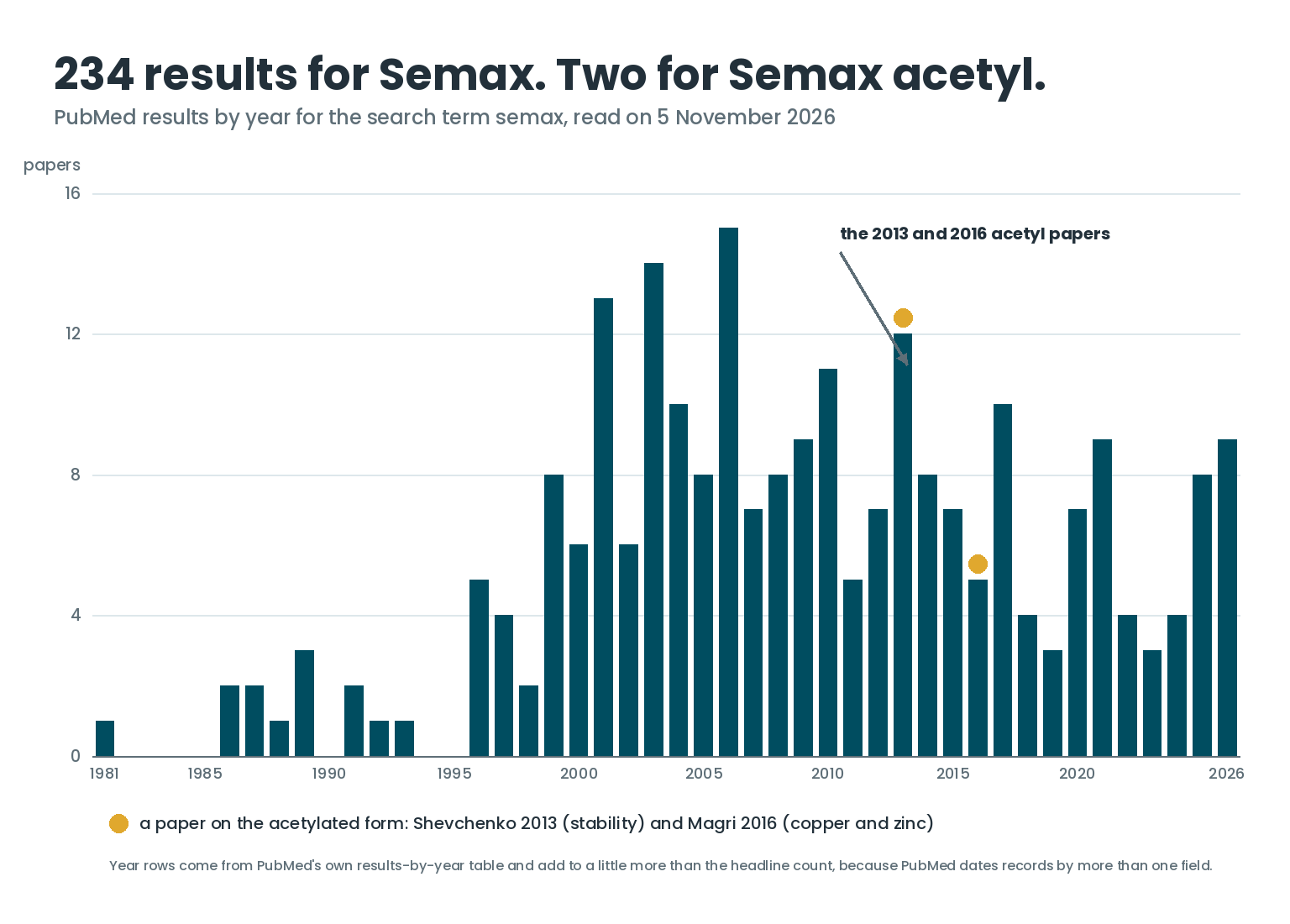
Type Semax into PubMed and you get 234 results. Add the word acetyl and you get two.
That gap is the whole story of this comparison. Almost everything anyone knows about either molecule was measured on plain Semax. The acetylated version has a chemistry paper and a stability paper to its name, and that’s it. So “N-Acetyl Semax vs Semax” isn’t really a contest between two bodies of evidence. It’s one body of evidence, a small chemical change, and a question about how much carries over.
What the Two Names Actually Mean
Semax is a seven-amino-acid peptide. Four of those residues are copied from positions 4 to 7 of ACTH, the pituitary stress hormone, and the last three are a Pro-Gly-Pro tail that was bolted on to make the molecule last longer in the body. That description comes straight from the abstracts of the chemistry groups who work on it, and it’s why you’ll see the molecule written as ACTH(4-7)PGP in the newer papers.
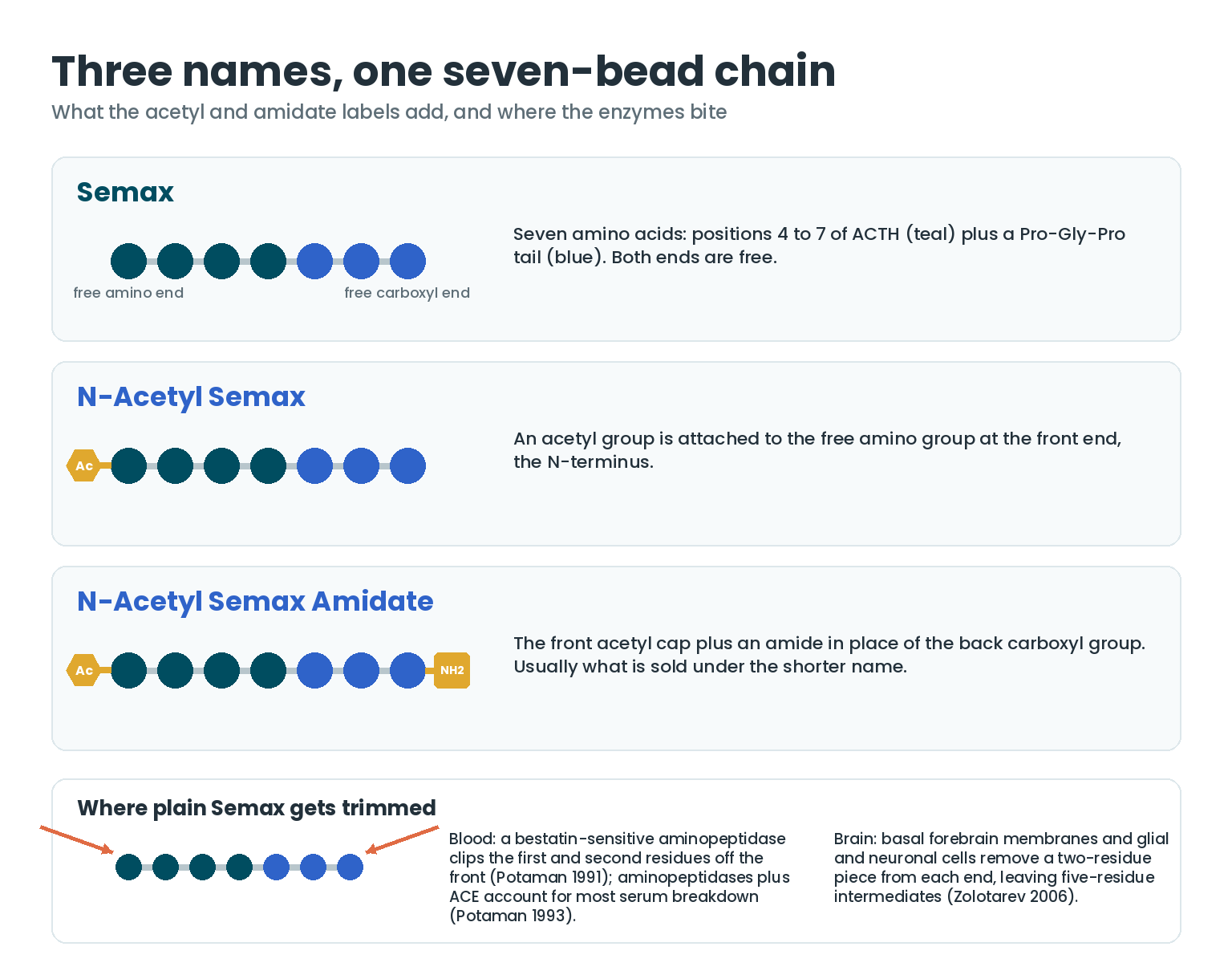
A peptide chain has two ends. The front end carries a free amino group; the back end carries a free carboxyl group. “N-Acetyl Semax” means an acetyl group has been attached to that front amino group, which is the N-terminus. “Amidate” means the back carboxyl has been converted into an amide. The product most vendors sell is N-Acetyl Semax Amidate, with both caps, and the name usually gets shortened to N-Acetyl Semax in conversation. If you want the chemistry of what each cap does and why, I covered it in detail in the N-Acetyl Semax Amidate piece, so I won’t repeat it here. This article is about the evidence.
Why Anyone Caps the Ends in the First Place
The rationale for capping isn’t a vendor invention. It comes from what the Russian group that designed Semax found when they followed it through blood and brain.
In 1991, V. N. Potaman and colleagues tracked ACTH(4-10) and Semax through rat blood and serum by HPLC. About a third to a half of the serum’s ability to break the peptide down came from a bestatin-sensitive aminopeptidase, an enzyme that bites the first and second residues off the front of the chain. Those clipped fragments were relatively stable, and the areas under the curves suggested they could contribute to the effects of the intact peptide. Semax was more stable than the natural ACTH fragment against the other enzymes involved. The same team’s 1993 inhibitor study put numbers on it: bestatin blocked up to 66% of the total degrading activity in rat serum, puromycin about 33%, and the ACE inhibitor lisinopril about 15%. Aminopeptidases and ACE did most of the work.
Aminopeptidases need a free front end to grab. That is the whole logic of an acetyl cap: cover the front end and the first family of enzymes has nothing to bite.
Brain tissue trims the chain too. In 2006, Yu. A. Zolotarev’s team used a Semax labeled at every residue to watch what rat basal forebrain membranes and cultured glial and neuronal cells did to it. The dominant events were the loss of a two-residue piece from the front and a two-residue piece from the back, leaving five-residue intermediates, and glial cells produced a different product mix than neurons. In the same year, K. V. Shevchenko’s group gave tritium-labeled Semax to rats by the nose at 50 micrograms per kilogram. Two minutes later, 0.093% of the dose per gram of tissue was in the brain, 80% of it still intact. The peptide broke down fast after that, and the Pro-Gly-Pro tail became the dominant species in the samples.
So the ends get chewed, from both directions, in blood and in brain. The acetyl cap and the amide cap sit exactly where the chewing starts. That is a sound reason to expect a capped version to survive longer. What it isn’t, yet, is a measurement of how the capped version behaves in an animal or a person.
The Two Papers That Tested the Acetyl Version
The chemistry paper
The most informative study of Ac-Semax came from an Italian inorganic chemistry group in 2016. Antonio Magrì and colleagues compared Semax and N-acetyl Semax on how they bind copper and zinc, and on what that does in a neuroblastoma cell line. The year before, the same group had shown that plain Semax binds copper(II) tightly, holding the metal in a flat arrangement of four nitrogen atoms, and that it reduced copper-induced toxicity in SH-SY5Y neuroblastoma cells and RBE4 endothelial cells.
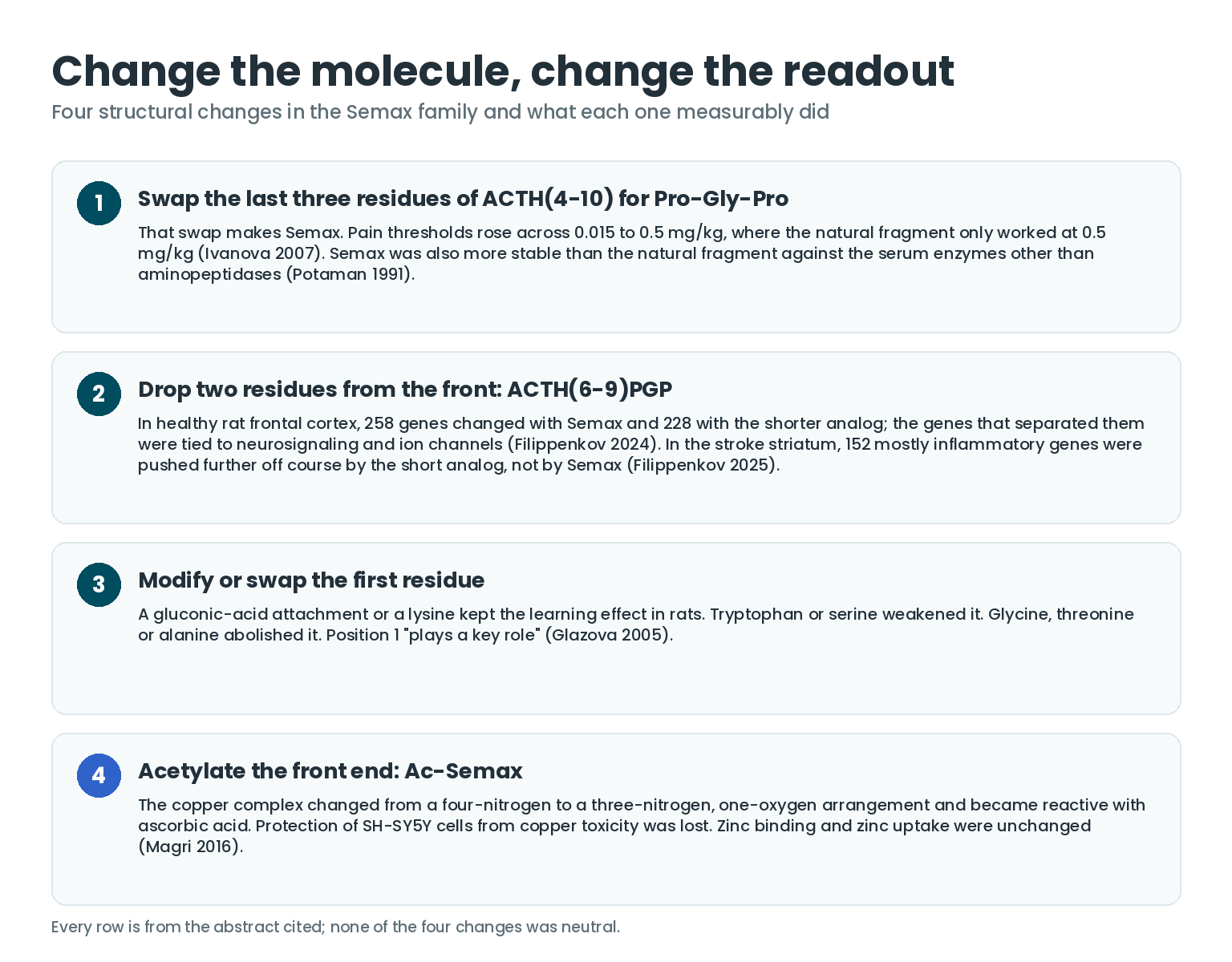
Acetylation changed that. With the front amino group covered, the copper complex switched to a three-nitrogen, one-oxygen arrangement with a weak contribution from the sulfur of the first residue. Its redox potential shifted more positive, and the acetylated complex reacted with ascorbic acid where the plain Semax complex stayed redox-stable. The biological readout followed the chemistry: Ac-Semax did not protect the neuroblastoma cells from copper toxicity. The authors’ conclusion was that the free amino terminus plays a crucial role in that protection. Zinc was a different story. Both forms bound zinc with comparable strength, and acetylation didn’t change how much zinc got into the cells.
That is a direct, same-experiment comparison, and it cuts both ways. The acetyl cap removed one property that plain Semax has. It left another untouched. Neither result tells you anything about memory, mood or blood flow, because none of those were measured.
The stability paper
In 2013, Shevchenko, Myasoedov and colleagues published a short communication in Doklady Biological Sciences titled “Stability of Semax acetyl to proteolysis in various biological media.” It is the one paper that asks the exact question the cap was designed to answer. It’s also a two-page note with no abstract on PubMed or on the publisher’s page, so I can’t quote its numbers here. What I can say is that the group that designed Semax thought the acetylated form worth testing for enzyme resistance, which lines up with the capping logic above.
The closest behavioral test
Nobody has published a learning or memory test of Ac-Semax that I could find in PubMed. The nearest thing is a 2005 study by N. Yu. Glazova and colleagues on what happens when you modify or swap the first residue of Semax. They ran rats through learning tasks with food reward and with pain avoidance. Attaching a gluconic-acid residue to the front of the chain, or swapping the first amino acid for lysine, kept the nootropic effect. Swapping it for tryptophan or serine weakened the effect. Swapping it for glycine, threonine or alanine wiped the effect out entirely. Their conclusion was that position 1 “plays a key role” in whether the peptide works and how strongly.
Read that carefully. A front-end modification can preserve activity, and a front-end change can also kill it. The acetyl group wasn’t one of the modifications tested, so this study doesn’t settle the question. It does tell you the front of the molecule is not a place where changes are automatically harmless.
Thirty Years of Semax: What the Plain Version Has Shown
Everything in this section was measured on plain Semax. I’m grouping it by how close the evidence gets to a human.
In people
The human work is mostly Russian clinical practice, published in Russian journals, and most of it is open-label. That matters for how much weight it carries, so I’ll describe each design as the abstract gives it.
E. I. Gusev’s 1997 stroke study gave Semax to 30 patients in the acute phase of a hemispheric ischemic stroke and compared them with 80 patients matched for stroke severity and location who got conventional care. The abstract doesn’t describe randomization or blinding. The authors reported faster recovery of neurological function, especially motor function, on clinical scales, EEG mapping and evoked potentials. The daily doses they found most effective were 12 mg for moderate strokes and 18 mg for severe ones, over 5 and 10 days.
The same group’s 2018 study followed 110 post-stroke patients for five months, split into early rehabilitation (starting around 89 days) and late rehabilitation (around 214 days), with each group further split into Semax and no-Semax subgroups. Semax was given as two 10-day courses of 6,000 micrograms a day with a 20-day gap. Patients who got Semax had higher plasma BDNF regardless of when rehab started, and the BDNF stayed high for the whole study. Semax and high BDNF both went with faster improvement and a better final score on the Barthel index of daily living, with a smaller effect on the paresis itself.
In 2005, Gusev, Skvortsova and Chukanova reported on 187 patients at various stages of chronic cerebrovascular insufficiency, diagnosed with a full workup that included Doppler ultrasound and MRI. The abstract describes clinical improvement, stabilization of the disease course, and a reduced rate of strokes and transient ischemic attacks, with a low rate of side effects including in older patients. It doesn’t describe a control group.
The eye is a piece of brain you can look at directly, and G. S. Polunin’s 2000 ophthalmology study used that. Patients with vascular, toxic-allergic and inflammatory optic nerve disease, or partial optic atrophy, got Semax on top of standard therapy either as nasal drops or by endonasal electrophoresis, with a third group as control. The Semax groups recovered faster and further on visual acuity, visual field, color vision and the electrical sensitivity and conductivity of the optic nerve, with the biggest effect in the acute stage.
The newest human data is imaging in healthy people. I. S. Lebedeva’s 2018 study put 24 healthy volunteers, average age 44, through resting-state fMRI before and then 5 and 20 minutes after a 1% intranasal Semax solution or placebo. The 14 people who got Semax showed a larger rostral subcomponent of the default mode network, in the medial frontal cortex, than the 10 who got placebo. In 2020, Ya. R. Panikratova’s group extended this to 52 healthy participants and compared Semax, Selank and placebo on whole-brain connectivity from the amygdala and the dorsolateral prefrontal cortex. Both peptides changed the connection between the right amygdala and a strip of right temporal cortex, with general and peptide-specific effects.
Behind all of this sits the 1997 review by I. P. Ashmarin and the rest of the design team, written after 15 years of work. They described Semax as stimulating working memory and attention, raising resistance to hypoxia and improving brain circulation in animals and people for 20 to 24 hours after an intranasal dose of 0.015 to 0.050 mg per kilogram, with no negative side effects observed in their experience. That is the designers’ own summary, and it reads like one.
In animals
The animal literature is where the mechanism comes from, and most of it uses the same route and dose range as the human work: intranasal, around 50 micrograms per kilogram.
Oleg Dolotov’s two 2006 papers are the anchor. In the first, a single 50 microgram per kilogram dose raised BDNF protein in the rat hippocampus by a maximum of 1.4-fold, raised phosphorylation of its receptor trkB by 1.6-fold, and tripled exon III BDNF mRNA while doubling trkB mRNA. The treated rats also learned a conditioned avoidance task better. In the second, tritium-labeled Semax bound to rat basal forebrain membranes in a way that was specific, reversible and calcium-dependent, with a dissociation constant of 2.4 nanomolar, and intranasal Semax at 50 and 250 micrograms per kilogram raised BDNF protein in the basal forebrain within 3 hours while leaving the cerebellum alone. Agapova’s 2007 follow-up found that one intranasal dose raised both NGF and BDNF gene expression in the hippocampus within an hour, raised BDNF in the brainstem and cerebellum, and lowered NGF in the frontal cortex. Maria Shadrina’s 2010 time course showed the pattern is region-specific and moves: at 20 minutes both neurotrophin genes dipped in the hippocampus and retina while rising in the frontal cortex, and retinal BDNF rose significantly by 90 minutes.
Semax also talks to the monoamine systems. Kirill Eremin’s 2005 study found that 0.15 mg per kilogram by injection raised striatal serotonin turnover, with the extracellular metabolite 5-HIAA climbing to 180% of baseline over 1 to 4 hours. On its own the peptide didn’t move dopamine, but given 20 minutes before amphetamine it dramatically amplified amphetamine’s effect on extracellular dopamine and on locomotion. On the ion-channel side, I. N. Sharonova’s 2018 concentration-clamp work showed 1 micromolar Semax boosted GABA-activated currents in cerebellar Purkinje cells and cut glycine-activated chloride currents in hippocampal pyramidal neurons to 68% and 43% of control at 0.1 and 1 micromolar, with both effects developing slowly and reversing poorly, which points to second messengers rather than a direct channel block. S. N. Kolbaev’s 2025 slice study found 1 micromolar Semax increased the frequency of spontaneous calcium fluctuations in CA1 pyramidal neurons but didn’t touch proton-triggered calcium entry in cerebellar granule cells.
The behavioral protection studies run through a lot of insults. Daily intranasal Semax at 0.2 mg per kilogram reduced the movement loss and anxiety that MPTP causes in rats after it damages the dopamine system. Six days of intranasal Semax shrank the infarct and preserved passive-avoidance memory after a photochemically induced cortical stroke. Semax counteracted the learning deficit caused by lead and molybdenum salts about as well as ascorbic acid did. Rats isolated from their mothers for five hours a day in their first two weeks of life, then given intranasal Semax at 50 micrograms per kilogram daily for the next two weeks, recovered their body weight, their metabolism and their corticosterone stress response. Rat pups exposed to the SSRI fluvoxamine in the first two weeks of life, then given Semax, had less anxiety-like behavior, learned a maze faster and had normalized brain monoamine levels compared with exposed pups that got vehicle. And in 2024, Ludmila Inozemtseva’s group gave stressed male rats a daily low dose of 60 nanomoles per kilogram by injection: Semax reversed or blunted the anhedonia, the stalled weight gain, the adrenal enlargement and the drop in hippocampal BDNF that chronic unpredictable stress produces, though it didn’t change immobility in the forced swim test.
Route matters, and Daria Manchenko’s 2010 study is the cleanest demonstration. Given by injection, Semax improved passive-avoidance learning and raised pain thresholds, each with its own dose-response curve. Given by the nose, it was more potent for learning and had no effect on pain at all. The authors read that as two different mechanisms in two different brain regions.
In cells and gene readouts
The ischemia work has gone deep on molecular profiling. Ivan Filippenkov’s 2020 RNA-seq study found 394 genes changed by more than 1.5-fold in the brains of rats 24 hours after a transient middle cerebral artery occlusion when they got Semax rather than saline, with inflammation genes pushed down and neurotransmission genes pushed up, which is the mirror image of what the ischemia alone did. Olga Sudarkina’s 2021 protein follow-up in the same model found active CREB up in subcortical structures including the ischemic core, MMP-9 and c-Fos down in the neighboring cortex, and active JNK down in both. An earlier biochip study from Ekaterina Medvedeva in 2017 had the immune response as the most affected process, with Semax enhancing antigen presentation and interferon signaling and raising the immunoglobulin heavy chain gene, while the Pro-Gly-Pro fragment on its own damped immune activity. Different platforms and time points give different directions on the immune genes, and I’d rather tell you that than pick one.
In culture, T. P. Storozhevykh’s 2007 study found that 100 micromolar Semax, and its Pro-Gly-Pro fragment at 20 and 100 micromolar, delayed the calcium overload and mitochondrial collapse that glutamate causes in cerebellar granule cells and improved survival by about 30%. Michele Sciacca’s 2022 work in artificial membrane models showed plain Semax prevents amyloid-beta from forming complexes with copper and slows copper-driven aggregation. Keep that one in mind, because it is exactly the kind of property the 2016 acetylation paper showed depends on the free front end.
Change the Molecule, Change the Readout
Here is the part of the comparison that people skip. This family of peptides has been tested in enough variants to know that small structural changes produce measurably different biology, and the same lab has shown it several times over.
D. M. Ivanova’s 2007 pain study compared natural ACTH(4-10) with Semax. The natural fragment only reduced pain at 0.5 mg per kilogram; Semax did it across 0.015 to 0.5 mg per kilogram. Swapping the last three residues for Pro-Gly-Pro raised analgesic potency after peripheral injection. Glazova’s 2005 learning study, covered above, showed front-end swaps ranging from harmless to fatal for the nootropic effect.
The transcriptome work makes the point in high resolution. In 2024, Filippenkov’s group gave healthy rats Semax, the shorter analog ACTH(6-9)PGP, or saline by injection and sequenced the frontal cortex 22.5 hours later. Semax changed 258 genes, the shorter analog 228, and both mostly lowered immune-system genes. But when the two peptides were compared head-to-head, the genes that separated them were tied to neurosignaling and ion-channel regulation. The authors’ own framing was that differences in the structure of ACTH derivatives show up as differences in the brain transcriptome. Their 2025 study in the striatum of stroke rats found both peptides normalized hundreds of ischemia-disturbed genes, but 152 genes, mostly inflammation genes, were pushed further out of line by the shorter analog and not by Semax.
And then there is the acetyl result itself: cover the front end and the copper chemistry changes, the copper protection disappears, and the zinc behavior stays. Four different modifications, four different patterns. Capping is not free.
Which Studies Answer Which Question
Since no paper puts Semax and N-Acetyl Semax head-to-head in an animal or a person, here is how I’d match the questions people actually ask to the evidence that exists.
If the question is whether Semax does anything in humans, the answer comes from the Russian stroke, cerebrovascular and optic nerve series and the two fMRI studies in healthy volunteers, all with plain Semax, mostly open-label and mostly small. If the question is how it works, the answer is the BDNF, monoamine and transcriptome work in rats, again plain Semax, mostly intranasal at 50 micrograms per kilogram. If the question is whether the acetyl cap changes what the molecule does, the one direct answer is the copper and zinc paper: it changed one property and not another. If the question is whether the acetyl cap makes it last longer, there is a 2013 stability study with no accessible numbers, and a chain of degradation studies on the plain peptide that explain why a cap should help.
If you’re reading vendor copy that says the acetylated version is “stronger” or “longer-lasting,” that claim is an inference from the stability logic. It isn’t a measurement from a trial, because no such trial has been published. That doesn’t make it wrong. It makes it untested.
Explore the Evidence Map
Every study in this article is a dot in the map below, clustered by how it was done and colored by which form of the molecule it used. Drag a dot, tap it for the one-line finding, and use the filters to see how the field looks when you keep only the human work or only the acetyl work.
Every study cited in this article is a dot. Dots cluster by how the work was done and take their color from which form of the molecule was tested. Drag one, tap it for the finding, and filter.
Positions are a layout, not data. Findings are one-line summaries of each abstract; numbers are in the article and the References list.
Doses Used in the Research
- Rats, intranasal: 50 micrograms per kilogram, single dose, for the hippocampal BDNF and trkB study (Dolotov 2006) and the one-hour neurotrophin gene study (Agapova 2007); 50 and 250 micrograms per kilogram for basal forebrain BDNF (Dolotov 2006); 50 micrograms per kilogram daily for two weeks after neonatal isolation (Volodina 2012); 0.2 mg per kilogram daily in the MPTP model (Levitskaya 2004); 50 micrograms per kilogram for the brain-entry kinetics study (Shevchenko 2006).
- Rats and mice, injection: 0.15 mg per kilogram intraperitoneal for the serotonin and dopamine study (Eremin 2005); 0.015 to 0.5 mg per kilogram for analgesia (Ivanova 2007); 60 nanomoles per kilogram daily in chronic unpredictable stress (Inozemtseva 2024).
- Cells and slices: 0.1 and 1 micromolar for GABA and glycine currents (Sharonova 2018); 1 micromolar for calcium imaging (Kolbaev 2025); 100 micromolar Semax and 20 to 100 micromolar Pro-Gly-Pro against glutamate toxicity (Storozhevykh 2007).
- People: 12 mg and 18 mg per day for 5 to 10 days in acute stroke (Gusev 1997); two 10-day courses of 6,000 micrograms per day after stroke (Gusev 2018); a 1% intranasal solution in healthy volunteers (Lebedeva 2018); 0.015 to 0.050 mg per kilogram intranasal in the designers’ 1997 review.
- N-Acetyl Semax: tested in solution and in neuroblastoma cell culture (Magrì 2016). No animal or human dose has been published.
FAQ
Is N-Acetyl Semax the same as N-Acetyl Semax Amidate?
Not strictly. N-Acetyl Semax has an acetyl cap on the front end only. N-Acetyl Semax Amidate has that cap plus an amide on the back end. Most products sold under the shorter name are the double-capped version, so check the full name on the label and on the certificate of analysis.
Has N-Acetyl Semax been tested in humans?
No published human study of the acetylated form appears in PubMed. The human work on Semax, including stroke, cerebrovascular, optic nerve and fMRI studies, all used plain Semax.
What did the one head-to-head study find?
Magrì’s 2016 chemistry study found that acetylating the front end changed how Semax binds copper, removed its ability to protect neuroblastoma cells from copper toxicity, and left its zinc binding and zinc uptake unchanged.
Why would capping the ends make Semax last longer?
Blood enzymes called aminopeptidases clip residues off the free front end, and brain membranes trim both ends. A cap covers the spot those enzymes attack. That logic is well supported for plain Semax; the measured stability of the acetylated form is in a 2013 short communication whose numbers aren’t accessible online.
How fast does Semax reach the brain?
In rats, 0.093% of an intranasal dose per gram of tissue was in the brain two minutes after dosing, 80% of it still intact, in Shevchenko’s 2006 tracer study.
What does Semax do to BDNF?
In rats, a single intranasal dose raised hippocampal BDNF protein by up to 1.4-fold and BDNF mRNA threefold, and raised basal forebrain BDNF within three hours. In post-stroke patients, two 10-day courses raised plasma BDNF and kept it high for five months.
Does the route of administration matter?
Yes. In rats, intranasal Semax was more potent for learning than injection and had no effect on pain, while injection improved learning and raised pain thresholds.
Do small changes to the molecule really matter?
In this family they’ve been measured repeatedly: the Pro-Gly-Pro tail raised analgesic potency, first-residue swaps ranged from harmless to activity-killing, a two-residue-shorter analog produced a different brain gene signature, and the acetyl cap changed copper behavior. None of these changes was neutral.
Which should I read about next?
The N-Acetyl Semax Amidate piece covers the chemistry of the two caps. Semax vs Selank compares the two Russian peptides that are often sold together, and the Semax safety review goes through what the studies reported on side effects. Joe’s own Semax 30mg post and the nootropic peptide literature roundup are the next stops.
Stay sharp,
Joe Mars
The Peptide Report
P.S. If you’ve got a bottle labeled N-Acetyl Semax and you’re wondering which molecule is in it, the Skool community is where that conversation happens: skool.com/peptides-biohacking-hub.
References
- Shevchenko KV, Nagaev IY, Andreeva LA, Shevchenko VP, Myasoedov NF. Stability of Semax acetyl to proteolysis in various biological media. Dokl Biol Sci. 2013;449:110-112. DOI
- Magrì A, Tabbì G, Giuffrida A, Pappalardo G, Satriano C, Naletova I, Nicoletti VG, Attanasio F. Influence of the N-terminus acetylation of Semax, a synthetic analog of ACTH(4-10), on copper(II) and zinc(II) coordination and biological properties. J Inorg Biochem. 2016;164:59-69. DOI
- Glazova NIu, Sebentsova EA, Levitskaia NG, Andreeva LA, Alfeeva LIu, Kamenskiĭ AA, Miasoedov NF. [Effect of modification of the N-terminal region of molecule on the expression of nootropic effect of semax analogues]. Izv Akad Nauk Ser Biol. 2005;(4):460-466. PubMed
- Potaman VN, Alfeeva LY, Kamensky AA, Levitzkaya NG, Nezavibatko VN. N-terminal degradation of ACTH(4-10) and its synthetic analog semax by the rat blood enzymes. Biochem Biophys Res Commun. 1991;176(2):741-746. DOI
- Potaman VN, Alfeeva LY, Kamensky AA, Nezavibatko VN. Degradation of ACTH/MSH(4-10) and its synthetic analog semax by rat serum enzymes: an inhibitor study. Peptides. 1993;14(3):491-495. DOI
- Zolotarev YA, Dolotov OV, Inozemtseva LS, Dadayan AK, Dorokhova EM, Andreeva LA, Alfeeva LY, Grivennikov IA, Myasoedov NF. Degradation of the ACTH(4-10) analog Semax in the presence of rat basal forebrain cell cultures and plasma membranes. Amino Acids. 2006;30(4):403-408. DOI
- Shevchenko KV, Nagaev IIu, Alfeeva LIu, Andreeva LA, Kamenskiĭ AA, Levitskaia NG, Shevchenko VP, Grivennikov IA, Miasoedov NF. [Kinetics of Semax penetration into the brain and blood of rats after its intranasal administration]. Bioorg Khim. 2006;32(1):64-70. DOI
- Tabbì G, Magrì A, Giuffrida A, Lanza V, Pappalardo G, Naletova I, Nicoletti VG, Attanasio F, Rizzarelli E. Semax, an ACTH4-10 peptide analog with high affinity for copper(II) ion and protective ability against metal induced cell toxicity. J Inorg Biochem. 2015;142:39-46. DOI
- Sciacca MFM, Naletova I, Giuffrida ML, Attanasio F. Semax, a Synthetic Regulatory Peptide, Affects Copper-Induced Abeta Aggregation and Amyloid Formation in Artificial Membrane Models. ACS Chem Neurosci. 2022;13(4):486-496. DOI
- Gusev EI, Skvortsova VI, Miasoedov NF, Nezavibat’ko VN, Zhuravleva EIu, Vanichkin AV. [Effectiveness of semax in acute period of hemispheric ischemic stroke (a clinical and electrophysiological study)]. Zh Nevrol Psikhiatr Im S S Korsakova. 1997;97(6):26-34. PubMed
- Gusev EI, Martynov MY, Kostenko EV, Petrova LV, Bobyreva SN. [The efficacy of semax in the treatment of patients at different stages of ischemic stroke]. Zh Nevrol Psikhiatr Im S S Korsakova. 2018;118(3 Vyp 2):61-68. DOI
- Gusev EI, Skvortsova VI, Chukanova EI. [Semax in prevention of disease progress and development of exacerbations in patients with cerebrovascular insufficiency]. Zh Nevrol Psikhiatr Im S S Korsakova. 2005;105(2):35-40. PubMed
- Polunin GS, Nurieva SM, Baiandin DL, Sheremet NL, Andreeva LA. [Evaluation of therapeutic effect of new Russian drug semax in optic nerve disease]. Vestn Oftalmol. 2000;116(1):15-18. PubMed
- Lebedeva IS, Panikratova YR, Sokolov OY, Kupriyanov DA, Rumshiskaya AD, Kost NV, Myasoedov NF. Effects of Semax on the Default Mode Network of the Brain. Bull Exp Biol Med. 2018;165(5):653-656. DOI
- Panikratova YR, Lebedeva IS, Sokolov OY, Rumshiskaya AD, Kupriyanov DA, Kost NV, Myasoedov NF. Functional Connectomic Approach to Studying Selank and Semax Effects. Dokl Biol Sci. 2020;490(1):9-11. DOI
- Ashmarin IP, Nezavibat’ko VN, Miasoedov NF, Kamenskiĭ AA, Grivennikov IA, Ponomareva-Stepnaia MA, Andreeva LA, Kaplan AIa, Koshelev VB, Riasina TV. [A nootropic adrenocorticotropin analog 4-10-semax (15 years experience in its design and study)]. Zh Vyssh Nerv Deiat Im I P Pavlova. 1997;47(2):420-430. PubMed
- Dolotov OV, Karpenko EA, Inozemtseva LS, Seredenina TS, Levitskaya NG, Rozyczka J, Dubynina EV, Novosadova EV, Andreeva LA, Alfeeva LY, Kamensky AA, Grivennikov IA, Myasoedov NF, Engele J. Semax, an analog of ACTH(4-10) with cognitive effects, regulates BDNF and trkB expression in the rat hippocampus. Brain Res. 2006;1117(1):54-60. DOI
- Dolotov OV, Karpenko EA, Seredenina TS, Inozemtseva LS, Levitskaya NG, Zolotarev YA, Kamensky AA, Grivennikov IA, Engele J, Myasoedov NF. Semax, an analogue of adrenocorticotropin (4-10), binds specifically and increases levels of brain-derived neurotrophic factor protein in rat basal forebrain. J Neurochem. 2006;97 Suppl 1:82-86. DOI
- Agapova TY, Agniullin YV, Shadrina MI, Shram SI, Slominsky PA, Lymborska SA, Myasoedov NF. Neurotrophin gene expression in rat brain under the action of Semax, an analogue of ACTH 4-10. Neurosci Lett. 2007;417(2):201-205. DOI
- Shadrina M, Kolomin T, Agapova T, Agniullin Y, Shram S, Slominsky P, Lymborska S, Myasoedov N. Comparison of the temporary dynamics of NGF and BDNF gene expression in rat hippocampus, frontal cortex, and retina under Semax action. J Mol Neurosci. 2010;41(1):30-35. DOI
- Eremin KO, Kudrin VS, Saransaari P, Oja SS, Grivennikov IA, Myasoedov NF, Rayevsky KS. Semax, an ACTH(4-10) analogue with nootropic properties, activates dopaminergic and serotoninergic brain systems in rodents. Neurochem Res. 2005;30(12):1493-1500. DOI
- Sharonova IN, Bukanova YV, Myasoedov NF, Skrebitskii VG. Modulation of GABA- and Glycine-Activated Ionic Currents with Semax in Isolated Cerebral Neurons. Bull Exp Biol Med. 2018;164(5):612-616. DOI
- Kolbaev SN, Sharonova IN, Skrebitsky VG. The Effect of Peptide Semax, an ACTH(4-10) Analogue, on Intracellular Calcium Dynamics in Rat Brain Neurons. Bull Exp Biol Med. 2025;179(4):416-420. DOI
- Levitskaya NG, Sebentsova EA, Andreeva LA, Alfeeva LY, Kamenskii AA, Myasoedov NF. The neuroprotective effects of Semax in conditions of MPTP-induced lesions of the brain dopaminergic system. Neurosci Behav Physiol. 2004;34(4):399-405. DOI
- Romanova GA, Silachev DN, Shakova FM, Kvashennikova YN, Viktorov IV, Shram SI, Myasoedov NF. Neuroprotective and antiamnesic effects of Semax during experimental ischemic infarction of the cerebral cortex. Bull Exp Biol Med. 2006;142(6):663-666. DOI
- Inozemtsev AN, Bokieva SB, Karpukhina OV, Gumargalieva KZ, Kamensky AA, Myasoedov NF. Semax prevents learning and memory inhibition by heavy metals. Dokl Biol Sci. 2016;468(1):112-114. DOI
- Volodina MA, Sebentsova EA, Glazova NY, Manchenko DM, Inozemtseva LS, Dolotov OV, Andreeva LA, Levitskaya NG, Kamensky AA, Myasoedov NF. Correction of long-lasting negative effects of neonatal isolation in white rats using semax. Acta Naturae. 2012;4(1):86-92. PubMed
- Glazova NY, Manchenko DM, Volodina MA, Merchieva SA, Andreeva LA, Kudrin VS, Myasoedov NF, Levitskaya NG. Semax, synthetic ACTH(4-10) analogue, attenuates behavioural and neurochemical alterations following early-life fluvoxamine exposure in white rats. Neuropeptides. 2021;86:102114. DOI
- Inozemtseva LS, Yatsenko KA, Glazova NY, Kamensky AA, Myasoedov NF, Levitskaya NG, Grivennikov IA, Dolotov OV. Antidepressant-like and antistress effects of the ACTH(4-10) synthetic analogs Semax and Melanotan II on male rats in a model of chronic unpredictable stress. Eur J Pharmacol. 2024;984:177068. DOI
- Manchenko DM, Glazova NIu, Levitskaia NG, Andreeva LA, Kamenskiĭ AA, Miasoedov NF. [Nootropic and analgesic effects of Semax following different routes of administration]. Ross Fiziol Zh Im I M Sechenova. 2010;96(10):1014-1023. PubMed
- Ivanova DM, Levitskaya NG, Andreeva LA, Kamenskii AA, Myasoedov NF. Comparative study of analgesic potency of ACTH4-10 fragment and its analog semax. Bull Exp Biol Med. 2007;143(1):5-8. DOI
- Filippenkov IB, Stavchansky VV, Denisova AE, Yuzhakov VV, Sevan’kaeva LE, Sudarkina OY, Dmitrieva VG, Gubsky LV, Myasoedov NF, Limborska SA, Dergunova LV. Novel Insights into the Protective Properties of ACTH(4-7)PGP (Semax) Peptide at the Transcriptome Level Following Cerebral Ischaemia-Reperfusion in Rats. Genes (Basel). 2020;11(6):681. DOI
- Sudarkina OY, Filippenkov IB, Stavchansky VV, Denisova AE, Yuzhakov VV, Sevan’kaeva LE, Valieva LV, Remizova JA, Dmitrieva VG, Gubsky LV, Myasoedov NF, Limborska SA, Dergunova LV. Brain Protein Expression Profile Confirms the Protective Effect of the ACTH(4-7)PGP Peptide (Semax) in a Rat Model of Cerebral Ischemia-Reperfusion. Int J Mol Sci. 2021;22(12):6179. DOI
- Medvedeva EV, Dmitrieva VG, Limborska SA, Myasoedov NF, Dergunova LV. Semax, an analog of ACTH(4-7), regulates expression of immune response genes during ischemic brain injury in rats. Mol Genet Genomics. 2017;292(3):635-653. DOI
- Storozhevykh TP, Tukhbatova GR, Senilova YE, Pinelis VG, Andreeva LA, Myasoyedov NF. Effects of semax and its Pro-Gly-Pro fragment on calcium homeostasis of neurons and their survival under conditions of glutamate toxicity. Bull Exp Biol Med. 2007;143(5):601-604. DOI
- Filippenkov IB, Glazova NY, Sebentsova EA, Stavchansky VV, Andreeva LA, Myasoedov NF, Levitskaya NG, Limborska SA, Dergunova LV. Changes of Transcriptomic Activity in Rat Brain Cells under the Influence of Synthetic Adrenocorticotropic Hormone-Like Peptides. Biochemistry (Mosc). 2024;89(9):1643-1656. DOI
- Filippenkov IB, Shpetko YY, Ales DA, Stavchansky VV, Denisova AE, Yuzhakov VV, Fomina NK, Gubsky LV, Andreeva LA, Myasoedov NF, Limborska SA, Dergunova LV. Genes That Associated with Action of ACTH-like Peptides with Neuroprotective Potential in Rat Brain Regions with Different Degrees of Ischemic Damage. Int J Mol Sci. 2025;26(13):6256. DOI