
Ask the adult sermorelin studies how much went into one injection, and the answers run from 100 micrograms to 2 milligrams. That’s a 20-fold spread.
Each end of that range has a story. The smallest came alongside two other peptides, three times a day. The biggest was a single nightly shot that older men gave themselves at home. And the children’s studies wrote their doses a different way entirely, by body weight.
Here’s each schedule, who got it and what it did, from a one-off pituitary test to overnight pumps.
How to Read a Sermorelin Dose
Sermorelin is the first 29 building blocks of growth hormone-releasing hormone (GHRH), the signal the brain sends to the pituitary to release growth hormone (GH). It’s the shortest piece that keeps the full hormone’s activity. Papers call it sermorelin, GHRH(1-29) or GRF(1-29).
Not every study in this post used sermorelin itself. A few used the full-length hormone (GHRH 1-44), a 40-unit version (GHRH-40), or a 29-unit analog with one building block swapped. I’ll name the molecule each time, because a dose of one doesn’t carry over exactly to another.
You’ll see doses written two ways:
- By body weight. The children’s studies dosed in micrograms per kilogram (µg/kg), so a heavier child got more.
- As flat amounts. Most adult studies used milligrams: 0.5 mg, 1 mg or 2 mg per injection. One milligram is 1,000 micrograms.
How a microgram dose turns into units on a syringe depends on how the vial was mixed. Our reconstitution guide and peptide dosage chart walk through that math.
The Smallest Dose: 1 µg/kg Into a Vein
The lowest dose in the sermorelin research isn’t a treatment. It’s a test. One 1 µg/kg injection into a vein asks the pituitary a single question: can it still release growth hormone on command?
Prakash and Goa’s 1999 review found fewer false positives with it than with other stimulation tests among children who didn’t have a GH deficiency. The review adds two points. The shot goes straight to the pituitary, so a normal answer can’t rule out a deficiency that starts higher up, in the hypothalamus. And in adults, pairing it with the amino acid arginine made the test more specific.
That pairing has been put head to head with the other options. Beverly Biller’s 2002 study ran five GH stimulation tests, in random order, on 39 adults with pituitary disease and several hormone deficiencies, and on 34 matched controls. Arginine plus GHRH matched the insulin tolerance test, the long-standing standard, for accuracy:
- At a cut-off of 4.1 µg/l, it picked up 95% of the deficient patients and correctly cleared 91% of the controls.
- Patients preferred it to the insulin test (P = 0.001).
Age doesn’t blunt the pituitary’s answer much. In 1986, Pavlov and colleagues gave 50 healthy men aged 21 to 86 a 1 µg/kg morning shot of full-length GHRH(1-44). The size, timing and frequency of the GH response didn’t change with age. Body size did matter: peak GH fell as BMI rose (r = -0.37). The older men did have lower IGF-I (insulin-like growth factor 1, the growth factor GH drives), which the authors linked to the body putting out less GH on its own with age.
One Injection, About Two Hours
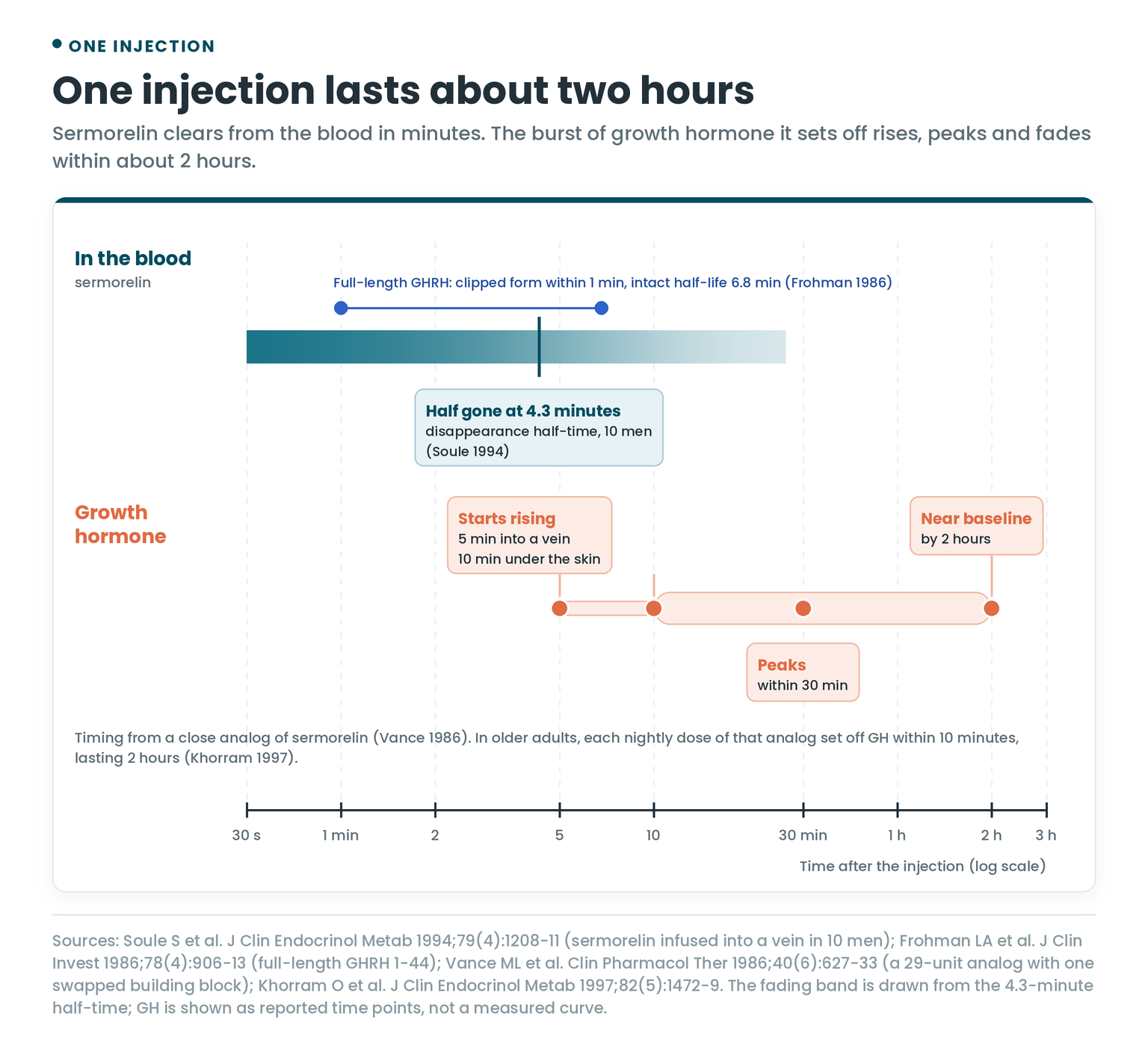
How fast does a dose act? Vance’s 1986 study used the 29-unit analog with one swapped building block. GH started rising within 5 minutes of an injection into a vein and within 10 minutes of one under the skin or into the nose. It peaked within 30 minutes and was back near baseline 2 hours after the dose.
Sermorelin itself is gone well before that. Soule and colleagues infused it into 10 men in 1994 and measured a disappearance half-time of 4.3 minutes. A modified version they tested alongside it lasted 6.7 minutes.
Frohman’s 1986 study, done with the full-length hormone, showed how it gets switched off. An enzyme in blood clips off its first two building blocks, and the clipped hormone has less than a thousandth of the original’s activity. After an injection into a vein, the clipped form showed up within a minute, and the intact hormone’s half-life was 6.8 minutes.
So each injection is one short push. The pituitary answers with a single burst of GH, and two hours later the system is back where it started. So the studies below tested schedules as well as doses, and longer-lasting relatives were built later. Our sermorelin vs CJC-1295 post compares the two clocks, and tesamorelin vs sermorelin covers another edit of the same hormone.
Under the Skin, Into a Vein or Up the Nose
The route changes the dose more than anything else.
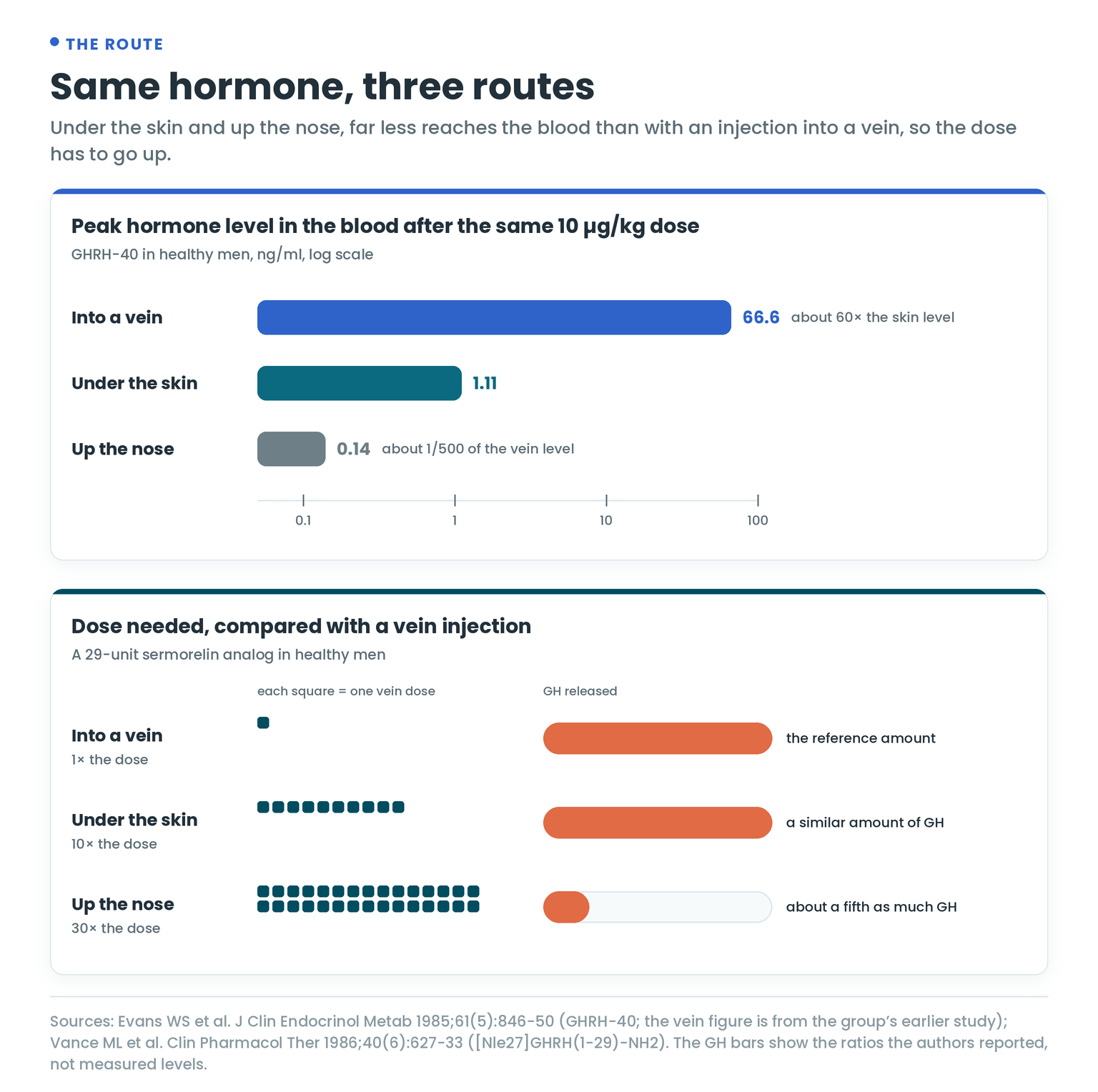
In 1985, Evans and colleagues gave healthy men GHRH-40 three ways. At the same 10 µg/kg dose, the peak level of the hormone in the blood was about 60 times higher after an injection into a vein than after one under the skin, and about 500 times higher than after a nasal dose (the vein figure came from the group’s earlier study):
- Into a vein: 66.6 ng/ml
- Under the skin: 1.11 ng/ml
- Into the nose: 0.14 ng/ml
Under the skin still worked. After a blank injection, GH rose by 10.2 ng/ml at its highest point. After 3.3 µg/kg it rose by 26.2, and after 10 µg/kg by 63.6. Nasal doses of 30 and 100 µg/kg raised GH by 18.5 and 21.7, against 2.8 after a blank spray. Every route showed a dose-response: more hormone, more GH.
Vance’s 1986 study put a number on the trade-off with the 29-unit analog. Under the skin needed 10 times the vein dose to release a similar amount of GH. The nose needed 30 times the vein dose to release about a fifth as much.
Keep that 10-fold step in mind for what comes next. The vein test uses 1 µg/kg once. The bedtime treatment dose given under the skin was 30 µg/kg.
Children: 30 µg/kg at Bedtime
The largest sermorelin treatment study gave one dose a day, under the skin, at bedtime. In 1996, Thorner’s international study group treated 110 children with GH deficiency who hadn’t reached puberty and had never been treated. They got 30 µg/kg a night for up to a year. Of the 86 included in the growth analysis:
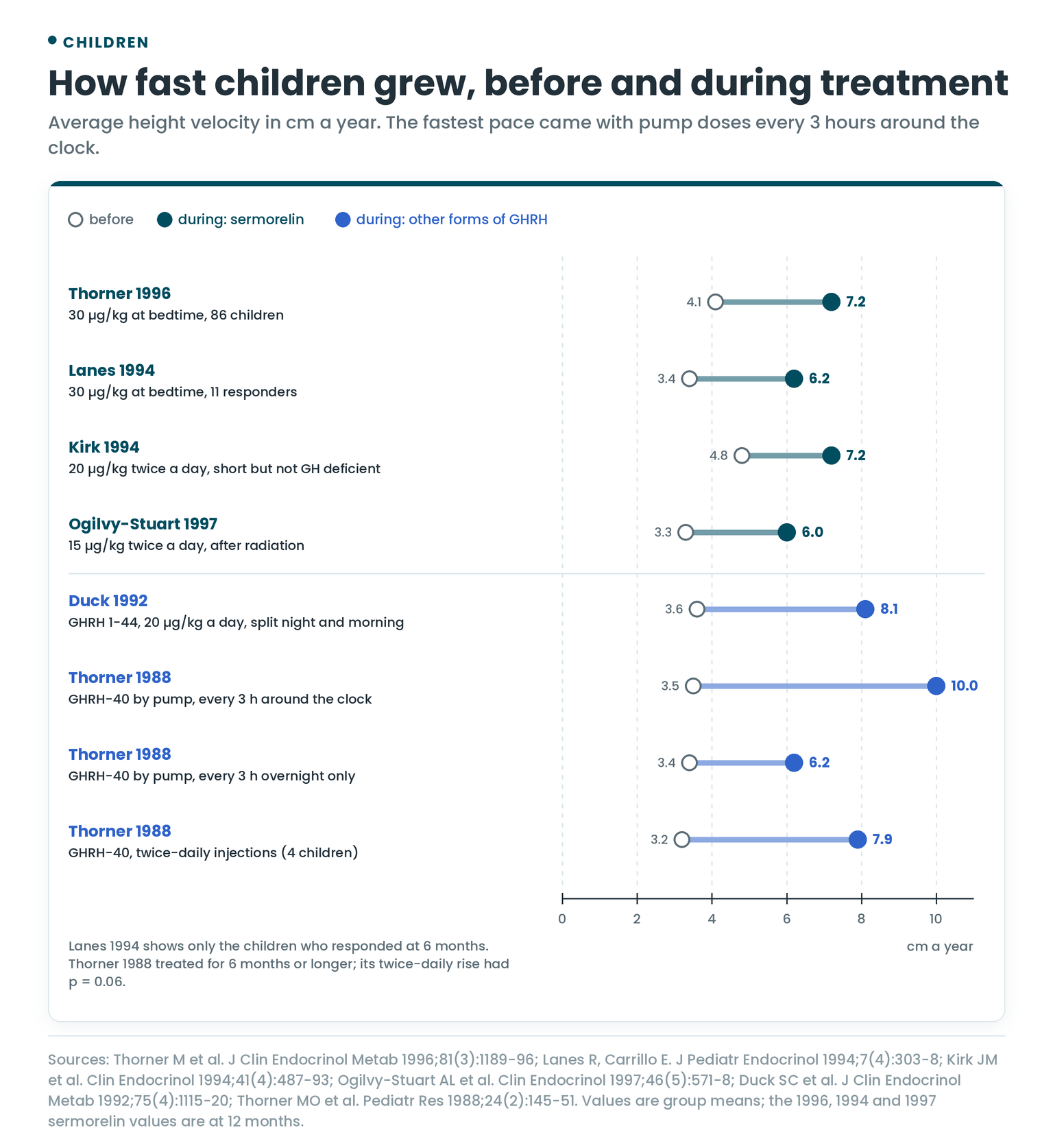
- Height velocity rose from 4.1 cm a year to 8.0 at 6 months and 7.2 at 12 months.
- 74% had a good response at 6 months.
- Bone age advanced at the same pace as height age (a ratio of 1.04).
- Fasting glucose didn’t change, and IGF-I didn’t overshoot.
As part of a multicenter study, Lanes and Carrillo used the same 30 µg/kg bedtime dose in 16 children for 12 to 24 months. At 6 months, 11 of them (68.7%) were growing more than 2 cm a year faster than before and stayed on it. The other 5 were switched to GH. In the 11 responders, height velocity went from 3.4 cm a year to 6.8, 6.2, 6.6 and 6.5 at 6, 12, 18 and 24 months. Antibodies against GHRH showed up in 4 of them at 6 months and 6 at 12, and didn’t seem to interfere with growth. No side effects were seen, and glucose and lipids held steady.
The same nightly dose was tried in children whose GH tests came back normal. Schwartz’s 2000 study gave 30 µg/kg a night for 6 months to 24 short, slow-growing children: 16 with idiopathic short stature and 8 with GH neurosecretory dysfunction, meaning normal test results but low GH output overnight. Both groups sped up by similar amounts. Six months after stopping, growth was back to the pre-treatment pace overall, though 6 of 21 kept growing faster.
Prakash and Goa’s review adds two details. A few children stayed on the bedtime dose for 36 months with their gains holding. And shorter, slower-growing children with delayed bone age tended to respond well.
Twice a Day, Three Times a Day or by Pump
Other studies split the day up in almost every way you can think of.
Twice a day. In Ross’s 1987 study, 18 children with GH deficiency injected sermorelin under the skin twice a day. Height velocity rose in 12. In 8 it rose by more than 2 cm a year in the first 6 months (by 2.7 to 11.2 cm a year) and held for up to 18 months. Fourteen children made antibodies, with no visible effect on growth. The authors wrote that ideal dose schedules still needed to be worked out.
Kirk’s 1994 study used 20 µg/kg twice a day, 40 µg/kg a day in all, for a year in 18 short children who weren’t GH deficient. Height velocity went from 4.8 to 7.2 cm a year, and predicted adult height rose by 3.4 cm. Ogilvy-Stuart’s 1997 study used 15 µg/kg twice a day in 9 children whose GH deficiency followed radiation treatment to the head. Their height velocity went from 3.3 to 6.0 cm a year, then to 7.5 the following year on GH.
Three times a day. Neyzi’s 1993 trial randomized children to two doses of sermorelin or to GH. Forty-three children with GH deficiency that started in the hypothalamus got sermorelin at 30 or 60 µg/kg a day, each split into three injections, or GH once a day, for 6 months:
- Growth was slowest on 30 µg/kg a day.
- On 60 µg/kg a day, it matched GH.
- Only GH moved height ahead relative to bone age.
In pulses. Thorner’s 1988 study used a small pump to give GHRH-40 under the skin, at 1 to 4 µg/kg per dose, on three schedules:
- Every 3 hours around the clock: height velocity went from 3.5 to 10.0 cm a year.
- Every 3 hours overnight only: from 3.4 to 6.2 cm a year.
- Twice-daily injections: from 3.2 to 7.9 cm a year (p = 0.06, in 4 children).
The schedules added up to different daily totals, and across the children the average daily dose tracked growth (r = 0.57).
Smith’s 1986 study gave GHRH-40 as four pulses under the skin each night, 1 µg/kg per pulse for 3 months and then 2 µg/kg for 6 more. In 3 of the 5 children, GH came out in pulses from the very first night. Their growth went from 3.7 cm a year to 5.5 over the first 3 months and 7.2 over the next 6. One child responded only at the higher dose, and one didn’t respond.
Smith and Brook’s 1988 comparison pointed the same way. Four nighttime pulses under the skin of GHRH 1-40 (4 to 8 µg/kg a day) produced a growth response in 73% of children. Twice-daily sermorelin (8 to 16 µg/kg a day) did it in 63%, and needed double the daily dose for the same growth. A matched group on GH grew better than either.
Ross’s 1990 study tried a slow overnight drip of sermorelin under the skin, from 9 pm to 6 am, in 5 children with GH insufficiency. The total GH released overnight rose about 2.7-fold at 5 µg/kg an hour and about 4.9-fold at 10, against placebo (8,125 and 14,816 against 3,032 mU·min/l). The number of GH pulses didn’t change significantly. At the higher rate, GH between the pulses rose too, and the authors favored 5 µg/kg an hour for keeping the pulse pattern. Brain’s 1989 report on a continuous drip under the skin in 8 children aged 6 to 9 with partial GH insufficiency found more GH and faster growth in all of them at 3 and 6 months.
Raising the dose. In Duck’s 1992 study of full-length GHRH(1-44), 20 children got at least 20 µg/kg a day, half at bedtime and half on waking. Height velocity rose from 3.6 to 8.1 cm a year over the first year. Four children growing just 5.5 cm a year at 6 months were moved up to 40 µg/kg a day, and over the next 6 months they reached 7.6, the same pace as the 16 who stayed at 20.
How did all this compare with GH itself? Prakash and Goa note that 30 µg/kg a day of sermorelin, given as a continuous infusion or in three doses, raised height velocity less than 30 µg/kg of GH once a day.
Each of those schedules leaves its own shape in a day of GH. See if you can match them:
Older Adults: 0.5 mg, 1 mg and 2 mg
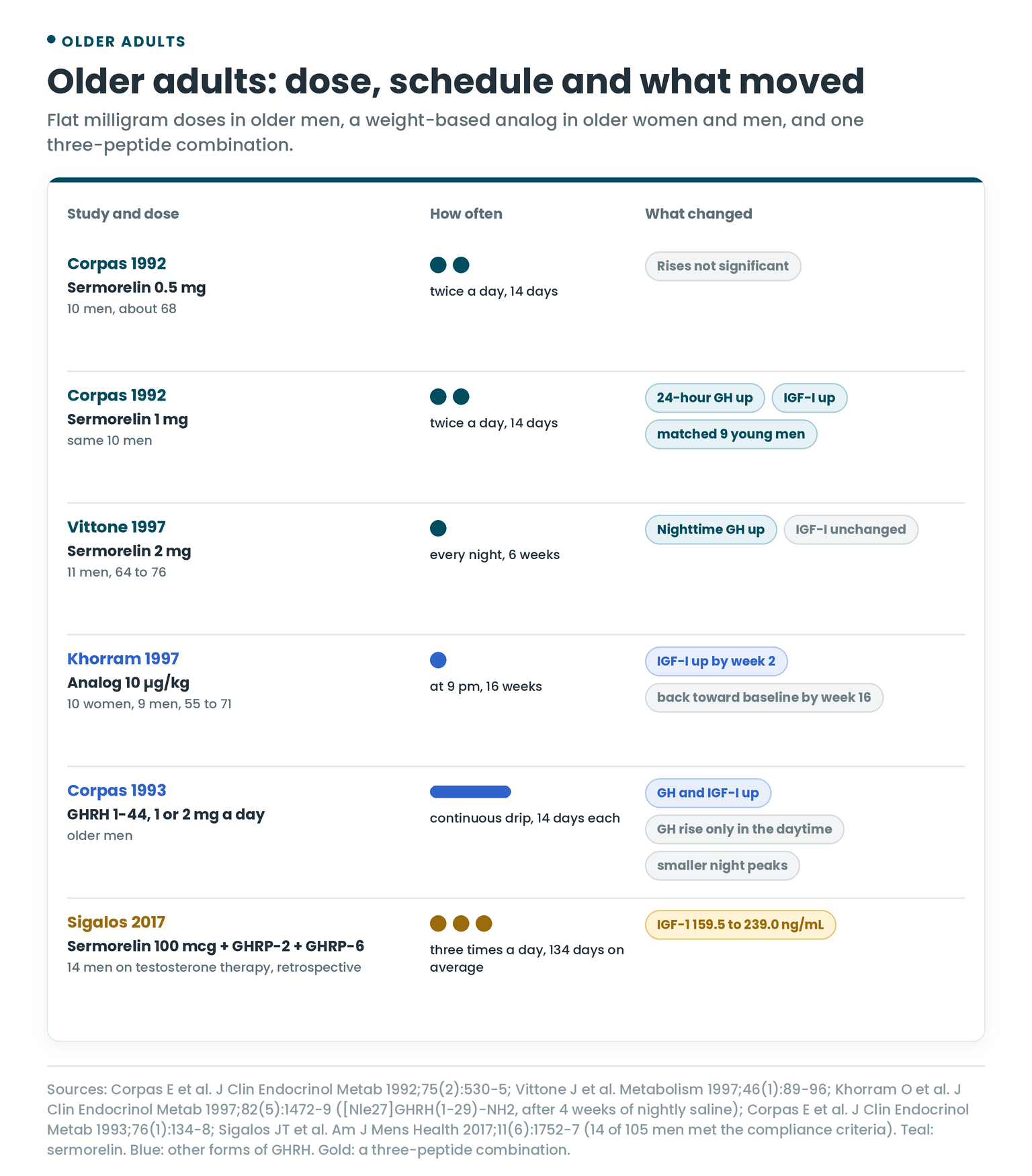
In older adults, the question shifts from growth to bringing GH and IGF-I back toward younger levels, and the doses switch to flat milligrams.
1 mg twice a day. Corpas and colleagues gave 10 healthy men with an average age of 68 two doses of sermorelin in 1992, in random order, each for 14 days with a 14-day break between: 0.5 mg twice a day and 1 mg twice a day. The response grew with the dose, but only 1 mg twice a day significantly raised 24-hour GH, the size of GH peaks and IGF-I. On that dose, the older men’s numbers no longer differed from those of 9 young men. Fasting glucose, blood pressure and routine blood tests didn’t change. Blood phosphate went up.
2 mg once a night. In Vittone’s 1997 study, 11 men aged 64 to 76 with low IGF-I injected 2 mg at home every night for 6 weeks. Nighttime GH went up: its average level, the area under its peaks and the height of the peaks. IGF-I didn’t. Two of six strength tests (the upright row and shoulder press) and an abdominal crunch endurance test improved, while weight, fat and muscle on DEXA scans held steady. No significant side effects showed up. The authors concluded that single nightly doses work less well than several doses a day.
10 µg/kg every night. Khorram’s 1997 trial used the 29-unit analog, injected at 9 pm. Ten women and 9 men aged 55 to 71 took nightly saline for 4 weeks, then the analog at 10 µg/kg for 16 weeks:
- Each injection set off GH within 10 minutes, lasting 2 hours, and that held for the whole study.
- IGF-I rose within 2 weeks, stayed up through week 12 and drifted back toward baseline by week 16.
- Skin got thicker in both sexes.
- Lean mass, insulin sensitivity, well-being and libido went up in the men only.
- The one side effect was a temporary rise in blood fats that cleared by the end.
A drip instead of shots. In a 1993 follow-up, Corpas’s group gave older men full-length GHRH(1-44) as a continuous infusion under the skin, at 1 mg and 2 mg a day for 14 days each. Both doses raised GH and IGF-I and added more GH pulses. The significant rises in GH came only in the daytime, between 8 am and 8 pm, though, and nighttime GH peaks got smaller and shorter.
100 mcg three times a day, with two other peptides. The most recent study here is a 2017 chart review. John Sigalos and colleagues looked back at 105 men on testosterone therapy who were given 100 mcg each of sermorelin, GHRP-2 and GHRP-6, three times a day. Fourteen met strict compliance criteria. In them, IGF-1 went from 159.5 to 239.0 ng/mL over an average of 134 days, and men also taking estrogen blockers had smaller rises. It’s a retrospective look at a three-peptide combination, so the rise belongs to the combination.
Why Bedtime?
Most of these schedules put a dose at night, and the body’s own rhythm is the reason. Van Cauter and Plat’s 1996 review lays it out:
- In adults, the most dependable GH pulse comes shortly after falling asleep, with the first stretch of deep slow-wave sleep.
- In men, about 70% of GH pulses during sleep line up with slow-wave sleep.
- That sleep-onset pulse depends mainly on the body’s own GHRH, and it’s often the biggest GH release of the day.
- Between ages 30 and 40, total daily GH output falls two- to threefold, and deep sleep drops off over the same years.
GHRH also seems to deepen sleep. In Kerkhofs’s 1993 study, healthy young men got a small 0.3 µg/kg dose of GHRH into a vein during the night. Given in the third REM period, late in the night, it cut time awake and raised slow-wave sleep almost 10-fold. Given at the start of the night, it raised REM sleep instead. Our sleep post covers the peptides tested in sleep labs.
The body still sets the rhythm. Achermann’s 1999 study ran sermorelin into healthy adults as a steady drip under the skin for 24 hours, at 60 ng/kg a minute. GH peaks got about three times bigger (a median of 21.1 rising to 62.0 mU/l), but they arrived at the same times as before. When the steady drip was paired with on-off pulses of somatostatin, the hormone that holds GH back, a burst of GH followed each time the somatostatin switched off. The authors concluded that a steady GHRH signal plus on-off somatostatin can generate the GH pulse pattern.
What Changed Over the Months
Several studies followed what happened as dosing went on:
- Antibodies. Children made antibodies to GHRH in Ross’s study (14 of 18), Lanes’s (up to 6 of 11 responders) and Thorner’s 1988 pump study (11 children). In all three, growth kept going.
- The pituitary’s answer. Over Kirk’s year of twice-daily dosing, overnight GH and the response to test doses both fell, while IGF-I, fasting glucose and insulin rose. Neyzi saw the reverse at 30 µg/kg a day, with test responses building up. Smith’s nightly pulses also drew bigger responses over time and at the higher dose, and Ross’s 1987 study found no consistent shift either way.
- IGF-I in older adults. In Khorram’s trial it rose early and eased back toward baseline by week 16 of nightly injections.
- After stopping. Kirk’s children grew more slowly than their old pace for 3 months (3.89 cm a year), then returned to it. Schwartz’s group was back to pre-treatment growth 6 months after the last dose.
Side Effects at These Doses
The studies here reported few side effects. Prakash and Goa list temporary facial flushing and pain at the injection site as the most common. The specific findings:
- 30 µg/kg at bedtime in children: no change in fasting glucose (Thorner 1996), or in glucose and lipids (Lanes).
- 20 µg/kg twice a day in short children: fasting glucose and insulin rose (Kirk).
- 1 mg twice a day in older men: no change in fasting glucose, urinary C-peptide or blood pressure (Corpas 1992).
- 2 mg nightly in older men: no significant adverse effects (Vittone).
- 10 µg/kg nightly of the analog: a temporary rise in blood fats (Khorram).
For the longer-term questions, including IGF-I and cancer risk, see our sermorelin side effects post. Joe’s sermorelin overview covers the basics.
Doses Used in the Research
- Diagnostic test: 1 µg/kg sermorelin, once, into a vein (Prakash 1999); 1 µg/kg GHRH(1-44) in men aged 21 to 86 (Pavlov 1986).
- Children, once a day: 30 µg/kg under the skin at bedtime, for 6 months to 2 years (Thorner 1996, Lanes 1994, Schwartz 2000).
- Children, twice a day: 15 µg/kg (Ogilvy-Stuart 1997) or 20 µg/kg (Kirk 1994) per dose, for a year.
- Children, three times a day: 30 or 60 µg/kg a day in total, for 6 months (Neyzi 1993).
- Children, overnight drip: 5 or 10 µg/kg an hour, 9 pm to 6 am (Ross 1990).
- Older men, twice a day: 0.5 mg or 1 mg per dose, 14 days each (Corpas 1992).
- Older men, once a night: 2 mg for 6 weeks (Vittone 1997).
- Older adults, analog: 10 µg/kg at 9 pm for 16 weeks (Khorram 1997).
- Men on testosterone therapy: 100 mcg three times a day alongside GHRP-2 and GHRP-6, for 134 days on average (Sigalos 2017, retrospective).
- Healthy adults, steady drip: 60 ng/kg a minute for 24 hours (Achermann 1999).
Frequently Asked Questions
How much sermorelin was injected in the studies?
It depended on the purpose. A one-off diagnostic test used 1 µg/kg into a vein. The largest children’s study used 30 µg/kg under the skin at bedtime, and older men got 0.5 mg to 2 mg per injection.
Why was sermorelin given at bedtime?
The body’s most dependable GH pulse comes soon after falling asleep and depends mainly on its own GHRH. The largest children’s study gave its 30 µg/kg dose at bedtime.
How long does one injection last?
Sermorelin’s disappearance half-time in men was 4.3 minutes. With a close analog, GH rose within 10 minutes of an injection under the skin, peaked within 30 and was near baseline by 2 hours.
Was once a day enough in older men?
In one study, 2 mg once a night for 6 weeks raised nighttime GH but not IGF-I. In another, 1 mg twice a day raised both GH and IGF-I to young men’s levels within 14 days.
Did higher doses work better in children?
In Neyzi’s randomized trial, 60 µg/kg a day of sermorelin matched GH for growth, while 30 µg/kg a day gave the slowest growth. In a study of full-length GHRH, slow responders moved from 20 to 40 µg/kg a day caught up with the rest.
Does sermorelin work as a nasal spray?
Nasal doses raised GH, but it took far more. With a close analog, the nose needed 30 times the vein dose to release about a fifth as much GH.
Stay sharp,
Joe Mars
The Peptide Report
P.S. Got a question about sermorelin schedules or the studies behind them? Bring it to the Peptides & Biohacking Hub on Skool.
References
- Prakash A, Goa KL. Sermorelin: a review of its use in the diagnosis and treatment of children with idiopathic growth hormone deficiency. BioDrugs. 1999;12(2):139-157. doi:10.2165/00063030-199912020-00007
- Biller BMK, Samuels MH, Zagar A, Cook DM, Arafah BM, Bonert V, et al. Sensitivity and specificity of six tests for the diagnosis of adult GH deficiency. J Clin Endocrinol Metab. 2002;87(5):2067-2079. doi:10.1210/jcem.87.5.8509
- Pavlov EP, Harman SM, Merriam GR, Gelato MC, Blackman MR. Responses of growth hormone (GH) and somatomedin-C to GH-releasing hormone in healthy aging men. J Clin Endocrinol Metab. 1986;62(3):595-600. doi:10.1210/jcem-62-3-595
- Vance ML, Evans WS, Kaiser DL, Burke RL, Rivier J, Vale W, Thorner MO. The effect of intravenous, subcutaneous, and intranasal GH-RH analog, [Nle27]GHRH(1-29)-NH2, on growth hormone secretion in normal men: dose-response relationships. Clin Pharmacol Ther. 1986;40(6):627-633. doi:10.1038/clpt.1986.237
- Soule S, King JA, Millar RP. Incorporation of D-Ala2 in growth hormone-releasing hormone-(1-29)-NH2 increases the half-life and decreases metabolic clearance in normal men. J Clin Endocrinol Metab. 1994;79(4):1208-1211. doi:10.1210/jcem.79.4.7962295
- Frohman LA, Downs TR, Williams TC, Heimer EP, Pan YC, Felix AM. Rapid enzymatic degradation of growth hormone-releasing hormone by plasma in vitro and in vivo to a biologically inactive product cleaved at the NH2 terminus. J Clin Invest. 1986;78(4):906-913. doi:10.1172/JCI112679
- Evans WS, Vance ML, Kaiser DL, Sellers RP, Borges JL, Downs TR, et al. Effects of intravenous, subcutaneous, and intranasal administration of growth hormone (GH)-releasing hormone-40 on serum GH concentrations in normal men. J Clin Endocrinol Metab. 1985;61(5):846-850. doi:10.1210/jcem-61-5-846
- Thorner M, Rochiccioli P, Colle M, Lanes R, Grunt J, Galazka A, et al. Once daily subcutaneous growth hormone-releasing hormone therapy accelerates growth in growth hormone-deficient children during the first year of therapy. Geref International Study Group. J Clin Endocrinol Metab. 1996;81(3):1189-1196. doi:10.1210/jcem.81.3.8772599
- Lanes R, Carrillo E. Long-term therapy with a single daily subcutaneous dose of growth hormone releasing hormone (1-29) in prepubertal growth hormone deficient children. Venezuelan Collaborative Study Group. J Pediatr Endocrinol. 1994;7(4):303-308. doi:10.1515/jpem.1994.7.4.303
- Schwartz ID, Grunt JA, Berg S, Jacobson JD, Moore WV, Howard CP. Growth during and after a trial of growth hormone releasing hormone 1-29 in children with idiopathic short stature or growth hormone neurosecretory dysfunction. J Pediatr Endocrinol Metab. 2000;13(6):645-650. doi:10.1515/jpem.2000.13.6.645
- Ross RJ, Rodda C, Tsagarakis S, Davies PS, Grossman A, Rees LH, et al. Treatment of growth-hormone deficiency with growth-hormone-releasing hormone. Lancet. 1987;1(8523):5-8. doi:10.1016/s0140-6736(87)90699-4
- Kirk JM, Trainer PJ, Majrowski WH, Murphy J, Savage MO, Besser GM. Treatment with GHRH(1-29)NH2 in children with idiopathic short stature induces a sustained increase in growth velocity. Clin Endocrinol (Oxf). 1994;41(4):487-493. doi:10.1111/j.1365-2265.1994.tb02580.x
- Ogilvy-Stuart AL, Stirling HF, Kelnar CJ, Savage MO, Dunger DB, Buckler JM, Shalet SM. Treatment of radiation-induced growth hormone deficiency with growth hormone-releasing hormone. Clin Endocrinol (Oxf). 1997;46(5):571-578. doi:10.1046/j.1365-2265.1997.1790998.x
- Neyzi O, Yordam N, Ocal G, Bundak R, Darendeliler F, Açikgöz E, et al. Growth response to growth hormone-releasing hormone(1-29)-NH2 compared with growth hormone. Acta Paediatr Suppl. 1993;388:16-21. doi:10.1111/j.1651-2227.1993.tb12828.x
- Thorner MO, Rogol AD, Blizzard RM, Klingensmith GJ, Najjar J, Misra R, et al. Acceleration of growth rate in growth hormone-deficient children treated with human growth hormone-releasing hormone. Pediatr Res. 1988;24(2):145-151. doi:10.1203/00006450-198808000-00001
- Smith PJ, Brook CG, Rivier J, Vale W, Thorner MO. Nocturnal pulsatile growth hormone releasing hormone treatment in growth hormone deficiency. Clin Endocrinol (Oxf). 1986;25(1):35-44. doi:10.1111/j.1365-2265.1986.tb03593.x
- Smith PJ, Brook CG. Growth hormone releasing hormone or growth hormone treatment in growth hormone insufficiency? Arch Dis Child. 1988;63(6):629-634. doi:10.1136/adc.63.6.629
- Ross RJ, Kirk JM, Tsagarakis S, Trainer PJ, Ciccarelli E, Touzel R, et al. Subcutaneous growth hormone-releasing hormone augments pulsatile nocturnal GH release in GH-insufficient children, but may also raise basal GH secretion. Clin Endocrinol (Oxf). 1990;33(2):239-248. doi:10.1111/j.1365-2265.1990.tb00488.x
- Brain C, Hindmarsh PC, Pringle PJ, Brook CG. Use of continuous subcutaneous growth hormone-releasing hormone (GHRH (1-29)NH2) infusions to augment growth hormone secretion and to promote growth. Acta Paediatr Scand Suppl. 1989;349:109-113. doi:10.1111/j.1651-2227.1989.tb17180.x
- Duck SC, Schwarz HP, Costin G, Rapaport R, Arslanian S, Hayek A, et al. Subcutaneous growth hormone-releasing hormone therapy in growth hormone-deficient children: first year of therapy. J Clin Endocrinol Metab. 1992;75(4):1115-1120. doi:10.1210/jcem.75.4.1400880
- Corpas E, Harman SM, Piñeyro MA, Roberson R, Blackman MR. Growth hormone (GH)-releasing hormone-(1-29) twice daily reverses the decreased GH and insulin-like growth factor-I levels in old men. J Clin Endocrinol Metab. 1992;75(2):530-535. doi:10.1210/jcem.75.2.1379256
- Vittone J, Blackman MR, Busby-Whitehead J, Tsiao C, Stewart KJ, Tobin J, et al. Effects of single nightly injections of growth hormone-releasing hormone (GHRH 1-29) in healthy elderly men. Metabolism. 1997;46(1):89-96. doi:10.1016/s0026-0495(97)90174-8
- Khorram O, Laughlin GA, Yen SS. Endocrine and metabolic effects of long-term administration of [Nle27]growth hormone-releasing hormone-(1-29)-NH2 in age-advanced men and women. J Clin Endocrinol Metab. 1997;82(5):1472-1479. doi:10.1210/jcem.82.5.3943
- Corpas E, Harman SM, Piñeyro MA, Roberson R, Blackman MR. Continuous subcutaneous infusions of growth hormone (GH) releasing hormone 1-44 for 14 days increase GH and insulin-like growth factor-I levels in old men. J Clin Endocrinol Metab. 1993;76(1):134-138. doi:10.1210/jcem.76.1.8421077
- Sigalos JT, Pastuszak AW, Allison A, Ohlander SJ, Herati A, Lindgren MC, Lipshultz LI. Growth hormone secretagogue treatment in hypogonadal men raises serum insulin-like growth factor-1 levels. Am J Mens Health. 2017;11(6):1752-1757. doi:10.1177/1557988317718662
- Van Cauter E, Plat L. Physiology of growth hormone secretion during sleep. J Pediatr. 1996;128(5 Pt 2):S32-S37. doi:10.1016/s0022-3476(96)70008-2
- Kerkhofs M, Van Cauter E, Van Onderbergen A, Caufriez A, Thorner MO, Copinschi G. Sleep-promoting effects of growth hormone-releasing hormone in normal men. Am J Physiol. 1993;264(4 Pt 1):E594-E598. doi:10.1152/ajpendo.1993.264.4.E594
- Achermann JC, Hindmarsh PC, Robinson IC, Matthews DR, Brook CG. The relative roles of continuous growth hormone-releasing hormone (GHRH(1-29)NH2) and intermittent somatostatin(1-14)(SS) in growth hormone (GH) pulse generation: studies in normal and post cranial irradiated individuals. Clin Endocrinol (Oxf). 1999;51(5):575-585. doi:10.1046/j.1365-2265.1999.00839.x