You’ve got a vial of white powder, a bottle of water and a syringe. Now what?
Reconstituting peptides sounds technical, but it comes down to three things: the right liquid, the right math and clean technique. Get those right and every dose you draw is the dose you think it is.
Here’s the whole process step by step, including the syringe math that trips up most people the first time.
What Does Reconstituting Peptides Mean?
Most peptides ship as a freeze-dried (lyophilized) powder, because peptides are far more stable dry than in liquid. Reconstituting simply means adding a sterile liquid to turn that powder back into a solution you can measure.
Two things are worth knowing before you start.
The powder in the vial isn’t 100% peptide. Peptide powders typically run 70 to 90% peptide by weight, and the rest is counter-ions (such as acetate or TFA) and a little water. That’s what “net peptide content” on a lab report refers to.
Freeze-dried vials are also often sealed under vacuum. When the needle goes in, the vial can pull the liquid in on its own, so keep a thumb on the plunger.
Choosing the Right Solvent
| Solvent | What it is | Best for |
|---|---|---|
| Bacteriostatic water | Sterile water with about 0.9% benzyl alcohol as a preservative | Most peptides, and any vial you’ll draw from more than once |
| Sterile water for injection | Sterile water with no preservative, packaged as single-dose | A vial you’ll use up quickly |
| Dilute acetic acid | A mild acid solution | Peptides that dissolve better in acid, when the maker specifies it |
Bacteriostatic water is the default for a reason. The benzyl alcohol keeps bacteria from growing, so it’s built for vials you’ll go back into again and again. Write the date on the water vial when you open it. The CDC standard for opened multi-dose vials is to discard them within 28 days.
Sterile water for injection has no preservative. Its label says to discard any unused portion right after you draw from it.
A few peptides dissolve better in mild acid. The maker of LONG R3 IGF-1, for example, recommends 100 mM acetic acid, which works out to about 0.6%. Whenever your peptide’s supplier names a specific solvent, use that one.
Calculating the Correct Concentration
This is the part that confuses people, and it’s simple once you see it.
You need two numbers: how much peptide is in the vial (in mg) and how much liquid you add (in mL). Divide the first by the second and you have your concentration.
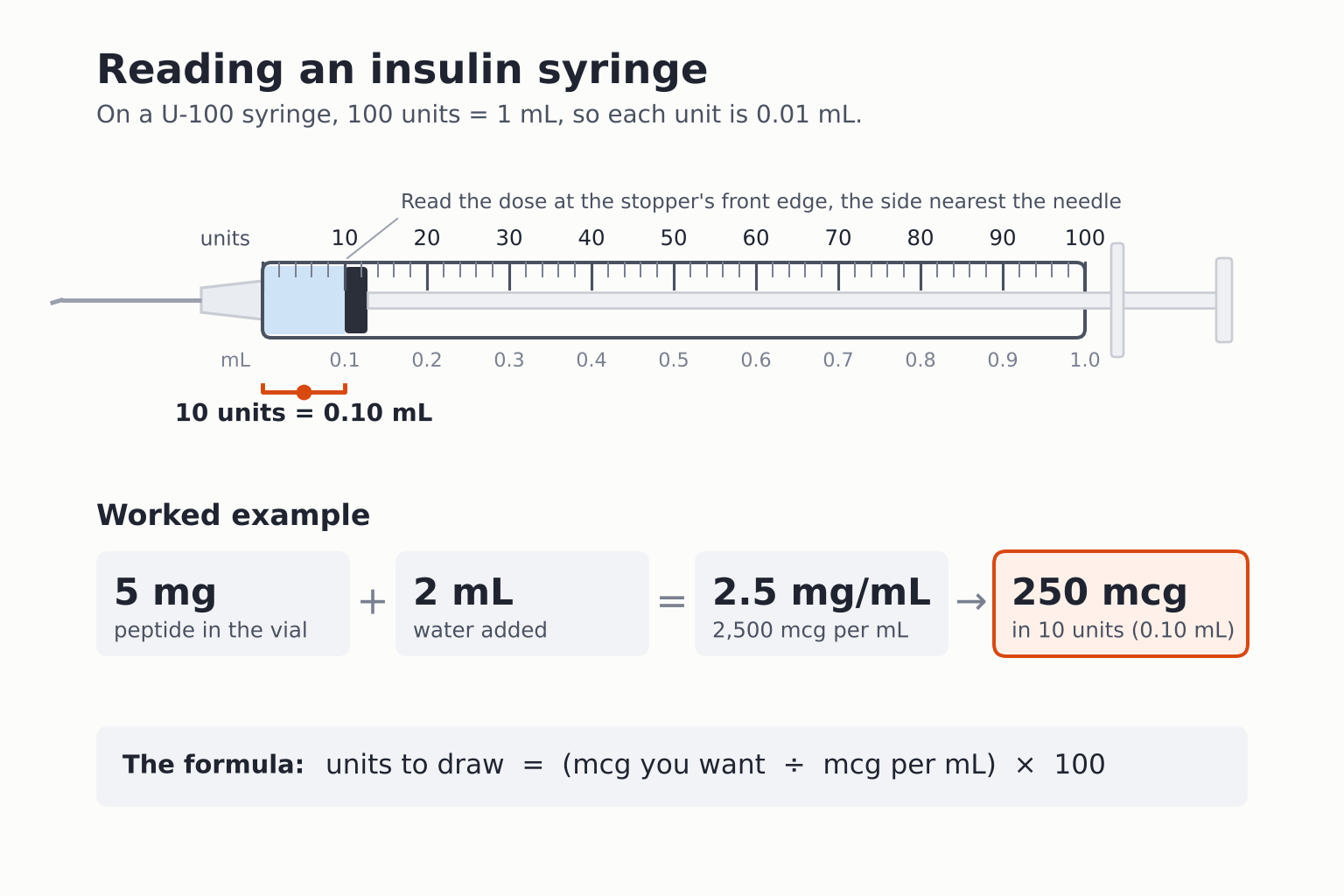
Then the syringe. A standard U-100 insulin syringe holds 100 units per mL, so 1 unit is 0.01 mL. A “unit” on the syringe is a volume, not a dose. What’s in each unit depends entirely on how much water you added.
The formula:
Units to draw = (amount you want in mcg ÷ concentration in mcg per mL) × 100
Example: a 5 mg vial with 2 mL of water gives you 2.5 mg/mL, or 2,500 mcg per mL. To draw 250 mcg, divide 250 by 2,500 to get 0.1 mL, which is 10 units on the syringe.
Here’s the same math for common setups:
| Vial | Water added | Concentration | 10 units contains |
|---|---|---|---|
| 2 mg | 1 mL | 2 mg/mL | 200 mcg |
| 5 mg | 1 mL | 5 mg/mL | 500 mcg |
| 5 mg | 2 mL | 2.5 mg/mL | 250 mcg |
| 10 mg | 2 mL | 5 mg/mL | 500 mcg |
| 10 mg | 3 mL | 3.33 mg/mL | 333 mcg |
My tip: pick a water volume that makes the math easy. More water spreads each dose over more units, which makes small amounts easier to measure accurately.
If you want the numbers for specific peptides, my peptide dosage chart has them.
Setting Up Your Workspace
Before you touch a vial, get everything in one place:
- The peptide vial
- Your solvent
- Alcohol prep pads
- New, sterile syringes
- A sharps container for used needles
Wash your hands and wipe down a clean, flat surface. Five minutes of setup keeps the whole vial sterile for every dose that follows.
Step-by-Step Guide to Reconstituting Peptides
- Bring it to room temperature. If the vial has been in the freezer or fridge, let it warm up first so moisture from the air doesn’t condense inside.
- Swab both stoppers. Pop the plastic caps, wipe the rubber tops of the peptide vial and the solvent vial with an alcohol pad, and let them dry before the needle goes in.
- Draw your solvent. Use a new sterile syringe to pull the exact volume you planned for your concentration.
- Add it slowly, down the glass. Angle the needle so the liquid runs down the inside wall of the vial rather than blasting onto the powder. If the vacuum starts pulling, control it with your thumb.
- Swirl, don’t shake. Gently swirl the vial or roll it between your fingers until the powder dissolves. Shaking whips air into the solution, and that air-liquid contact makes protein molecules clump together. Some peptides take a few minutes to dissolve fully.
- Check it. The solution should be clear with no floating particles. If it stays cloudy, the peptide may need the solvent its maker specifies.
- Label and refrigerate. Write the date and concentration on the vial, then put it in the fridge.
Needle Size and Gauge Recommendations
Insulin syringes are the standard tool here, and they come in three sizes: 0.3 mL, 0.5 mL and 1 mL. The 0.3 mL size is the easiest to read when you’re drawing small volumes, and some versions are marked in half units.
The needles on these syringes are usually 28 to 31 gauge. The higher the number, the thinner the needle. Common lengths are 6 mm, 8 mm and 12.7 mm.
For adding the solvent itself, use a syringe big enough to hold the full volume in one draw, or simply draw twice.
Can You Reuse Syringes and Needles?
Syringes and needles are single-use. The CDC’s rule is a new needle and a new syringe every time you go into a vial, because once a syringe has been used, both the needle and the syringe count as contaminated. Swapping the needle onto a used syringe still leaves the syringe contaminated.
There’s a comfort reason too. Under a microscope, reused needles have been shown to turn blunt and bent at the tip, which makes injections more painful.
Shelf Life of Reconstituted Peptides
As a powder: the freezer at −20 °C or colder is best for long-term storage, and many peptides keep for several years that way. The fridge works for shorter stretches, and peptides ship at room temperature without trouble.
In solution: keep the vial in the fridge at 2 to 8 °C. General guidance from peptide manufacturers is about a week at 4 °C, and some peptides last longer. Your peptide’s own data and the supplier’s instructions come first.
If you need it to last longer, split the solution into single-use portions and freeze them, then thaw each portion once.
One clarification that saves a lot of confusion: the 28-day date on bacteriostatic water is about keeping the water vial itself sterile. The peptide in your mixed vial runs on its own clock, which is usually shorter.
Peptide Degradation Factors
Here’s what breaks peptides down, and how to stay ahead of each one:
- Oxidation: peptides containing cysteine, methionine or tryptophan oxidize in solution, and cysteine oxidizes faster above pH 7.
- Deamidation: asparagine and glutamine slowly convert in solution, especially at higher pH.
- Clumping: shaking and foaming push peptides to clump at the air-liquid surface.
- Moisture: dry powder pulls water from the air, which is why the vial should warm up before you open it.
- Heat and light: store vials cold and away from bright light.
- Freeze-thaw cycles: each one stresses the peptide, which is why single-use portions beat refreezing one vial.
Solutions also hold up best at a mildly acidic pH of about 5 to 6.
Finding Quality Peptides
Good technique starts with a good vial. Before you mix anything, check the batch’s certificate of analysis (COA) for three things: identity confirmed by mass spectrometry, purity by HPLC, and ideally the net peptide content.
I go through exactly what to look for in my guide on how to judge a supplier.
Bottom Line
Reconstituting peptides is simple once you have the system: bacteriostatic water for most vials, a clean setup, liquid down the side of the glass, a gentle swirl and a label with the date and concentration.
The math is one formula: units equal the amount you want divided by your concentration, times 100. Pick a water volume that makes that easy.
Store the powder cold, keep the mixed vial in the fridge, and use a fresh syringe every time.
Frequently Asked Questions About Reconstituting Peptides
What do you mix peptides with?
Most peptides are mixed with bacteriostatic water, which is sterile water with about 0.9% benzyl alcohol to keep bacteria from growing. A few peptides dissolve better in dilute acetic acid, and the supplier’s instructions should name it when that’s the case.
How much bacteriostatic water do I add to a peptide vial?
Any volume works, as long as you know it. Common choices are 1 to 3 mL. Divide the mg in the vial by the mL you add to get your concentration, and pick a volume that makes your doses easy to measure.
How many units are in 1 mL on an insulin syringe?
A U-100 insulin syringe holds 100 units per mL, so each unit is 0.01 mL. How much peptide is in a unit depends on how much water you added to the vial.
How long do reconstituted peptides last in the fridge?
General guidance from peptide manufacturers is about a week at 4 °C, and some peptides last longer. For longer storage, freeze the solution in single-use portions and thaw each one only once.
Should you shake a peptide vial?
No. Swirl it gently or roll it between your fingers. Shaking creates foam, and the air-liquid contact makes peptide molecules clump together.
Can you reuse an insulin syringe?
Syringes and needles are single-use. Use a new needle and a new syringe every time you draw from a vial, to keep both you and the vial sterile.
Can you freeze reconstituted peptides?
Yes, in single-use portions. Each freeze-thaw cycle stresses the peptide, so thaw each portion once and use it.
References
- Centers for Disease Control and Prevention. Injection safety: clinical safety and multi-dose vials. CDC
- Centers for Disease Control and Prevention. Injection safety: clinical guidance. CDC
- United States Pharmacopeia. USP General Chapter <797> FAQs, December 2023. USP
- Pfizer (Hospira). Bacteriostatic Water for Injection prescribing information. Pfizer
- American Regent. Sterile Water for Injection label. MedLibrary
- Bachem. Handling and storage guidelines for peptides. Bachem
- Bachem. What does net peptide content mean? Bachem
- GenScript. Peptide storage and handling. GenScript
- GenScript. Peptide solubility guidelines. GenScript
- Sigma-Aldrich. Handling and storage guidelines for peptides.
- Repligen. LONG R3 IGF-I frequently asked questions.
- Li J, et al. Interfacial stress in the development of biologics: fundamental understanding, current practice, and future perspective. AAPS J. 2019;21:44. Springer
- BD. BD insulin syringes with BD Ultra-Fine needle, product information.
Stay sharp,
Joe Mars
The Peptide Report
P.S. Mixing your first vial and want a second set of eyes on your math? Ask inside the Peptides and Biohacking Hub on Skool. Free community, real protocols, and people actually running this stuff. Join here.