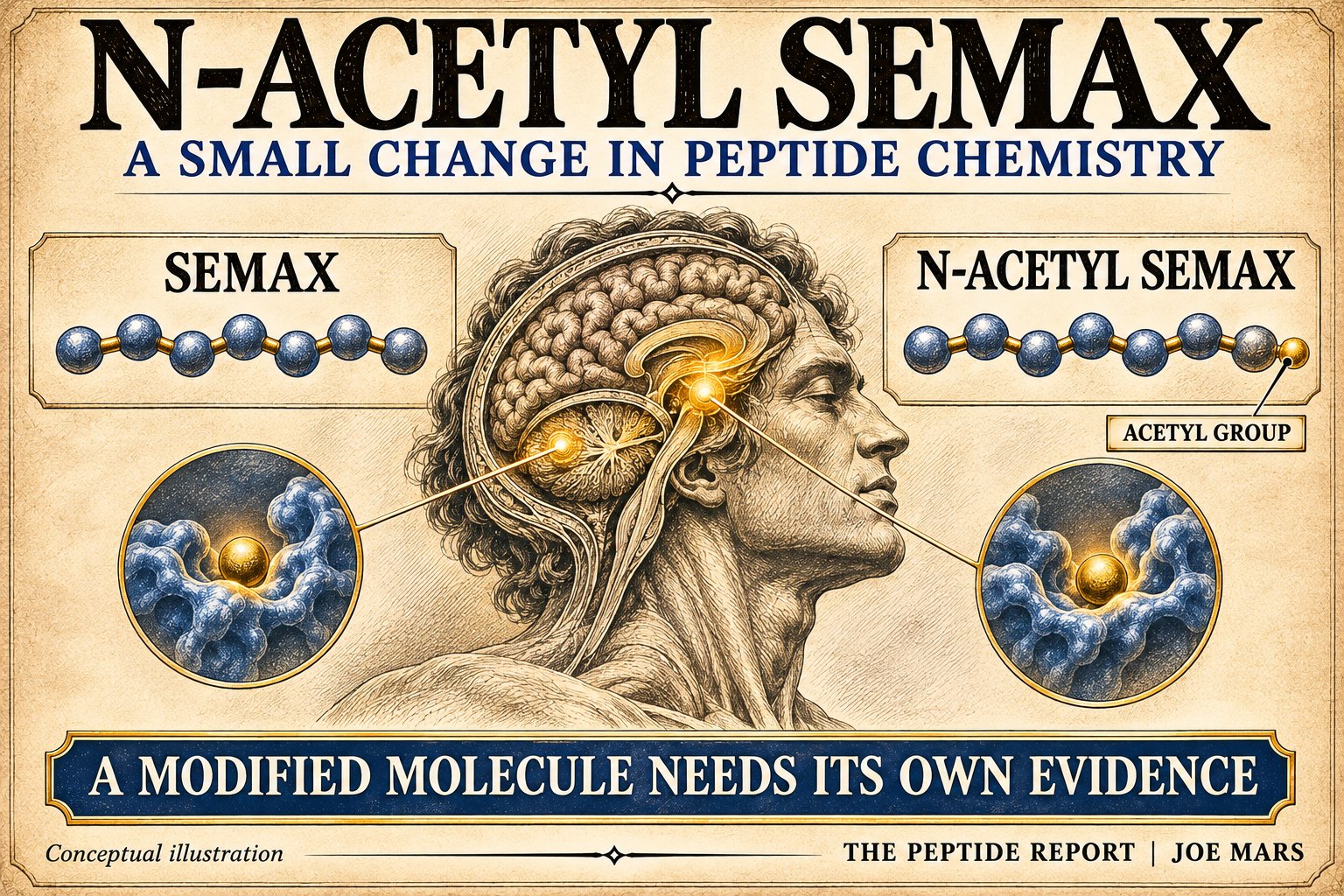
N-Acetyl Semax often gets introduced as the upgraded version of Semax. Better absorption, stronger effects, longer duration. The explanation usually moves on before showing the study behind those claims.
I wanted to slow that down. Adding an acetyl group is a real chemical change, and there is research on what it does to Semax. The interesting part is that the result is more complicated than a simple upgrade.
What Is N-Acetyl Semax?
Standard Semax is a seven-amino-acid peptide with the sequence Met-Glu-His-Phe-Pro-Gly-Pro. N-acetylation adds an acetyl group to its amino end, often called the N-terminus. The rest of that seven-unit sequence can remain the same while the end group changes.
An end group matters because it can take part in chemical interactions. Changing it can alter how a peptide behaves around enzymes, metals, and other molecules. Whether that is helpful depends on the property being measured.
The parent peptide’s research is covered in my Semax overview. This article focuses on the acetyl modification so the two pages answer different questions.
N-Acetyl Semax Is Not the Same Name as Semax Acetate
These names are easy to mix up. “Acetate” describes a salt form; “N-acetyl” describes a group attached to the peptide itself. A product labeled Semax acetate is not automatically N-Acetyl Semax.
“Amidate” describes another change, at the other end of the chain. N-Acetyl Semax and N-Acetyl Semax Amidate therefore should not be assumed to mean the same molecule. The N-Acetyl Semax Amidate article looks at the two end modifications together.
The Copper Study: A Small Change With a Different Result
A 2016 study by Magrì and colleagues directly compared Semax with N-terminally acetylated Semax. The researchers studied how the two interacted with copper and zinc, then examined biological effects in a human neuroblastoma cell line.
Acetylation changed the way Semax coordinated copper. In the copper-toxicity experiment, the acetylated version did not preserve the protective effect associated with the parent peptide. The free amino end appeared important for that particular result.
Both peptides could bind zinc with comparable strength, and the study also examined zinc movement in cells. This was chemistry and cell research, not a trial measuring memory, focus, or anxiety in people.
I would not use this paper to claim that N-Acetyl Semax harms the brain. It does show why changing a molecule can remove an effect as well as add one. “Modified” tells us what was done; it does not tell us the clinical outcome.
Does Acetylation Make Semax Last Longer?
Protecting a peptide’s end from certain enzymes is one reason scientists investigate chemical caps. But the general reason for making a modification is not a measured half-life for the finished molecule in people.
Before accepting a duration claim, I would want the actual compound name, administration route, sampling method, and exposure measurements. A testimonial that something “felt stronger” does not supply those details.
I did not find a controlled human comparison establishing that N-Acetyl Semax has better absorption, a longer duration, or stronger cognitive effects than standard Semax. That is the central gap behind the upgrade claims, rather than something that needs repeating under every heading.
BDNF and Neuroprotection: Which Molecule Was Tested?
The well-known hippocampal BDNF experiment tested Semax in rats. It did not compare acetylated Semax with the original. A citation can be relevant background without proving the claims made for a different version.
The same check matters for stress relief, memory, motivation, and protection from brain injury. If a page cites a parent-Semax study, I want that identified clearly. Otherwise several products can end up borrowing the same experiment while being described as separate breakthroughs.
Why Selank Does Not Answer the Semax Question
Selank has its own peptide sequence and research history. It often appears beside Semax because both come up in discussions of anxiety and cognition, but its results cannot fill a gap in an N-Acetyl Semax article.
For a useful comparison, I keep the two compounds distinct in Semax vs. Selank. Research on one molecule is not a substitute for testing another.
Dosage, Formulation, and Product Labels
A standard-Semax study dose should not be presented as a validated N-Acetyl Semax dose. Neither should an online range become a recommendation just because several sellers repeat it. My Semax dosage guide identifies the parent-peptide study amounts and their populations.
For a modified product, the first practical questions are identity and testing. Does the label specify acetylation, amidation, and salt form? Does the test identify the actual material, or only report a purity percentage? A percentage alone does not settle which molecule was supplied.
How I Read the Safety Claims
I would be cautious about “safer,” “cleaner,” and “no side effects” without a direct comparison. A change intended to improve one property can alter another, as the copper experiment makes clear.
The question I keep coming back to is simple: what was measured for this exact molecule? That lets the chemistry stay interesting without promising an improvement that has not been demonstrated. For the broader parent-peptide safety discussion, see Semax side effects and research risks.