Eight rats and four people. In the published research I could find, that is everyone who has been given BPC-157 together with TB-500 or thymosin beta-4 and had the outcome written up. The rats arrived in July 2026, in a tendon study built to answer the exact question people ask about this pair, and they are what this post is about.
The Study That Gave the Pair Its Own Group
The paper comes from an orthopedic group in Istanbul. Biçer and colleagues took thirty-two young male Sprague-Dawley rats, about 330 grams each, cut the right Achilles tendon straight across a few millimeters above the heel bone, and sewed it back together with a Kessler stitch, a standard tendon repair. Nothing was put in a cast afterward. The rats moved freely.
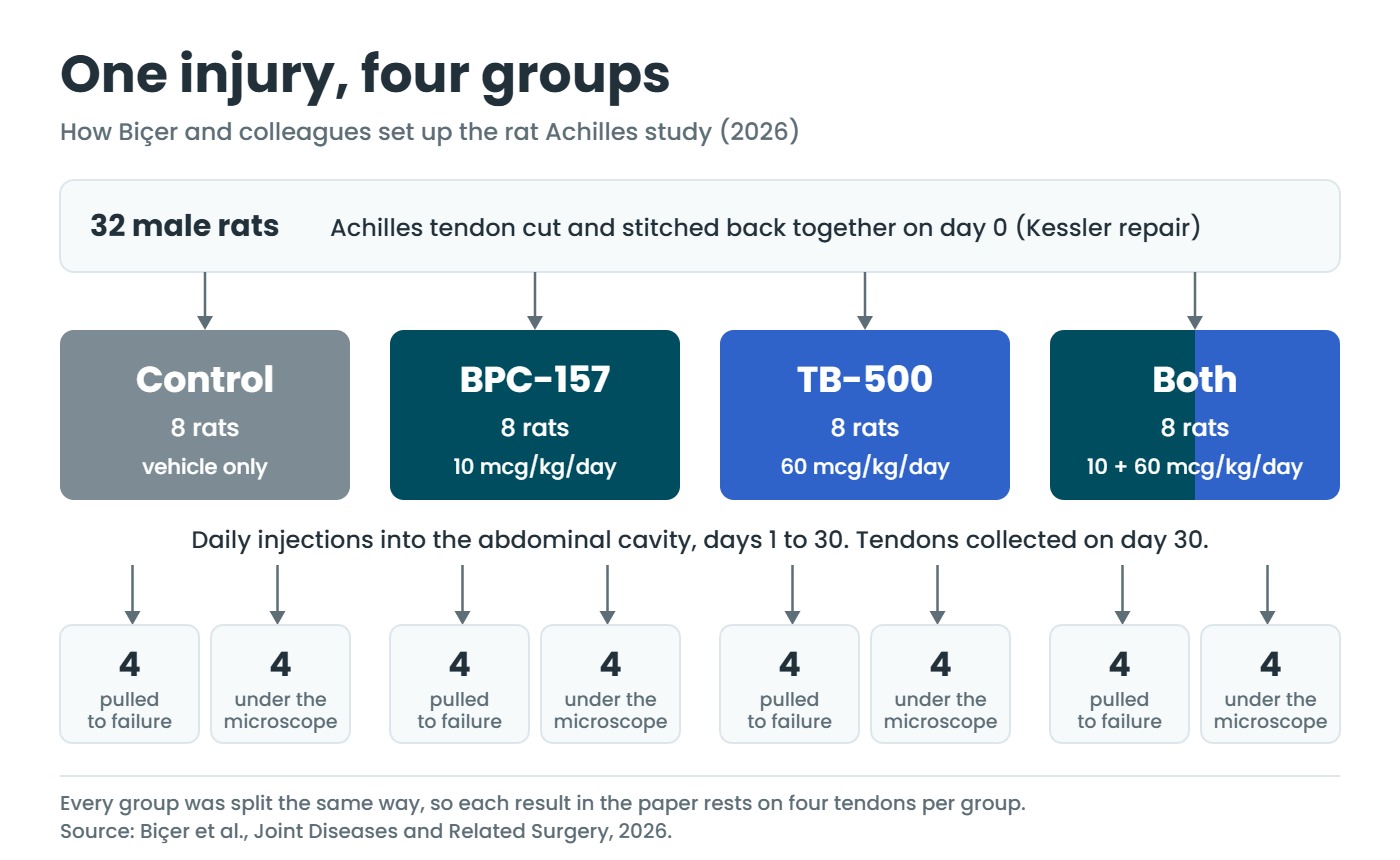
Then the rats were split four ways, eight to a group:
- Control: an injection of the vehicle alone
- BPC-157: 10 micrograms per kilogram per day
- TB-500: 60 micrograms per kilogram per day
- Both: the same two doses, given together
Every injection went into the abdominal cavity, once a day, starting the day after surgery and running for thirty days. On day thirty, four tendons from each group went to a tensile tester and the other four went to a pathologist who did not know which group they came from.
The authors are clear about why the fourth group exists. Because the two peptides have been reported to work on different parts of tissue repair, they wrote, they included a combination arm, and they hypothesized that giving both would provide additive benefits. That is the claim behind every “stack” of these two, stated as a testable prediction by people who then tested it.
Two details about the doses matter for everything that follows. The BPC-157 dose was taken from the earlier rat tendon studies, where that same daily amount, given the same way, had produced the improvements those papers reported. The TB-500 dose was borrowed from thymosin beta-4 work in other soft tissues, and the authors note that no dose-finding study for TB-500 in a tendon model has been published. The pair simply got both full doses at once.
The paper describes its TB-500 as synthetic thymosin beta-4 and identifies it by a supplier’s catalog number. The name TB-500 is used for more than one molecule, and our blend post covers which TB-500 is in the vial if you want that side of it.
Why It Takes Four Groups to Test a Pair
Most trials compare two groups. Cipriani and Barbui note that about a quarter of published randomized trials use three or more, and they describe the factorial trial as the special case where two treatments are tested at the same time across four or more groups. Control, A, B, and A plus B is the smallest version of that shape.
Each group answers a different question. The control shows how a cut tendon heals with nothing added. Each single-peptide group shows what that peptide adds. And the combination group is the only one that can show whether the second peptide adds anything on top of the first. Foucquier and Guedj describe what combination research is usually after: evidence of a significant superiority compared to the single agents. Beating the control is not enough. The pair has to beat each peptide on its own.
It helps to put numbers on what “additive” would look like. Say BPC-157 adds ten units of tendon strength and TB-500 adds ten. If the pair adds about twenty, the effects are additive. If it adds about ten, the pair is behaving as though one of the two is doing the work the other would have done. If it adds well over twenty, that is the territory pharmacologists call synergy.
Trials built to measure a combination are rarer than you might think. McAlister and colleagues reviewed forty-four factorial trials with clinically important yes-or-no outcomes and found that only eight, about eighteen percent, were set up to measure the extra benefit of combining two treatments; the rest used the design to test two treatments efficiently in one population. They also made a point that applies directly here: you can only read a factorial study properly if it reports every group separately. This one does, so we can go through it group by group.
How Much Load the Repaired Tendons Took
The mechanical test is the bluntest measure in the paper and the easiest to picture. Clamp the healed tendon, pull it at one millimeter per second, and record the force at the moment it fails. That number is called the maximum load to failure, and it was measured in newtons.
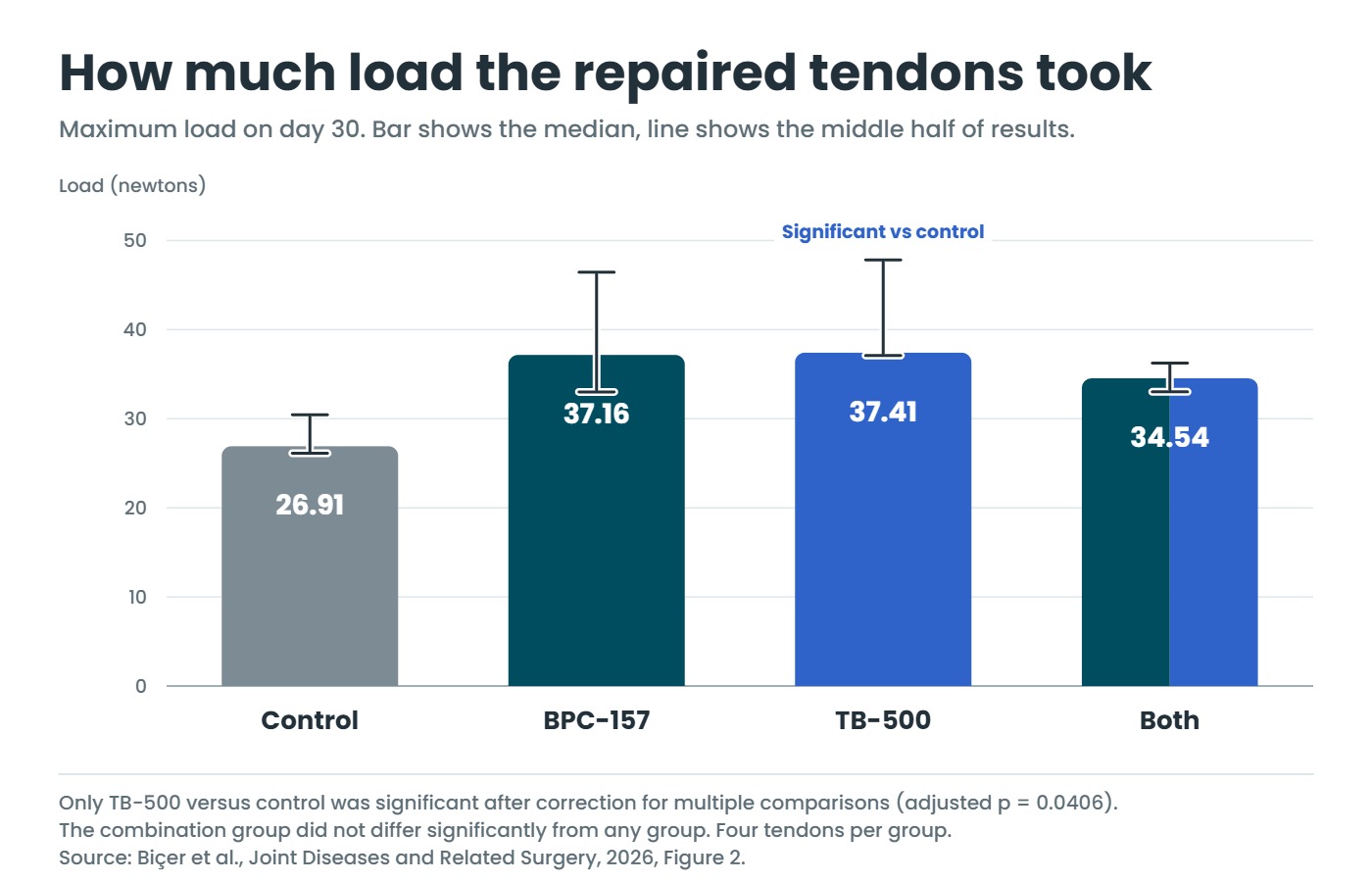
Here are the medians, four tendons per group:
- Control: 26.91 newtons (middle half of the results from 26.12 to 30.44)
- BPC-157: 37.16 newtons (33.01 to 46.45)
- TB-500: 37.41 newtons (37.10 to 47.82)
- Both: 34.54 newtons (33.02 to 36.24)
The overall comparison across the four groups was significant. When the groups were compared pair by pair, with a correction for making several comparisons at once, only one difference held up: TB-500 against the control, with an adjusted p-value of 0.0406. BPC-157 against the control came in at an adjusted 0.389. The combination group did not differ significantly from any group, the control included.
Look at the spread as well as the middle. The middle half of the BPC-157 results ran up to 46.45 newtons and the TB-500 results to 47.82. The combination group had the narrowest spread of the three treated groups, and the top of its middle half, 36.24 newtons, sat below the median of either single-peptide group.
The authors are careful about how far this one number goes. Maximum load was the only mechanical measure taken, and without the tendons’ cross-sectional area, they note, figures like Young’s modulus, which correct for a thicker or thinner repair, could not be calculated.
They also address why BPC-157 looks weaker here than in the older tendon work. Staresinic’s 2003 study cut the Achilles about five millimeters above its insertion and left a gap between the cut ends, with no repair, and tested the tendons over the first two weeks. Krivic’s 2006 study detached the tendon from the heel bone entirely. In both, BPC-157 raised the load the healing tendon could take. Biçer’s tendons were stitched back together on day zero and tested once, at four weeks, and the authors suggest those differences in the model may explain why BPC-157 did not move maximum load significantly here.
What the Pathologist Scored
The other four tendons from each group were sliced lengthwise, stained, and scored with two systems that tendon researchers use to grade how abnormal a piece of tendon looks. In both, a higher score is worse.
The Bonar score rates four features from zero (normal) to three (severely abnormal): the shape and number of tendon cells, the amount of ground substance between the fibers, how well the collagen bundles line up, and vascularity. The total runs from zero to twelve. The Movin score rates eight features on the same zero-to-three scale, for a total out of twenty-four. Its features trace back to Movin’s 1997 study of biopsies from forty patients with long-standing Achilles pain, where the abnormal tendons showed disordered fiber structure and arrangement, rounded cell nuclei, collagen that took up less stain, and extra non-collagen material between the fibers.
One feature on both scales trips people up. Increased vascularity counts against the tendon. That surprises anyone who has read that both of these peptides are “angiogenic,” meaning they encourage new blood vessels, but it fits how tendon biologists describe repair. Schulze-Tanzil and colleagues, reviewing Achilles healing, write that pro-angiogenic signals can trigger too many vessels and leave behind immature repair tissue that cannot handle mechanical load. In a tendon, more vessels is not automatically better.
Here is how the groups scored against the control:
- Total Bonar score: TB-500 was significantly better (p-value 0.016). BPC-157 (p-value 0.273) and the combination (p-value 0.103) were not.
- Total Movin score: TB-500 (p-value 0.017) and the combination (p-value 0.040) were significantly better. BPC-157 was not (p-value 0.601).
- Cell shape and ground substance: TB-500 and the combination both scored significantly better.
- Collagen alignment: only TB-500 differed significantly from the control (p-value 0.049).
- Vascularity: no significant difference across the groups (p-value 0.108).
BPC-157 on its own improved some individual features, including fiber arrangement and how well the collagen took up stain, without moving either total score far enough to count. And across both totals, none of the three treated groups differed significantly from one another.
Under the microscope, the pathologist described the control tendons as disorganized, crowded with cells and loaded with ground substance, and the treated tendons as more orderly, with more uniform, spindle-shaped cells and better-aligned collagen. The difference was clearest in the TB-500 group. The combination group, in the paper’s words, showed similar features without an obvious qualitative advantage over the single treatments.
One pathologist read every slide. That keeps the scoring consistent from slide to slide, and it also means the authors could not check how closely a second reader would have agreed, which they list among the study’s limits.
Collagen, and Why Four Weeks Is an Early Look
Chartier and colleagues describe tendon repair as three overlapping phases, inflammation, proliferation and remodeling, each lasting a different length of time in different tendons. Early repair tissue is rich in type III collagen, which is laid down quickly. Over time it is replaced by type I, the collagen that gives a mature tendon its strength. Biçer’s team frames day thirty as the transition from the proliferative phase into remodeling, which makes it a snapshot of a tendon still in the middle of changing.
They looked at collagen two ways. Sirius red staining viewed under polarized light shows how ordered the collagen fibers are. Antibody staining shows how much of each collagen type is present.
Under polarized light, type I collagen intensity was higher than the control in both the BPC-157 group (p-value 0.009) and the TB-500 group (p-value 0.041). Type III intensity differed between the BPC-157 and TB-500 groups (p-value 0.028). The antibody staining told a slightly different story. Type I collagen showed no significant difference among the four groups (p-value 0.242), which led the authors to read the polarized-light result as better fiber alignment rather than more collagen being made. Type III differed significantly across the groups, and the TB-500 group carried the most.
That last result is the one the authors treat most carefully. High type III at four weeks could be a scar in the making, or it could be a tendon in the middle of active remodeling. Because the TB-500 group also had better microscope scores, less ground substance, better-ordered type I fibers and higher failure loads, the authors lean toward remodeling, and they say outright that later time points and molecular work are needed to settle it. The combination group’s antibody staining, they note, resembled the BPC-157 group’s.
The TB-500 pattern lines up with older thymosin beta-4 wound work. Ehrlich and Hazard found that rat skin incisions treated with thymosin beta-4 healed narrower, with collagen that showed the red birefringence of mature tissue rather than the green of immature tissue, and with few myofibroblasts, the contractile cells that Goldstein and colleagues tie to scar formation. Sponges implanted under the skin and dosed with 100 micrograms of thymosin beta-4 on days two, three and four held longer, thicker collagen bundles at day fourteen. Philp and colleagues found that thymosin beta-4 raised matrix metalloproteinase 2 and 9, enzymes that break down matrix during remodeling, several-fold in mouse skin wounds on day two, and traced that activity to the peptide’s central actin-binding domain.
What the Combination Group Showed
The paper’s own summary is one sentence: combined BPC-157 and TB-500 treatment did not confer additional benefits compared to either agent alone.
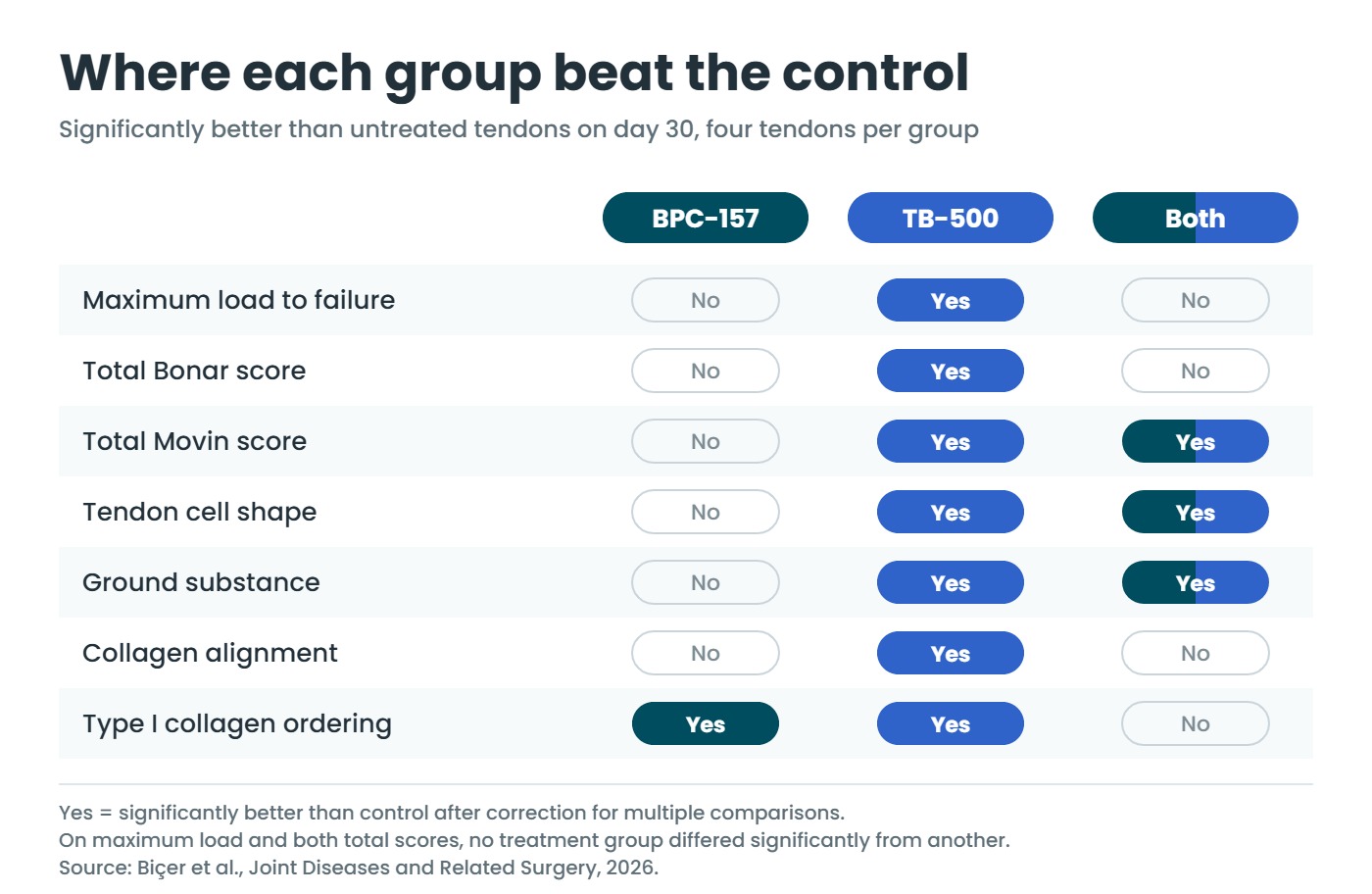
Laid out measure by measure, the combination group matched TB-500 on some features (cell shape, ground substance, total Movin score), fell short of significance where TB-500 reached it on others (maximum load, total Bonar score, collagen alignment), and did not reach significance on type I collagen ordering, where both single peptides did. It was never significantly better than either peptide on its own.
The load numbers make the additive question concrete. Each single peptide added roughly ten newtons to the control median: 10.25 for BPC-157 and 10.50 for TB-500. A pair that added both would sit near 47.66 newtons. The combination median was 34.54, about 7.63 above the control. That is my arithmetic on the published medians, not a test the authors ran, and medians do not add together the way averages do, especially from four tendons a group. It shows the size of the gap between what an additive pair would have looked like and what this one did.
Three Explanations the Authors Offered
The authors give three possible reasons the pair did not add up, and they label all three as hypotheses because the study measured no molecular signals and no blood levels.
The two peptides may converge on the same downstream machinery. If both push the same levers, giving both pushes those levers no harder. The published mechanism work gives this idea something to stand on, though nothing that settles it. For BPC-157, McGuire and colleagues summarize activity through the VEGFR2 receptor and nitric oxide production via the Akt and eNOS pathway, plus ERK1/2 signaling. In Chang’s 2011 study of rat Achilles tendon cells, BPC-157 did not make the cells multiply faster, but it improved their survival under oxidative stress, increased their migration in a dose-dependent way, and raised the activation of two cell-adhesion proteins, FAK and paxillin. Chang’s 2014 follow-up found it increased the growth hormone receptor on the same cells. And Brcic and colleagues saw no direct effect of BPC-157 on blood vessel growth in cell culture, but more VEGF, one of the main signals for vessel growth, in healing rat muscle and tendon.
For thymosin beta-4, Goldstein and colleagues describe a peptide that binds actin, promotes cell migration, including the movement of stem and progenitor cells, and reduces myofibroblasts. Bock-Marquette and colleagues found that in heart cells it forms a complex with two proteins called PINCH and integrin-linked kinase, which switches on Akt, a kinase that promotes cell survival. So both records include cell migration and both include Akt, though the thymosin beta-4 Akt work was done in heart cells, not tendon. That is consistent with the overlap idea. It is not a test of it.
There may be a ceiling at four weeks. If each peptide already moves early repair about as far as it can go by day thirty, a second one has little room to add. The authors call for studies with several time points, which could separate groups that look alike at four weeks.
The combination dose may have been wrong. Each dose was borrowed from single-agent work, and the pair got both at full strength from the first day. They suggest future work try other dosing regimens and schedules to see whether those change how the two interact.
Four Tendons per Measurement
Each result in this paper rests on four tendons per group. The authors used rank-based tests suited to small groups, a Kruskal-Wallis test across all four groups followed by Dunn’s comparisons between pairs of groups with a Bonferroni correction. They report that a power calculation done after the fact reached the conventional 0.80 for twelve of their fourteen histology outcomes, and they list the lack of a calculation done in advance among their limitations.
Group size matters in a specific way for a combination question, and it is worth working through. A rank test throws away the raw numbers and keeps only the order. With four groups of four, the sixteen tendons are ranked one to sixteen, and each group gets an average rank. The biggest possible gap between the top group and the bottom group is twelve places: the top group holding ranks thirteen to sixteen, the bottom group holding ranks one to four.
Now ask the combination question in rank terms. For the pair to beat TB-500 after TB-500 has beaten the control, the test needs two separate gaps in a row, each big enough to count. With four tendons in each group, each gap needs to be more than about 6.6 places even with no correction for multiple comparisons. Two of those add up to more than thirteen places, and only twelve exist. So in this design, on any measure where a single peptide had already beaten the control, the pair could not have come out significantly ahead of that peptide, whatever was true underneath. That is my arithmetic from the test the paper names, not a calculation the authors published, and it applies to maximum load and both total scores, where TB-500 beat the control.
The same limit applies to any four-group study this size. Button and colleagues showed why it cuts both ways: a study with low statistical power has less chance of detecting a real effect, and the significant results it does produce are less likely to reflect a true effect and tend to overstate its size. The widget below lets you see how the picture changes with more animals.
The Other Record: Four Knees
The only human report of the two given together is a chart review. Lee and Padgett looked back over a year of patients at a Florida clinic who had received knee injections of BPC-157, alone or combined with thymosin beta-4, for knee pain from several causes. Of seventeen patients, sixteen were reached by phone. Twelve had received BPC-157 alone, and eleven of them reported significant improvement. Four had received both peptides, and three of those four reported significant improvement while one had no relief.
The patients rated their own pain over the phone, most of them six months to a year after the injection, and no standard tools were used to measure function, stiffness or quality of life. There was no comparison group. The abstract names the second peptide as thymosin beta-4 rather than TB-500. Tham and colleagues, reviewing these peptides for orthopedic surgeons, describe the entire human musculoskeletal evidence for BPC-157 as one small retrospective uncontrolled case series without validated outcome measures, which matches this knee review.
No controlled human study of the pair has been published.
How the Single-Peptide Record Frames It
For BPC-157, the rat tendon and ligament work is older and broader. Krivic’s tendon-to-bone study tested three BPC-157 doses at six time points over three weeks and also included a corticosteroid group, which worsened healing; BPC-157 reduced that effect. Cerovecki followed a cut knee ligament for ninety days and found improvements with BPC-157 given into the abdomen, in drinking water, or as a cream on the injury site. Vasireddi’s systematic review gathered thirty-six studies on BPC-157 in musculoskeletal injury, thirty-five of them preclinical.
For thymosin beta-4, Tham’s review describes the direct musculoskeletal evidence as limited to cell and rodent studies. One rodent example is a mouse fracture model in which Brady and colleagues found that thymosin beta-4 raised the peak force a healing bone could take by forty-one percent and made it about twenty-five percent stiffer. Biçer’s team, writing their introduction, called tendon-specific evidence for TB-500 scarce and described their study as, to their knowledge, the first direct comparison of TB-500 and BPC-157 in a rat Achilles repair model.
That is the context for the combination result. It comes from a single four-week experiment, in healthy young male rats, built on doses each borrowed from one peptide’s literature. Mayfield and colleagues, writing for orthopedic and sports medicine physicians, put the human side plainly: the indications, dosing, frequency and duration of treatment for these peptides remain unknown. If you want the other angles on this pair, we have posts on what has been measured about each molecule and on the Wolverine stack versus GLOW.
Doses Used in the Research
- Biçer 2026 (rats, Achilles repair): BPC-157 at 10 micrograms per kilogram per day, TB-500 at 60 micrograms per kilogram per day, or both together, into the abdominal cavity once daily for thirty days.
- Staresinic 2003 (rats, unrepaired Achilles cut): BPC-157 at 10 micrograms, 10 nanograms or 10 picograms per kilogram, into the abdominal cavity once daily.
- Krivic 2006 (rats, tendon detached from bone): the same three BPC-157 doses into the abdominal cavity once daily, alone or with methylprednisolone at 1 milligram per kilogram.
- Cerovecki 2010 (rats, cut knee ligament): BPC-157 at 10 micrograms or 10 nanograms per kilogram into the abdominal cavity once daily, 1.0 microgram per gram of cream on the injury, or 0.16 micrograms per milliliter of drinking water.
- Ehrlich and Hazard 2010 (implanted sponges): thymosin beta-4 at 100 micrograms into each sponge on days two, three and four.
- Brady 2014 (mice, bone fracture): thymosin beta-4 at 6 milligrams per kilogram into the abdominal cavity.
Frequently Asked Questions
Has the BPC-157 and TB-500 combination been tested in a controlled study?
In one published study, in rats. Biçer and colleagues gave thirty-two rats a repaired Achilles tendon and split them into control, BPC-157, TB-500 and combination groups for thirty days of daily injections.
Did the combination work better than either peptide alone?
Not in that study. The authors report that the combination did not confer additional benefits compared to either agent alone, and it was never significantly better than either single peptide on any measure.
Which peptide did better on its own?
TB-500 was the only group with a significantly higher failure load than the control, and it improved both total microscope scores. BPC-157 improved selected features and type I collagen ordering without significantly changing the totals or the failure load.
What doses did the combination study use?
BPC-157 at 10 micrograms per kilogram per day and TB-500 at 60 micrograms per kilogram per day, injected into the abdominal cavity of rats. The combination group got both full doses.
Has the pair been studied in people?
Only in a retrospective chart review, where four patients received knee injections of BPC-157 combined with thymosin beta-4 and three reported significant improvement in pain. There was no comparison group and no standard outcome measure.
Why might two repair peptides not add up?
The authors suggest the two may converge on the same downstream signals, that early repair may hit a ceiling by four weeks, or that the combination dose was not the right one. None of the three was tested.
Could a bigger study find a combination effect?
A larger one would have the room to. With four tendons per group and a rank-based test, the pair had no mathematical room to show up as significantly better than TB-500 on measures where TB-500 had already beaten the control.
Stay sharp,
Joe Mars
The Peptide Report
P.S. If you want to talk through combination studies like this one with people who read the same papers, the conversation carries on over at the Peptides and Biohacking Hub.
References
- Biçer O, Adanir O, Güleryüz Y, Balci EC, Dinçel YM, Yenigün MY, Aydin C, Yaprak Bayrak B. Effects of BPC-157 and TB-500 on Achilles tendon healing in rats: a histopathological and biomechanical study. Joint Diseases and Related Surgery. 2026 Jul 23;37(3):822-837. doi:10.52312/jdrs.2026.2951
- Cipriani A, Barbui C. What is a factorial trial? Epidemiology and Psychiatric Sciences. 2013 Sep;22(3):213-5. doi:10.1017/S2045796013000231
- Foucquier J, Guedj M. Analysis of drug combinations: current methodological landscape. Pharmacology Research and Perspectives. 2015 Jun;3(3):e00149. doi:10.1002/prp2.149
- McAlister FA, Straus SE, Sackett DL, Altman DG. Analysis and reporting of factorial trials: a systematic review. JAMA. 2003 May 21;289(19):2545-53. doi:10.1001/jama.289.19.2545
- Staresinic M, Sebecic B, Patrlj L, Jadrijevic S, Suknaic S, Perovic D, Aralica G, Zarkovic N, Borovic S, Srdjak M, Hajdarevic K, Kopljar M, Batelja L, Boban-Blagaic A, Turcic I, Anic T, Seiwerth S, Sikiric P. Gastric pentadecapeptide BPC 157 accelerates healing of transected rat Achilles tendon and in vitro stimulates tendocytes growth. Journal of Orthopaedic Research. 2003 Nov;21(6):976-83. doi:10.1016/S0736-0266(03)00110-4
- Krivic A, Anic T, Seiwerth S, Huljev D, Sikiric P. Achilles detachment in rat and stable gastric pentadecapeptide BPC 157: promoted tendon-to-bone healing and opposed corticosteroid aggravation. Journal of Orthopaedic Research. 2006 May;24(5):982-9. doi:10.1002/jor.20096
- Movin T, Gad A, Reinholt FP, Rolf C. Tendon pathology in long-standing achillodynia. Biopsy findings in 40 patients. Acta Orthopaedica Scandinavica. 1997 Apr;68(2):170-5. doi:10.3109/17453679709004002
- Schulze-Tanzil GG, Delgado-Calcares M, Stange R, Wildemann B, Docheva D. Tendon healing: a concise review on cellular and molecular mechanisms with a particular focus on the Achilles tendon. Bone and Joint Research. 2022 Aug;11(8):561-574. doi:10.1302/2046-3758.118.BJR-2021-0576.R1
- Chartier C, ElHawary H, Baradaran A, Vorstenbosch J, Xu L, Efanov JI. Tendon: principles of healing and repair. Seminars in Plastic Surgery. 2021 Aug;35(3):211-215. doi:10.1055/s-0041-1731632
- Ehrlich HP, Hazard SW 3rd. Thymosin beta4 enhances repair by organizing connective tissue and preventing the appearance of myofibroblasts. Annals of the New York Academy of Sciences. 2010 Apr;1194:118-24. doi:10.1111/j.1749-6632.2010.05483.x
- Goldstein AL, Hannappel E, Sosne G, Kleinman HK. Thymosin beta4: a multi-functional regenerative peptide. Basic properties and clinical applications. Expert Opinion on Biological Therapy. 2012 Jan;12(1):37-51. doi:10.1517/14712598.2012.634793
- Philp D, Scheremeta B, Sibliss K, Zhou M, Fine EL, Nguyen M, Wahl L, Hoffman MP, Kleinman HK. Thymosin beta4 promotes matrix metalloproteinase expression during wound repair. Journal of Cellular Physiology. 2006 Jul;208(1):195-200. doi:10.1002/jcp.20650
- McGuire FP, Martinez R, Lenz A, Skinner L, Cushman DM. Regeneration or risk? A narrative review of BPC-157 for musculoskeletal healing. Current Reviews in Musculoskeletal Medicine. 2025 Dec;18(12):611-619. doi:10.1007/s12178-025-09990-7
- Chang CH, Tsai WC, Lin MS, Hsu YH, Pang JH. The promoting effect of pentadecapeptide BPC 157 on tendon healing involves tendon outgrowth, cell survival, and cell migration. Journal of Applied Physiology. 2011 Mar;110(3):774-80. doi:10.1152/japplphysiol.00945.2010
- Chang CH, Tsai WC, Hsu YH, Pang JH. Pentadecapeptide BPC 157 enhances the growth hormone receptor expression in tendon fibroblasts. Molecules. 2014 Nov 19;19(11):19066-77. doi:10.3390/molecules191119066
- Brcic L, Brcic I, Staresinic M, Novinscak T, Sikiric P, Seiwerth S. Modulatory effect of gastric pentadecapeptide BPC 157 on angiogenesis in muscle and tendon healing. Journal of Physiology and Pharmacology. 2009 Dec;60 Suppl 7:191-6. PubMed 20388964
- Bock-Marquette I, Saxena A, White MD, Dimaio JM, Srivastava D. Thymosin beta4 activates integrin-linked kinase and promotes cardiac cell migration, survival and cardiac repair. Nature. 2004 Nov 25;432(7016):466-72. doi:10.1038/nature03000
- Button KS, Ioannidis JPA, Mokrysz C, Nosek BA, Flint J, Robinson ESJ, Munafò MR. Power failure: why small sample size undermines the reliability of neuroscience. Nature Reviews Neuroscience. 2013 May;14(5):365-76. doi:10.1038/nrn3475
- Lee E, Padgett B. Intra-articular injection of BPC 157 for multiple types of knee pain. Alternative Therapies in Health and Medicine. 2021 Jul;27(4):8-13. PubMed 34324435
- Tham A, Hodgkins CW, Kennedy JG. Investigational peptides in orthopaedic practice: evidence, safety, and patient counseling for BPC-157, thymosin beta-4, and TB-500. Journal of the American Academy of Orthopaedic Surgeons. 2026 Oct 27. Online ahead of print. doi:10.5435/JAAOS-D-26-00049
- Cerovecki T, Bojanic I, Brcic L, Radic B, Vukoja I, Seiwerth S, Sikiric P. Pentadecapeptide BPC 157 (PL 14736) improves ligament healing in the rat. Journal of Orthopaedic Research. 2010 Sep;28(9):1155-61. doi:10.1002/jor.21107
- Vasireddi N, Hahamyan H, Salata MJ, Karns M, Calcei JG, Voos JE, Apostolakos JM. Emerging use of BPC-157 in orthopaedic sports medicine: a systematic review. HSS Journal. 2025 Jul 31;21(4):485-495. doi:10.1177/15563316251355551
- Brady RD, Grills BL, Schuijers JA, Ward AR, Tonkin BA, Walsh NC, McDonald SJ. Thymosin beta4 administration enhances fracture healing in mice. Journal of Orthopaedic Research. 2014 Oct;32(10):1277-82. doi:10.1002/jor.22686
- Mayfield CK, Bolia IK, Feingold CL, Lin EH, Liu JN, Hatch GFR, Gamradt SC, Weber AE. Injectable peptide therapy: a primer for orthopaedic and sports medicine physicians. The American Journal of Sports Medicine. 2026 Jan;54(1):223-229. doi:10.1177/03635465251357593