Two research teams have given thymosin beta-4 to healthy volunteers through a vein. One team worked in hundreds of milligrams. The other worked in micrograms per kilogram of body weight, and a microgram is a thousandth of a milligram. Same molecule, same route into the body, and the two dose ladders never come near each other.
That is the arithmetic sitting behind any bottle that offers you this molecule and a second one together. Before a blend can mean anything, each half has to mean something on its own. So this is what the research has actually measured about each of them, one at a time.
Two Names on the Label, Two Very Different Molecules
The first thing to get straight is that a blend bottle is not holding a compound. It is holding two separate molecules that happen to share a container, and they are not built to anything like the same scale.
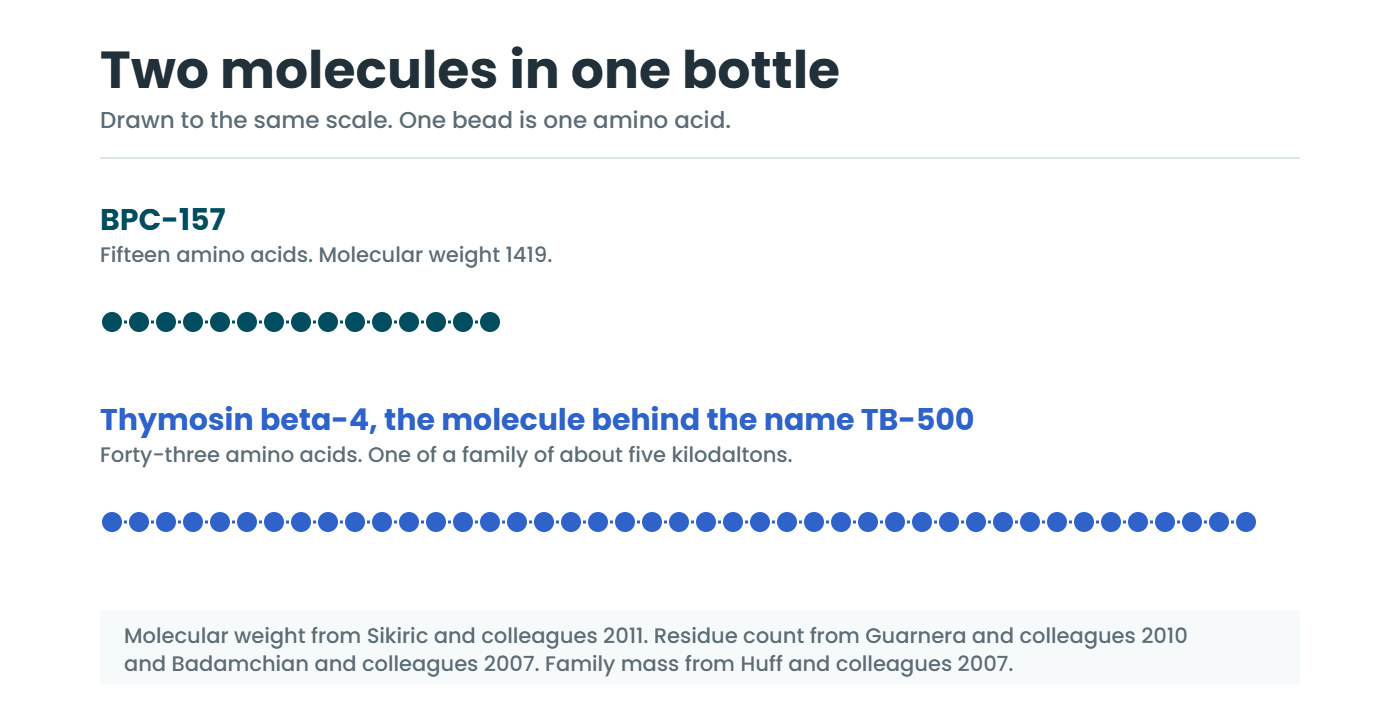
BPC-157 is a synthetic pentadecapeptide, which is a precise way of saying it is fifteen amino acids long. Sikiric and colleagues give its molecular weight as 1419 in their 2011 review in Current Pharmaceutical Design. Mateescu and colleagues, writing in Pharmaceutics in 2026, describe it as derived from a fragment of a protein found in gastric juice.
TB-500 is a product name rather than a molecule name, and the molecule it points at is thymosin beta-4. Guarnera and colleagues describe it as a synthetic copy of a naturally occurring peptide forty-three amino acids long. Huff, Mueller and Hannappel place it in a family of closely related polypeptides of roughly five kilodaltons, and call thymosin beta-4 the most abundant member of that family.
So one of these is about three times the length of the other, and as you will see further down, in nasal delivery that difference is not cosmetic. It is most of the story.
What Thymosin Beta-4 Does Inside a Cell
Thymosin beta-4 is not an exotic visitor. Huff and colleagues describe it as the main intracellular peptide that holds monomeric actin, the protein your cells build their internal scaffolding from. Badamchian and colleagues identified and quantified it in human saliva and tears, which tells you how ordinary its presence in the body is.
The binding itself has been mapped in detail. Van Troys and colleagues, in the EMBO Journal in 1996, went through the molecule with chemically synthesized variants and found two separate structural pieces doing the work: the first sixteen residues at one end, and a six-residue stretch immediately after them. Those two parts behave as distinct entities, and the longer piece has to fold into a helix before it can grip actin at all.
That detail is worth sitting with, because you will often see the shorthand that a short fragment “is” the active part of the molecule. The mapping work says something more interesting. Two regions contribute, and one of them only works once it has taken up a particular shape. A fragment clipped out of context is not automatically the same thing as the region it came from.
The Human Record for Thymosin Beta-4
This molecule has been into human trials by several routes, and the trials are specific about what they gave.
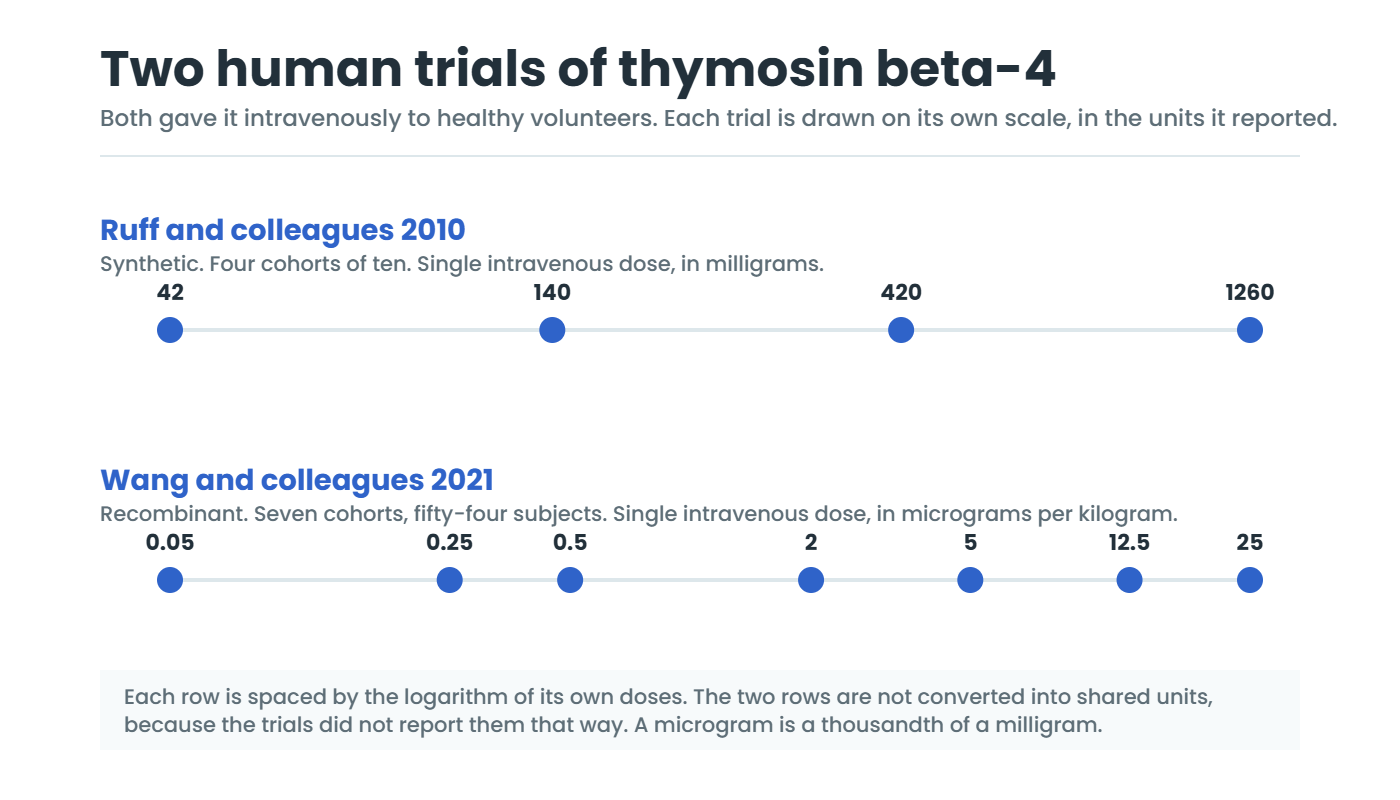
Ruff, Crockford, Girardi and Zhang ran four cohorts of ten healthy subjects each. Every cohort got a single intravenous dose of either placebo or synthetic thymosin beta-4, with the cohorts receiving ascending doses of forty-two, one hundred and forty, four hundred and twenty, or one thousand two hundred and sixty milligrams. After a safety review, subjects were given the same daily regimen for fourteen days. Adverse events were infrequent and mild or moderate, with no dose-limiting toxicities and no serious adverse events. The pharmacokinetics were dose-proportional for the single dose, and the half-life got longer as the dose got bigger.
Then compare Wang and colleagues, writing in the Journal of Cellular and Molecular Medicine in 2021. Their first-in-human study used a recombinant version of the same molecule in fifty-four healthy subjects across seven cohorts, with single intravenous doses ascending from five hundredths of a microgram per kilogram to twenty-five micrograms per kilogram. A further thirty subjects took part in the multiple-dose arm at half a microgram, two micrograms and five micrograms per kilogram daily for ten days.
Put those two side by side. One trial’s smallest dose is a fixed forty-two milligrams. The other trial’s largest dose is twenty-five micrograms for every kilogram the volunteer weighs. These are not neighboring numbers, and they are not a disagreement anyone has resolved. They are two different research programs, using material made two different ways, asking their questions at two different scales.
Neither team was careless. A first-in-human study of a recombinant protein starts low on purpose and climbs slowly, because the point of the exercise is to find out what the body does with it. A study aimed at a specific clinical use starts where the modeling says the effect might live. Both are legitimate designs, and they are not trying to agree with each other.
What that means for a reader is simple enough. If you go looking for the human dose of this molecule, you will not find one, because the research has not produced one. You will find the doses that particular trials used, for particular purposes, by a route that puts the whole amount directly into the bloodstream. That is a different kind of fact, and it is the kind that is actually available.
Outside the vein, the record is mostly topical. Sosne, Dunn and Kim ran a small multicenter phase two trial in severe dry eye, published in Cornea in 2015, in which nine patients used either thymosin beta-4 eye drops at one tenth of one percent or a vehicle control six times daily for twenty-eight days. At day fifty-six the treated group showed a thirty-five point one percent reduction in ocular discomfort against vehicle control, with a P value of 0.0141, and a fifty-nine point one percent reduction in total corneal fluorescein staining, with a P value of 0.0108. Tear film breakup time and tear volume also improved.
Sosne and Ousler’s other 2015 trial, in Clinical Ophthalmology, was larger: seventy-two subjects randomized one to one, run at a single center using a controlled adverse environment model.
Guarnera, DeRosa and Camerini took the same molecule to venous stasis ulcers in a double-blind, placebo-controlled dose-escalation study, applying it topically. Kleinman and Sosne later reviewed the dermal healing work in Vitamins and Hormones.
The animal work that pointed in this direction is specific too. Malinda and colleagues used a rat full-thickness wound model and reported that thymosin beta-4, given topically or into the abdominal cavity, increased reepithelialization by forty-two percent over saline controls at four days and by as much as sixty-one percent at seven days. Treated wounds also contracted at least eleven percent more than controls by day seven. In a migration chamber, as little as ten picograms stimulated keratinocyte movement two to three times over medium alone.
The Record for BPC-157 Has a Different Shape
BPC-157’s literature is large, long-running and almost entirely preclinical, and the most useful thing I can point you at is the review Mateescu and colleagues published in Pharmaceutics in 2026, which looks at the molecule specifically as a formulation problem rather than a biology problem.
What they report: BPC-157 is unusually stable in gastric juice, and shows activity by oral, parenteral and topical routes. Its human pharmacokinetic profile, though, remains critically undercharacterized. A formal preclinical study in two species found a plasma half-life under thirty minutes, linear dose-proportional kinetics, and intramuscular bioavailability between fourteen and fifty-one percent depending on the species. That short half-life, confirmed preclinically and in a preliminary two-subject human pilot, sits against biological effects described as lasting hours to days, which the authors call a disconnect with real implications for how anyone would design a dose.
They also note that no pharmaceutical-grade formulation has been developed or validated, that the peptide lacks permeability characterization, and that the clinical data available come from fewer than thirty subjects in total.
Sikiric and colleagues, in their 2011 review, describe the peptide as stable in human gastric juice and as having been used in inflammatory bowel disease trials without reported toxicity.
For the nasal route in particular, our guide to where a BPC-157 nasal dose actually goes works through the delivery question in detail, including the plain fact that no study has measured this peptide given intranasally. If you want the comparison between the two molecules laid out on its own terms, we have that in BPC-157 versus TB-500.
Stable in One Place Is Not Stable Everywhere
The single most repeated fact about BPC-157 is that it survives gastric juice. Sikiric and colleagues say so directly, and the Mateescu review calls the stability unusual. It is a real property and a genuinely interesting one, because gastric juice is an aggressive environment and most peptides do not last in it.
It is also a narrower claim than it sounds, and the narrowness matters here. Surviving gastric juice means resisting acid and digestive enzymes for the time it takes to pass through. It is not the same question as whether a molecule stays intact in a sealed bottle of water on a shelf for three months.
That second question is the one Zapadka and colleagues are writing about, and almost nothing on their list is digestive. Peptides in storage are lost to self-association into clumps, to slow chemical modification, to sticking onto container surfaces and gathering at the boundary between liquid and air, and to what happens when all of that is stirred up by agitation and warmth. A molecule can be excellent at surviving a stomach and unremarkable at surviving a shelf, because the two challenges barely overlap.
A nasal spray is squarely the second kind of problem. It is an aqueous solution that gets shaken, carried in a pocket, warmed to body temperature in a hand, and opened to the air repeatedly over weeks. Whatever a molecule’s record in gastric juice, that record was not earned under these conditions, and it does not transfer by itself.
Measuring the Molecule Is Its Own Problem
Here is a thing that surprises people. Even measuring how much thymosin beta-4 is circulating in a person is not a settled procedure.
Tan and colleagues reviewed the literature on quantifying it in human serum and plasma and found substantial variability both within and between studies, in healthy controls, with a lack of protocol standardization underneath it. They flag specific confounders: platelets left in suspension after centrifugation, and more of the peptide being released when platelets are activated during sample handling rather than inside the person.
Huff and colleagues add a wrinkle to that. Their title says it directly: thymosin beta-4 is not always the main beta-thymosin in mammalian platelets. The family members are closely related, so what an assay counts depends on what it can tell apart.
Yesilay and colleagues measured endogenous levels in patients before and after treatment for a heart attack, which is the kind of study that only works if you trust your assay.
None of this says the measurements are worthless. It says that a number describing this molecule is a result produced by a method, and the method matters. A number printed on a bottle is not that kind of number at all.
What Changes When Two Peptides Share One Solution
This is the part that is specific to a blend, and it is the part that almost never gets discussed.
Zapadka and colleagues reviewed the factors that drive peptides to clump together in solution, which is the failure mode that quietly removes active material from a liquid. Their list is long and worth reading as a list: the sequence itself, concentration, pH, net charge, excipients, chemical degradation and modification, surfaces and interfaces, and impurities. Then the physical conditions on top of that, including temperature, agitation, pressure and whether the material was freeze-dried.
Read that list again with a two-peptide bottle in mind. Concentration is on it. Impurities are on it. Excipients are on it. In a blend, each peptide is part of the other one’s chemical environment. Whatever the second molecule does to pH, to ionic strength, to the amount of material competing for the air-water interface when you shake the bottle, it does to the first.
And this is where the Mateescu review lands its sharpest point for our purposes. Among the things it lists as not yet done for BPC-157 are formal excipient compatibility studies. That is the study type whose entire job is to answer “what happens to this molecule when you put it in a solution with other things.” It has not been done for this peptide on its own, which means a two-peptide formulation is asking a question that nobody has asked for the simpler case first.
The Preservative Is an Ingredient Too
A multi-dose nasal bottle gets opened repeatedly, so it generally contains a preservative, and that preservative is usually benzalkonium chloride.
Marple, Roland and Benninger reviewed its safety in intranasal solutions and set out the situation plainly: benzalkonium chloride is the preservative of choice for most multiuse aqueous nasal, ophthalmic and otic products, it has been in clinical use since 1935, and the American College of Toxicology concluded it can be safely used as an antimicrobial agent at concentrations up to one tenth of one percent. Their review identified eighteen studies evaluating its effects on human nasal epithelium, fourteen in living subjects and four in the laboratory, and the published picture across them conflicts.
Bernstein took the cautionary side in the Journal of Allergy and Clinical Immunology, summarizing reports of reduced mucociliary transport, rhinitis medicamentosa and neutrophil dysfunction associated with the preservative in nasal sprays.
I am not going to tell you how that argument resolves, because it has not. The useful point is narrower: the preservative is a real ingredient with its own literature, and if you are thinking carefully about what is in a bottle, it belongs on the list alongside the two names on the front.
Size Still Sets the Ceiling
Everything above is about the molecules. This last part is about the nose, and it is the oldest and most reliable finding in the whole area.
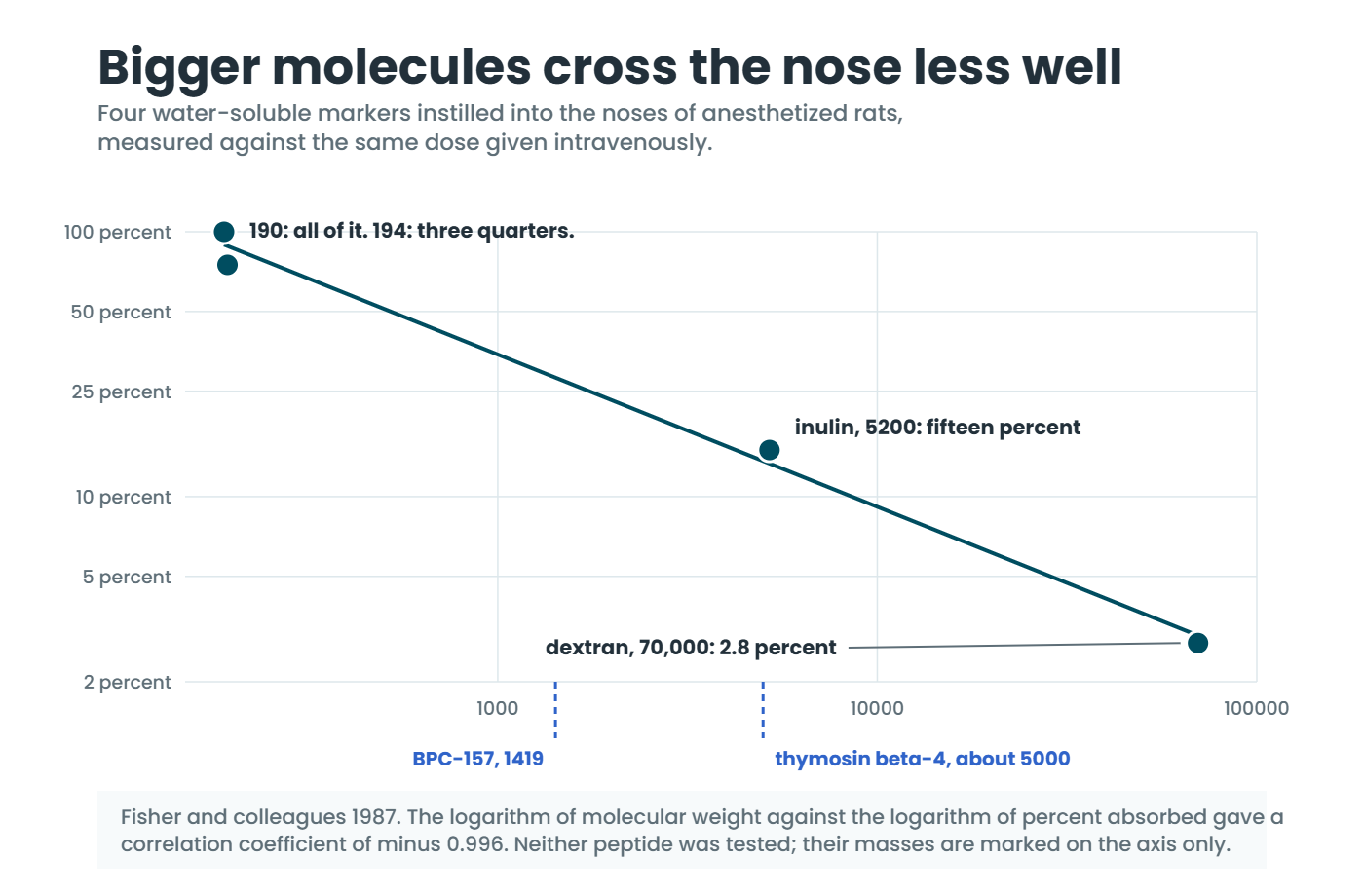
Fisher and colleagues instilled a range of water-soluble compounds into the nasal cavities of anesthetized rats and compared how much turned up in bile and urine against the same dose given intravenously. The results line up by size almost perfectly. A compound of molecular weight 190 was absorbed essentially completely. One of molecular weight 194 managed seventy-five percent. Inulin, at 5200, managed fifteen percent. Dextran, at 70,000, managed two point eight percent. Plotting the logarithm of molecular weight against the logarithm of percentage absorbed gave a correlation coefficient of minus 0.996, which is about as straight a line as biology produces.
Now place our two molecules on it. BPC-157, at 1419, sits between the small markers and inulin. Thymosin beta-4, in that five-kilodalton family, sits essentially where inulin sits. The same bottle is therefore asking the same nose to do two jobs with quite different ceilings, and the larger molecule is working against the steeper part of that curve.
Illum made the general version of this point back in 1991 in Trends in Biotechnology, writing about nasal delivery of peptides and proteins and the search for systems that could make it efficient enough to be useful.
Frequently Asked Questions
Is TB-500 the same thing as thymosin beta-4?
TB-500 is a product name. The molecule behind it is thymosin beta-4, which Guarnera and colleagues describe as a synthetic copy of a naturally occurring forty-three amino acid peptide. Some material sold under the name is described instead as a shorter fragment, which is not automatically equivalent, as the Van Troys mapping work shows.
Why do two human trials of the same molecule use such different doses?
Because they were different programs with different aims and different material. Ruff and colleagues used synthetic thymosin beta-4 in fixed milligram doses up to one thousand two hundred and sixty milligrams. Wang and colleagues used a recombinant version dosed by body weight, topping out at twenty-five micrograms per kilogram. Neither trial was designed to validate the other’s scale.
Has anyone studied the two peptides given together?
Twice, as far as the published record goes. A 2026 rat study gave a repaired Achilles tendon BPC-157, TB-500 or both by injection and found no added benefit from the pair, and a small retrospective knee review included four patients who received both peptides by injection. Our post on what the four-group tendon study found goes through both.
Does mixing two peptides change either one?
It can. Zapadka and colleagues list concentration, excipients, impurities and interfaces among the factors governing whether peptides stay dissolved and intact, and in a blend each peptide is part of the other’s environment. Mateescu and colleagues note that formal excipient compatibility studies have not been done for BPC-157 even on its own.
How much of each would be in a blended spray?
That depends entirely on what was put in the bottle, and no published study has measured the contents of these products. What the research can tell you is what trials used, which is set out above with the route attached to each number.
Is the preservative in a nasal spray something to think about?
It is at least worth knowing it is there. Marple and colleagues reviewed eighteen studies on benzalkonium chloride in nasal products and found the published evidence conflicting, while Bernstein summarized reports of reduced mucociliary transport associated with it.
Where can I read about the nasal route itself?
Our piece on where a nasal dose actually goes covers deposition, clearance and the enzymes in the lining. For thymosin beta-4 on its own, see our guide to thymosin beta-4, and for the nasal version specifically, TB-500 nasal spray.
Stay sharp,
Joe Mars
The Peptide Report
P.S. If you want to talk this through with people who are reading the same papers, come find us at the Peptides and Biohacking Hub.
References
- Sikiric P, Seiwerth S, Rucman R, Turkovic B, Stancic Rokotov D, Brcic L, Sever M, Klicek R, Radic B, Drmic D, Ilic S, Kolenc D, Vrcic H, Sebecic B. Stable gastric pentadecapeptide BPC 157: novel therapy in gastrointestinal tract. Current Pharmaceutical Design. 2011;17(16):1612-32. doi:10.2174/138161211796196954
- Mateescu DM, Gavrilescu DM, Constantinescu FE, Oancea C, Ilie AC, Folescu R, Popa MD, Iurciuc S, Muresan CO, Enache A. BPC-157 as an investigational peptide therapeutic: biopharmaceutical challenges, formulation strategies, and translational development barriers. Pharmaceutics. 2026 May 20;18(5):625. doi:10.3390/pharmaceutics18050625
- Guarnera G, DeRosa A, Camerini R. The effect of thymosin treatment of venous ulcers. Annals of the New York Academy of Sciences. 2010 Apr;1194:207-12. doi:10.1111/j.1749-6632.2010.05490.x
- Huff T, Mueller CSG, Hannappel E. Thymosin beta4 is not always the main beta-thymosin in mammalian platelets. Annals of the New York Academy of Sciences. 2007 Sep;1112:451-7. doi:10.1196/annals.1415.029
- Badamchian M, Damavandy AA, Damavandy H, Wadhwa SD, Katz B, Goldstein AL. Identification and quantification of thymosin beta4 in human saliva and tears. Annals of the New York Academy of Sciences. 2007 Sep;1112:458-65. doi:10.1196/annals.1415.046
- Van Troys M, Dewitte D, Goethals M, Carlier MF, Vandekerckhove J, Ampe C. The actin binding site of thymosin beta 4 mapped by mutational analysis. The EMBO Journal. 1996 Jan 15;15(2):201-10. PubMed 8617195
- Ruff D, Crockford D, Girardi G, Zhang Y. A randomized, placebo-controlled, single and multiple dose study of intravenous thymosin beta4 in healthy volunteers. Annals of the New York Academy of Sciences. 2010 Apr;1194:223-9. doi:10.1111/j.1749-6632.2010.05474.x
- Wang X, Liu L, Qi L, Lei C, Li P, Wang Y, Liu C, Bai H, Han C, Sun Y, Liu J. A first-in-human, randomized, double-blind, single- and multiple-dose, phase I study of recombinant human thymosin beta 4 in healthy Chinese volunteers. Journal of Cellular and Molecular Medicine. 2021 Sep;25(17):8222-8228. doi:10.1111/jcmm.16693
- Sosne G, Dunn SP, Kim C. Thymosin beta 4 significantly improves signs and symptoms of severe dry eye in a phase 2 randomized trial. Cornea. 2015 May;34(5):491-6. doi:10.1097/ICO.0000000000000379
- Sosne G, Ousler GW. Thymosin beta 4 ophthalmic solution for dry eye: a randomized, placebo-controlled, phase II clinical trial conducted using the controlled adverse environment model. Clinical Ophthalmology. 2015 May 20;9:877-84. doi:10.2147/OPTH.S80954
- Kleinman HK, Sosne G. Thymosin beta 4 promotes dermal healing. Vitamins and Hormones. 2016;102:251-75. doi:10.1016/bs.vh.2016.04.005
- Malinda KM, Sidhu GS, Mani H, Banaudha K, Maheshwari RK, Goldstein AL, Kleinman HK. Thymosin beta4 accelerates wound healing. The Journal of Investigative Dermatology. 1999 Sep;113(3):364-8. doi:10.1046/j.1523-1747.1999.00708.x
- Tan WKY, Purnamawati K, Pakkiri LS, Tan SH, Yang X, Chan MY, Drum CL. Sources of variability in quantifying circulating thymosin beta-4: literature review and recommendations. Expert Opinion on Biological Therapy. 2018 Jul;18(sup1):141-147. doi:10.1080/14712598.2018.1448382
- Yesilay AB, Karakurt O, Akdemir R, Erden G, Kilic H, Acikel S, Karasu B, Sari M, Balci M, Aksoy M. Thymosin beta4 levels after successful primary percutaneous coronary intervention for acute myocardial infarction. Turk Kardiyoloji Dernegi Arsivi. 2011 Dec;39(8):654-60. doi:10.5543/tkda.2011.01751
- Zapadka KL, Becher FJ, Gomes Dos Santos AL, Jackson SE. Factors affecting the physical stability (aggregation) of peptide therapeutics. Interface Focus. 2017 Dec 6;7(6):20170030. doi:10.1098/rsfs.2017.0030
- Marple B, Roland P, Benninger M. Safety review of benzalkonium chloride used as a preservative in intranasal solutions: an overview of conflicting data and opinions. Otolaryngology-Head and Neck Surgery. 2004 Jan;130(1):131-41. doi:10.1016/j.otohns.2003.07.005
- Bernstein IL. Is the use of benzalkonium chloride as a preservative for nasal formulations a safety concern? A cautionary note based on compromised mucociliary transport. The Journal of Allergy and Clinical Immunology. 2000 Jan;105(1 Pt 1):39-44. doi:10.1016/s0091-6749(00)90175-1
- Fisher AN, Brown K, Davis SS, Parr GD, Smith DA. The effect of molecular size on the nasal absorption of water-soluble compounds in the albino rat. The Journal of Pharmacy and Pharmacology. 1987 May;39(5):357-62. doi:10.1111/j.2042-7158.1987.tb03398.x
- Illum L. The nasal delivery of peptides and proteins. Trends in Biotechnology. 1991 Aug;9(8):284-9. doi:10.1016/0167-7799(91)90091-u