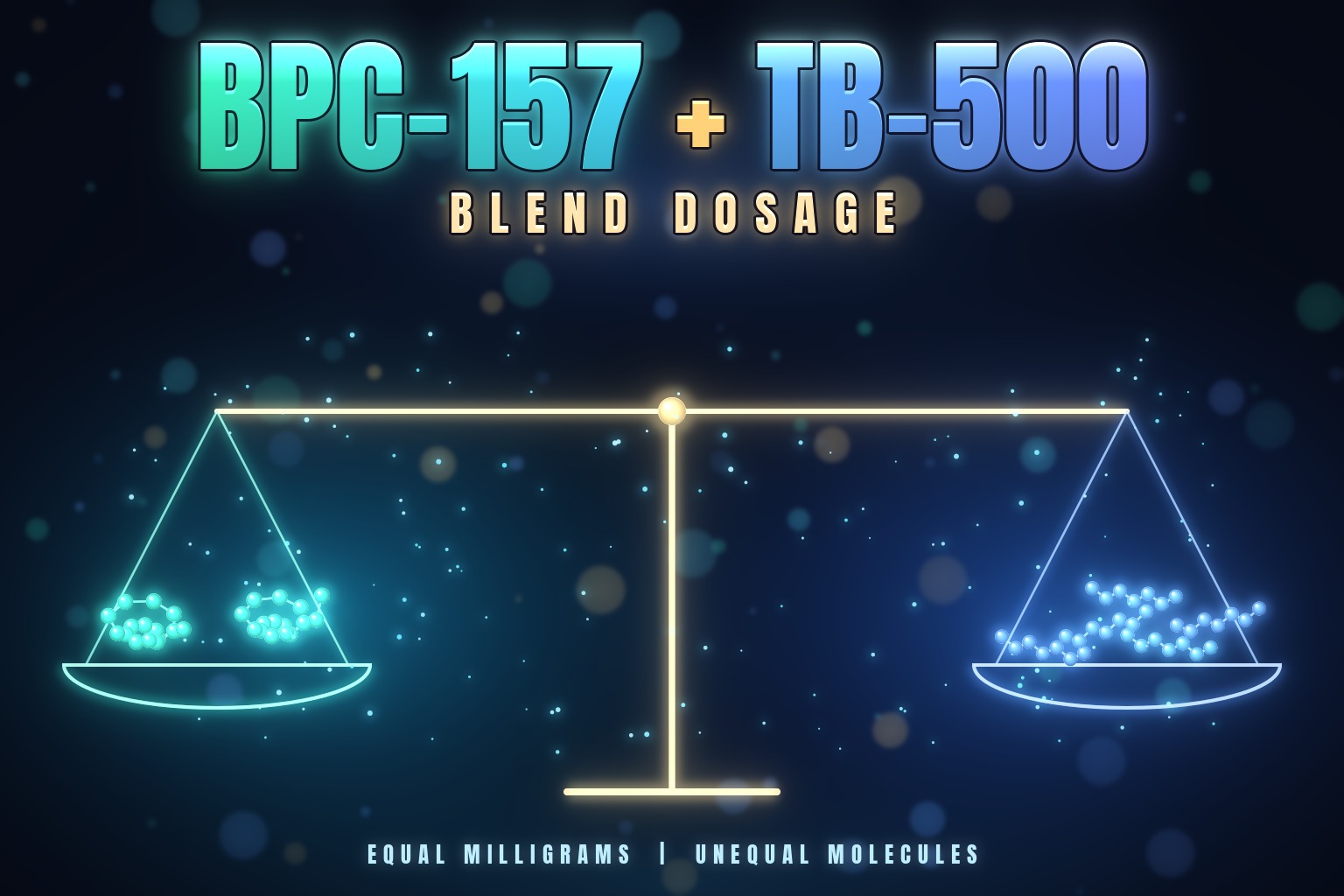
A 1:1 blend of BPC-157 and TB-500 holds the same number of milligrams of each peptide. It does not hold the same number of molecules.
If the TB-500 half is the seven-residue fragment a lab analysis found in a product sold under that name, there are about 1.6 TB-500 molecules for every BPC-157 molecule. If it’s full-length thymosin beta-4, it flips: about 3.5 BPC-157 molecules for every thymosin beta-4.
Same label, same ratio on paper, two very different vials. Let’s read one properly.
What the Label on a Blend Vial Tells You
A blend label gives you two amounts, one for each peptide, and sometimes a total. The total is the least useful number on it. A vial sold as a “10 mg blend” could be 5 mg plus 5 mg, and a vial labeled 10 mg plus 10 mg holds 20 mg in all.
So the first rule of blend math is simple: work each peptide out on its own. Every calculation that follows runs twice, once for BPC-157 and once for TB-500, and the two answers never get added together into one dose.
Here’s how the two most common ways of writing a blend label break down.
| Label | BPC-157 | TB-500 | Total peptide |
|---|---|---|---|
| 5 mg + 5 mg | 5 mg | 5 mg | 10 mg |
| 10 mg + 10 mg | 10 mg | 10 mg | 20 mg |
| “10 mg blend,” split 1:1 | 5 mg | 5 mg | 10 mg |
That handles the milligrams. The more interesting question is what those milligrams are made of.
Equal Milligrams, Unequal Molecules
Peptides come in very different sizes, and a milligram of a big one holds far fewer molecules than a milligram of a small one.
BPC-157 is a 15-amino-acid peptide with a molecular weight of 1,419. That figure appears in Staresinic and colleagues’ Achilles tendon study and in Sikiric and colleagues’ review, and PubChem lists it as 1,419.5.
Thymosin beta-4, the natural peptide TB-500 traces back to, is much bigger. Mora and colleagues and Guarnera and colleagues describe it as a 43-amino-acid peptide, Malinda and colleagues put it at 4.9 kDa, and PubChem lists 4,963.
TB-500 itself is smaller still. When Esposito and colleagues analyzed a product called TB-500, what they found was a seven-amino-acid piece of thymosin beta-4, acetylated at one end and taken from positions 17 to 23. PubChem lists that fragment, under the name TB-500, at a molecular weight of 889.0.
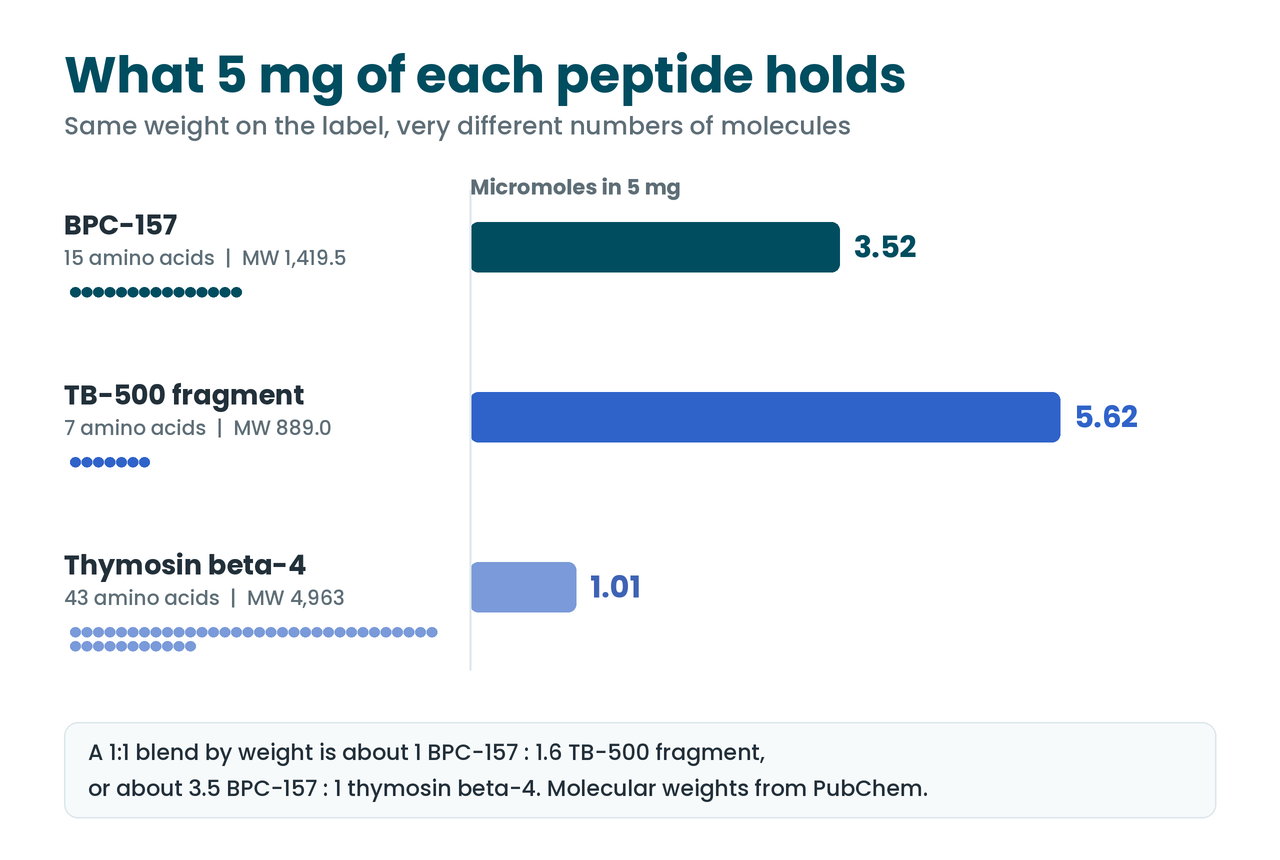
Divide each 5 mg by its molecular weight and you get the number of molecules in micromoles:
| 5 mg of | Length | Molecular weight | Micromoles |
|---|---|---|---|
| BPC-157 | 15 amino acids | 1,419.5 | 3.52 |
| TB-500 fragment | 7 amino acids | 889.0 | 5.62 |
| Thymosin beta-4 | 43 amino acids | 4,963 | 1.01 |
That’s where the numbers at the top come from. A 5 mg plus 5 mg vial with the fragment holds about 1.6 TB-500 molecules per BPC-157 molecule. The same label with full-length thymosin beta-4 holds about 3.5 BPC-157 molecules per thymosin beta-4.
Why do molecules matter more than milligrams? Because that’s how the lab compares peptides. Philp and colleagues tested thymosin beta-4 against its seven-amino-acid actin-binding motif in endothelial cell migration and blood vessel sprouting assays. The two showed near-identical activity at about 50 nanomolar, a molecule-for-molecule match. Peptides missing any part of that motif were inactive.
At 50 nanomolar, the full protein weighs roughly 5.6 times as much as a seven-residue piece the size of the TB-500 fragment. Equal activity took equal molecules, at very unequal milligrams.
You can see the gap for yourself below. Put the same milligrams on both pans, then switch the scale to count molecules instead.
Which TB-500 Is in the Vial?
The name doesn’t settle it on its own. In the analytical work, TB-500 is the seven-residue fragment Esposito’s group identified and also made by solid-phase synthesis. Thymosin beta-4 is the full 43-residue peptide used in the human trials, from Ruff and colleagues’ intravenous study to the eye drop and skin gel work.
The molecular weight is what tells them apart: about 889 for the fragment, about 4,960 for the full peptide. Every per-molecule number in this article depends on knowing which one is in your vial.
If you want the backstory on both, our TB-500 explainer covers what the fragment is, and our thymosin beta-4 guide covers what the full peptide does.
The Vial Math, One Peptide at a Time
Once you know what’s in the vial, the arithmetic is the same two lines for each peptide.
- Concentration (mg/mL) = milligrams of that peptide in the vial divided by the final liquid volume in mL
- Amount in a draw (mcg) = concentration in mg/mL times the volume drawn in mL, times 1,000
Take a 5 mg plus 5 mg vial made up to 2 mL. Each peptide sits at 5 divided by 2, which is 2.5 mg/mL. A 0.1 mL draw holds 2.5 times 0.1 times 1,000, which is 250 mcg of BPC-157 and 250 mcg of TB-500.
| Vial, made up to 2 mL | Each peptide | In 0.1 mL | In 0.2 mL |
|---|---|---|---|
| 5 mg + 5 mg | 2.5 mg/mL | 250 mcg of each | 500 mcg of each |
| 10 mg + 10 mg | 5 mg/mL | 500 mcg of each | 1 mg of each |
The same draw from the second vial holds twice as much of both peptides. That’s why a volume or a syringe mark only means something next to the concentration it came from.
And those 250 mcg, counted in molecules, are three different numbers: about 176 nanomoles of BPC-157, 281 nanomoles of the TB-500 fragment, or 50 nanomoles of full-length thymosin beta-4.
Unequal Blends
Some labels list different amounts for the two peptides, say 10 mg of BPC-157 with 5 mg of TB-500. The milligram math doesn’t change: each peptide gets its own concentration. A 10 mg plus 5 mg vial made up to 2 mL holds 5 mg/mL of BPC-157 and 2.5 mg/mL of TB-500, so a 0.1 mL draw carries 500 mcg and 250 mcg.
The molecule count moves a lot more than the label suggests:
| Label | If TB-500 is the fragment | If it is thymosin beta-4 |
|---|---|---|
| 5 mg + 5 mg | 1 BPC-157 : 1.6 TB-500 | 3.5 BPC-157 : 1 thymosin beta-4 |
| 10 mg + 5 mg | 1.25 BPC-157 : 1 TB-500 | 7 BPC-157 : 1 thymosin beta-4 |
How Long a Vial Lasts
Divide the milligrams of each peptide by the amount in each draw. A 5 mg plus 5 mg vial drawn at 250 mcg of each gives 20 draws for both, so both run out together. With a 10 mg plus 5 mg vial, both peptides still leave in every draw, so the vial still runs out for both on the same draw, just with twice as much BPC-157 used up.
Syringe Units Are Volume
The units on an insulin syringe measure liquid, not peptide. They’re built for insulin at 100 units per mL, which is the strength Keith and colleagues used when they tested how accurately small doses could be drawn. On that scale, 10 units is 0.1 mL and 20 units is 0.2 mL, whatever is dissolved in it.
Small volumes are where syringes struggle. In Keith’s test, pens and a pump beat syringes at 1 and 2 units, syringes were described as dangerously inaccurate at the 1-unit mark, and finer half-unit markings didn’t make them more accurate.
For the general steps of mixing a vial, see our reconstitution guide, and for the arithmetic, the peptide calculator. Run it twice for a blend, once per peptide.
One Ratio, Two Clocks
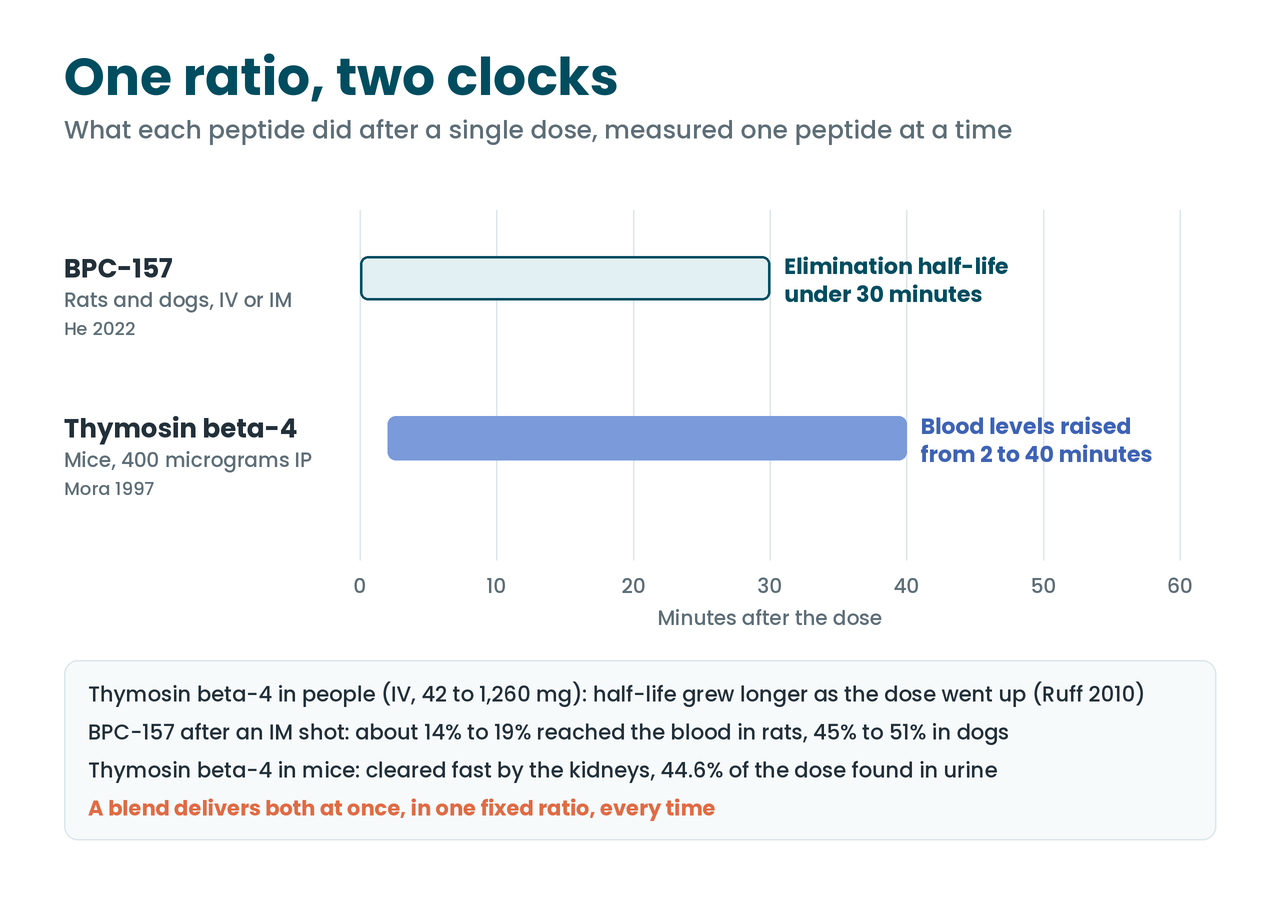
A blend puts both peptides into the body at the same moment, in the same proportion, every time. The two peptides don’t behave on the same timescale once they’re in.
- BPC-157: in He and colleagues’ study in rats and beagle dogs, the intact peptide’s elimination half-life was under 30 minutes after both intravenous and intramuscular doses. It was broken down quickly into small peptide fragments and then single amino acids. Bioavailability after an intramuscular shot was about 14% to 19% in rats and 45% to 51% in dogs.
- Thymosin beta-4 in mice: after 400 micrograms injected into the abdominal cavity, Mora and colleagues saw blood levels rise within 2 minutes and stay up for about 40 minutes. The kidneys cleared it fast, and 44.6% of the dose turned up in urine.
- Thymosin beta-4 in people: in Ruff’s intravenous study, blood levels rose in proportion to dose, and the half-life got longer as the dose went up.
These are three separate measurements, made on BPC-157 and on full-length thymosin beta-4 one at a time. Together they show each half of a blend running on its own clock, while a fixed ratio ties both to the same schedule.
What Each Half Was Studied For
The two peptides end up in one vial because both show up in tissue repair research. They got there by different routes.
BPC-157
BPC-157 came out of stomach research. Sikiric and colleagues describe it as a stable gastric pentadecapeptide, stable in human gastric juice, studied across lesions of the esophagus, stomach, intestine, liver and pancreas, and given both by mouth and by injection in their rat work.
The tendon side of its reputation traces to studies like Staresinic’s. After the Achilles tendon was cut in rats, BPC-157 given once a day improved the load the healing tendon could take before failing, its stiffness, the animals’ walking function scores and the look of the tissue under the microscope. In tendon cells grown in a dish, BPC-157 had no effect on growth by itself but countered the growth-blocking effect of 4-hydroxynonenal, a toxic product of fat breakdown.
Thymosin Beta-4
Thymosin beta-4’s main day job is holding actin, the protein cells use to build their internal scaffolding. Its repair story starts with cell movement. Malinda and colleagues found it drew endothelial cells, the cells that line blood vessels, across a membrane four to six times more than plain medium, and sped their movement into a scratched gap in a cell layer.
In rats with full-thickness skin wounds, thymosin beta-4 given on the skin or into the abdominal cavity increased the regrowth of the wound’s surface layer by 42% over saline at day 4 and by as much as 61% at day 7. Treated wounds also closed at least 11% more by day 7.
In people, the trials cited here used the full peptide as eye drops, as a skin gel and as an intravenous infusion. In Sosne’s small dry eye trial, the drops cut ocular discomfort by 35.1% and corneal staining by 59.1% compared with the vehicle at day 56. In Guarnera’s venous ulcer trial, the authors reported complete healing within 3 months in about 25% of patients, mostly those with smaller or milder wounds.
Blend or Separate Vials?
The practical difference comes down to what you’re able to change.
With a blend, one draw sets both amounts. If you want more of one peptide, you get more of the other too, in exactly the label ratio. A fixed 1:1 blend also can’t reproduce a pattern that uses the two on different days or at different amounts.
With separate vials, each peptide gets its own concentration, its own amount and its own timing. The cost is two calculations and two draws, and if both go into one syringe, the mixing itself can add error. Arnott and colleagues found that when two insulins were drawn into the same syringe, syringes with dead space produced errors of more than 100% at low doses. Syringes with minimal dead space avoided the problem.
The Wolverine and GLOW stacks are built around this exact choice, and our Wolverine vs GLOW post walks through separate vials against a premixed blend.
Doses Used in the Research
Blend labels and the research behind each half use different kinds of numbers. The animal studies dose per kilogram of body weight, the human intravenous work doses per infusion, and the skin and eye studies dose by concentration. Here’s what each study actually used.
BPC-157
- 10 micrograms, 10 nanograms or 10 picograms per kg, injected into the abdominal cavity once a day after an Achilles tendon was cut, in rats (Staresinic, 2003)
- A single intravenous dose, single intramuscular doses at three rising levels and repeated intramuscular doses, in rats and beagle dogs (He, 2022)
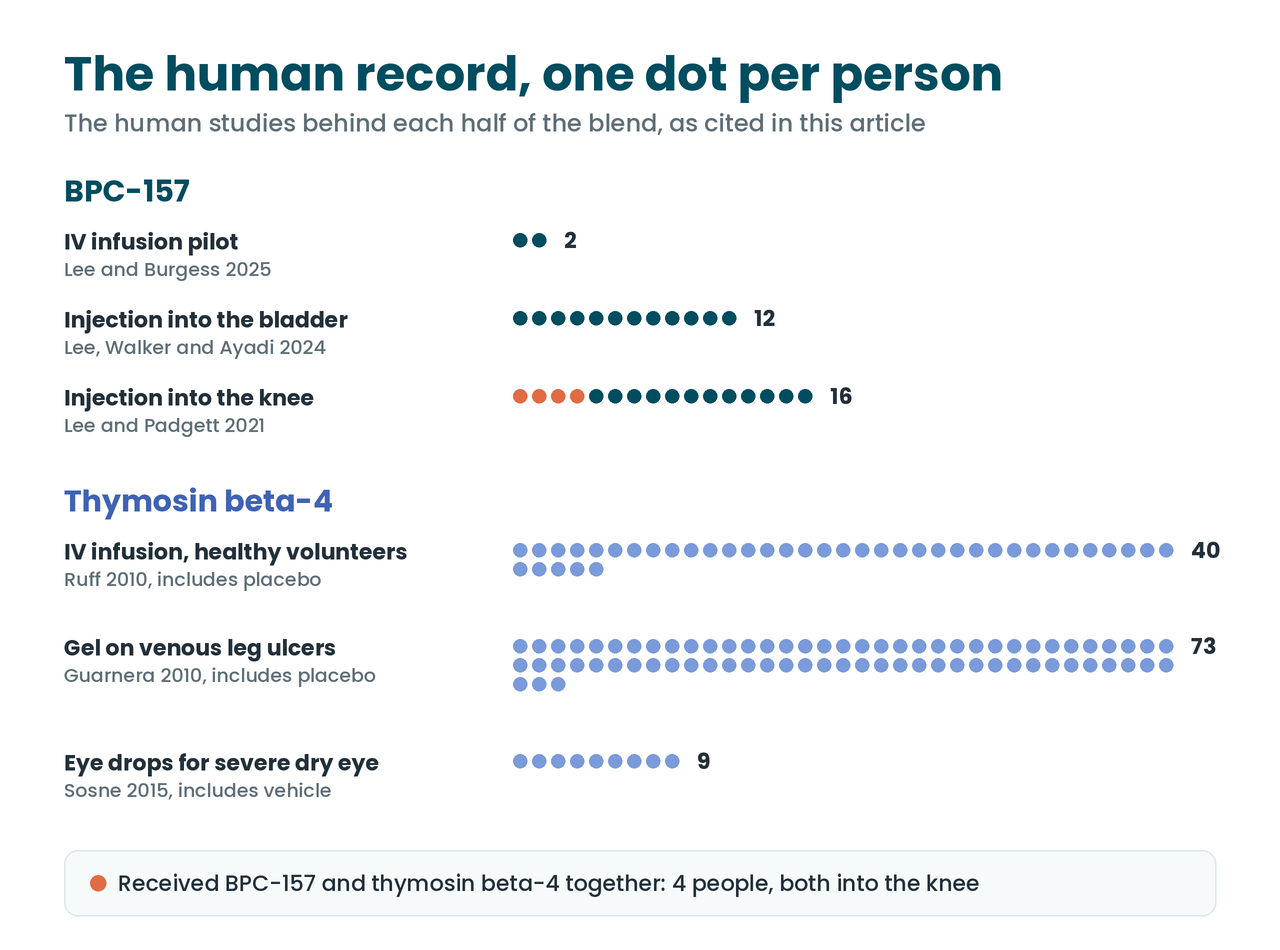
- 10 mg by intravenous infusion over one hour on day 1, then 20 mg on day 2, in 2 adults (Lee and Burgess, 2025)
- A total of 10 mg injected around the inflamed area of the bladder in a single procedure, in 12 women with interstitial cystitis (Lee, Walker and Ayadi, 2024)
- Injection into the knee joint, BPC-157 alone in 12 people and BPC-157 with thymosin beta-4 in 4, in a retrospective review of 16 patients (Lee and Padgett, 2021)
Those last three are the whole human record for BPC-157 so far, according to Poolton and colleagues’ systematic review: three small studies, 30 people in total. Of the 4 knee patients who got both peptides, 3 reported relief.
Thymosin beta-4
- 42, 140, 420 or 1,260 mg by intravenous infusion, once, then daily for 14 days, in healthy volunteers, 10 per group (Ruff, 2010)
- Topical gel in a dose-escalation trial in 73 people with venous leg ulcers, with 0.03% the strength singled out for faster healing (Guarnera, 2010)
- 0.1% eye drops, 6 times a day for 28 days, in 9 people with severe dry eye (Sosne, 2015)
- 400 micrograms injected into the abdominal cavity, in mice (Mora, 1997)
- Topical or intraperitoneal treatment of full-thickness skin wounds, in rats (Malinda, 1999)
The two peptides’ human numbers sit on different scales. The intravenous thymosin beta-4 doses ran from 42 mg to 1,260 mg, while the largest single BPC-157 infusion was 20 mg.
Frequently Asked Questions
How do you calculate the dose in a BPC-157 and TB-500 blend?
Work out each peptide separately: its milligrams divided by the final volume gives its concentration, and concentration times the volume drawn gives the amount of that peptide. A 5 mg plus 5 mg vial made up to 2 mL holds 2.5 mg/mL of each.
Does a 1:1 blend contain equal amounts of BPC-157 and TB-500?
It contains equal milligrams, not equal molecules. With the seven-residue TB-500 fragment there are about 1.6 TB-500 molecules per BPC-157 molecule; with full-length thymosin beta-4 there are about 3.5 BPC-157 molecules per thymosin beta-4.
Is TB-500 the same as thymosin beta-4?
TB-500 is the name attached to a seven-amino-acid fragment of thymosin beta-4 in lab analysis, with a molecular weight of about 889. Thymosin beta-4 is the full 43-amino-acid peptide, at about 4,960.
How many units is 250 mcg in a blend?
It depends on the concentration. In a 5 mg plus 5 mg vial made up to 2 mL, 250 mcg of each peptide sits in 0.1 mL, which is 10 units on a U-100 insulin syringe.
What is the ratio of BPC-157 to TB-500 in a blend?
By weight it is whatever the label says, often 1:1. By molecule count, a 1:1 blend is about 1 BPC-157 to 1.6 TB-500 with the fragment, or about 3.5 BPC-157 to 1 thymosin beta-4 with the full peptide.
Why are human thymosin beta-4 doses so much larger than BPC-157 doses?
The intravenous thymosin beta-4 study tested 42 mg to 1,260 mg, while the largest BPC-157 infusion in people was 20 mg. The two studies had different aims, and thymosin beta-4 is also a much heavier molecule, at about 4,960 against 1,419.5.
Why do BPC-157 and TB-500 have different schedules?
They clear on different timescales. BPC-157’s half-life was under 30 minutes in rats and dogs, while thymosin beta-4’s half-life in people lengthened as the intravenous dose went up.
Has the BPC-157 and TB-500 combination been studied in people?
One retrospective knee review included 4 patients who received injections of both BPC-157 and thymosin beta-4, and 3 of them reported relief. In the same review, 11 of the 12 who received BPC-157 alone reported improvement.
References
- Arnott RD, Cameron MA, Stepanas TV, Cohen M. Insulin syringes: dangers of dead space. Med J Aust. 1982;2(1):39-40. doi:10.5694/j.1326-5377.1982.tb124209.x
- Esposito S, Deventer K, Goeman J, et al. Synthesis and characterization of the N-terminal acetylated 17-23 fragment of thymosin beta 4 identified in TB-500, a product suspected to possess doping potential. Drug Test Anal. 2012;4(9):733-738. doi:10.1002/dta.1402
- Guarnera G, DeRosa A, Camerini R. The effect of thymosin treatment of venous ulcers. Ann N Y Acad Sci. 2010;1194:207-212. doi:10.1111/j.1749-6632.2010.05490.x
- He L, Feng D, Guo H, et al. Pharmacokinetics, distribution, metabolism, and excretion of body-protective compound 157, a potential drug for treating various wounds, in rats and dogs. Front Pharmacol. 2022;13:1026182. doi:10.3389/fphar.2022.1026182
- Keith K, Nicholson D, Rogers D. Accuracy and precision of low-dose insulin administration using syringes, pen injectors, and a pump. Clin Pediatr (Phila). 2004;43(1):69-74. doi:10.1177/000992280404300109
- Lee E, Burgess K. Safety of intravenous infusion of BPC157 in humans: a pilot study. Altern Ther Health Med. 2025;31(5):20-24. PubMed 40131143
- Lee E, Padgett B. Intra-articular injection of BPC 157 for multiple types of knee pain. Altern Ther Health Med. 2021;27(4):8-13. PubMed 34324435
- Lee E, Walker C, Ayadi B. Effect of BPC-157 on symptoms in patients with interstitial cystitis: a pilot study. Altern Ther Health Med. 2024;30(10):12-17. PubMed 39325560
- Malinda KM, Goldstein AL, Kleinman HK. Thymosin beta 4 stimulates directional migration of human umbilical vein endothelial cells. FASEB J. 1997;11(6):474-481. doi:10.1096/fasebj.11.6.9194528
- Malinda KM, Sidhu GS, Mani H, et al. Thymosin beta4 accelerates wound healing. J Invest Dermatol. 1999;113(3):364-368. doi:10.1046/j.1523-1747.1999.00708.x
- Mora CA, Baumann CA, Paino JE, et al. Biodistribution of synthetic thymosin beta 4 in the serum, urine, and major organs of mice. Int J Immunopharmacol. 1997;19(1):1-8. doi:10.1016/s0192-0561(97)00005-2
- Philp D, Huff T, Gho YS, et al. The actin binding site on thymosin beta4 promotes angiogenesis. FASEB J. 2003;17(14):2103-2105. doi:10.1096/fj.03-0121fje
- Poolton JT, Minett J, Kazmi A. Human evidence for BPC-157 in orthopaedic and regenerative medicine: a systematic review of efficacy and safety. Acta Orthop Belg. 2026;92(3). doi:10.52628/92.3.15837
- PubChem. Bpc-157, compound summary (CID 9941957). National Center for Biotechnology Information. PubChem CID 9941957
- PubChem. TB-500, compound summary (CID 62707662). National Center for Biotechnology Information. PubChem CID 62707662
- PubChem. Thymosin beta 4, compound summary (CID 45382195). National Center for Biotechnology Information. PubChem CID 45382195
- Ruff D, Crockford D, Girardi G, Zhang Y. A randomized, placebo-controlled, single and multiple dose study of intravenous thymosin beta4 in healthy volunteers. Ann N Y Acad Sci. 2010;1194:223-229. doi:10.1111/j.1749-6632.2010.05474.x
- Sikiric P, Seiwerth S, Rucman R, et al. Stable gastric pentadecapeptide BPC 157: novel therapy in gastrointestinal tract. Curr Pharm Des. 2011;17(16):1612-1632. doi:10.2174/138161211796196954
- Sosne G, Dunn SP, Kim C. Thymosin beta4 significantly improves signs and symptoms of severe dry eye in a phase 2 randomized trial. Cornea. 2015;34(5):491-496. doi:10.1097/ICO.0000000000000379
- Staresinic M, Sebecic B, Patrlj L, et al. Gastric pentadecapeptide BPC 157 accelerates healing of transected rat Achilles tendon and in vitro stimulates tendocytes growth. J Orthop Res. 2003;21(6):976-983. doi:10.1016/S0736-0266(03)00110-4
Stay sharp,
Joe Mars
The Peptide Report
P.S. If you want to talk blend math through with people who read the same papers, the conversation carries on over at the Peptides & Biohacking Hub.