Here’s the middle of a peptide serum’s ingredient list. The product is made up (it’s the first sample in the decoder below), but the names are real, and you’ll find them on plenty of shelves:
…Pentylene Glycol, Sodium Hyaluronate, Palmitoyl Tripeptide-1, Palmitoyl Tetrapeptide-7, Acetyl Hexapeptide-8, Carnosine, Panthenol, Xanthan Gum…
Four of those are peptides. They were built for different jobs, they run from about 230 to almost 900 daltons in size, and they’ve been tested in very different ways. Here’s how to read the names, how far each kind gets into skin, and what happened when people put them on their faces.
How to Read a Peptide Name on a Label
A peptide is a short chain of amino acids. The names on ingredient lists (INCI names, the standard naming system for cosmetic ingredients) are built from parts, and once you know the parts, most peptide names read like a short description:
- The count. Di, tri, tetra, penta, hexa and octa mean two, three, four, five, six and eight amino acids. “Oligopeptide” means a short chain, without the exact count in the name.
- The number after the dash. An index number, not a strength. Different numbers usually mean different molecules: pentapeptide-18 and palmitoyl pentapeptide-4 are two different five-amino-acid chains built for different jobs. Acetyl hexapeptide-3 and acetyl hexapeptide-8 are the exception, two names for the same molecule.
- Palmitoyl. A tail of palmitic acid, a 16-carbon fatty acid, attached to the chain. The outer layer of skin is a fatty barrier, and the tail changes how a peptide behaves in it.
- Acetyl and amide. Small chemical caps on the front and back ends of the chain. Acetyl hexapeptide-8 carries both, even though only “acetyl” appears in its name: the same two caps that turn Semax into N-Acetyl Semax Amidate.
- Copper. A copper ion held by the peptide, as in copper tripeptide-1, better known as GHK-Cu.
The names can still surprise you. Tripeptide-10 citrulline is a four-amino-acid chain (the name counts three, plus the citrulline), according to the 2008 paper from the ingredient supplier that developed it.
Trade names sit on top of all this. Matrixyl is palmitoyl pentapeptide-4. Matrixyl 3000 is palmitoyl tripeptide-1 plus palmitoyl tetrapeptide-7. Argireline is acetyl hexapeptide-8.
Decode Your Own Label
Paste the ingredient list from any product into the decoder, or load one of the sample labels. It picks out the peptides, breaks each name into its parts, places it against the 500 dalton line and pulls up the studies covered below.
The Four Jobs Cosmetic Peptides Are Built For
In their 2009 review of topical peptides for aging skin, Gorouhi and Maibach sorted them into four groups, and later papers still use the same split:
| Group | Built to | Examples on labels |
|---|---|---|
| Signal peptides | Prompt fibroblasts, the cells that build the skin’s support layer, to make more collagen, elastin and related proteins | Palmitoyl pentapeptide-4, palmitoyl tripeptide-1, palmitoyl tetrapeptide-7, palmitoyl tripeptide-5, tripeptide-10 citrulline |
| Carrier peptides | Deliver a trace metal such as copper | Copper tripeptide-1 |
| Neurotransmitter-inhibitor peptides | Damp down the nerve-to-muscle signal behind expression lines | Acetyl hexapeptide-8, pentapeptide-18, dipeptide diaminobutyroyl benzylamide diacetate |
| Enzyme-inhibitor peptides | Slow the enzymes that break down skin proteins | Soy, silk and rice peptides |
A 2017 review of topical peptides by Schagen describes where they come from. Many signal peptides are modeled on pieces of the skin’s own proteins. Palmitoyl pentapeptide-4 is related to a fragment of procollagen type I, the precursor of the main collagen in skin. Tripeptide-10 citrulline mimics decorin, a protein that binds collagen and helps keep its fibers evenly sized. Palmitoyl tripeptide-5 mimics thrombospondin-1, which boosts the activity of TGF-beta, a growth signal that raises fibroblasts’ output of type I and type III collagen. Palmitoyl tetrapeptide-7 is a fragment of immunoglobulin G and is reported to lower secretion of IL-6, an inflammatory signal.
The neurotransmitter group aims at the junction where a nerve tells a muscle to contract. Acetyl hexapeptide-8 is patterned on the front end of SNAP-25, one of the proteins a nerve uses to release its signal. Pentapeptide-18 mimics enkephalins, natural peptides that quiet nerve activity. Dipeptide diaminobutyroyl benzylamide diacetate is modeled on waglerin-1, a peptide from viper venom, and acts on the muscle side as a reversible blocker of the acetylcholine receptor.
The 500 Dalton Line
In 2000, Bos and Meinardi, dermatologists in Amsterdam, argued that a compound has to weigh under 500 daltons to be absorbed through skin. Their case rested on three patterns: virtually all common contact allergens are under 500, the most widely used topical skin drugs are under 500, and every drug then used in skin patches is under 500. The barrier they meant is the stratum corneum, the outer layer of dead, flattened skin cells.
Here are the peptides you’re likely to see on a label, plus three familiar non-peptide actives for scale, lined up against that line using molecular weights from PubChem:
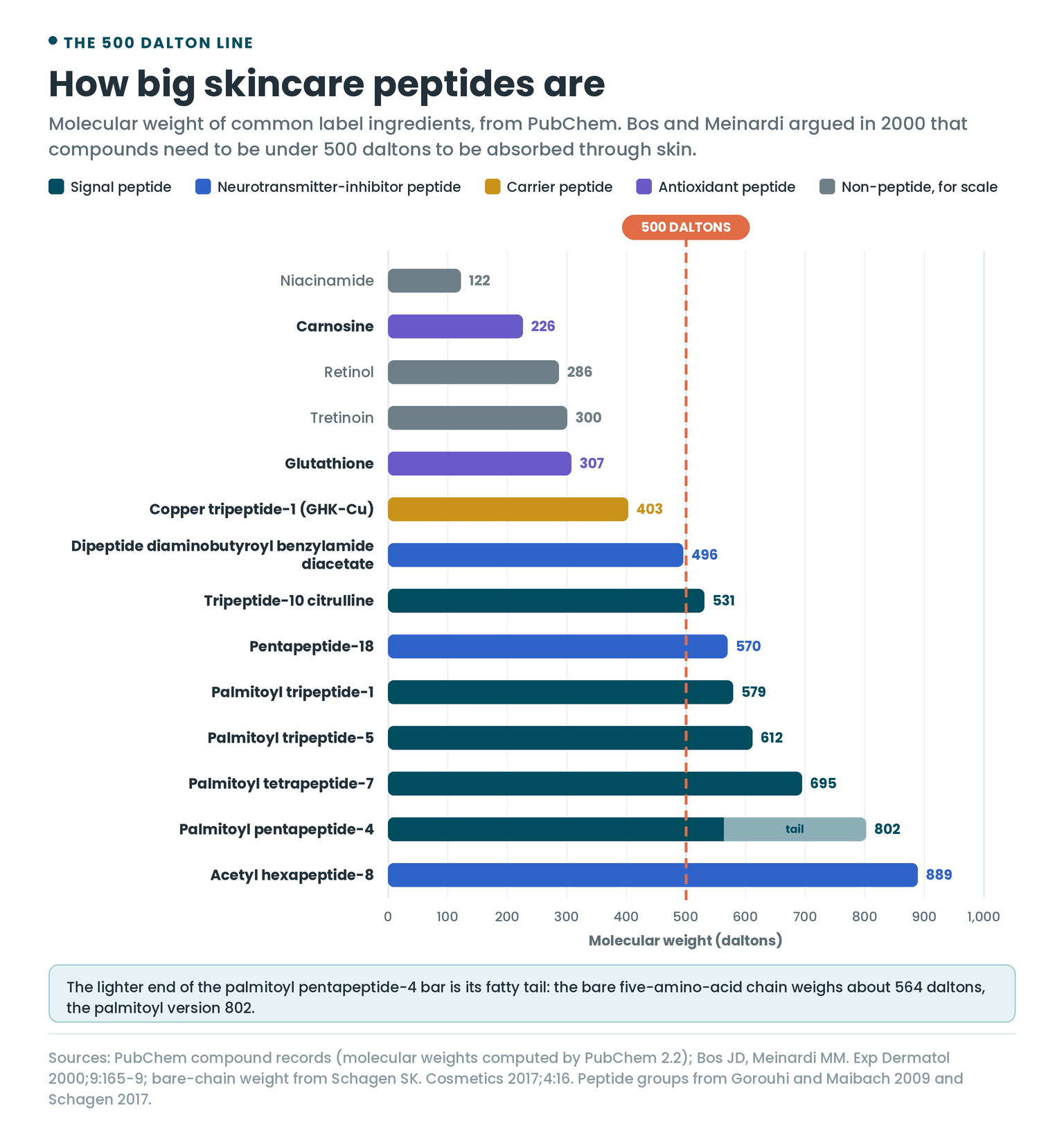
Most of them sit over it. Palmitoyl pentapeptide-4 weighs 802 daltons and acetyl hexapeptide-8 weighs 889. The fatty tail adds weight, too: the bare five-amino-acid chain inside palmitoyl pentapeptide-4 is about 564 daltons, and the palmitoyl version is 802. The peptides under the line are the small ones: carnosine at 226, glutathione (the antioxidant from our detoxification post) at 307, copper tripeptide-1 at 403 and dipeptide diaminobutyroyl benzylamide diacetate just under, at 496.
The line is a rule of thumb. Schagen’s review notes that newer studies show larger molecules can cross the barrier, especially in dry and aged skin. And being small isn’t enough on its own. The same review describes plain carnosine as having very little affinity for skin and not getting past the first layer of the stratum corneum, while its palmitoyl version spreads into the deeper layers.
How Far Peptides Get Into Skin
The signal peptides are aimed at fibroblasts in the dermis, the thick layer under the epidermis. The neurotransmitter peptides are aimed at the nerve-muscle junctions in the facial muscles, deeper still. Three studies tracked where a cosmetic peptide actually ends up.
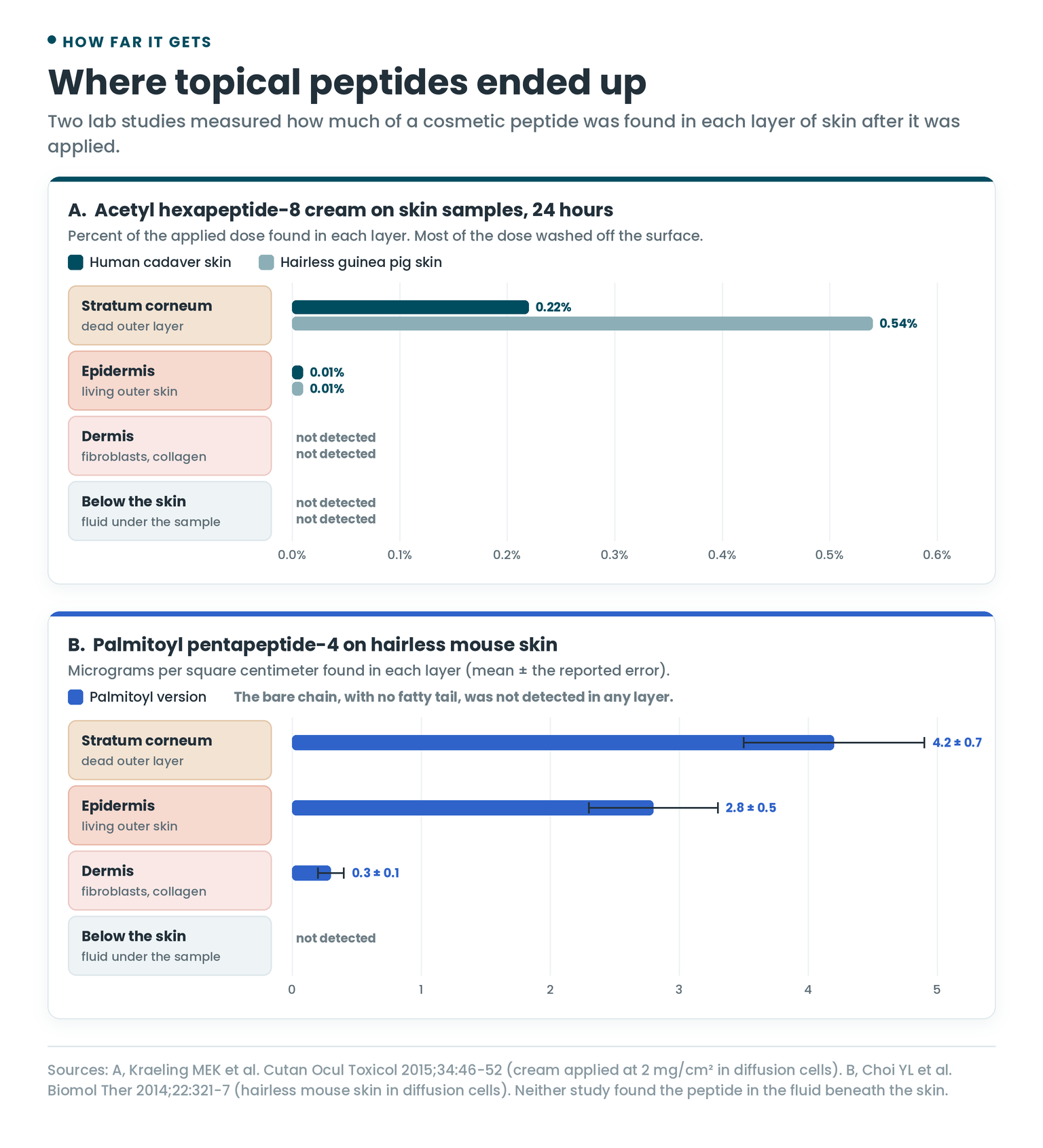
Acetyl hexapeptide-8 on skin samples (2015). Margaret Kraeling and colleagues put a cream containing acetyl hexapeptide-8 on human cadaver skin and on hairless guinea pig skin, mounted in diffusion cells, for 24 hours. Most of it washed off the surface. What did go in stayed mostly in the stratum corneum: 0.22% of the applied dose in human skin and 0.54% in guinea pig skin, with less in each deeper layer they stripped off. About 0.01% reached the epidermis in both. None was found in the dermis or in the fluid beneath the skin, and neither was any breakdown product.
Palmitoyl pentapeptide-4 in mouse skin (2014). Yun Lim Choi and colleagues compared the palmitoyl peptide with its bare chain in hairless mouse skin. Both broke down quickly in skin extracts. The palmitoyl version lasted longer, and both lasted longer when the researchers added enzyme blockers. Neither crossed the full thickness of skin. The bare chain wasn’t found in any layer, while the palmitoyl version turned up in all three: 4.2 µg/cm² in the stratum corneum, 2.8 in the epidermis and 0.3 in the dermis.
Matrixyl 3000 on living skin (2026). A University of Nottingham team, with two co-authors from a skincare company, applied serums containing palmitoyl tripeptide-1 and palmitoyl tetrapeptide-7 to three women for half an hour, two hours or five hours, then lifted the stratum corneum off layer by layer with tape and imaged each strip with mass spectrometry. Both peptides showed up through every layer, fading with depth, with no significant change between the shorter and longer applications. The pattern suggested they sat on the outer surfaces of the cells, in the spaces between them, rather than inside.
A 2025 review of acetyl hexapeptide-8 by Julita Zdrada-Nowak and colleagues sums up the delivery side: the peptide is water-loving and relatively large, so it gets through the fatty stratum corneum poorly, and whether it reaches nerve-muscle junctions remains uncertain. The review calls the mechanism behind its effect on skin incompletely understood.
Palmitoyl Pentapeptide-4 (Matrixyl): The 93-Woman Split-Face Trial
A 2005 trial from Procter & Gamble scientists tested palmitoyl pentapeptide-4 on its own. Robinson and colleagues enrolled 93 white women aged 35 to 55 for 12 weeks. Each woman used a moisturizer on one side of her face and the same moisturizer with 3 ppm palmitoyl pentapeptide-4 (0.0003%) on the other. Which side got the peptide was randomized, and neither the women nor the researchers knew.
Because both sides got the same cream base, the difference between them comes down to the peptide.
The peptide side improved significantly more than the moisturizer-only side for wrinkles and fine lines, measured two ways: computer analysis of facial images and expert graders scoring the images. The women’s own ratings also showed a significant improvement in fine lines and wrinkles, and pointed the same way, without reaching significance, on other facial measures.
P&G followed with two split-face trials in 42 and 35 women aged 30 to 70, published by Joseph Kaczvinsky and colleagues in 2009. The products combined niacinamide, two palmitoyl peptides (one of them palmitoyl pentapeptide-4) and carnosine, with sunscreen and antioxidants, caffeine or retinyl propionate added in some, and each woman left the other half of her face untreated. After four weeks of twice-daily use, the pooled data showed smoother skin around the eyes and less apparent depth in the larger wrinkles on the treated side. With bare skin as the comparison, that result covers the whole product, base included.
Acetyl Hexapeptide-8 (Argireline): The Topical Take on Botulinum Toxin
Argireline came out of a design program at a Spanish university, aimed at a non-toxic molecule that mimics botulinum toxin. In their 2002 paper, Blanes-Mira and colleagues showed it interferes with the SNARE complex, the protein machinery a nerve needs to release its signal. In the lab, it blocked neurotransmitter release with a potency similar to botulinum toxin A but a much lower efficacy. Potency is how little of something you need for an effect; efficacy is how big the effect can get. So it acted at similar concentrations, with a much smaller maximum effect.
On healthy women volunteers, an emulsion containing the peptide reduced wrinkle depth by up to 30% over 30 days, measured by skin topography. In safety tests, it showed no oral toxicity and no primary skin irritation at high doses.
The placebo-controlled trial came from Xi’an, China, in 2013. Yuan Wang and colleagues randomized 60 people with wrinkles around the eyes to argireline or placebo in a 3:1 ratio, applied twice daily for four weeks. On a subjective global assessment, overall anti-wrinkle efficacy was 48.9% in the argireline group and 0% in the placebo group. On silicone replicas of the skin, every measure of roughness fell in the argireline group (p < 0.01), with no clear decrease in the placebo group (p > 0.05).
A 2022 trial tested the same peptide against facial oiliness. In cultured human oil-gland cells, it lowered fat content at several concentrations. In a randomized split-face study, with a lotion containing acetyl hexapeptide-8 on one side and the plain lotion on the other, oil output trended 10% lower on the peptide side, short of significance (p = 0.16).
Copper Peptides
Copper tripeptide-1 is the main carrier peptide and one of the most examined cosmetic peptides. In its two controlled human trials on skin, a 2006 trial after laser resurfacing around the mouth and a 1992 trial in venous leg ulcers, the copper peptide matched its comparison on objective measures. Both are covered in full in Skin, Hair and Aesthetics: What the Evidence Supports.
For copper peptides on the scalp, see Hair Restoration with Peptides.
The Cream Itself Counts
A small 2023 trial from Jakarta tested both peptides against a placebo cream. Rompu Roger Aruan and colleagues randomized 21 Indonesian women aged 26 to 55, seven per group, to an acetyl hexapeptide-3 cream, a palmitoyl pentapeptide-4 cream or a placebo cream. Each woman applied 0.5 g, one fingertip unit, around her eyes twice a day for eight weeks, double-blind. The study was funded by the Indonesian company Paragon Technology and Innovation.
The instrument readings for hydration, water loss and elasticity showed no significant differences. Here’s how the average crow’s feet grades moved on a scale from 0 (no wrinkles) to 4 (severe):
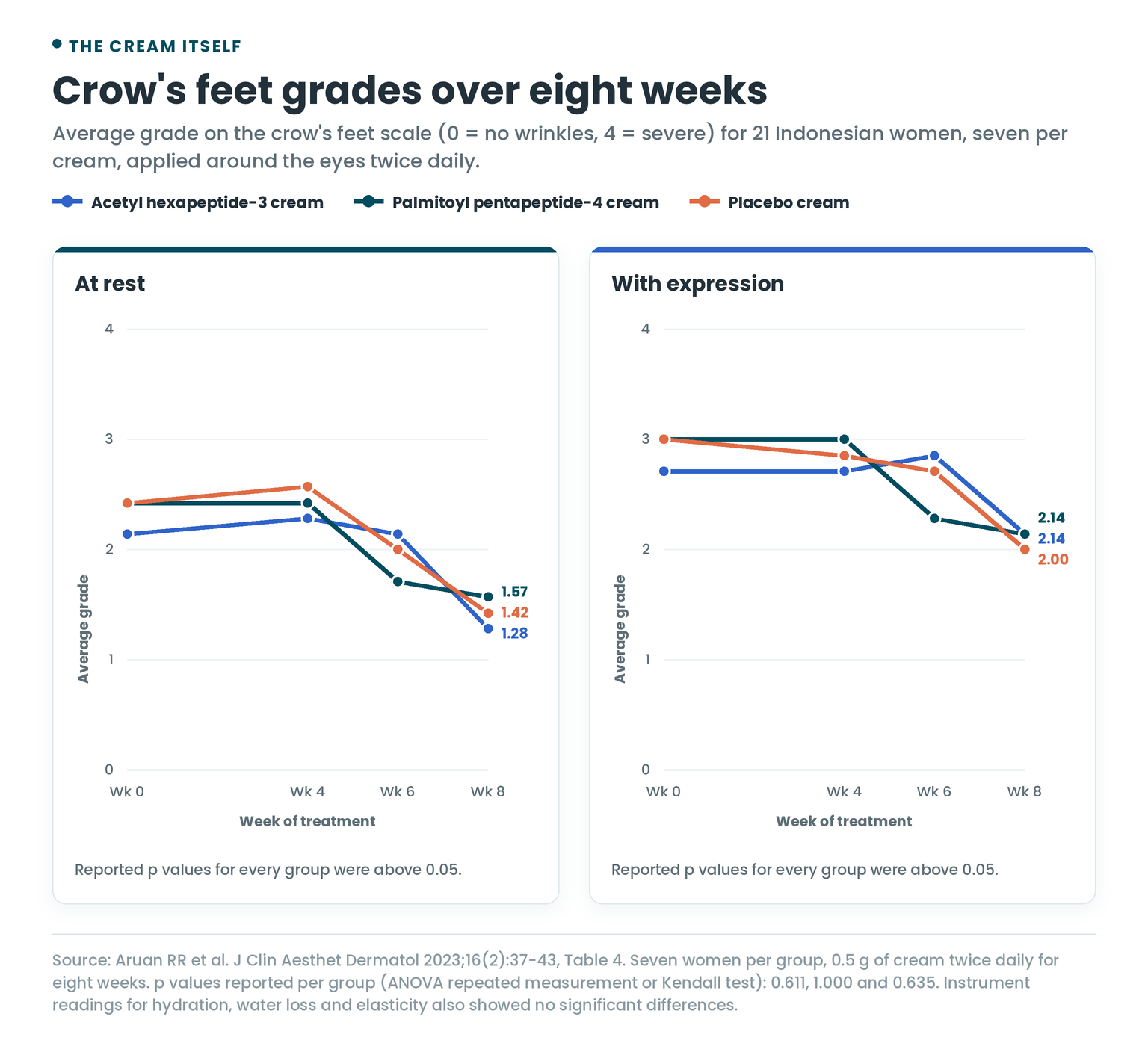
- At rest: acetyl hexapeptide-3 from 2.14 to 1.28, palmitoyl pentapeptide-4 from 2.42 to 1.57 and placebo from 2.42 to 1.42.
- With expression: acetyl hexapeptide-3 from 2.71 to 2.14, palmitoyl pentapeptide-4 from 3.00 to 2.14 and placebo from 3.00 to 2.00.
The reported p values for all three groups were above 0.05. The authors concluded the palmitoyl pentapeptide-4 cream did better than the other two, based on clinical photos and the women’s questionnaires, and described the work as an initial study that needs more women and a longer run.
In this trial, the placebo cream’s grades fell as far as either peptide cream’s.
Peptides vs Tretinoin
In 2010, a study led by Procter & Gamble scientists compared a cosmetic regimen with tretinoin, which the authors describe as the benchmark prescription treatment for fine facial wrinkles. The eight-week randomized trial enrolled 196 women with moderate to moderately severe wrinkles around the eyes.
The 99 women on the cosmetic regimen used three products: an SPF 30 lotion with 5% niacinamide, peptides and antioxidants; a cream with niacinamide and peptides; and a wrinkle treatment with niacinamide, peptides and 0.3% retinyl propionate. The 97 women on the prescription regimen used 0.02% tretinoin plus a moisturizing SPF 30 sunscreen. Subsets of 25 women kept going for another 16 weeks.
At eight weeks, the cosmetic regimen had improved the look of wrinkles significantly more than tretinoin, and at 24 weeks the two were comparable. The cosmetic regimen was also significantly better tolerated through eight weeks on every measure: redness, dryness, the women’s own ratings, water loss through the skin and changes in skin proteins. With niacinamide and a retinoid in the same regimen, the result belongs to the regimen as a whole.
What the Pooled Trials Show
A 2026 meta-analysis by Houriah Nukaly and colleagues pooled 19 randomized, double-blind, placebo-controlled trials of peptides for skin aging, with 1,341 people and runs of four to 12 weeks. Seventeen trials tested peptides by mouth and two tested them on the skin, one of them the Wang argireline trial.
The pooled effect on wrinkles was modest (mean difference 0.27, p = 0.04), and it came mostly from the oral trials. The topical peptides showed a smaller effect that wasn’t statistically significant. Hydration and brightness improved overall, and elasticity didn’t change significantly.
Collagen peptides taken by mouth have a much bigger trial base. A 2025 meta-analysis in the American Journal of Medicine found benefits overall and none in the trials without pharmaceutical company funding or in the high-quality trials; the collagen evidence is covered in full in the skin and aesthetics review linked above.
A 2026 narrative review by Kyu-Ho Yi and colleagues reaches a similar place for the topical side. Controlled studies in people report gains in selected measures, including wrinkles, hydration, elasticity, dermal density and pigmentation, but many trials are small, short, industry-sponsored or test several ingredients at once. The authors conclude the evidence supports judging each product on its own data rather than treating different peptide classes, or different routes such as skin and mouth, as interchangeable.
Side Effects and Tolerability
Palmitoyl pentapeptide-4 was well tolerated in the 93-woman split-face trial. In the Jakarta trial, the women using the palmitoyl pentapeptide-4 cream reported no complaints, while the acetyl hexapeptide-3 group reported one case of itching, two of stinging and one of burning, and the placebo group two of itching and two of burning, with single reports of oiliness or dryness in both groups and stickiness with placebo. Nobody had a serious reaction. The Nukaly meta-analysis found minimal adverse events across its trials and no severe ones.
Concentrations and Amounts Used in the Studies
- Palmitoyl pentapeptide-4: 3 ppm (0.0003%) in a moisturizer, used on one side of the face for 12 weeks.
- Acetyl hexapeptide-8 on skin samples: a cream applied at 2 mg/cm² and left on for 24 hours.
- Acetyl hexapeptide-8 on oil-gland cells (lab): 0.00005% to 0.025%.
- Jakarta trial creams: 0.5 g (one fingertip unit) around the eyes twice daily for eight weeks.
- P&G split-face products: 0.5 g of each product twice daily for four weeks.
- Tretinoin comparison: 5% niacinamide and 0.3% retinyl propionate in the cosmetic regimen, against 0.02% tretinoin.
Frequently Asked Questions
Do peptides in skincare actually work?
In a 93-woman split-face trial, women used a moisturizer with palmitoyl pentapeptide-4 on one side of the face and the same moisturizer without it on the other for 12 weeks, and the peptide side showed significantly more improvement in wrinkles and fine lines. A 2026 meta-analysis that included two topical peptide trials found a smaller, non-significant pooled effect on wrinkles for the topical peptides.
What do peptides do for your skin?
Cosmetic peptides are designed for one of four jobs: signaling fibroblasts to make more collagen and related proteins, carrying copper, damping the nerve-to-muscle signal behind expression lines, or slowing the enzymes that break down skin proteins.
Can peptides get through the skin?
Mostly into the outer layer. In human cadaver skin, the acetyl hexapeptide-8 that went in stayed mostly in the stratum corneum, about 0.01% of the dose reached the epidermis and none reached the dermis. In mouse skin, palmitoyl pentapeptide-4 reached all three layers in small amounts, while the same chain without its fatty tail wasn’t detected in any of them.
Is argireline like Botox?
It was designed to mimic botulinum toxin, the active ingredient in Botox. In the lab it blocked the nerve’s signal at concentrations similar to botulinum toxin A, with a much smaller maximum effect. On skin, in a four-week placebo-controlled trial in 60 people, roughness around the eyes fell in the argireline group and not in the placebo group.
Can you use peptides with niacinamide or retinol?
The P&G regimens combined peptides with niacinamide in the same products, and the wrinkle treatment also carried retinyl propionate, an ester of retinol. In the 196-woman tretinoin comparison, that regimen was better tolerated than 0.02% tretinoin.
How long do peptide creams take to work?
The trials here ran from four weeks (the argireline trial and the P&G split-face trials) to 12 weeks (the palmitoyl pentapeptide-4 trial), and the tretinoin comparison followed some women to 24 weeks.
Stay sharp,
Joe Mars
The Peptide Report
P.S. Got a label you can’t make sense of? Bring it to the Peptides & Biohacking Hub on Skool.
References
- Puig A, Garcia Antón JM, Mangues M. A new decorin-like tetrapeptide for optimal organization of collagen fibres. Int J Cosmet Sci. 2008;30(2):97-104. doi:10.1111/j.1468-2494.2008.00429.x
- Gorouhi F, Maibach HI. Role of topical peptides in preventing or treating aged skin. Int J Cosmet Sci. 2009;31(5):327-345. doi:10.1111/j.1468-2494.2009.00490.x
- Schagen SK. Topical peptide treatments with effective anti-aging results. Cosmetics. 2017;4(2):16. doi:10.3390/cosmetics4020016
- Bos JD, Meinardi MM. The 500 Dalton rule for the skin penetration of chemical compounds and drugs. Exp Dermatol. 2000;9(3):165-169. doi:10.1034/j.1600-0625.2000.009003165.x
- PubChem compound records (molecular weights computed by PubChem). National Library of Medicine. pubchem.ncbi.nlm.nih.gov
- Kraeling MEK, Zhou W, Wang P, Ogunsola OA. In vitro skin penetration of acetyl hexapeptide-8 from a cosmetic formulation. Cutan Ocul Toxicol. 2015;34(1):46-52. doi:10.3109/15569527.2014.894521
- Choi YL, Park EJ, Kim E, Na DH, Shin YH. Dermal stability and in vitro skin permeation of collagen pentapeptides (KTTKS and palmitoyl-KTTKS). Biomol Ther (Seoul). 2014;22(4):321-327. doi:10.4062/biomolther.2014.053
- Trzaska AH, Kotowska AM, Starr NJ, et al. Permeation behaviour of cosmetic actives into the human stratum corneum. Int J Pharm. 2026;705:127447. doi:10.1016/j.ijpharm.2026.127447
- Zdrada-Nowak J, Surgiel-Gemza A, Szatkowska M. Acetyl hexapeptide-8 in cosmeceuticals: a review of skin permeability and efficacy. Int J Mol Sci. 2025;26(12):5722. doi:10.3390/ijms26125722
- Robinson LR, Fitzgerald NC, Doughty DG, Dawes NC, Berge CA, Bissett DL. Topical palmitoyl pentapeptide provides improvement in photoaged human facial skin. Int J Cosmet Sci. 2005;27(3):155-160. doi:10.1111/j.1467-2494.2005.00261.x
- Kaczvinsky JR, Griffiths CEM, Schnicker MS, Li J. Efficacy of anti-aging products for periorbital wrinkles as measured by 3-D imaging. J Cosmet Dermatol. 2009;8(3):228-233. doi:10.1111/j.1473-2165.2009.00444.x
- Blanes-Mira C, Clemente J, Jodas G, et al. A synthetic hexapeptide (Argireline) with antiwrinkle activity. Int J Cosmet Sci. 2002;24(5):303-310. doi:10.1046/j.1467-2494.2002.00153.x
- Wang Y, Wang M, Xiao S, Pan P, Li P, Huo J. The anti-wrinkle efficacy of argireline, a synthetic hexapeptide, in Chinese subjects: a randomized, placebo-controlled study. Am J Clin Dermatol. 2013;14(2):147-153. doi:10.1007/s40257-013-0009-9
- Shi VY, Burney W, Shakhbazova A, et al. The effect of synthetic acetylhexapeptide-8 (AH8) on sebaceous function. Int J Cosmet Sci. 2022;44(4):477-483. doi:10.1111/ics.12795
- Miller TR, Wagner JD, Baack BR, Eisbach KJ. Effects of topical copper tripeptide complex on CO2 laser-resurfaced skin. Arch Facial Plast Surg. 2006;8(4):252-259. doi:10.1001/archfaci.8.4.252
- Bishop JB, Phillips LG, Mustoe TA, et al. A prospective randomized evaluator-blinded trial of two potential wound healing agents for the treatment of venous stasis ulcers. J Vasc Surg. 1992;16(2):251-257. doi:10.1067/mva.1992.37086
- Aruan RR, Hutabarat H, Widodo AA, Firdiyono MTCC, Wirawanty C, Fransiska L. Double-blind, randomized trial on the effectiveness of acetylhexapeptide-3 cream and palmitoyl pentapeptide-4 cream for crow’s feet. J Clin Aesthet Dermatol. 2023;16(2):37-43. PMID 36909866
- Fu JJJ, Hillebrand GG, Raleigh P, et al. A randomized, controlled comparative study of the wrinkle reduction benefits of a cosmetic niacinamide/peptide/retinyl propionate product regimen vs. a prescription 0.02% tretinoin product regimen. Br J Dermatol. 2010;162(3):647-654. doi:10.1111/j.1365-2133.2009.09436.x
- Nukaly HY, Halawani IR, Irtaza HM, et al. Oral and topical peptides for skin aging: systematic review and meta-analysis of randomized controlled trials. Front Med (Lausanne). 2026;13:1618306. doi:10.3389/fmed.2026.1618306
- Myung SK, Park Y. Effects of collagen supplements on skin aging: a systematic review and meta-analysis of randomized controlled trials. Am J Med. 2025;138(9):1264-1277. doi:10.1016/j.amjmed.2025.04.034
- Yi KH, Kim HS, Lee HE, Choi WS, Kim JH. Peptides in aesthetic dermatology: classification, fibroblast-centered mechanisms, delivery technologies, and clinical evidence. Life (Basel). 2026;16(10):1660. doi:10.3390/life16101660