
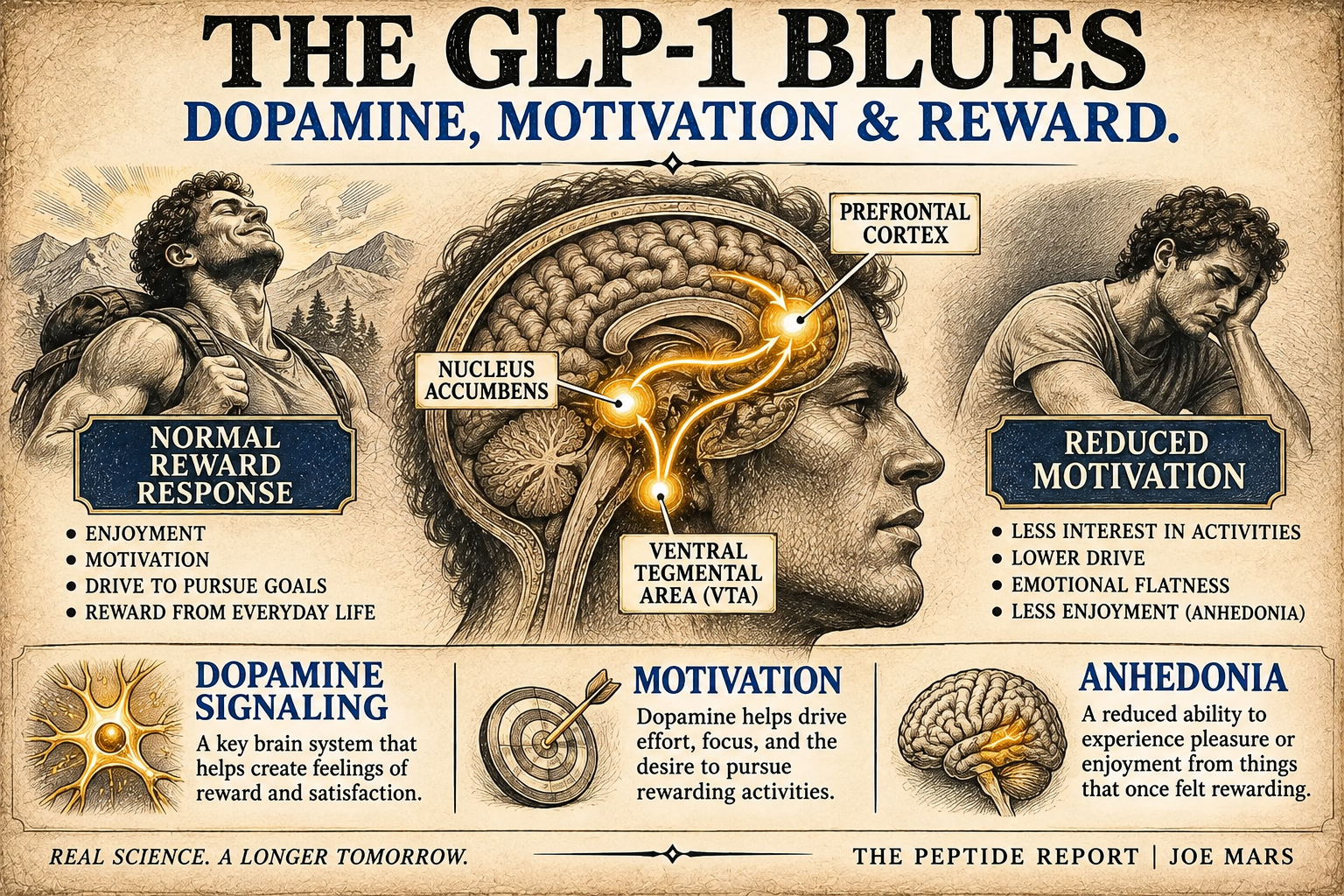
I’ve been seeing more people talk about something they’re calling the GLP-1 blues. They’re having success losing weight with medications like tirzepatide and semaglutide, but some are noticing changes they didn’t expect. They aren’t as motivated, their hobbies don’t seem as enjoyable, and some describe feeling emotionally flat.
There may be a biological reason for this. GLP-1 medications don’t just affect hunger. They also influence the brain’s reward system, including dopamine pathways involved in motivation and pleasure. A 2026 medical report described three people taking higher doses of tirzepatide who developed these symptoms. When their treatment was adjusted, their motivation and enjoyment improved.
But this article isn’t really about GLP-1 medications. Plenty of people struggle with the same feelings without ever taking one. They might be dealing with depression, chronic stress, or a general lack of motivation that makes even simple things feel like work.
That’s what got me looking into PE-22-28, an experimental peptide being studied for its antidepressant effects. The research is still early, but scientists have found some interesting things about how it affects the brain.
Why Some People Experience the GLP-1 Blues
To understand what’s happening, we need to talk about dopamine. Most people think of dopamine as the chemical that makes you feel good. That’s only part of its job.
Dopamine also helps drive motivation. It plays a role in how much effort you’re willing to put into getting something you want.
Your brain has a network of reward pathways that influence everything from food cravings to exercise, hobbies, and personal goals. One important pathway connects an area called the ventral tegmental area (VTA) to the nucleus accumbens. These brain regions help determine how rewarding something feels and whether it’s worth pursuing.
GLP-1 medications can influence these pathways. They can reduce the desire to eat, especially when it comes to highly rewarding foods. Researchers are also studying their effects on alcohol cravings, addictive behaviors, and other habits. For many people, that’s a welcome change.
But reducing the brain’s response to rewards may have an unwanted effect in some individuals. Instead of just losing interest in food, they may find themselves less interested in other things they normally enjoy. Researchers call this anhedonia, which means losing the ability to experience pleasure or enjoyment from activities that once felt rewarding.
A 2026 Study Offers Some Clues
A case series published in 2026 looked at three patients who developed anhedonia-like symptoms while taking tirzepatide. All three were using doses above 10 mg. They described reduced motivation, less enjoyment of everyday activities, and emotional flatness.
What made these cases interesting was that the patients weren’t necessarily experiencing typical depression or anxiety. They simply weren’t getting the same satisfaction from life.
The clinicians adjusted their treatment, including reducing tirzepatide doses and, in some cases, using bupropion, a medication that affects dopamine and norepinephrine signaling. Their symptoms largely improved.
The researchers proposed that changes in dopamine signaling could help explain what these patients experienced. A three-person case series can’t establish how common this problem is or prove exactly what caused it. Larger studies have generally found that GLP-1 medications do not increase depression risk overall. Still, it gives us a possible explanation for why some people may feel different while taking these medications.
It also raises a bigger question about depression and motivation in general. What happens when the brain’s reward system isn’t functioning the way it should?
Depression Isn’t Always About Feeling Sad
I think people sometimes misunderstand what depression looks like. They picture someone who’s constantly sad or crying. But depression can also show up as a loss of interest in life.
You might still go to work, take care of your family, and handle your responsibilities. From the outside, everything looks normal. The problem is that you don’t enjoy much of it.
Getting yourself to exercise feels harder. You put things off. You stop looking forward to activities that used to make you happy. These symptoms can involve several brain systems, including dopamine signaling, stress responses, and the connections between nerve cells.
Traditional antidepressants often target serotonin or norepinephrine. Those medications help millions of people, but they don’t work equally well for everyone. Some people continue struggling with motivation or emotional flatness even after other symptoms improve.
Researchers have been looking for different ways to treat depression. One of those approaches involves a potassium channel called TREK-1. And that’s where PE-22-28 comes in.
What Is PE-22-28?
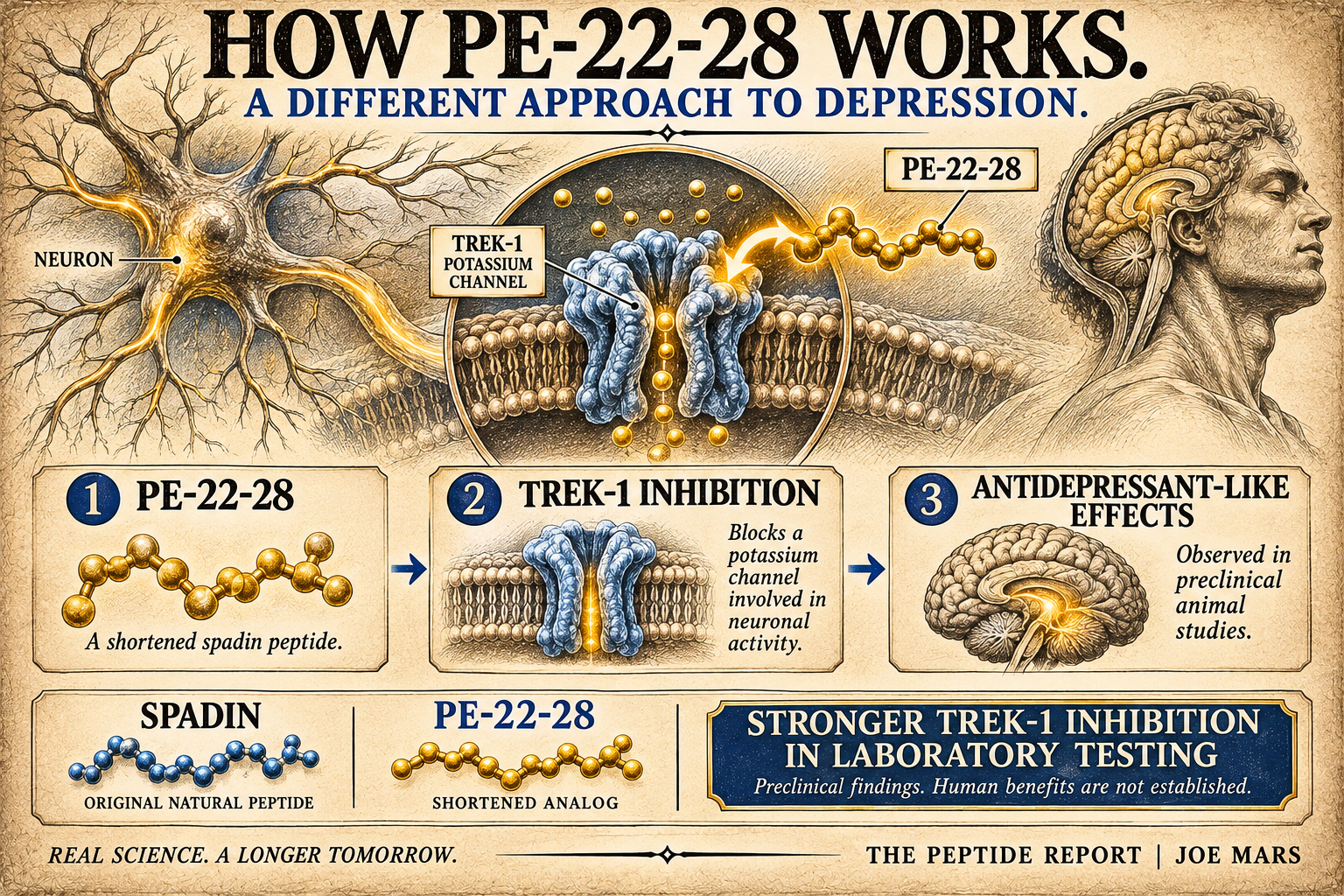
PE-22-28 is a synthetic peptide made up of seven amino acids. It’s derived from a naturally occurring peptide called spadin, which researchers began studying for its effects on depression.
Spadin blocks TREK-1, a potassium channel found in nerve cells. You can think of potassium channels as part of the system that controls how easily nerve cells become active. TREK-1 helps regulate electrical activity in the brain. When this channel is active, it can make certain nerve cells less responsive.
Scientists discovered that blocking TREK-1 produced antidepressant-like effects in animals.
The interest in TREK-1 actually goes back to 2006, when researchers discovered something unusual about mice that lacked this potassium channel. The animals were more resistant to depression-like behavior in five different tests. They also had stronger serotonin signaling and a smaller stress-hormone response. Their behavior was similar to that of mice treated with antidepressants like Prozac.
That discovery suggested that TREK-1 might play a bigger role in depression than scientists previously understood. It also raised the possibility of developing antidepressants that work through an entirely different pathway. Researchers eventually began studying spadin, a peptide that blocks TREK-1, and later developed shorter versions to see whether they could improve its effects.
In 2017, researchers published a study examining several shortened spadin peptides. PE-22-28 was one of them.
In laboratory testing, PE-22-28 blocked TREK-1 at a concentration of about 0.1 nanomolar, compared with approximately 40 nanomolar for the original spadin. That’s a substantial increase in potency at the channel being studied.
It doesn’t mean PE-22-28 is hundreds of times more effective at treating depression. Laboratory potency and real-world antidepressant effects are different things. But it was enough to make researchers take a closer look.
What the PE-22-28 Studies Found
The 2017 study tested PE-22-28 in several animal models used to investigate depression. One was the forced swim test, which measures how animals respond to a stressful situation. Mice receiving PE-22-28 spent significantly less time immobile than untreated mice.
In one experiment, untreated mice remained immobile for about 162 seconds. The PE-22-28 group averaged approximately 92 seconds. That’s a reduction of roughly 43%.
The researchers also tested animals exposed to corticosterone, a stress-related hormone used to produce depression-like changes in mice. PE-22-28 again produced antidepressant-like behavioral effects.
Another experiment used the learned helplessness test. Animals were placed in situations where they had previously learned that they couldn’t escape an unpleasant event. After four days of treatment with spadin-related peptides, the animals showed improvements in escape behavior.
These are useful early research findings, although animal behavior tests can’t tell us how a person would actually feel. The researchers also found something that may be even more important. PE-22-28 appeared to influence the brain’s ability to form new cells and connections.
Why Researchers Developed a Longer-Lasting Version
One problem with the original spadin peptide was how quickly its effects wore off. In animal experiments, the antidepressant-like effects disappeared about six hours after injection.
Researchers developed shorter versions to improve both potency and stability. PE-22-28 showed greater stability than spadin, with a reported half-life of approximately 23 hours. That doesn’t tell us how long its effects would last in people, but it helps explain why researchers were interested in developing this shorter peptide.
PE-22-28 and Neuroplasticity
Neuroplasticity is your brain’s ability to adapt and change. Every time you learn something new, develop a habit, or recover from an experience, your brain is making adjustments.
Researchers have found that chronic stress and depression can affect this process. One area of particular interest is the hippocampus, a region involved in memory, learning, and emotional regulation.
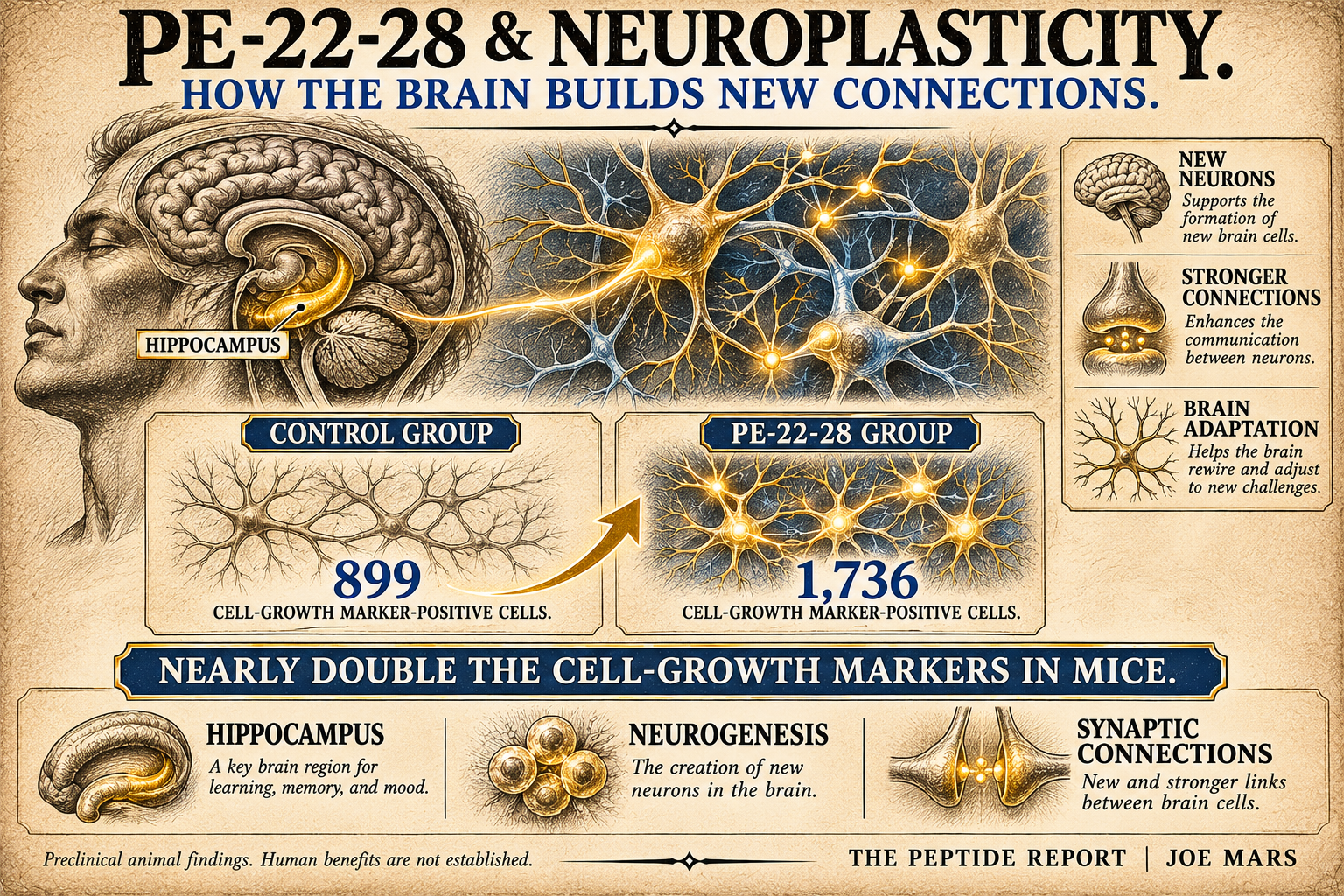
In the 2017 PE-22-28 study, researchers examined the hippocampus after four days of treatment. They found an increase in markers associated with neurogenesis, the formation of new nerve cells.
The untreated mice had an average of 899 cells positive for a marker of cell growth. The PE-22-28 group had approximately 1,736. That’s nearly double.
The researchers also observed increases in PSD-95, a protein associated with connections between nerve cells, in laboratory-grown neurons. These findings suggest that PE-22-28 may influence both the growth of new cells and the formation of connections.
Why does that matter for depression? Researchers believe that restoring healthier communication between brain cells may be part of how some antidepressant treatments work. For example, certain antidepressant medications can increase markers of neuroplasticity, although those changes often take time to develop.
PE-22-28 produced some of these changes within four days in the animal experiments. That makes it an interesting candidate for further research into faster-acting antidepressant treatments.
Could PE-22-28 Improve Motivation?
This is the question I was most interested in when I started researching it. We know that PE-22-28 blocks TREK-1 and produces antidepressant-like effects in mice. We also know that the peptide influences markers of neuroplasticity.
But does that mean it can help someone who has lost their motivation? Possibly, although the research hasn’t established that.
Motivation involves several brain systems, particularly dopamine pathways that help us decide whether something is worth the effort. PE-22-28 has not been shown to directly increase dopamine or restore motivation in humans. Its proposed antidepressant effects come primarily from TREK-1 inhibition and changes in brain signaling.
That could eventually turn out to be useful for people whose depression includes low motivation and loss of pleasure. It could also turn out that the peptide affects some symptoms more than others. The animal studies weren’t designed to answer those specific human questions.
I wouldn’t describe PE-22-28 as a dopamine booster. That’s not what the research has established. It’s more accurate to describe it as an experimental TREK-1 blocker with antidepressant-like effects and evidence of increased neuroplasticity in preclinical studies.
What Peptides Could Be Stacked With PE-22-28?
One thing I always look at when researching peptides is how different compounds might complement each other.
PE-22-28 works by blocking the TREK-1 potassium channel, which has been linked to depression and mood regulation. But depression and low motivation can involve several different systems in the brain.
There are a few other peptides that I think are worth looking at alongside PE-22-28.
PE-22-28 + Semax: Motivation and Mental Clarity
Semax would be my first choice to investigate alongside PE-22-28. Semax has been studied for its effects on brain-derived neurotrophic factor (BDNF), a protein involved in learning, memory, and the growth and maintenance of nerve cells.
While PE-22-28 targets TREK-1, Semax influences other pathways involved in brain function and neuroplasticity. For someone struggling with low motivation, poor concentration, or mental fatigue, I find this pairing particularly interesting.
PE-22-28 + Selank: Stress and Anxiety
Selank is another peptide I’ve researched quite a bit, particularly for its possible effects on anxiety and stress regulation. Selank may influence GABA-related signaling, which helps regulate how the brain responds to stress.
Anxiety and depression often overlap. Someone might feel unmotivated partly because they’re constantly stressed or mentally overwhelmed. PE-22-28 and Selank target different aspects of brain function, which makes this an interesting combination to investigate.
PE-22-28 + MOTS-c: Energy and Fatigue
MOTS-c takes a different approach. It’s a mitochondrial-derived peptide that has been studied for its effects on metabolism, insulin sensitivity, and cellular energy regulation. I’ve been interested in MOTS-c for a while, particularly its connection to metabolic health and exercise.
There’s also an important difference between being unmotivated and being physically exhausted. Sometimes people describe having no motivation when they’re actually struggling with fatigue.
MOTS-c wouldn’t be my first choice for mood-related research, but it could be worth exploring when low energy is part of the picture.
PE-22-28 + BPC-157: Brain Signaling
Most people know BPC-157 for its potential role in tissue repair and recovery. But researchers have also investigated its effects on brain signaling and behavior in animal studies. Some of that research involves dopamine and serotonin-related systems.
That makes BPC-157 worth mentioning, although I find Semax and Selank more relevant to the mood and motivation discussion.
Could PE-22-28 Help With the GLP-1 Blues?
The connection is interesting, but it hasn’t been tested directly. GLP-1 medications can change how the brain processes rewards. PE-22-28 acts on a different system involving TREK-1 channels. Both systems are relevant to mood and brain function, but that doesn’t mean one automatically reverses the effects of the other.
Someone experiencing emotional flatness while taking a GLP-1 might be dealing with changes in reward processing. They might also be dealing with fatigue, poor nutrition, inadequate calorie intake, sleep problems, or an unrelated mood disorder. Those possibilities matter because the right approach depends on what’s causing the symptoms.
For people whose symptoms started after increasing a GLP-1 dose, the 2026 tirzepatide case series suggests that reviewing the medication with a clinician may be useful. PE-22-28 has not been tested as a treatment for GLP-1-related anhedonia.
My interest in it goes beyond GLP-1 users anyway. I’m more interested in whether targeting TREK-1 could eventually help people dealing with depression, loss of pleasure, and difficulty finding the motivation to do things they once enjoyed.
How Does PE-22-28 Compare With Antidepressants?
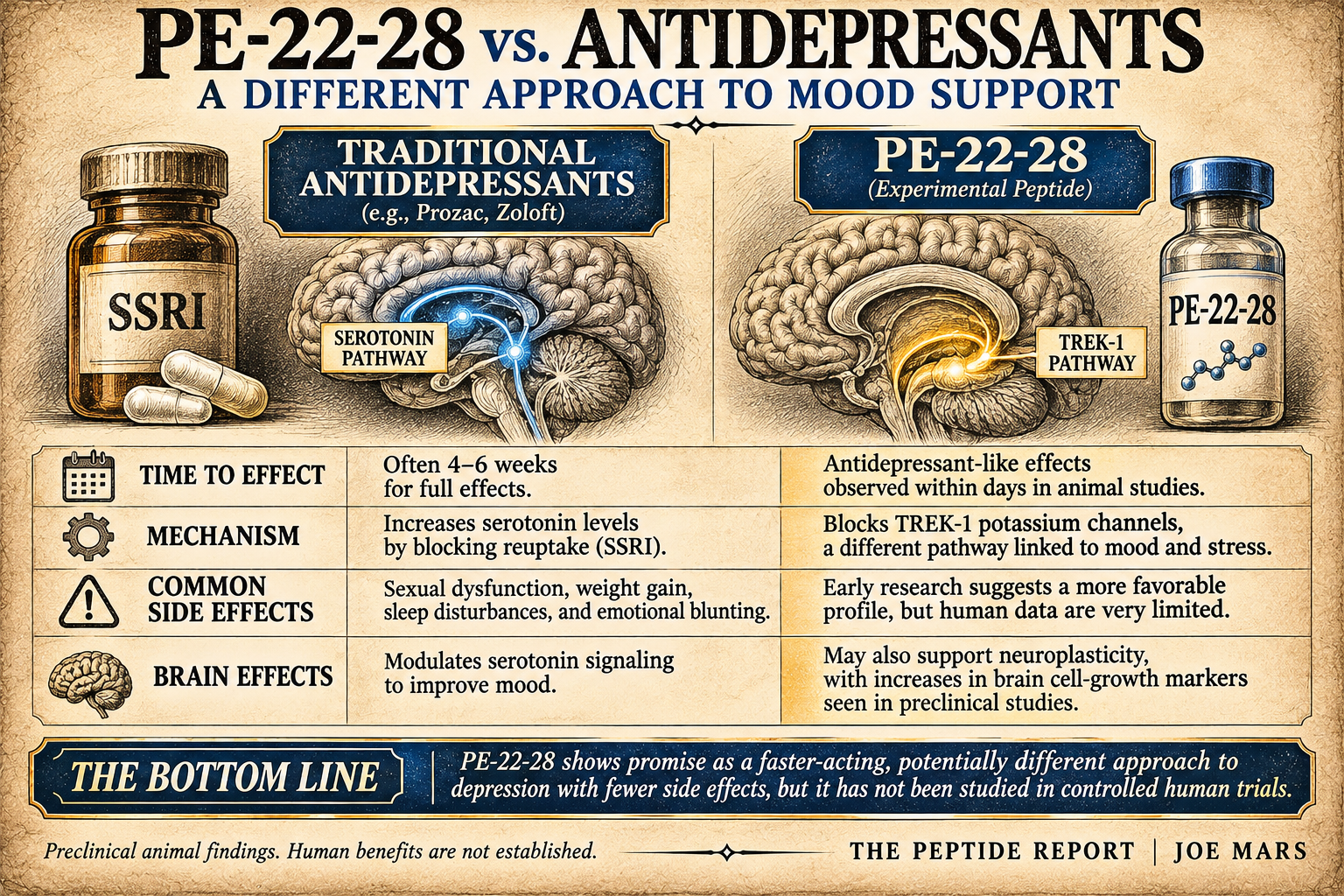
One of the more interesting things about PE-22-28 is how it compares with traditional antidepressants. Medications like Prozac and Zoloft can take several weeks to produce their full effects. They can also cause unwanted side effects, including sexual dysfunction, weight gain, sleep problems, and emotional blunting.
PE-22-28 works through a different pathway by blocking TREK-1 potassium channels. In animal studies, researchers observed antidepressant-like effects within days, along with changes in markers associated with neuroplasticity. Researchers may eventually have another way to treat depression without relying primarily on serotonin reuptake.
The important distinction is that conventional antidepressants have been studied extensively in humans, while PE-22-28 has not. We don’t yet know whether its promising animal results will translate into faster relief or fewer side effects in people.
PE-22-28 Dosage: What Amounts Are Being Discussed?
Dr. Elizabeth Yurth, co-founder of the Boulder Longevity Institute, discussed PE-22-28 during a 2020 interview on Super Human Radio. During that conversation, Yurth also shared something personal. She had lost her mother, father, and sister within a relatively short period and experienced about a year of depression and grief.
She explained that situations like losing a loved one or a job can leave someone struggling emotionally, even when they believe they’ll eventually recover. That was part of what interested her about PE-22-28. She wanted to explore whether a faster-acting treatment might help people through difficult periods without waiting weeks for a conventional antidepressant to take effect.
Yurth has explored the peptide for depression and cognitive function, with a preference for intranasal administration. She also reported that patients “have also had great success with just 400 micrograms improving cognition and no lethargy.”
The goal of treating depression isn’t simply to improve someone’s mood. For many people, getting their motivation and mental clarity back is just as important. Her comments suggest that more isn’t necessarily better. However, these are observations from clinical practice, not results from controlled human trials.
Could PE-22-28 Have Other Benefits for the Brain?
Researchers have also investigated spadin and PE-22-28 in animal models of stroke. Some experiments found improvements in learning, movement, and depression-like behavior following brain injury. They also observed increased markers of neurogenesis, suggesting that these compounds may influence how the brain responds to injury.
This doesn’t mean PE-22-28 has been shown to improve memory or help people recover from strokes. Those possibilities still need human studies. But it adds another reason scientists are interested in the TREK-1 pathway.
PE-22-28 Side Effects: What Has Been Reported?
So far, PE-22-28 appears to have a relatively favorable safety profile in early animal research, but human safety data are extremely limited. Dr. Elizabeth Yurth has also mentioned that higher amounts, around 800 mcg, may cause lethargy, while lower amounts appeared better tolerated in her clinical experience. These are anecdotal observations, not findings from controlled human trials.
My Thoughts on PE-22-28
I’ve spent a lot of time researching peptides for physical recovery, metabolism, inflammation, and longevity. But mental health is just as important. You can be in great physical shape and still feel miserable if you’ve lost your motivation or stopped enjoying life. That’s one reason I’ve become more interested in peptides that affect the brain.
PE-22-28 caught my attention because it targets a pathway that most people have probably never heard of. The original research showed measurable antidepressant-like effects in mice, along with changes in neurogenesis and the connections between nerve cells. Those are meaningful findings. Whether they’ll translate into an effective treatment for people remains an open question.
I also think the growing discussion around the GLP-1 blues is bringing attention to something that deserves more research. Mood, motivation, and the ability to enjoy life are closely connected, but they’re not all controlled by one chemical. The more we understand about those systems, the better our chances of developing treatments that help people who aren’t getting enough relief from what’s currently available.
PE-22-28 may eventually have a place in that research. For now, it’s one I’m going to keep following.
Where to Get PE-22-28
I source all my peptides from BioEdge Research Labs. Every lot is third-party tested, and the COA is on the product page.
Use code MARS15 at checkout.
Join the Conversation
Have you experienced a period where you lost your motivation or stopped enjoying things you normally love? Maybe you’ve noticed changes while taking a GLP-1, or maybe you’ve struggled with depression or low motivation for years.
I’d be interested to hear what you’ve experienced, especially if you’ve researched PE-22-28 or other peptides being studied for mood and brain health. We discuss peptides, research, and biohacking in my free Skool community.
Join the Peptides & Biohacking Hub on Skool
PE-22-28 FAQ
What is PE-22-28?
PE-22-28 is a synthetic peptide made up of seven amino acids, derived from spadin, that blocks the TREK-1 potassium channel.
What is PE-22-28 studied for?
Animal research has looked at antidepressant-like effects, increases in markers of neurogenesis, and changes in connections between nerve cells.
What PE-22-28 dosages are discussed?
Dr. Elizabeth Yurth has reported 400 micrograms intranasally in her clinical practice, with around 800 micrograms associated with lethargy. These are practitioner reports, not established recommendations.
Does PE-22-28 have side effects?
Early animal research suggests a relatively favorable safety profile, but human safety data are extremely limited.
How long does PE-22-28 last?
Researchers reported a half-life of approximately 23 hours. The original spadin peptide lost its antidepressant-like effects about six hours after injection in animal experiments.
Is PE-22-28 approved for depression?
No. PE-22-28 is an experimental research peptide and has not been tested in published human trials for depression.
Research References
- Djillani A, et al. (2017). Shortened Spadin Analogs Display Better TREK-1 Inhibition, In Vivo Stability and Antidepressant Activity. Frontiers in Pharmacology. https://pmc.ncbi.nlm.nih.gov/articles/PMC5601071/
- Resolution of Anhedonia-Like Symptoms in Patients Treated for Obesity With Tirzepatide: A Three-Case Series. (2026). https://pmc.ncbi.nlm.nih.gov/articles/PMC13382402/
- Fighting Against Depression With TREK-1 Blockers: Past and Future. A Focus on Spadin. Pharmacology & Therapeutics (2019). https://doi.org/10.1016/j.pharmthera.2018.10.003
- Dr. Elizabeth Yurth. The Pep Talk: Treating Major Depressive Disorder With Peptides. Super Human Radio, February 7, 2020. https://superhumanradio.net/shr-shows/shr-2466-the-pep-talk-treating-major-depressive-disorder-with-peptides
Disclaimer: This article is for educational purposes only. PE-22-28 is an experimental research peptide and is not approved for treating depression or any other medical condition. The dosages discussed are practitioner reports, not established recommendations for human use.