An erection is a nitric oxide event. A nerve fires, nitric oxide reaches the smooth muscle of the penis, and blood rushes in.
BPC-157 keeps turning up in the nitric oxide literature: rat aorta, cultured blood vessel cells, blood pressure experiments. That overlap is the whole reason the two get mentioned together.
Does that mean BPC-157 fixes ED? We do not know. Blood vessel studies give us a reason to ask the question. They do not show that it works in men with ED, or tell us what dose would be safe.
If ED is new or keeps happening, get it checked. Sometimes it is an early clue to a heart or blood vessel problem. Do not skip that check to try a peptide.
Let’s walk the chain one link at a time and put each study in context.
The Erection Chain, Link by Link
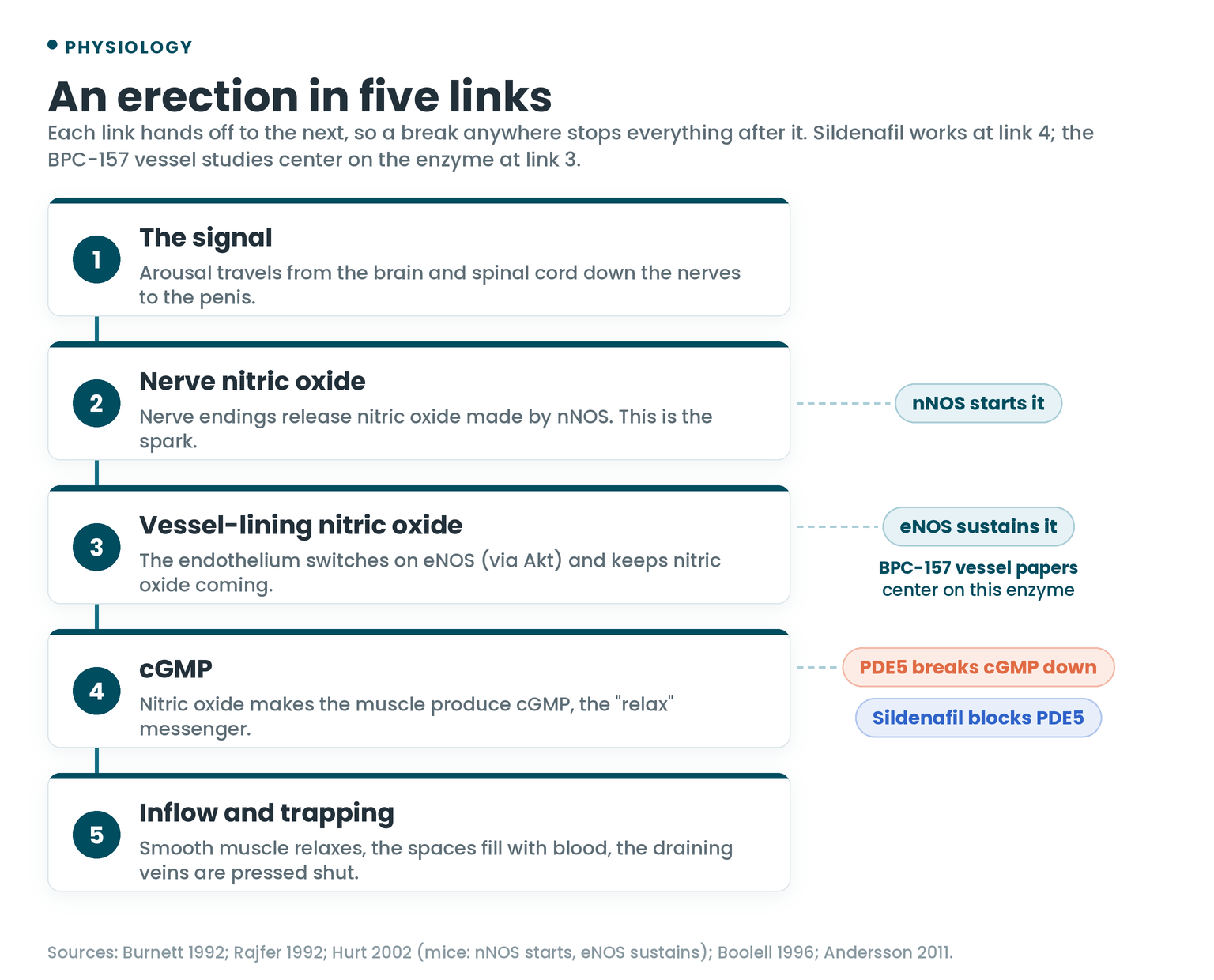
An erection is a reflex built from five links. Each one hands off to the next, and a break anywhere stops everything downstream.
- The signal. Arousal travels from the brain and spinal cord down the nerves to the penis. Erection is, at its core, a spinal reflex that the brain can switch on.
- Nerve nitric oxide. Those nerve endings release nitric oxide made by neuronal nitric oxide synthase (nNOS). That is the spark.
- Vessel-lining nitric oxide. The endothelium, the inner lining of the blood vessels, takes over with its own enzyme, endothelial nitric oxide synthase (eNOS), and keeps the nitric oxide coming.
- cGMP. Nitric oxide makes the muscle cells produce cyclic GMP, the messenger that tells smooth muscle to relax. An enzyme called PDE5 breaks cGMP down again.
- Inflow and trapping. The smooth muscle of the corpora cavernosa relaxes, the spongy spaces fill with blood, and the swelling presses on the veins that would drain it. Blood comes in faster than it leaves.
The nitric oxide part was nailed down in 1992. Burnett’s team found nitric oxide synthase in the nerves supplying rat erectile tissue, and small doses of a nitric oxide synthase blocker abolished nerve-triggered erections. The same year, Rajfer’s group took strips of erectile tissue from 21 men having penile implants and showed that the tissue relaxed to nerve stimulation through nitric oxide, and that a cGMP-sparing drug made the relaxation stronger.
The handoff from link 2 to link 3 came from a 2002 study in mice. Nerve stimulation rapidly switched on eNOS through an enzyme called Akt. Blocking the switch above Akt weakened erections, and mice bred without eNOS responded far less to an erection-inducing drug. The authors’ model: nNOS starts the erection, eNOS sustains it.
Sildenafil and its cousins work at link 4. They block PDE5 so cGMP lasts longer. PDE5 is the main cGMP-breaking enzyme in human erectile tissue, and in Boolell’s 1996 study sildenafil strengthened the erectile response to visual sexual stimulation in 12 men. The drug amplifies a signal that arousal still has to start.
What BPC-157 Is
BPC-157 is a chain of 15 amino acids, a stable fragment of a protein found in human gastric juice. Predrag Sikiric’s group in Zagreb described it in the early 1990s, and most of what’s known about it still comes from rats: stomach lesions, tendon, muscle and nerve injuries, and blood vessels.
The human side is small. Three recent published reports discussed here cover 30 people in total: a knee pain chart review (16 patients), a bladder pain pilot (12 women) and an intravenous safety pilot (2 adults). I went through those in detail in BPC 157 and cancer, and the side effect picture is in BPC 157 side effects.
BPC-157 and Nitric Oxide: The Rat Aorta Study
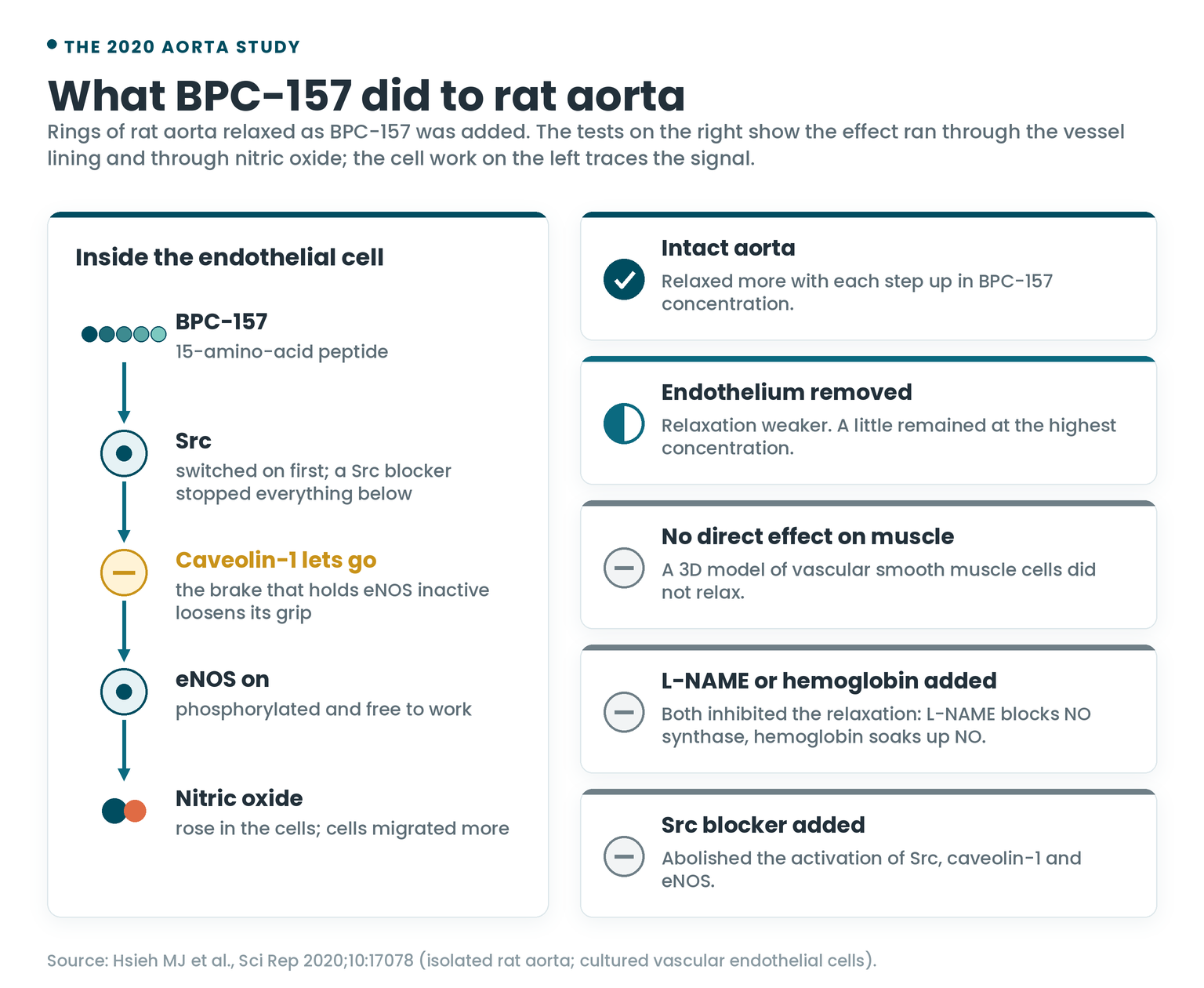
The most direct BPC-157 nitric oxide paper is a 2020 study in Scientific Reports. The researchers hung rings of rat aorta in an organ bath and added BPC-157 in rising concentrations.
- The aorta relaxed, more with each step up in concentration.
- With the endothelium removed, the relaxation was weaker. A little remained at the highest concentration, but BPC-157 had no direct relaxing effect on a three-dimensional model built from vascular smooth muscle cells.
- L-NAME, which blocks nitric oxide synthase, and hemoglobin, which soaks up nitric oxide, both inhibited the relaxation.
So the effect ran through the vessel lining, and through nitric oxide.
The signaling: Src, caveolin-1 and eNOS
In cultured endothelial cells, BPC-157 raised nitric oxide (tracked with a fluorescent dye) and helped the cells migrate. It increased phosphorylation of three proteins: Src, caveolin-1 and eNOS. A Src inhibitor wiped that out, which puts Src at the top of the chain.
Caveolin-1 is eNOS’s brake. It binds the enzyme and holds it inactive, and eNOS has to come off it before it can work. BPC-157 reduced the binding between the two. The sequence the paper lays out runs Src → caveolin-1 lets go → eNOS switches on → nitric oxide.
A steadying effect, in both directions
A 1997 Zagreb study looked at blood pressure. In rats, L-NAME pushes blood pressure up by cutting nitric oxide, and a large dose of L-arginine, nitric oxide’s raw material, pulls it down. BPC-157 blunted the L-NAME rise, brought an already raised pressure back down, and prevented the L-arginine drop, while leaving normal blood pressure alone. In stomach tissue it generated as much nitric oxide as an equal dose of L-arginine, and L-NAME couldn’t block it.
The Zagreb group’s 2025 review describes BPC-157’s effect on nitric oxide as going up or down depending on the situation, always alongside less free radical formation. “Steadies” is a better word for it than “boosts”.
Where the Two Lines of Research Meet: eNOS
Here’s the connection in one sentence: the enzyme that keeps an erection going is eNOS, and eNOS is the enzyme BPC-157 switched on in the vessel studies.
In the 2002 mouse work, both nerve stimulation and an injected relaxant drug rapidly raised activated Akt and eNOS in penile tissue. BPC-157 reached the same enzyme by two routes: Src and caveolin-1 in the 2020 aorta paper, and VEGFR2 → Akt → eNOS in a 2017 blood vessel growth paper, the same Akt step the penile study described.
The two lines of research meet at that one enzyme. The erection work was done in mouse penile tissue; the BPC-157 work in rat aorta, rat muscle and endothelial cells grown in a dish.
New Blood Vessels: The VEGFR2 Study
Erectile function depends on blood supply as much as on the signal, which is why the 2017 angiogenesis paper from the same research group comes up so often.
- BPC-157 increased vessel density in the chick embryo membrane assay and in endothelial tube formation in a dish.
- In rats whose hind-limb muscle had lost its blood supply, BPC-157 sped up the return of blood flow on laser Doppler scans and left more vessels in the muscle.
- It raised VEGFR2, the main receptor for the growth factor VEGF, in that muscle and in human endothelial cells. In the cells, VEGF-A itself stayed the same.
- It pulled VEGFR2 inside the cell and switched on the VEGFR2 → Akt → eNOS pathway. Blocking that uptake with a drug called dynasore blocked the boost in tube formation.
That makes it the clearest BPC-157 data on bringing blood back to tissue that had lost it.
Nerves: The Sciatic and Spinal Cord Studies
When link 1 fails, the vascular machinery can be in perfect shape and simply never get the message. That’s what happens after pelvic surgery that damages the nerves to the penis, after spinal cord injury, and with the nerve damage of long-standing diabetes. Nerve work is why BPC-157 gets mentioned for this kind of ED.
- Sciatic nerve (2010). Rats had the sciatic nerve cut, then either sewn back together or bridged across a 7 mm gap with a tube. BPC-157 given soon after injury, by injection, by stomach tube or right at the repair site, produced faster axon regrowth, more and thicker myelinated fibers, more blood vessels in the nerve, stronger muscle responses on EMG and better walking scores.
- Spinal cord (2019). The lower (sacrocaudal) spinal cord was compressed for 60 seconds, which paralyzes the rat’s tail. A single injection 10 minutes later led to steadily better tail movement, spasticity gone by day 15, and far less loss of axons and nerve cells, with the rats followed for a full year.
- Spinal cord, delayed (2022). The follow-up found the same recovery when treatment started four days after injury, given in drinking water for a month. Thirty minutes after injury, treated rats also showed higher expression of all three nitric oxide synthase genes.
The nerves in these studies were the sciatic nerve and the sacral spinal cord, which in rats runs the tail.
The Pelvic Studies
Two BPC-157 studies sit closest to the region, one in rats and one in people.
In a 2013 study, female rats were given stress urinary incontinence by surgically freeing the urethra or by prolonged vaginal stretching. BPC-157 for seven days, by injection or in drinking water, restored the pressure the urethra could hold; with some regimens it reached the values of healthy rats. In healthy rats it changed nothing. Under the microscope, treated urethras had more muscle markers and more of the blood vessel marker CD34.
In a 2024 pilot, 12 women aged 39 to 76 with interstitial cystitis, none of whom had responded to pentosan polysulfate, the usual drug, had 10 mg of BPC-157 injected around the inflamed area of the bladder during one cystoscopy. Ten rated their symptoms fully resolved and two rated them 80% better. Nobody dropped out and no adverse events were reported. It was a single-group pilot measured by questionnaire.
What Causes ED, and Which Link Each Cause Hits
ED is common. In the Massachusetts Male Aging Study, 52% of men aged 40 to 70 had some degree of it, and complete ED tripled from 5% to 15% across that age range. After age, it tracked with heart disease, high blood pressure, diabetes, the medications for those conditions, and measures of anger and depression.
Clinicians sort the causes into four groups, and each one breaks a different part of the chain:
- Vascular. Poor inflow or weak endothelial nitric oxide (links 3 and 5).
- Neurogenic. The signal never arrives (links 1 and 2): pelvic surgery, spinal injury, diabetic nerve damage.
- Hormonal. Low testosterone and other endocrine problems, which dull drive and the nerve side of the reflex. The kisspeptin vs HCG piece covers the testosterone axis.
- Psychogenic. Stress, anxiety or depression interrupting the signal at the start (link 1).
Tap a cause in the explorer below to see which links it hits, or a research line to see where it lands on the chain.
The erection chain: where it breaks, where the research lands
Pick a cause or a research line, then tap any link for the detail.
What happens
What can break it
Research on this link
Why ED Often Shows Up Before Heart Trouble
The vascular causes are the reason cardiologists care about erections.
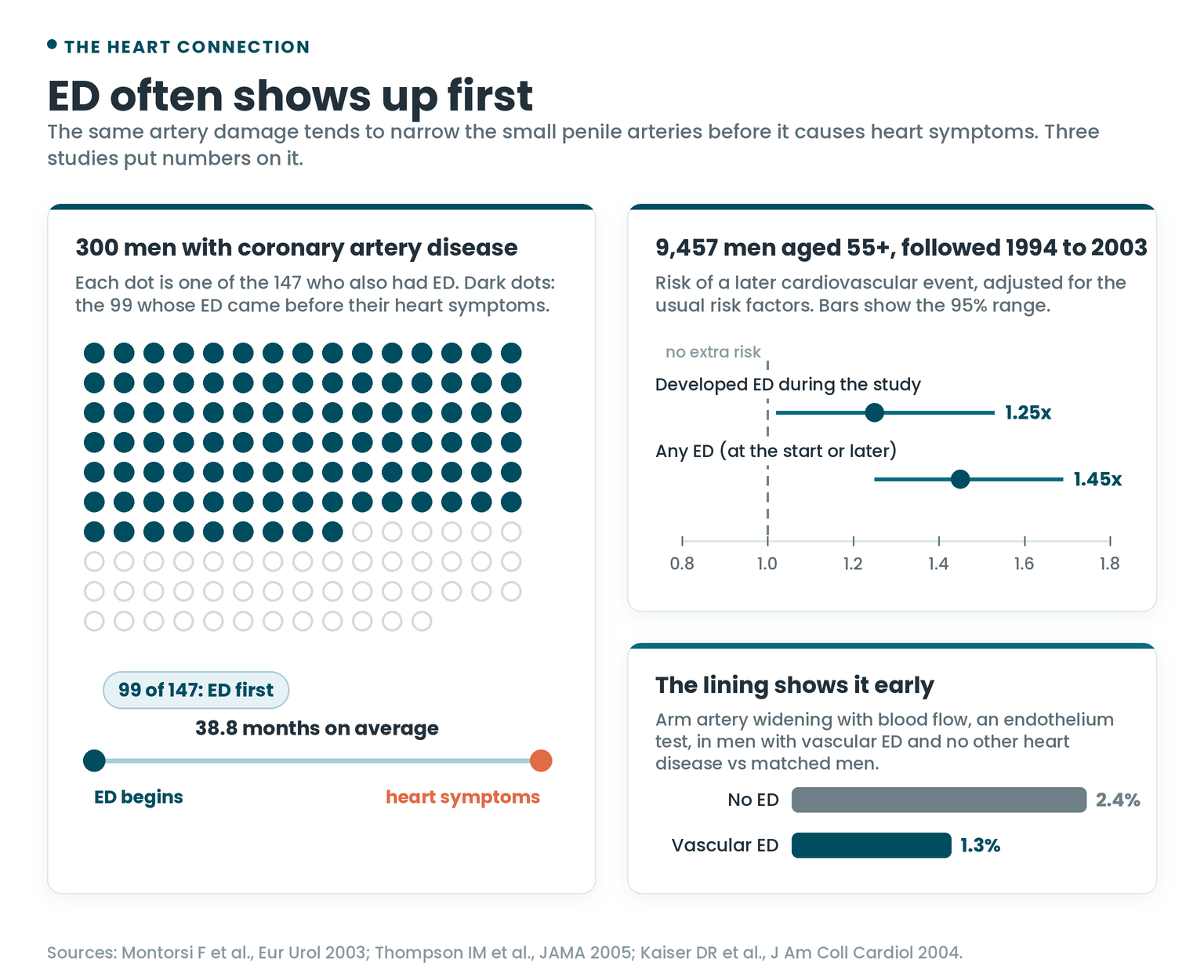
In 2003, Montorsi’s team interviewed 300 men with chest pain and coronary artery disease confirmed on angiography. Almost half (147) had ED. In two thirds of those, 99 men, the ED came first, on average 38.8 months before their heart symptoms. Every man with type 1 diabetes and ED had the ED before the heart disease.
A much larger study followed 9,457 men aged 55 and over from the placebo group of the Prostate Cancer Prevention Trial. Men who developed ED during the study had a 25% higher risk of a later cardiovascular event after adjusting for the usual risk factors. Counting men who already had ED at the start too, the risk was 45% higher, in the same range as current smoking or a family history of heart attack. The authors concluded that ED should prompt a look at cardiovascular risk factors.
The lining itself shows it early. A 2004 study compared 30 men with vascular ED and no other heart or vessel disease against 27 matched men without ED. Most measures of artery structure were the same, but the arm artery’s ability to widen in response to blood flow, which depends on the endothelium, was about half as strong: 1.3% versus 2.4%.
The leading explanation is the artery size hypothesis, set out in a 2005 paper. Plaque builds up across the whole body, but the same amount narrows a small penile artery sooner than a wider coronary artery, so the penis tends to show it first.
Doses Used in the Research
These are the amounts researchers used. They are not an ED protocol. You cannot take a rat dose, adjust it for your weight and call it safe. The animal amounts below are per kilogram of body weight. The human reports looked at bladder symptoms and short-term IV safety, not erections.
- Sciatic nerve, rats (2010): 10 µg/kg or 10 ng/kg, by injection into the abdomen, by stomach tube or at the repair site, shortly after injury.
- Spinal cord, rats (2019): one injection of 200 µg/kg or 2 µg/kg, 10 minutes after injury.
- Spinal cord, rats (2022): the same peptide in drinking water from day 4 to one month after injury.
- Urethra, rats (2013): 10 µg/kg or 10 ng/kg by injection once a day, or 10 µg/kg a day in drinking water (0.16 µg/mL), for seven days.
- Blood pressure, rats (1997): 10 µg/kg or 10 ng/kg into a vein.
- Bladder pilot, 12 women (2024): 10 mg in total, injected through a cystoscope in a single procedure.
- Intravenous pilot, 2 adults (2025): 10 mg on day one and 20 mg on day two, each in 250 mL of saline over an hour. Blood markers for heart, liver, kidney, thyroid and glucose didn’t move, and no side effects were reported.
FAQ
Does BPC-157 increase nitric oxide?
In rat aorta and endothelial cells it did, through Src, caveolin-1 and eNOS. In rat blood pressure experiments it countered effects of a nitric oxide blocker and extra L-arginine. That does not mean it balances nitric oxide or blood pressure in people.
Has BPC-157 been studied in men with erectile dysfunction?
The three recent human reports discussed here cover knee pain, interstitial cystitis and short-term intravenous safety. They did not test ED. Older rectal-enema studies are also described in the FDA 2026 briefing document; the 30-person figure is not a count of all human research. The lab and animal results still cannot tell us whether it helps ED or what dose is safe.
How is BPC-157 different from sildenafil?
Sildenafil blocks PDE5 so cGMP lasts longer, at link 4 of the chain. The BPC-157 findings discussed here involve eNOS, blood vessel growth and nerve injury models in cells and animals. They do not show that BPC-157 works like sildenafil or can replace it.
Does BPC-157 grow new blood vessels?
In the 2017 study it raised vessel density in two lab assays, sped up the return of blood flow to starved rat muscle, and increased VEGFR2, the main receptor for the vessel growth factor VEGF.
Why is ED linked to heart disease?
The same artery damage tends to show up in the smaller penile arteries first. In one study of 300 men with coronary artery disease, two thirds of those with ED had it roughly three years before their heart symptoms.
Where does BPC-157 come from?
It’s a 15-amino-acid fragment of a protein found in human gastric juice, described by a Zagreb research group in the early 1990s. The BPC-157 vs TB-500 post compares it with the other repair peptide people pair it with.
References
- Burnett AL, et al. Nitric oxide: a physiologic mediator of penile erection. Science. 1992;257(5068):401-403. DOI
- Rajfer J, et al. Nitric oxide as a mediator of relaxation of the corpus cavernosum in response to nonadrenergic, noncholinergic neurotransmission. N Engl J Med. 1992;326(2):90-94. DOI
- Hurt KJ, et al. Akt-dependent phosphorylation of endothelial nitric-oxide synthase mediates penile erection. Proc Natl Acad Sci U S A. 2002;99(6):4061-4066. DOI
- Andersson KE. Mechanisms of penile erection and basis for pharmacological treatment of erectile dysfunction. Pharmacol Rev. 2011;63(4):811-859. DOI
- Boolell M, et al. Sildenafil: an orally active type 5 cyclic GMP-specific phosphodiesterase inhibitor for the treatment of penile erectile dysfunction. Int J Impot Res. 1996;8(2):47-52. PubMed
- Sikiric P, et al. A new gastric juice peptide, BPC. An overview of the stomach-stress-organoprotection hypothesis and beneficial effects of BPC. J Physiol Paris. 1993;87(5):313-327. PubMed
- Hsieh MJ, et al. Modulatory effects of BPC 157 on vasomotor tone and the activation of Src-Caveolin-1-endothelial nitric oxide synthase pathway. Sci Rep. 2020;10(1):17078. DOI
- Sikiric P, et al. The influence of a novel pentadecapeptide, BPC 157, on N(G)-nitro-L-arginine methylester and L-arginine effects on stomach mucosa integrity and blood pressure. Eur J Pharmacol. 1997;332(1):23-33. DOI
- Sikiric P, et al. Stable gastric pentadecapeptide BPC 157 as a therapy and safety key: a special beneficial pleiotropic effect controlling and modulating angiogenesis and the NO-system. Pharmaceuticals (Basel). 2025;18(6):928. DOI
- Hsieh MJ, et al. Therapeutic potential of pro-angiogenic BPC157 is associated with VEGFR2 activation and up-regulation. J Mol Med (Berl). 2017;95(3):323-333. DOI
- Gjurasin M, et al. Peptide therapy with pentadecapeptide BPC 157 in traumatic nerve injury. Regul Pept. 2010;160(1-3):33-41. DOI
- Perovic D, et al. Stable gastric pentadecapeptide BPC 157 can improve the healing course of spinal cord injury and lead to functional recovery in rats. J Orthop Surg Res. 2019;14(1):199. DOI
- Perovic D, et al. Novel therapeutic effects in rat spinal cord injuries: recovery of the definitive and early spinal cord injury by the administration of pentadecapeptide BPC 157 therapy. Curr Issues Mol Biol. 2022;44(5):1901-1927. DOI
- Jandric I, et al. Salutary effect of gastric pentadecapeptide BPC 157 in two different stress urinary incontinence models in female rats. Med Sci Monit Basic Res. 2013;19:93-102. DOI
- Lee E, Walker C, Ayadi B. Effect of BPC-157 on symptoms in patients with interstitial cystitis: a pilot study. Altern Ther Health Med. 2024;30(10):12-17. PubMed
- Lee E, Padgett B. Intra-articular injection of BPC 157 for multiple types of knee pain. Altern Ther Health Med. 2021;27(4):8-13. PubMed
- Lee E, Burgess K. Safety of intravenous infusion of BPC157 in humans: a pilot study. Altern Ther Health Med. 2025;31(5):20-24. PubMed
- Feldman HA, et al. Impotence and its medical and psychosocial correlates: results of the Massachusetts Male Aging Study. J Urol. 1994;151(1):54-61. DOI
- Montorsi F, et al. Erectile dysfunction prevalence, time of onset and association with risk factors in 300 consecutive patients with acute chest pain and angiographically documented coronary artery disease. Eur Urol. 2003;44(3):360-364. DOI
- Thompson IM, et al. Erectile dysfunction and subsequent cardiovascular disease. JAMA. 2005;294(23):2996-3002. DOI
- Kaiser DR, et al. Impaired brachial artery endothelium-dependent and -independent vasodilation in men with erectile dysfunction and no other clinical cardiovascular disease. J Am Coll Cardiol. 2004;43(2):179-184. DOI
- Montorsi P, et al. The artery size hypothesis: a macrovascular link between erectile dysfunction and coronary artery disease. Am J Cardiol. 2005;96(12B):19M-23M. DOI
Stay sharp,
Joe Mars
The Peptide Report
P.S. If chain-by-chain breakdowns like this one are your thing, the conversation keeps going in our Skool community. Bring the paper you’re stuck on.