A pregnancy test is looking for one hormone: hCG.
Kisspeptin started out as a cancer gene.
Put them side by side and you get two of the most interesting hormones in human reproduction. One flips the master switch at the top of your hormone system. The other skips the chain of command and goes straight to the ovaries or testes.
That one difference shapes everything else: how long each one lasts, what it sets off, and where it shines. Here’s how they compare in IVF, in pregnancy, and for testosterone and libido.
Kisspeptin vs HCG at a Glance
| Kisspeptin | HCG | |
|---|---|---|
| Where it acts | The hypothalamus, on GnRH neurons | The ovaries and testes, on the LH receptor |
| What it sets off | Your own GnRH, then LH and FSH from the pituitary | Acts like LH directly |
| Where your body makes it | Brain neurons, and the placenta during pregnancy | The placenta |
| Half-life | About 28 minutes (kisspeptin-54) | 24 to 36 hours |
| Signal style | A short, natural-shaped LH surge | A long, steady LH-like signal |
| Main research areas | Safer IVF triggers, miscarriage prediction, libido | IVF triggers, pregnancy testing, testicular function on TRT |
What Is Kisspeptin?
Kisspeptin comes from a gene called KISS1. Researchers found it in 1996 while studying melanoma, because it stopped cancer cells from spreading. The peptide it makes was later nicknamed metastin.
Then came the plot twist.
In 2003, two research teams, one in Paris and one in Boston, found that people born with a broken kisspeptin receptor never go through puberty. Their reproductive system simply never switches on.
That’s when it clicked. Kisspeptin is the signal that starts the whole reproductive axis.
Kisspeptin neurons sit in the hypothalamus. They fire onto GnRH neurons. GnRH tells the pituitary to release LH and FSH. And LH and FSH run the ovaries and the testes.
Your body makes kisspeptin in several lengths. The two you’ll see in research are kisspeptin-54 and kisspeptin-10. Kisspeptin-54 has a half-life of about 28 minutes in the blood. Kisspeptin-10, the short fragment, is cleared within a few minutes.
Kisspeptin in Hormonal Regulation
Because kisspeptin works through GnRH, one signal ripples out into LH and FSH together, the same way your body’s own signals do.
It also sets the rhythm. Your reproductive hormones are released in pulses, and kisspeptin is part of the clock behind them. In healthy men, a single shot of kisspeptin-10 fired off an LH pulse on the spot, essentially resetting the brain’s pulse generator.
What Is HCG?
HCG (human chorionic gonadotropin) is the pregnancy hormone. The placenta starts making it right after an embryo implants, and it’s what a home pregnancy test detects.
Its job in early pregnancy is to keep the corpus luteum alive, so it keeps pumping out progesterone and holding the uterine lining in place until the placenta can take over.
Structurally, hCG is a near-twin of LH. It shares the same alpha subunit and binds the same receptor. The big difference is staying power. LH has a half-life of about 20 minutes. HCG’s is roughly 24 to 36 hours.
That makes hCG a long-acting LH stand-in, and that’s exactly how medicine uses it.
Differences in Functionality
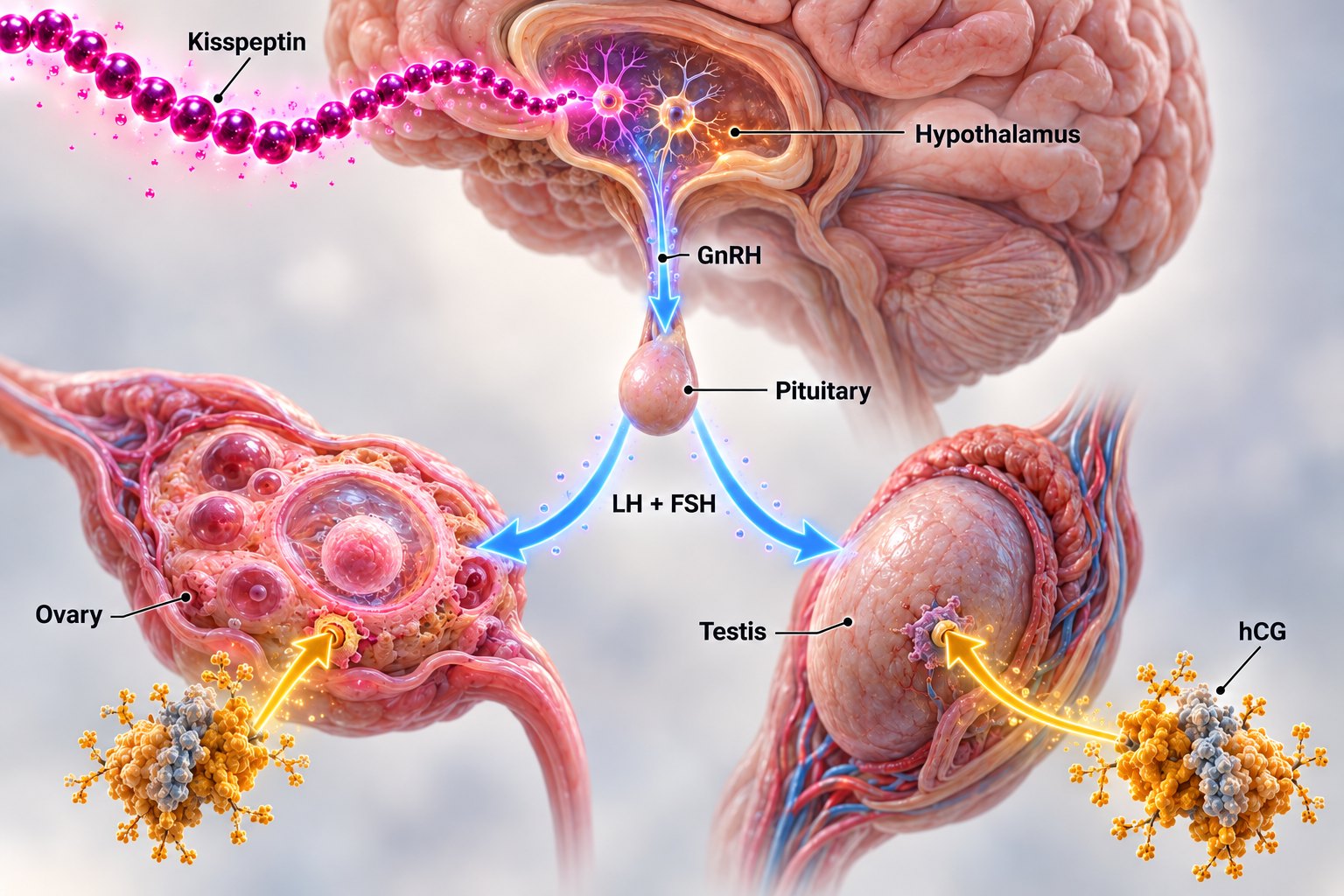
Think of the reproductive axis as a chain of command: hypothalamus, then pituitary, then ovaries or testes.
Kisspeptin gives the order at the top. Your own GnRH, LH and FSH carry it down the chain. The result is a natural-shaped hormone surge that rises and fades within hours.
HCG goes straight to the bottom of the chain. It binds the LH receptors on the ovaries or testes directly and keeps them stimulated for days.
Kisspeptin works through your system. HCG works on your target organs. Everything else in this comparison follows from that.
Kisspeptin vs HCG as an IVF Trigger
In IVF, the “trigger shot” is the step that finishes egg maturation, about 36 hours before the eggs are collected. For decades the standard trigger has been hCG, standing in for the body’s natural LH surge.
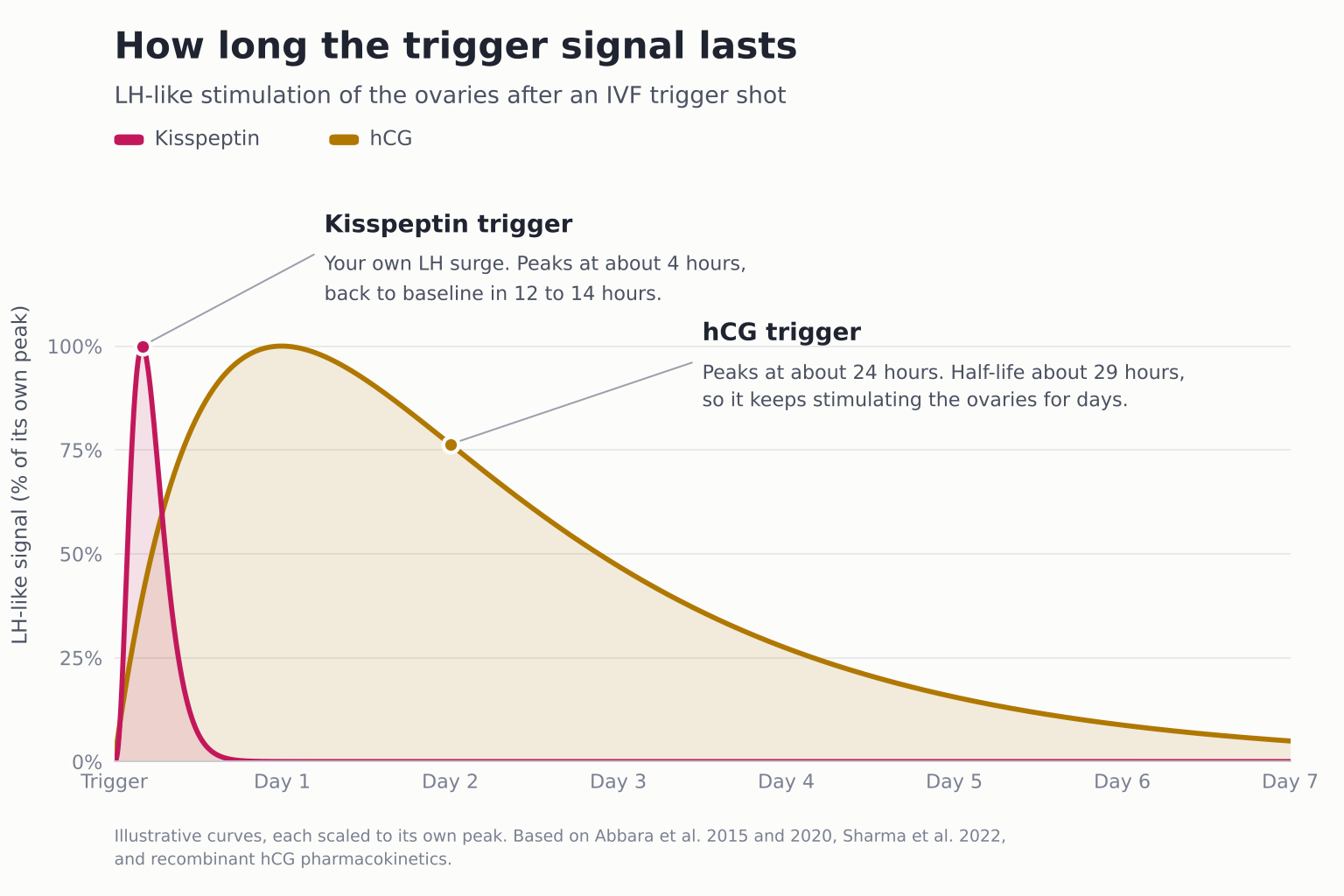
The catch is hCG’s staying power. Its LH-like signal can keep stimulating the ovaries for up to a week. In women with a lot of follicles, that can tip into ovarian hyperstimulation syndrome (OHSS), where blood vessels leak fluid into the abdomen. A growth factor called VEGF drives most of it, and severe cases end up in hospital.
Kisspeptin takes a different route. It tells the woman’s own brain to release a surge of LH, which peaks about 4 hours later and is back to baseline within 12 to 14 hours. Long enough to mature the eggs, then it’s over.
What the Kisspeptin Trigger Studies Found
Researchers at Imperial College London have run the key trials:
| Study | Women | Key result |
|---|---|---|
| First trigger trial (2014) | 53 | Mature eggs in 51 of 53 women; 12 clinical pregnancies |
| High OHSS risk (2015) | 60 | Mature eggs in 95% of women, zero moderate or severe OHSS, and a 45% live birth rate per embryo transfer |
| Second dose (2017) | 62 | 71% of women reached a strong egg yield with two doses, versus 45% with one |
| All three trials combined | 175 | One case of moderate OHSS (0.6%) |
In the high-risk trial, the best results came at a dose of 9.6 nmol/kg, with a 77% clinical pregnancy rate per transfer.
The most striking number comes from one clinic’s records of women at high risk of OHSS. Those triggered with hCG had 33.6 times the odds of an OHSS diagnosis compared with those triggered with kisspeptin.
The usual fallback for high-risk women is a GnRH agonist trigger. It cuts OHSS too, but in fresh embryo transfers it comes with lower live birth rates, so clinics pair it with intensive hormone support or freeze the embryos for later.
All of the kisspeptin trigger trials used GnRH antagonist protocols, where the woman’s own GnRH system stays active and ready to answer the signal.
Role of Kisspeptin in Predicting Miscarriage
Here’s a fact most people never hear: the placenta makes huge amounts of kisspeptin. By late pregnancy, blood levels are thousands of times higher than normal.
That makes kisspeptin a candidate early-warning signal.
In a study of 993 pregnant women seen at around 11 weeks, those who went on to miscarry had kisspeptin levels about 60% lower than expected for their stage of pregnancy. As a predictor of miscarriage, kisspeptin scored an accuracy (AUC) of 0.90, versus 0.78 for hCG. On that scale, 1.0 would be perfect.
A 2021 follow-up put the two closer together: 0.87 for kisspeptin and 0.86 for hCG, with the two combined reaching 0.92. Kisspeptin’s accuracy climbed as pregnancy went on and pulled ahead from around 8 weeks onward.
Kisspeptin vs HCG for Testosterone and Male Fertility
For men, the top-of-the-chain versus bottom-of-the-chain difference matters even more.
HCG talks directly to the Leydig cells in your testes, the cells that make testosterone. That’s why it’s the go-to for keeping the testes working on TRT.
Testosterone therapy shuts down your own LH, and without LH, testosterone inside the testes drops off a cliff. In men on weekly testosterone injections, intratesticular testosterone fell 94% without hCG. With 250 IU of hCG every other day, it held at about 93% of baseline. At 500 IU it went above baseline.
Fertility follows the same pattern. In 26 men on TRT plus 500 IU of hCG every other day, semen parameters held steady, none lost sperm production entirely, and 9 went on to conceive with their partners.
Kisspeptin works one level higher. It drives your own LH and FSH, so it moves the whole axis, not just the testes.
In healthy men, a 90-minute kisspeptin-54 infusion more than doubled LH, from 4.2 to 10.8 IU/L, and nudged testosterone from 21.7 to 24.9 nmol/L. A longer, 22-hour infusion of kisspeptin-10 nearly quadrupled LH and lifted testosterone from 16.6 to 24.0 nmol/L.
FSH is the hormone that drives sperm production, and kisspeptin brings it along with LH. Because it works through your own pituitary, kisspeptin shines when that system is online and ready to answer.
Kisspeptin, Libido and the Brain
This is where kisspeptin gets really interesting.
Kisspeptin also acts in the limbic system, the brain’s emotion and reward centers. Researchers at Imperial College London have been putting people in brain scanners to see what it does there:
- 29 healthy young men: kisspeptin boosted activity in brain regions tied to sexual arousal and romance while they viewed sexual and couple-bonding images. The bigger the boost, the better their mood. Testosterone stayed flat during the scan, so the effect came from the brain itself.
- 32 men with low sexual desire: kisspeptin increased activity in sexual-processing brain regions and increased penile tumescence while watching erotic video, and the men reported feeling happier.
- 32 women with low sexual desire: kisspeptin changed activity in the brain networks that process sexual cues.
For a hormone that started out as a cancer gene, that’s quite a résumé.
Potential Side Effects
Kisspeptin has been smooth in human studies. Across the IVF trials and the brain-scan studies, side effects from kisspeptin itself were minimal, and heart rate and blood pressure stayed steady.
The thing to know is the dosing pattern. Kisspeptin works best in pulses, the way the body uses it. In women with hypothalamic amenorrhea, twice-daily injections for two weeks shrank the LH response from 24.0 to 2.5 IU/L as the system tuned out the constant signal.
HCG’s main risk in women is OHSS. In the manufacturer’s data for the recombinant hCG trigger, OHSS showed up in 1.7% of IVF patients, and injection-site reactions in 14%.
In men, hCG pushes the testes to make more testosterone, and some of that converts to estradiol. Estrogen-related effects like breast tenderness are the classic thing to watch at higher doses.
Kisspeptin vs HCG: Which One Fits Which Goal?
| Goal | Where the research points |
|---|---|
| IVF trigger for women at high risk of OHSS | Kisspeptin |
| Standard IVF trigger | HCG |
| Keeping testicular function and fertility on TRT | HCG |
| Raising your own LH and FSH together | Kisspeptin |
| Predicting miscarriage risk | Kisspeptin, with hCG alongside it |
| Libido and sexual brain response | Kisspeptin |
Bottom Line
Kisspeptin and hCG end up in the same place, the ovaries and testes, but they get there from opposite ends.
Kisspeptin starts at the top and lets your own system do the work, in short, natural bursts. HCG goes straight to the target and stays there for a day or more.
That’s why kisspeptin is the rising star for safer IVF triggers, miscarriage prediction and libido research, and why hCG is still the workhorse for IVF and for men protecting their testicular function on TRT.
Frequently Asked Questions About Kisspeptin vs HCG
What is the difference between kisspeptin and hCG?
Kisspeptin acts in the hypothalamus and triggers your own GnRH, LH and FSH. HCG acts directly on the ovaries and testes as a long-acting stand-in for LH.
How long do kisspeptin and hCG last in the body?
Kisspeptin-54 has a half-life of about 28 minutes, and kisspeptin-10 is cleared within a few minutes. HCG’s half-life is roughly 24 to 36 hours, which is why its effects last for days.
Is kisspeptin safer than hCG for IVF?
For women at high risk of OHSS, kisspeptin has a strong record. In the main high-risk trial, 95% of women produced mature eggs and none developed moderate or severe OHSS. Across 175 women in three trials, there was one case of moderate OHSS.
Can kisspeptin be used instead of hCG on TRT?
For keeping testicular testosterone and sperm production going during TRT, hCG is the one with the clinical data. At 500 IU every other day, it kept semen parameters stable in men on TRT. Kisspeptin works through your own pituitary, so its testosterone effects have been studied in men whose hormone axis is active.
Does kisspeptin increase testosterone?
Yes. In healthy men, kisspeptin infusions raised LH and testosterone within hours. During a 22-hour kisspeptin-10 infusion, testosterone rose from 16.6 to 24.0 nmol/L.
Can kisspeptin predict miscarriage?
Kisspeptin is a promising marker. In a study of 993 pregnant women, low kisspeptin predicted miscarriage with an accuracy (AUC) of 0.90, versus 0.78 for hCG. Its accuracy improves from around 8 weeks of pregnancy.
Does kisspeptin affect libido?
In brain-scan studies, kisspeptin boosted activity in sexual-processing regions in both men and women with low sexual desire, and increased penile tumescence in men.
References
- Lee JH, et al. KiSS-1, a novel human malignant melanoma metastasis-suppressor gene. J Natl Cancer Inst. 1996;88(23):1731-1737. PubMed
- de Roux N, et al. Hypogonadotropic hypogonadism due to loss of function of the KiSS1-derived peptide receptor GPR54. Proc Natl Acad Sci USA. 2003;100(19):10972-10976. DOI
- Seminara SB, et al. The GPR54 gene as a regulator of puberty. N Engl J Med. 2003;349(17):1614-1627. PubMed
- Dhillo WS, et al. Kisspeptin-54 stimulates the hypothalamic-pituitary gonadal axis in human males. J Clin Endocrinol Metab. 2005;90(12):6609-6615. PubMed
- Chan YM, et al. Kisspeptin resets the hypothalamic GnRH clock in men. J Clin Endocrinol Metab. 2011;96(6):E908-E915. DOI
- George JT, et al. Kisspeptin-10 is a potent stimulator of LH and increases pulse frequency in men. J Clin Endocrinol Metab. 2011;96(8):E1228-E1236. DOI
- Cole LA. Biological functions of hCG and hCG-related molecules. Reprod Biol Endocrinol. 2010;8:102. DOI
- Abbara A, et al. Endocrine requirements for oocyte maturation following hCG, GnRH agonist, and kisspeptin during IVF treatment. Front Endocrinol. 2020;11:537205. DOI
- Jayasena CN, et al. Kisspeptin-54 triggers egg maturation in women undergoing in vitro fertilization. J Clin Invest. 2014;124(8):3667-3677. DOI
- Abbara A, et al. Efficacy of kisspeptin-54 to trigger oocyte maturation in women at high risk of ovarian hyperstimulation syndrome (OHSS) during in vitro fertilization (IVF) therapy. J Clin Endocrinol Metab. 2015;100(9):3322-3331. PubMed
- Abbara A, et al. A second dose of kisspeptin-54 improves oocyte maturation in women at high risk of ovarian hyperstimulation syndrome: a Phase 2 randomized controlled trial. Hum Reprod. 2017;32(9):1915-1924. DOI
- Sharma B, et al. Use of kisspeptin to trigger oocyte maturation during in vitro fertilisation (IVF) treatment. Front Endocrinol. 2022;13:972137. DOI
- Abbara A, et al. Clinical parameters of ovarian hyperstimulation syndrome following different hormonal triggers of oocyte maturation in IVF treatment. Clin Endocrinol. 2018;88(6):920-927. PubMed
- Practice Committee of the American Society for Reproductive Medicine. Prevention of moderate and severe ovarian hyperstimulation syndrome: a guideline. Fertil Steril. 2024;121(2):230-245.
- Youssef MA, et al. Gonadotropin-releasing hormone agonist versus HCG for oocyte triggering in antagonist-assisted reproductive technology. Cochrane Database Syst Rev. 2014;(10):CD008046.
- Jayasena CN, et al. Reduced levels of plasma kisspeptin during the antenatal booking visit are associated with increased risk of miscarriage. J Clin Endocrinol Metab. 2014;99(12):E2652-E2660. PubMed
- Abbara A, et al. Performance of plasma kisspeptin as a biomarker for miscarriage improves with gestational age during the first trimester. Fertil Steril. 2021;116(3):809-819. DOI
- Coviello AD, et al. Low-dose human chorionic gonadotropin maintains intratesticular testosterone in normal men with testosterone-induced gonadotropin suppression. J Clin Endocrinol Metab. 2005;90(5):2595-2602. PubMed
- Hsieh TC, et al. Concomitant intramuscular human chorionic gonadotropin preserves spermatogenesis in men undergoing testosterone replacement therapy. J Urol. 2013;189(2):647-650. PubMed
- Comninos AN, et al. Kisspeptin modulates sexual and emotional brain processing in humans. J Clin Invest. 2017;127(2):709-719. DOI
- Mills EG, et al. Effects of kisspeptin on sexual brain processing and penile tumescence in men with hypoactive sexual desire disorder: a randomized clinical trial. JAMA Netw Open. 2023;6(2):e2254313. DOI
- Thurston L, et al. Effects of kisspeptin administration in women with hypoactive sexual desire disorder: a randomized clinical trial. JAMA Netw Open. 2022;5(10):e2236131. PubMed
- Jayasena CN, et al. Subcutaneous injection of kisspeptin-54 acutely stimulates gonadotropin secretion in women with hypothalamic amenorrhea, but chronic administration causes tachyphylaxis. J Clin Endocrinol Metab. 2009;94(11):4315-4323. PubMed
- Ovidrel (choriogonadotropin alfa injection) prescribing information. EMD Serono.
Stay sharp,
Joe Mars
The Peptide Report
P.S. Want to go deeper on fertility and hormone peptides? I break it all down inside the Peptides and Biohacking Hub on Skool. Free community, real protocols, and people actually running this stuff. Join here.