
Every side effect in this article started out as an answer to a question. At each study visit, someone asked the participant what they had experienced since the last visit, wrote the answer down, and a doctor decided later whether the fragment had anything to do with it.
Six trials. 893 people. In the four smallest alone, 451 recorded answers.
Here is what they add up to, and what the way they were collected means for reading them.
The six trials, end to end
| Trial | Route | People | Doses | Duration |
|---|---|---|---|---|
| First, phase 1 | Intravenous | 15 healthy men | 25 to 400 micrograms per kilogram | Single doses, a week apart |
| Second, phase 2a | Intravenous | 23 obese men | 25, 50 and 100 micrograms per kilogram | Single doses, a week apart |
| Third, phase 2a | Oral capsules | 17 obese men | 9, 27 and 54 milligrams | Single doses, two weeks apart |
| Fourth, phase 2a | Oral capsules | 36 obese men | 9, 27 or 54 milligrams daily | Seven days |
| Fifth, phase 2b | Oral capsules | 300 obese adults | 1, 5, 10, 20 or 30 milligrams daily | 12 weeks, after a two-week placebo run-in |
| Sixth, phase 2b | Oral tablets | 502 obese adults | 0.25, 0.5 or 1 milligram daily | 24 weeks, after a four-week placebo run-in |
All six were randomized, double-blind and placebo-controlled, run between 2001 and 2006, and cleared by ethics committees at up to sixteen Australian hospitals and medical centers. The first four enrolled men only. The sixth enrolled 534 people and randomized 502 of them, which is the number that matters when you are reading rates.
Stier, Vos and Kenley pulled all six into a single safety summary in 2013, and that paper is where almost every number below comes from. The paper trail around it is thin: a search of the public United States trials registry returns no entries for this molecule at all, so there is no registry record to read the summary against. The two largest trials were registered in Australia instead.
The fragment itself is the tail end of human growth hormone, amino acids 177 to 191, with an extra tyrosine at the front for stability and a ring closed by a disulfide bond between its two cysteines, a shape Ogru and colleagues found resembles the matching stretch of the intact hormone. The dosing side of the record is in our dosing guide.
How a side effect got onto the list
In every one of the six trials, participants were interviewed at each visit about anything they had experienced since the previous one. Physical examinations, vital signs, hematology, biochemistry, urinalysis, lipid panels and electrocardiograms were taken before and after treatment. The two long trials added glucose tolerance testing, antibody testing and IGF-1 measurement.
Then the principal investigator decided, for each event, whether the treatment had caused it: definitely related, probably related, possibly related, or unrelated.
That last step is the soft joint in the whole structure. Arimone and colleagues gave five senior experts 150 drug and event pairs and asked each of them, independently, to rate the probability that the drug caused the event. Overall agreement was poor, with a kappa of 0.20. It was worst in exactly the middle categories: 0.03 for unlikely, 0.03 for doubtful, minus 0.01 for unassessable and 0.13 for plausible. Agreement was better at the ends, at 0.40 for excluded, 0.32 for likely and 0.30 for certain.
So when you read “possibly related” below, read it as the weakest label in the set. Two of the more interesting events in this record carry it.
The two intravenous trials
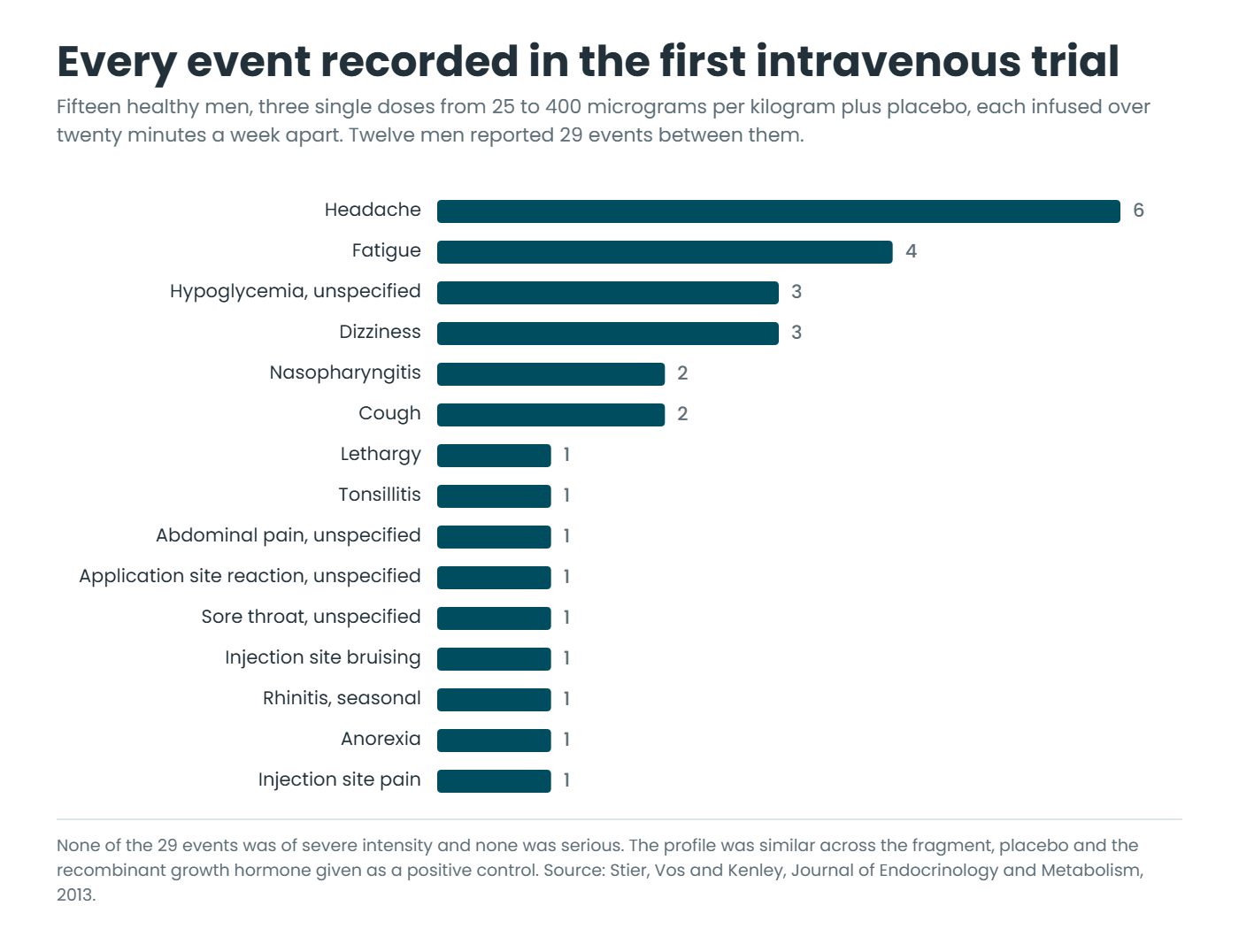
The first trial gave 15 healthy men three single doses between 25 and 400 micrograms per kilogram, plus placebo, each infused over twenty minutes with a week in between. One man left for personal reasons and 14 finished.
Twelve of them reported 29 events in total, none of severe intensity and none serious. Headache came up six times. Then fatigue four times, unspecified hypoglycemia three, dizziness three, nasopharyngitis twice and cough twice. One each of lethargy, tonsillitis, unspecified abdominal pain, an unspecified application site reaction, unspecified sore throat, injection site bruising, seasonal rhinitis, anorexia and injection site pain.
The profile was similar across the fragment, the placebo, and the recombinant human growth hormone used as a positive control in that trial. Nothing clinically significant turned up in vital signs, examinations, laboratory work or electrocardiograms, and there was no significant trend in glycerol, glucose or IGF-1 for any of the three.
The second trial ran the same idea in 23 obese men aged 19 to 50, with body mass index between 36 and 67. Each man received four single doses in a Latin-square design, 25, 50 and 100 micrograms per kilogram and placebo, again infused over twenty minutes a week apart.
This time there were 118 events and still no serious ones. Mild or moderate headache was reported by 16 of the 23 men, which is 69.6 percent. Three events reached severe intensity: one in the 50 micrograms per kilogram period and two during placebo. The severe event on active treatment was a feeling of chest tightness, judged possibly related.
Euphoria, in five men, and never on placebo
The one symptom in the human record that tracked with the drug rather than the calendar was euphoria. Five of the 23 men in that second trial reported mild or moderate euphoria during the periods when they were given the fragment. None reported it during their placebo period. It was judged possibly related.
In a crossover design, each man is his own control, so a symptom that shows up only in the active periods is the pattern least easily explained by expectation. It is also five men, under the weakest causality label there is, in a trial that was never repeated at that route.
One fact sits alongside it without resolving it. When rats were given fragment labeled with carbon-14, the label showed up in every tissue examined except the central nervous system.
The oral trials, and the one event judged definitely related
The third trial gave 17 obese men single oral doses of 9, 27 and 54 milligrams, two weeks apart; 15 completed. All 17 reported something, 97 events between them. Two were serious: diarrhea, judged possibly related, and bronchial pneumonia, judged unrelated, both in men who had taken 54 milligrams. The common complaints were mild or moderate headache first, then diarrhea, flatulence, increased appetite and nausea.
One event across all six trials was judged definitely related to study treatment. It was taste perversion, ten minutes after a dose. The dose was placebo.
The fourth trial put 36 obese men on 9, 27 or 54 milligrams daily or placebo for seven days, nine men per arm. Every one of the 36 reported something, 207 events in total. All but one were mild or moderate, the exception being a soft tissue shoulder injury in a man on placebo, judged unrelated. No serious events occurred during the week of treatment or the week of follow-up.
The rates and the profile matched each other in the 9 milligram arm, the 27 milligram arm and placebo. The 54 milligram arm had more headaches, more diarrhea and more flatulence. That is the only dose-related pattern anywhere in the human record. For proportion, 54 milligrams a day is well above the range the two long trials used, which ran from 1 to 30 milligrams and from 0.25 to 1 milligram.
The run-in weeks are how you read 88.9 percent
The fifth trial is the one that makes the rest of the numbers legible, because it started by putting everybody on placebo.
For two weeks before any active treatment, all 300 participants took placebo capsules and were interviewed the same way they would be later. In those two weeks, 70 percent of them reported at least one adverse event, ranging from 64.6 to 79.6 percent across the groups they would later be randomized into. Nervous system complaints accounted for 32.2 percent, almost all of it headache at 30.4 percent. Gastrointestinal complaints came to 19.4 percent, mostly unspecified diarrhea at 5.5 percent. Infections came to 16.6 percent.
Then the trial started. Across twelve weeks on 1, 5, 10, 20 or 30 milligrams daily or placebo, 88.9 percent reported at least one event, spread evenly across all six arms. Nervous system complaints rose to 48.4 percent, headache to 42.6 percent, gastrointestinal to 30.4 percent, diarrhea to 9.0 percent and infections to 45.3 percent. The distribution of severity was similar across arms, and so was the proportion of events the investigator judged possibly or probably related, placebo included.
The sixth trial has the same shape and a sharper detail. In its four-week placebo run-in, 48.4 percent of 502 people reported an event. Over 24 weeks of treatment, 78.7 percent did. The range across arms was 75.6 to 83.2 percent, and the highest rate belonged to placebo at 83.2 percent, against 75.6 percent in the 0.25 milligram arm.
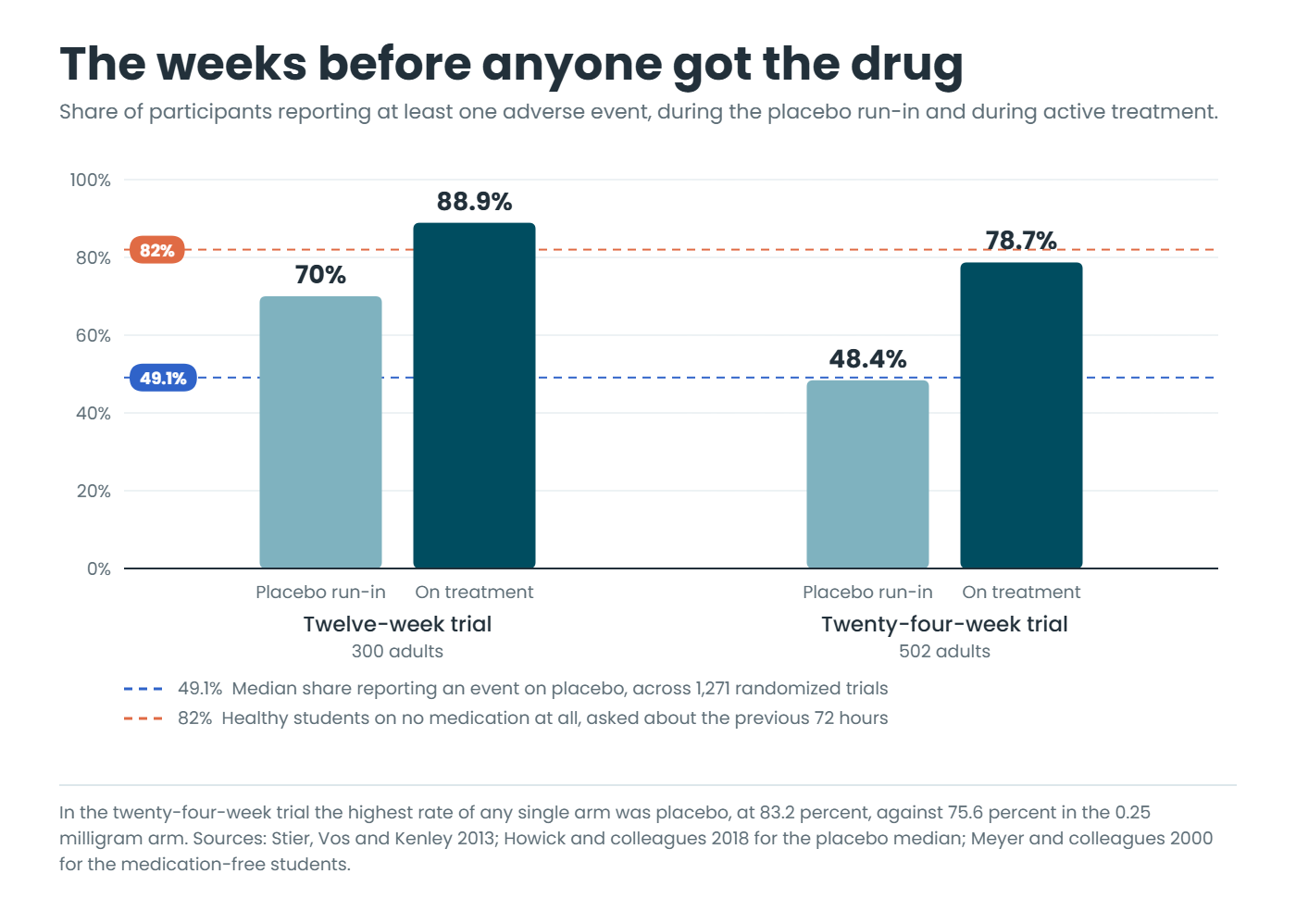
None of that is unusual. Howick and colleagues pooled twenty systematic reviews covering 1,271 randomized trials and 250,726 placebo-treated patients: the median proportion reporting at least one adverse event on placebo was 49.1 percent, with an interquartile range of 25.7 to 64.4 percent. In the subset of trials that also carried an untreated group, 6.51 percent of placebo patients reported events against 4.25 percent of untreated ones.
Meyer and colleagues went further back, asking 78 healthy medical students to tick off anything they had experienced in the previous 72 hours. In the medication-free control period, before any placebo at all, only 14 of them, 18 percent, had nothing to report. Tiredness, headaches, and muscle and joint pains made up most of the rest. For scale, Stovner and colleagues put the global prevalence of an active headache disorder at 52.0 percent, with a 95 percent confidence interval of 48.9 to 55.4 percent.
Which sets up the comparison that matters. It is not 88.9 percent against nothing. It is 88.9 percent against the 70 percent recorded in the same 300 people, on placebo, two weeks earlier.
Two things limit what those percentages can carry. Żegleń and colleagues, reviewing placebo and nocebo effects specifically in weight loss, found only preliminary trends across a small number of studies, so there is no well-populated comparison set for this kind of trial. And Khera and colleagues, pooling 28 obesity drug trials with 29,018 patients, note attrition of 30 to 45 percent: a 24-week adverse event profile is the profile of whoever was still turning up at week 24.
The five serious events in the twelve-week trial
Five of the 300 participants in the twelve-week trial had a serious adverse event. Three were in the 20 milligram arm: a basal cell carcinoma, a moderate lipoma and a squamous cell carcinoma. One was in the 5 milligram arm, a breast cancer. One was in the 10 milligram arm, a malignant melanoma.
The investigator judged none of them possibly, probably or definitely related to study medication, and the reasoning is stated in the paper. None had occurred in the top 30 milligram arm, so a dose effect was taken to be excluded. Examination of the cases indicated the participants had neglected their personal medical care for a long period. Three of the five were skin cancers in a trial run in Australia, which Sneyd and Cox describe, with New Zealand, as having the highest melanoma incidence and mortality rates in the world. And cancer incidence rises with body mass index, in a group whose median body mass index was 40 and whose range reached 67.
Two things about that argument. The absence of cases in the 30 milligram arm is an observation across arms of 50 people each. And twelve weeks is the window in which these cancers were detected, not a window in which a treatment could plausibly have produced them, which cuts against attributing them to the drug and equally against the trial settling the question either way. What the trial could do was measure the mechanism behind the worry, which it did.
The serious events in the twenty-four-week trial
Eighteen of the 502 participants, 3.6 percent, had at least one serious adverse event, distributed similarly across all arms. Six of them, 1.2 percent, fell under injury, poisoning and procedural complications. Then two each, 0.4 percent apiece, under general disorders and administration site conditions, infections and infestations, musculoskeletal and connective tissue disorders, and vascular disorders.
No adverse event in that trial was judged definitely related to treatment. The events judged possibly or probably related were most often gastrointestinal, at 5.2 percent overall, and nervous system, at 4.9 percent overall, and those proportions were similar across every arm including placebo.
What was measured besides symptoms
IGF-1 is the number this whole program was built around. The hormone the fragment comes from raises it, and higher IGF-1 has been tied to cancer risk: Chan and colleagues, working with 152 cases and 152 controls from a physicians’ cohort, found men in the top quartile of IGF-1 carried a relative risk of 4.3 for prostate cancer, with a 95 percent confidence interval of 1.8 to 10.6, independent of baseline prostate-specific antigen.
In the twelve-week trial, IGF-1 was measured at baseline and at the end of treatment and did not change significantly in any arm. In the twenty-four-week trial, overall mean changes were 1.76 and 1.24 nanomoles per liter at twelve and twenty-four weeks, with p-values of 0.50844 and 0.75754 against placebo.
How much a null result like that carries depends on how steady the measurement is. Milani and colleagues took fasting IGF-1 twice, two weeks apart, in 84 volunteers aged 50 to 90. The two sets correlated at 0.922, but individual values moved between minus 36.25 and plus 38.24 percent, the group means differed with a p-value of 0.03, and 34 of the 84 volunteers, 40.5 percent, landed in a different quartile the second time. A null IGF-1 finding rules out a large shift confidently and a small one much less so.
Glucose handling was tested the same way, and across both long trials oral glucose tolerance testing found no significant change in any arm. In the twenty-four-week trial the overall change in pre-load glucose was minus 0.02 units at twelve weeks, with a p-value of 0.73488, and plus 0.04 units at twenty-four weeks, with a p-value of 0.62787. At twelve weeks the placebo group’s change differed from the 0.25, 0.5 and 1 milligram arms by minus 0.08, minus 0.06 and minus 0.07 units; at twenty-four weeks the differences from placebo were minus 0.03, plus 0.02 and plus 0.06 units. None reached significance. In the twelve-week trial there was a trend the other way, toward better glucose tolerance, which also fell short of significance, and the authors add that participants who began with impaired glucose tolerance were less likely to develop diabetes on the fragment than on placebo, while saying plainly that this needs a trial of its own.
Here too the test has a floor. Ko and colleagues gave 212 people two 75 gram glucose tolerance tests within six weeks and the resulting classification agreed only 65.6 percent of the time, 139 of 212, with no improvement among those who had higher glycated hemoglobin, body mass index or waist-to-hip ratio.
Antibodies were the third thing watched. In the twelve-week trial, blood was drawn at baseline and at four, eight and twelve weeks, and no anti-fragment antibodies were found in any participant at any timepoint; in the twenty-four-week trial, none were found in the subset of patients selected for the assay. The animal studies came back the same way, and the authors conclude the fragment is not immunogenic. That conclusion rests on an assay, and assays for peptides are a live methodological problem: Chen and colleagues compared formats for detecting anti-drug antibodies against a therapeutic peptide and found they differ substantially in sensitivity, drug tolerance, matrix variability and precision. “None detected” is a statement about a method as much as about an immune system, and in the longest trial it is a statement about a subset.
What the parent hormone does that this does not
Most of what people expect from this molecule, good and bad, is borrowed from growth hormone. The receptor reason it does not inherit the hormone’s effects is covered in our piece on what else the fragment was measured for. What matters here is the safety half of that comparison.
Liu and colleagues pooled 31 articles covering 18 study populations, 220 people given growth hormone over 107 person-years at a mean starting dose of 14 micrograms per kilogram daily for a mean of 27 weeks. Those treated were significantly more likely to develop soft tissue edema, arthralgia, carpal tunnel syndrome and gynecomastia, and somewhat more likely to develop diabetes and impaired fasting glucose. Bredella and colleagues put 79 obese premenopausal women on growth hormone or placebo for six months at a mean 1.7 plus or minus 0.1 milligrams a day: the IGF-1 standard deviation score rose from minus 1.7 plus or minus 0.08 to minus 0.1 plus or minus 0.3, and by the end four women, three of them on the hormone, had a two-hour glucose above 200 milligrams per deciliter.
The animal work points the same way. Heffernan and colleagues, in the 2001 International Journal of Obesity paper, found that over fourteen days in mice the fragment matched the hormone on fat oxidation but caused no hyperglycemia and no fall in insulin secretion, did not compete with the hormone for its receptor, and did not drive cell proliferation. In the 2001 Endocrinology paper the same group showed the effect runs through the beta-3 adrenergic pathway: in mice lacking that receptor, chronic treatment no longer changed body weight or lipolysis. Ng and colleagues found insulin sensitivity under a euglycemic clamp unaffected in obese Zucker rats given 500 micrograms per kilogram by mouth for nineteen days, where chronic hormone treatment is not.
That is the profile the fragment was built to avoid, and across both long human trials the two markers behind it, IGF-1 and glucose tolerance, did not move.
The animal record, and the only repeat-dose injection data there is
Moré and Kenley published the non-clinical package in 2014, and it holds something the human trials do not: repeat dosing by injection.
Rats received 0.1, 1.0 or 10 milligrams per kilogram daily into the tail vein for four weeks, ten males and ten females per dose against five of each on vehicle alone. There were no treatment-related deaths, no clinical signs and no local effects at the injection site. Female body mass gain was significantly lower at 1.0 and 10 milligrams per kilogram from the first week, which the authors read as the fragment’s known action on body weight rather than a toxic effect, noting the same in two earlier intravenous rat studies. Males at the top dose had significantly smaller thymus masses, and decreased thymic cortical width appeared more often in both sexes at that dose without reaching significance, and in control animals too at lower frequency. Nothing turned up in ophthalmology, hematology, biochemistry, urinalysis or gross pathology, and no antibodies were found after four weeks.
Every human dose by injection was a single dose with a washout after it. That four-week rat study is the whole of the repeat-dose injection record.
The chronic studies were oral: rats at up to 100 milligrams per kilogram daily for 26 weeks and monkeys at up to 50 milligrams per kilogram daily for nine months. Both threw up scattered differences with no dose relationship behind them, mostly in blood chemistry, plus lower liver masses and liver glycogen in treated male monkeys after 39 weeks. In each case the authors set the finding aside for the same stated reason: no dose relationship, or no corroborating pathology, or no repeat in a duplicate. The no-observed-adverse-effect level came out at least 100 milligrams per kilogram daily in rats, the highest dose given, and up to 50 in monkeys.
The genotoxicity testing produced the same shape of result. A bacterial reverse mutation test across five standard tester strains gave nothing on plate incorporation up to 2,000 micrograms per plate, and the one strain that showed slight increases in the pre-incubation version showed nothing at the top dose and nothing on a repeat. In Chinese hamster ovary cells, a single rise in chromosome aberrations at 100 micrograms per milliliter did not hold between duplicate cultures and did not appear at 200. The micronucleus test built into the four-week injection study found slight increases at 0.1 and 10 milligrams per kilogram but not at 1. The one finding the authors could not wave off was polyploidy, which rose at the two top cell-culture doses without metabolic activation at both harvest times; they read it, with the growth inhibition alongside it, as interference with cell cycling at very high concentrations.
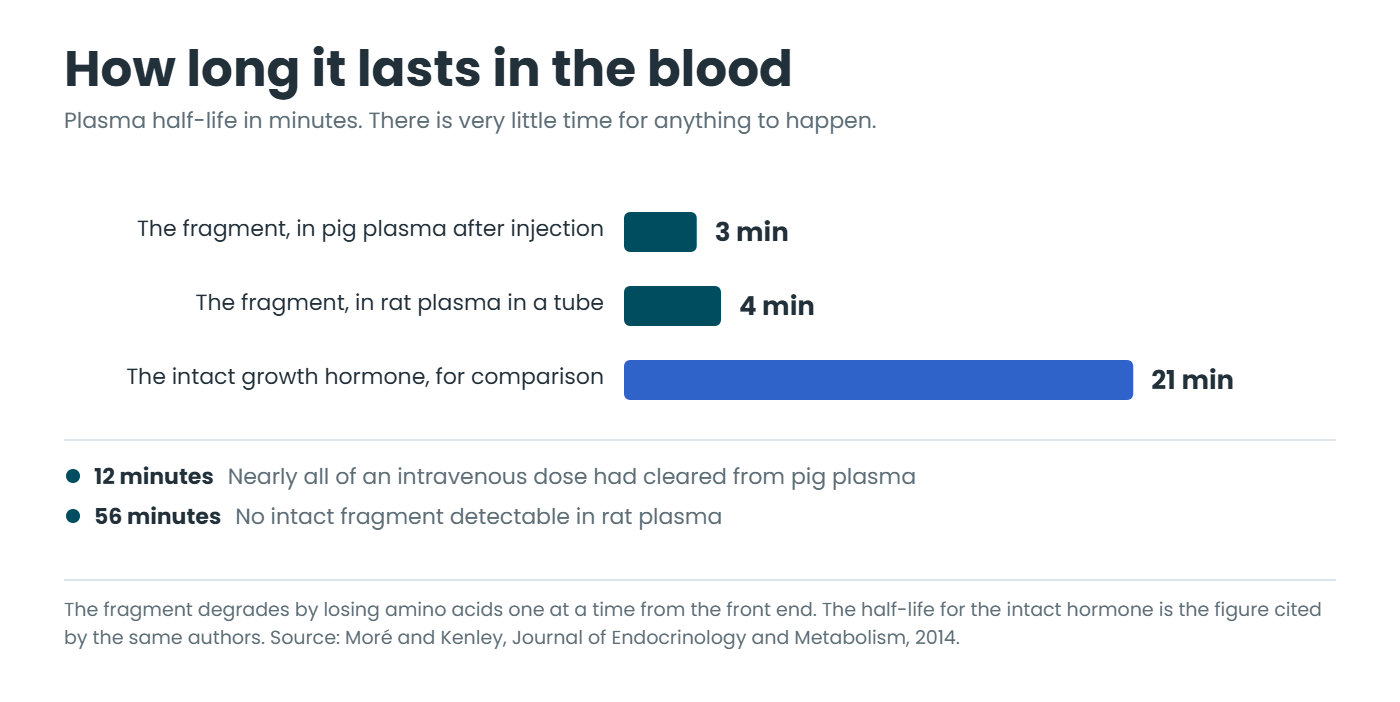
One more thing from that paper matters for reading any of the symptom lists: there is very little time for anything to happen. In rat plasma the fragment has a half-life of about four minutes and is undetectable at 56, degrading by losing amino acids one at a time from the front end. Six pigs given 400 micrograms per kilogram intravenously peaked at 1,945 nanograms per milliliter after two minutes, with a half-life of roughly three minutes and nearly everything cleared by twelve. The intact hormone’s plasma half-life is 21 minutes. Five minutes after an intravenous dose of carbon-14 labeled fragment, label was spread throughout the body except the central nervous system, concentrating in the pancreas, pineal body, thyroid, liver and kidney cortex.
The one route nobody has tested in people is the joint. Kwon and Park injected 0.25 milligrams into rabbit knees weekly in a collagenase model of osteoarthritis, covered in our piece on what else the fragment was measured for.
Who ran the trials
All six human trials were funded by the company developing the molecule. In the 2013 safety summary, one author held an equity interest in the sponsor’s parent company, one was the sponsor’s former medical director and still consulted for it, and one was an employee of a consultancy retained by it. The 2014 non-clinical paper was co-written by the sponsor’s chief executive, who held stock in the same parent company.
That does not make any individual number wrong. It does mean both of the papers that assemble this safety record come from the sponsor’s side of the table, and that the raw study reports behind them sit with contract laboratories rather than in the public literature.
Frequently Asked Questions
What side effects came up most often?
Headache came first in every trial that ranked them, followed by gastrointestinal complaints: diarrhea, flatulence, nausea and increased appetite. All of them appeared at similar rates in the placebo arms, and in the twenty-four-week trial the placebo arm had the highest overall rate of any group.
Did anyone have a serious reaction?
Serious adverse events occurred, including five in the twelve-week trial, four of them cancers, and at least one each in eighteen of the 502 people in the twenty-four-week trial. The investigators judged none of them related to the fragment. The only event in all six trials judged definitely related to study treatment followed a placebo dose.
Does it raise IGF-1 the way growth hormone does?
Not in these trials. IGF-1 did not change significantly in any arm of the twelve-week trial, and mean changes in the twenty-four-week trial were 1.76 and 1.24 nanomoles per liter at twelve and twenty-four weeks, with p-values of 0.50844 and 0.75754.
Does it affect blood sugar?
Glucose tolerance testing across both long trials found no significant change in any arm, and the twelve-week trial saw a non-significant trend in the other direction, toward better glucose tolerance.
Can it cause an allergic reaction?
No anti-fragment antibodies were detected at any of four timepoints in the twelve-week trial, none in the assayed subset at twenty-four weeks, and none in the animal studies, which is the basis for the authors’ conclusion that it is not immunogenic.
Is there any injection data beyond single doses?
Not in people. Both intravenous trials used single doses separated by washout periods. The only repeat-dose injection data is the four-week rat study at up to 10 milligrams per kilogram daily, which found no effects at the injection site.
What is the highest dose anyone has taken?
400 micrograms per kilogram as a single intravenous infusion, and 54 milligrams a day by mouth for seven days. That oral arm is where the extra headaches, diarrhea and flatulence showed up.
References
- Arimone Y, Bégaud B, Miremont-Salamé G, Fourrier-Réglat A, Moore N, Molimard M, Haramburu F. Agreement of expert judgment in causality assessment of adverse drug reactions. Eur J Clin Pharmacol. 2005;61(3):169-173. doi:10.1007/s00228-004-0869-2
- Bredella MA, Lin E, Brick DJ, Gerweck AV, Harrington LM, Torriani M, Thomas BJ, et al. Effects of GH in women with abdominal adiposity: a 6-month randomized, double-blind, placebo-controlled trial. Eur J Endocrinol. 2012;166(4):601-611. doi:10.1530/EJE-11-1068
- Chan JM, Stampfer MJ, Giovannucci E, Gann PH, Ma J, Wilkinson P, Hennekens CH, Pollak M. Plasma insulin-like growth factor-I and prostate cancer risk: a prospective study. Science. 1998;279(5350):563-566. doi:10.1126/science.279.5350.563
- Chen F, He X, Mao Y, Coble K. Method development for the detection of anti-drug antibodies against a therapeutic peptide: assay format selection. Bioanalysis. 2025;17(8):537-548. doi:10.1080/17576180.2025.2501937
- Cunningham BC, Ultsch M, De Vos AM, Mulkerrin MG, Clauser KR, Wells JA. Dimerization of the extracellular domain of the human growth hormone receptor by a single hormone molecule. Science. 1991;254(5033):821-825. doi:10.1126/science.1948064
- Heffernan MA, Thorburn AW, Fam B, Summers R, Conway-Campbell B, Waters MJ, Ng FM. Increase of fat oxidation and weight loss in obese mice caused by chronic treatment with human growth hormone or a modified C-terminal fragment. Int J Obes Relat Metab Disord. 2001;25(10):1442-1449. doi:10.1038/sj.ijo.0801740
- Heffernan M, Summers RJ, Thorburn A, Ogru E, Gianello R, Jiang WJ, Ng FM. The effects of human GH and its lipolytic fragment (AOD9604) on lipid metabolism following chronic treatment in obese mice and beta(3)-AR knock-out mice. Endocrinology. 2001;142(12):5182-5189. doi:10.1210/endo.142.12.8522
- Howick J, Webster R, Kirby N, Hood K. Rapid overview of systematic reviews of nocebo effects reported by patients taking placebos in clinical trials. Trials. 2018;19(1):674. doi:10.1186/s13063-018-3042-4
- Khera R, Murad MH, Chandar AK, Dulai PS, Wang Z, Prokop LJ, Loomba R, Camilleri M, Singh S. Association of pharmacological treatments for obesity with weight loss and adverse events: a systematic review and meta-analysis. JAMA. 2016;315(22):2424-2434. doi:10.1001/jama.2016.7602
- Ko GT, Chan JC, Woo J, Lau E, Yeung VT, Chow CC, Cockram CS. The reproducibility and usefulness of the oral glucose tolerance test in screening for diabetes and other cardiovascular risk factors. Ann Clin Biochem. 1998;35(Pt 1):62-67. doi:10.1177/000456329803500107
- Kwon DR, Park GY. Effect of intra-articular injection of AOD9604 with or without hyaluronic acid in rabbit osteoarthritis model. Ann Clin Lab Sci. 2015;45(4):426-432. PubMed 26275694
- Liu H, Bravata DM, Olkin I, Nayak S, Roberts B, Garber AM, Hoffman AR. Systematic review: the safety and efficacy of growth hormone in the healthy elderly. Ann Intern Med. 2007;146(2):104-115. doi:10.7326/0003-4819-146-2-200701160-00005
- Meyer FP, Tröger U, Röhl FW. Reliability of symptom reports by healthy volunteers treated with placebo over several time periods. Arzneimittelforschung. 2000;50(8):768-771. doi:10.1055/s-0031-1300286
- Milani D, Carmichael JD, Welkowitz J, Ferris S, Reitz RE, Danoff A, Kleinberg DL. Variability and reliability of single serum IGF-I measurements: impact on determining predictability of risk ratios in disease development. J Clin Endocrinol Metab. 2004;89(5):2271-2274. doi:10.1210/jc.2003-032150
- Moré MI, Kenley D. Safety and metabolism of AOD9604, a novel nutraceutical ingredient for improved metabolic health. J Endocrinol Metab. 2014;4(3):64-77. doi:10.14740/jem213w
- Ng FM, Sun J, Sharma L, Libinaka R, Jiang WJ, Gianello R. Metabolic studies of a synthetic lipolytic domain (AOD9604) of human growth hormone. Horm Res. 2000;53(6):274-278. doi:10.1159/000053183
- Ogru E, Wilson JC, Heffernan M, Jiang WJ, Chalmers DK, Libinaki R, Ng F. The conformational and biological analysis of a cyclic anti-obesity peptide from the C-terminal domain of human growth hormone. J Pept Res. 2000;56(6):388-397. doi:10.1034/j.1399-3011.2000.00771.x
- Sneyd MJ, Cox B. A comparison of trends in melanoma mortality in New Zealand and Australia: the two countries with the highest melanoma incidence and mortality in the world. BMC Cancer. 2013;13:372. doi:10.1186/1471-2407-13-372
- Stier H, Vos E, Kenley D. Safety and tolerability of the hexadecapeptide AOD9604 in humans. J Endocrinol Metab. 2013;3(1-2):7-15. doi:10.4021/jem157w
- Stovner LJ, Hagen K, Linde M, Steiner TJ. The global prevalence of headache: an update, with analysis of the influences of methodological factors on prevalence estimates. J Headache Pain. 2022;23(1):34. doi:10.1186/s10194-022-01402-2
- Żegleń M, Kryst Ł, Bąbel P. Diet, gym, supplements, or maybe it is all in your mind? A systematic review and meta-analysis of studies on placebo and nocebo effects in weight loss in adults. Obes Rev. 2024;25(2):e13660. doi:10.1111/obr.13660
Stay sharp,
Joe Mars
The Peptide Report
P.S. If you want to go through these numbers with people reading the same papers, the conversation carries on over at the Peptides & Biohacking Hub.