Press the pump and the dose leaves the nozzle as a cone of droplets. Where that cone lands is settled in a fraction of a second, before absorption, before chemistry, before anything you would call pharmacology. In the cast studies, most of it never gets past the front of the nose. That single fact shapes everything else about putting a peptide up there, and it is where any honest conversation about a BPC-157 nasal spray has to start.
Where the Spray Actually Lands
The nose is not one surface. It is a vestibule at the front, a narrow valve just behind it, the turbinates filling the middle, and a small patch of olfactory tissue up at the roof. Those regions do completely different jobs, and a spray does not distribute itself evenly across them.
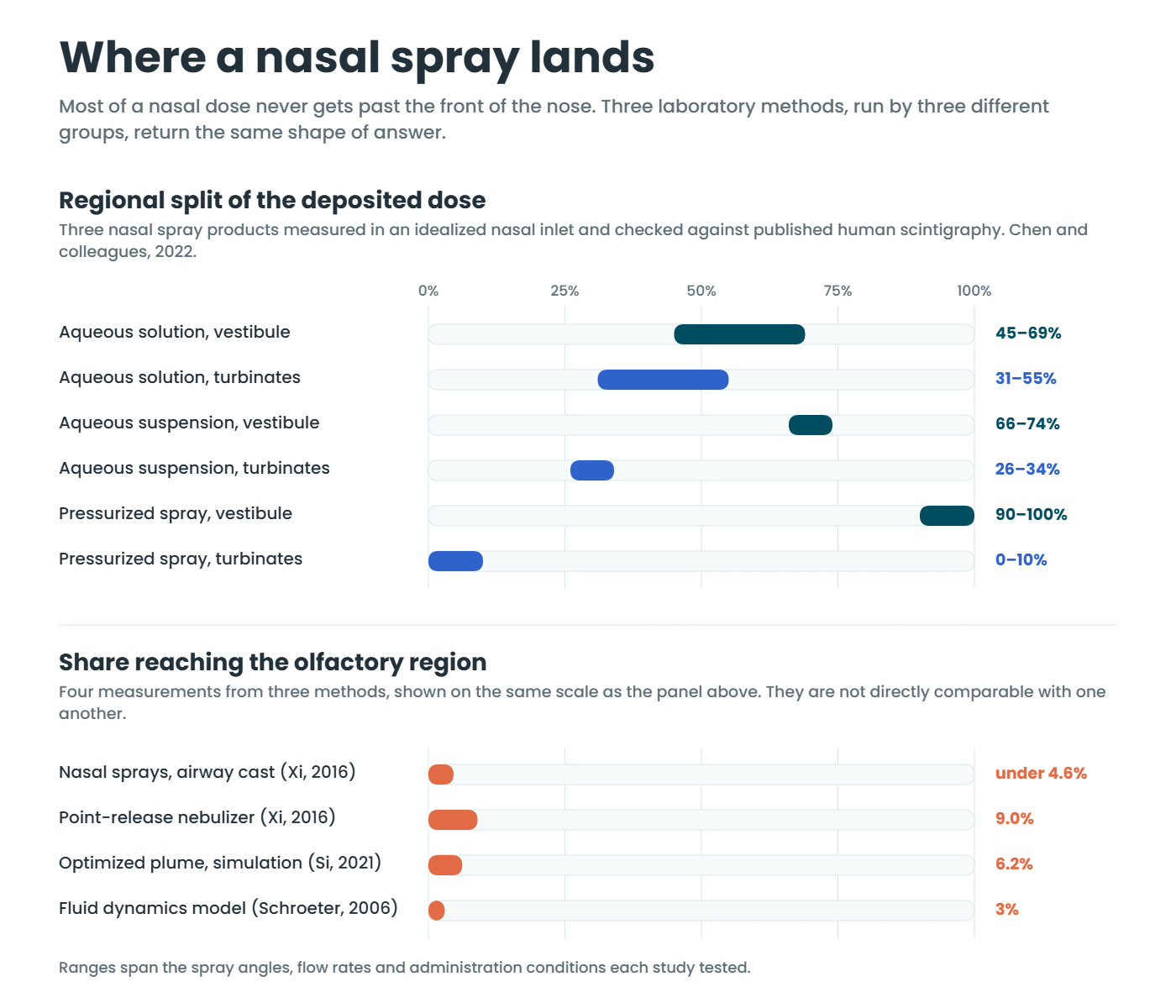
Xi and colleagues built a sectional cast of an adult nasal airway from an MRI model and tested four nasal spray pumps and four nebulizers through it, using a color-changing gel to measure how much mass landed where. The result was lopsided. The majority of nasal spray droplets deposited in the anterior nose, and less than 4.6 percent reached the olfactory region. Switching technique helped more than switching pump: with a point-release administration using one of the nebulizers, up to 9.0 percent of the administered drug reached the olfactory region and 15.7 percent the upper nose.
Chen and colleagues ran a similar question through the Alberta Idealized Nasal Inlet and then checked the answers against published human gamma scintigraphy. An aqueous solution product put 45 to 69 percent of its deposited dose in the vestibule and 31 to 55 percent on the turbinates. An aqueous suspension product came in at 66 to 74 percent vestibule against 26 to 34 percent turbinates. A pressurized metered dose spray was the most front-loaded of the three, at 90 to 100 percent vestibule and 0 to 10 percent turbinates. The in vitro numbers matched the in vivo ones closely enough that the model was considered able to stand in for the real thing.
Schroeter and colleagues came at it from computational fluid dynamics, releasing particles from 5 to 50 micrometers into a nasal geometry traced from an MRI scan at inspiratory flow rates of 7.5, 15 and 30 liters per minute. Peak deposition efficiency was 53 percent at the nasal valve, 20 percent on the turbinates and 3 percent in the olfactory region.
Three methods, three groups, one shape to the answer: the front of the nose gets most of it.
That is not a fixed ceiling, though, and the variables that move it are not the ones people usually think about. Si and colleagues modeled the spray plume itself and found that the initial olfactory deposit is highly sensitive to plume angle. In their simulation, with the head in a vertex-to-floor position, a 10 degree plume angle with the device held at 45 degrees to the nostril delivered the optimal olfactory dose. They also modeled something easy to overlook: the liquid film that forms where droplets land does not stay put. Gravity moves it. That translocation raised the olfactory dose ninefold over the initial deposit, and their optimized delivery system put 6.2 percent of the applied spray into the olfactory region while cutting losses in the vestibule.
Then there is the nose you happened to be born with. Sicard and Frank-Ito classified the nasal vestibule shape of three healthy subjects as elongated, notched and standard, then ran the whole parameter space through each of them: six flow rates from resting to sniffing, five spray release locations, five head positions, three particle velocities. The elongated vestibule was the standout, taking 75.3 percent of particles in the 6 to 10 micrometer band into the olfactory cleft on one side. The standard vestibule’s best result anywhere in that sweep was 29.1 percent, at a different particle size, and the authors’ overall finding was that micron-sized particles generally beat nanoparticles into the olfactory regions. Same sweep, same settings, different anatomy, and the best achievable number moves by more than a factor of two.
The Clock Starts With the Spray
Whatever lands has a deadline. The nasal lining is carpeted in cilia that move a sheet of mucus steadily backward toward the throat, and anything sitting on that sheet goes with it.
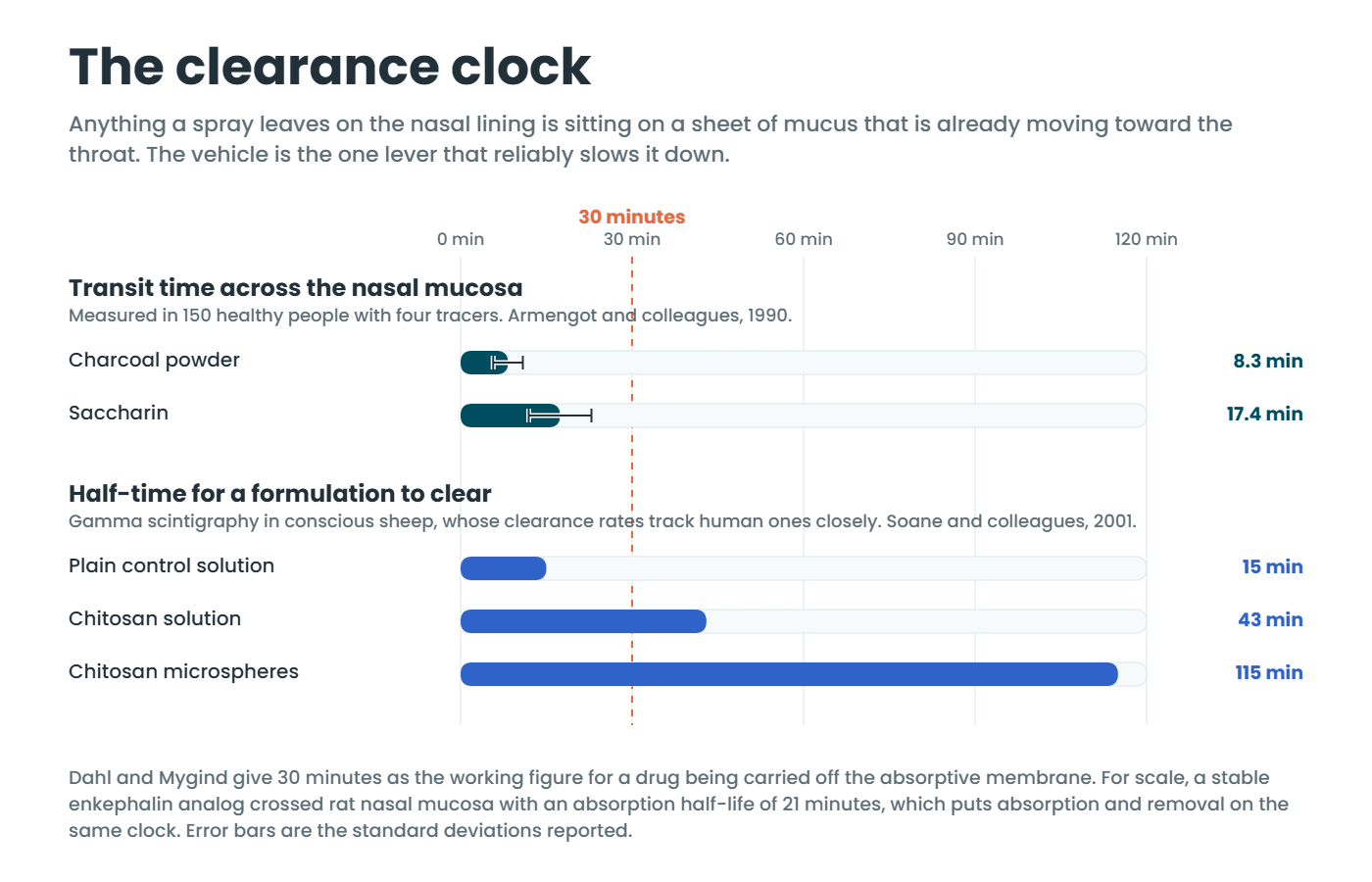
Dahl and Mygind put the practical version plainly in their review of nasal anatomy and physiology: mucociliary transport removes the drug from the absorptive mucous membrane within 30 minutes. They also made two points that get lost in product talk. Nasal inflammation does not increase drug absorption, contrary to what people assume, and blockage, sneezing and a running nose can prevent absorption outright. The nose also changes shape on you, because large venous sinusoids in the mucosa swell and shrink quickly, and reflex watery secretion can flood the surface you were counting on.
How fast is the sheet moving? Armengot and colleagues measured nasal mucociliary clearance in 150 normal people using four different tracers and found that the answer depends on what you put down. Mean transport time was 8.3 minutes for charcoal powder and 17.4 minutes for saccharin, and mean transport velocity was 8 millimeters per minute for labeled serum albumin against 5 millimeters per minute for pertechnetate. Insoluble substances traveled faster, which puts a dissolved peptide at the slower end of what they measured, though not by a margin that changes the problem.
The one lever that genuinely moves this is the vehicle. Soane and colleagues tracked two bioadhesive formulations through the nasal cavity of conscious sheep against a plain control solution. The control cleared with a half-time of about 15 minutes. A chitosan solution stretched that to 43 minutes, and chitosan microspheres to 115 minutes, nearly eight times the control. The authors noted that sheep clearance rates closely mimic the human rates from their earlier work, which makes the comparison worth something.
Even the device matters here, and the classic demonstration is thirty years old. Harris and colleagues gave desmopressin to humans as a spray from metered-dose pumps or as drops from a catheter or pipette, tagged the dose with labeled albumin and watched it on gamma scintigraphy while measuring plasma levels and the factor VIII response. The sprays deposited mainly anteriorly and cleared slowly, in small portions. The drops deposited mostly posteriorly, cleared very rapidly in large portions, and some was swallowed immediately. The spray produced a two to threefold increase in relative bioavailability over the drops, and the biological response tracked it, with a linear correlation between peak plasma desmopressin and peak factor VIII activity.
Landing in the back of the nose sounds like it should be better. It is worse, because the back of the nose is where the exit is.
The Lining Is Also an Enzyme
Swallowing a peptide means running it past the stomach and then the liver. Spraying one into the nose skips the liver, which is the usual selling point of the route. It does not skip digestion, it just relocates it.
Sarkar’s review of drug metabolism in the nasal mucosa named this directly: the enzymatic barrier of the nasal mucosa creates what he called a pseudo-first-pass effect. The predominant enzyme acting on peptides is aminopeptidase, working alongside other exopeptidases and endopeptidases. There is also a striking piece of trivia in that review that says a lot about the tissue: cytochrome P-450 activity in the olfactory region of the nasal epithelium is higher than in the liver, driven mainly by a three to fourfold higher content of the reductase that feeds it.
Ohkubo and colleagues measured the peptidase side of this in human nasal mucosa from twelve subjects. The membrane-rich fraction was the largest reservoir, at 630 picomoles of leucine-enkephalin cleaved per minute per milligram of protein, against 32 picomoles per minute per milligram in the cytoplasmic fraction. Staining localized the activity to the epithelial and gland cells, which is to say the exact surface a spray lands on.
What that does to a peptide depends on how the peptide ends. Hussain and colleagues made a series of enkephalin analogs that differed only in the amino acid at the N-terminus and ran them through rat nasal mucosa. Only the one carrying aspartic acid at that position was stable. The degradation order ran tyrosine fastest, then alanine, then serine and lysine, with aspartate slowest, a pattern the authors read as high aminopeptidase N and B activity with low aminopeptidase A. The stable analog, given as a 50 microliter dose of a 3 milligram per milliliter solution, showed an absorption half-life of 21 minutes.
Put that beside the 30 minute clearance deadline and the problem comes into focus: the absorption and the removal are running on the same timescale.
You can fight the enzymes, but the fight has a cost. Agu and colleagues tested protease inhibitors and absorption enhancers on cultured human nasal epithelium. Puromycin combined with glycocholate or dimethyl-beta-cyclodextrin raised leucine-enkephalin absorption by 9 to 14 percent, against 1 to 3 percent for the bestatin combinations and 2 to 4 percent for inhibitors used alone. The same combinations that worked best also dropped epithelial resistance and raised sodium fluorescein transport, and both inhibitors induced a rebound in aminopeptidase activity of 25 to 61 percent alongside protein leakage of 21 to 46 percent. The authors were explicit that whether this amounts to a real problem needs in vivo work.
Size Explains Most of the Spread
Strip away the devices and the enzymes and one variable still predicts most of the outcome.
Huang and Donovan, writing in 1998, summarized it as a rule: for compounds larger than 1000 daltons, nasal bioavailability can be predicted directly from molecular weight, and for large therapeutic agents in general it falls between 0.5 and 5 percent. They also noted that the nose takes up particles as well as molecules, with particles up to about 1 micrometer entering the bloodstream rapidly.
Ozsoy and colleagues put the peptide-specific number lower still. In their review of nasal delivery of high molecular weight drugs, the nasal bioavailability of peptide and protein drugs is normally less than 1 percent, for the four reasons that have now all appeared in this article: hydrophilic structure, weak membrane permeability, enzymatic degradation in the mucosa, and mucociliary clearance.
Here is where it gets more interesting than the rule suggests. Johansen and colleagues measured nasal absorption for a set of small peptidyl growth hormone secretagogues in rats and did not get 1 percent. Ipamorelin came in at approximately 20 percent bioavailability after intranasal application. Two related compounds and GHRP-2 reached approximately 50 percent, with GHRP-6 somewhat lower. The authors concluded that this family crosses the nasal epithelium easily enough that the route looks promising for them. Short peptides are not all the same, and the generalization that peptides do not absorb nasally is doing a lot of averaging.
The human data on well-studied peptides sits in between and comes with a wrinkle. Gossen and colleagues gave eight healthy men a single intranasal dose of 26 international units of oxytocin and sampled plasma out to 210 minutes. Plasma oxytocin rose substantially at 30 minutes in seven of the eight. The group mean was back at baseline by 90 minutes, and in no one did it stay elevated past 150 minutes. Striepens and colleagues took the same question further by sampling blood and cerebrospinal fluid together after 24 international units. Both rose. But plasma peaked at 15 minutes and fell after 75, while cerebrospinal fluid took up to 75 minutes just to reach a significant level, and the two compartments did not correlate with each other at all, with a correlation coefficient below 0.10.
That last finding matters for the nose-to-brain idea generally. Veronesi and colleagues, describing intranasal delivery of neuropeptides in rats, named the structural reason: the pathway to the brain runs from the posterior olfactory neuroepithelium, while the anterior respiratory epithelium feeds the lungs and then the peripheral blood, and selectively hitting the posterior patch is hard enough that their protocol implanted cannulas to bypass the respiratory epithelium entirely. Meredith and colleagues, reviewing the route for proteins and peptides aimed at the brain, make the positive case for it, including that it gives substances which degrade quickly in blood time to act.
For context on where BPC-157 sits in this, its molecular weight is about 1419 daltons, which puts it squarely in the window Huang and Donovan described in 1998, and makes it a larger molecule than the hexapeptides and related short secretagogues Johansen’s group pushed across the nasal epithelium at 20 to 50 percent. If you want the background on what that molecular weight means in practice, we covered what peptides are and how they work separately.
What Has Actually Been Measured for BPC-157
Mateescu and colleagues published a review in 2026 that gathered the pharmaceutical side of this peptide into one place, and it is the most useful starting point because it is interested in exactly the questions a spray raises.
On the chemistry, the picture is more favorable than you might expect. The peptide carries a near-neutral net charge at physiological pH, with a single lysine supplying most of what charge there is, and it is amphipathic, with a water-liking front end and a more hydrophobic tail. It contains none of methionine, cysteine, tryptophan, asparagine or glutamine, which means the oxidation and deamidation routes that dominate peptide formulation work simply do not apply to it. The main chemical liability the authors identify is hydrolysis at an internal aspartate site under acidic and neutral conditions. The well-known stability in gastric juice they attribute to a polyproline-driven conformation that shields the backbone, while noting that this explanation has not been confirmed by circular dichroism, nuclear magnetic resonance or crystallography.
On the nasal route specifically, the review is direct: no preclinical or clinical data exist for intranasal BPC-157. The authors raise the route anyway, and their reasoning is the one this article has been circling, that the olfactory and trigeminal pathways run from the nasal mucosa to the central nervous system and could in principle give central exposure without a systemic dose.
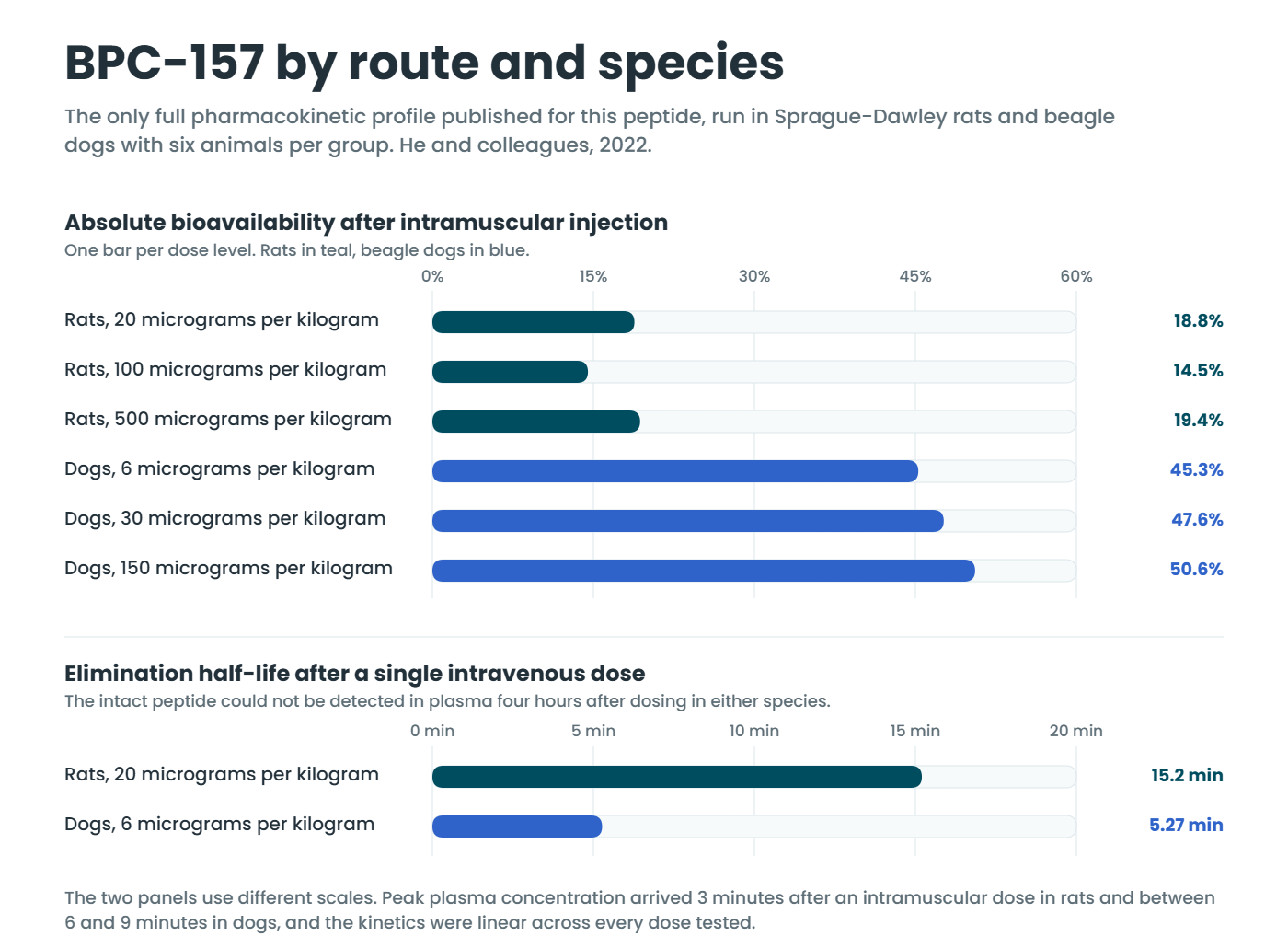
What has been characterized is what happens when the peptide goes in by needle. He and colleagues ran the first full pharmacokinetic profile, in Sprague-Dawley rats and beagle dogs with six animals per group, across single intravenous dosing, single intramuscular dosing at three escalating levels, and seven days of repeated intramuscular dosing. After a single intravenous dose the elimination half-life was 15.2 minutes in rats and 5.27 minutes in dogs, the intact peptide could not be detected at all by four hours, and the kinetics stayed linear at every dose in both species. After an intramuscular injection, rats reached peak plasma concentration at 3 minutes. Absolute bioavailability by that route was 14 to 19 percent in rats and 45 to 51 percent in beagle dogs. Excretion ran through urine and bile, and a tritium-labeled version showed the peptide being broken rapidly into small fragments and then into single amino acids that join ordinary amino acid metabolism.
Sit with that species gap for a second, because it is the most transferable lesson in the whole dataset. Same molecule, same route, same study, and the fraction reaching circulation differed roughly threefold between rats and dogs. Route numbers are a property of the animal as much as the drug. Anyone quoting a nasal percentage for a peptide should be asked which species it came from.
The only human pharmacokinetic data the review could point to is a two-subject pilot in which intravenous infusions were given on consecutive days. The half-life was again under half an hour, plasma concentrations returned to baseline within 24 hours, and clearance was primarily renal. Two people is two people, but it points the same direction as the animal work.
Which brings us to the one experiment that ever put BPC 157 and the nose in the same room. Kalogjera and colleagues induced rhinitis in Wistar rats by applying capsaicin to the nostrils, then scored the nasal mucosa for mast cell infiltration, degranulation and inflammatory cell infiltration at 1, 3 and 12 hours. BPC 157 pretreatment significantly prevented mast cell infiltration at 1 hour, and polymorphonuclear leukocyte infiltration was significantly reduced in the animals given 10 micrograms per kilogram, with a dose-dependent effect for that measure at 12 hours.
Read the methods, though. The capsaicin went up the nose. The peptide went in by intraperitoneal injection. The nasal mucosa was the tissue being protected, not the way in.
A Surface, Not a Doorway
Everything above treats the nose as a route to somewhere else. There is a second question hiding underneath, and it has better evidence behind it: what a peptide does to the tissue it is sitting on.
Lazić and colleagues debrided the corneal epithelium in 48 rats and then treated the eyes with drops, either distilled water or BPC 157 at 2 picograms, 2 nanograms or 2 micrograms per milliliter, two drops per eye starting immediately after the injury and repeated every eight hours out to 40 hours. The microgram and nanogram regimens markedly accelerated recovery. Those lesions had closed by 40 and 48 hours respectively, while the control lesions were still there at 48 hours, and the authors reported the effect as dose dependent. The two higher concentrations were the ones that carried it.
Skin tells a similar story. Sikiric and colleagues, in 2003, applied a thin layer of BPC-157 cream to deep partial-thickness burns in mice and reported improved healing on both microscopy and tensiometry, including in animals whose healing had been impaired by a corticosteroid. Huang and colleagues, in 2015, used a topical preparation on an alkali burn in rats and found faster wound closure, with better granulation tissue formation, reepithelialization, dermal remodeling and collagen deposition at day 18, alongside raised vascular endothelial growth factor expression in the wounded tissue. In cultured human endothelial cells the same work showed increased proliferation, migration and tube formation, with signaling running through ERK1/2 and the downstream factors c-Fos, c-Jun and Egr-1.
Angiogenesis runs through all of it. Sikiric and colleagues, in their 2011 review, describe strong angiogenic potential alongside stability in human gastric juice and effects on the nitric oxide system.
There is also a reason the central nervous system keeps coming up. Tohyama and colleagues measured regional serotonin synthesis rates in the rat brain using autoradiography after dosing with 10 micrograms per kilogram, given intraperitoneally as a single dose and subcutaneously over seven days. Synthesis rates shifted in specific regions in both experiments, up in some and down in others. The authors were careful to say that their data cannot establish the mechanism behind it. What the result does establish is that a peptide given outside the brain changes something inside it, which is precisely the observation that makes a nose-to-brain route worth someone’s time.
So the two questions genuinely are separate. How much of a nasal dose reaches the bloodstream is a delivery problem with four decades of measurements behind it, and for a molecule of this size the published range is narrow and low unless the formulation does something clever. Whether a peptide sitting on the nasal epithelium does anything to that epithelium is a different question, and the cornea and burn studies are the closest existing analogy, because they tested exactly that: a peptide placed on an injured surface, at concentrations that mattered.
Neither of those questions has been answered for BPC-157 in the nose. The delivery science tells you what to expect and what to measure. For the related reconstitution math, we have worked through what water volume actually changes, and the companion piece on TB-500 nasal spray runs the same analysis on a much larger molecule. If you are weighing the two peptides against each other, our side-by-side comparison covers that ground, and the broader evidence on repair sits in our write-up on tendon and tissue repair.
Droplet fate simulator
Set the spray, release the droplets, and watch where they stop. This is a teaching model, not a measurement: the direction each control pushes the result follows the published work above, but the counts are the model's own.
Droplet size
Plume angle
Head position
Pick a combination and release the droplets.
Zones are drawn schematically and the droplets follow straight paths, which a real nasal airway does not. What the model keeps from the literature is the ranking: coarse droplets stop early, a wide plume spreads across the front, a narrow plume aimed higher is the only setting that puts much anywhere near the roof, and the finest droplets are the ones most likely to carry past the turbinates.
Doses Used in the Research
These are the figures the studies above actually used. They are trial and animal doses from published experiments, not a protocol.
- 10 micrograms per kilogram and 10 nanograms per kilogram of BPC 157, intraperitoneally, as pretreatment before intranasal capsaicin in rats. Kalogjera and colleagues, 1997.
- 2 picograms, 2 nanograms and 2 micrograms per milliliter of BPC 157 as eye drops, two drops per eye every eight hours out to 40 hours, in rats. Lazić and colleagues, 2005.
- 10 micrograms per kilogram of BPC157, intraperitoneally as a single dose and subcutaneously daily for seven days, in rats. Tohyama and colleagues, 2004.
- 20, 100 and 500 micrograms per kilogram intramuscularly in rats, and 6, 30 and 150 micrograms per kilogram intramuscularly in beagle dogs, single and repeated. He and colleagues, 2022.
- 26 international units of oxytocin intranasally in healthy men. Gossen and colleagues, 2012.
- 24 international units of oxytocin intranasally, with paired blood and cerebrospinal fluid sampling. Striepens and colleagues, 2013.
- A 50 microliter dose of a 3 milligram per milliliter enkephalin analog solution, applied nasally in rats. Hussain and colleagues, 1995.
Frequently Asked Questions
Has anyone studied BPC-157 given as a nasal spray?
No. Mateescu and colleagues searched the literature to April 2026 and reported that no preclinical or clinical data exist for intranasal BPC-157. The one study linking the peptide to the nose, by Kalogjera and colleagues, delivered it by intraperitoneal injection and applied capsaicin to the nostrils.
How much of a nasal dose would be expected to reach the bloodstream?
For molecules above 1000 daltons, Huang and Donovan reported in 1998 that nasal bioavailability generally runs between 0.5 and 5 percent and can be predicted from molecular weight, and Ozsoy and colleagues put peptides and proteins normally below 1 percent. Johansen and colleagues are the counterexample, reaching roughly 20 to 50 percent in rats with peptides smaller than this one.
Does spraying something up the nose get it to the brain?
A pathway exists, from the posterior olfactory neuroepithelium, but reaching it is the hard part. Xi and colleagues measured less than 4.6 percent of nasal spray droplets landing in the olfactory region, and Striepens and colleagues found that oxytocin levels in cerebrospinal fluid and plasma rose on completely different schedules and did not correlate with one another.
How long does a nasal dose stay where it lands?
Dahl and Mygind put the working figure at 30 minutes before mucociliary transport clears the drug off the absorptive membrane. Soane and colleagues showed the vehicle can stretch that, from a 15 minute clearance half-time for a plain solution to 115 minutes for chitosan microspheres in sheep.
Why does the nose break peptides down if it skips the liver?
Because the lining carries its own enzymes. Sarkar described this as a pseudo-first-pass effect, and Ohkubo and colleagues measured aminopeptidase activity in human nasal mucosa at 630 picomoles per minute per milligram of protein in the membrane fraction, localized to the epithelial and gland cells.
Does a spray work better than drops?
In the one head-to-head human comparison here, yes. Harris and colleagues found that desmopressin sprays deposited anteriorly and cleared slowly, while drops landed posteriorly, cleared fast and were partly swallowed, and the spray gave a two to threefold higher relative bioavailability.
Could a nasal spray still do something locally?
That is a separate question from absorption, and it is the one with the closest supporting evidence. BPC 157 applied directly to an injured cornea in rats accelerated healing in a dose-dependent way, and topical preparations improved burn healing in mice and rats, which is at least the right kind of experiment for a peptide sitting on a mucosal surface.
References
- Xi J, Yuan JE, Zhang Y, Nevorski D, Wang Z, Zhou Y. Visualization and quantification of nasal and olfactory deposition in a sectional adult nasal airway cast. Pharmaceutical Research. 2016;33(6):1527-1541. doi:10.1007/s11095-016-1896-2
- Chen JZ, Finlay WH, Martin A. In vitro regional deposition of nasal sprays in an idealized nasal inlet: comparison with in vivo gamma scintigraphy. Pharmaceutical Research. 2022;39(11):3021-3028. doi:10.1007/s11095-022-03388-7
- Schroeter JD, Kimbell JS, Asgharian B. Analysis of particle deposition in the turbinate and olfactory regions using a human nasal computational fluid dynamics model. Journal of Aerosol Medicine. 2006;19(3):301-313. doi:10.1089/jam.2006.19.301
- Si XA, Sami M, Xi J. Liquid film translocation significantly enhances nasal spray delivery to olfactory region: a numerical simulation study. Pharmaceutics. 2021;13(6):903. doi:10.3390/pharmaceutics13060903
- Sicard RM, Frank-Ito DO. Parameter characteristics in intranasal drug delivery: a key to targeting medications to the olfactory airspace. Clinical Biomechanics. 2024;114:106231. doi:10.1016/j.clinbiomech.2024.106231
- Dahl R, Mygind N. Anatomy, physiology and function of the nasal cavities in health and disease. Advanced Drug Delivery Reviews. 1998;29(1-2):3-12. doi:10.1016/s0169-409x(97)00058-6
- Armengot M, Basterra J, Garín L. Normal values of nasal mucociliary clearance: comparison of various techniques and substances. Acta Otorrinolaringologica Espanola. 1990;41(5):333-336. PubMed:2076314
- Soane RJ, Hinchcliffe M, Davis SS, Illum L. Clearance characteristics of chitosan based formulations in the sheep nasal cavity. International Journal of Pharmaceutics. 2001;217(1-2):183-191. doi:10.1016/s0378-5173(01)00602-0
- Harris AS, Nilsson IM, Wagner ZG, Alkner U. Intranasal administration of peptides: nasal deposition, biological response, and absorption of desmopressin. Journal of Pharmaceutical Sciences. 1986;75(11):1085-1088. doi:10.1002/jps.2600751113
- Sarkar MA. Drug metabolism in the nasal mucosa. Pharmaceutical Research. 1992;9(1):1-9. doi:10.1023/a:1018911206646
- Ohkubo K, Baraniuk JN, Hohman R, Merida M, Hersh LB, Kaliner MA. Aminopeptidase activity in human nasal mucosa. Journal of Allergy and Clinical Immunology. 1998;102(5):741-750. doi:10.1016/s0091-6749(98)70013-2
- Hussain MA, Seetharam R, Wilk RR, Aungst BJ, Kettner CA. Nasal mucosal metabolism and absorption of pentapeptide enkephalin analogs having varying N-terminal amino acids. Journal of Pharmaceutical Sciences. 1995;84(1):62-64. doi:10.1002/jps.2600840115
- Agu RU, Dang HV, Jorissen M, Willems T, Kinget R, Verbeke N. Nasal absorption enhancement strategies for therapeutic peptides: an in vitro study using cultured human nasal epithelium. International Journal of Pharmaceutics. 2002;237(1-2):179-191. doi:10.1016/s0378-5173(02)00039-x
- Huang Y, Donovan MD. Large molecule and particulate uptake in the nasal cavity: the effect of size on nasal absorption. Advanced Drug Delivery Reviews. 1998;29(1-2):147-155. doi:10.1016/s0169-409x(97)00066-5
- Ozsoy Y, Gungor S, Cevher E. Nasal delivery of high molecular weight drugs. Molecules. 2009;14(9):3754-3779. doi:10.3390/molecules14093754
- Johansen PB, Hansen KT, Andersen JV, Johansen NL. Pharmacokinetic evaluation of ipamorelin and other peptidyl growth hormone secretagogues with emphasis on nasal absorption. Xenobiotica. 1998;28(11):1083-1092. doi:10.1080/004982598238976
- Gossen A, Hahn A, Westphal L, Prinz S, Schultz RT, Gründer G, Spreckelmeyer KN. Oxytocin plasma concentrations after single intranasal oxytocin administration: a study in healthy men. Neuropeptides. 2012;46(5):211-215. doi:10.1016/j.npep.2012.07.001
- Striepens N, Kendrick KM, Hanking V, Landgraf R, Wüllner U, Maier W, Hurlemann R. Elevated cerebrospinal fluid and blood concentrations of oxytocin following its intranasal administration in humans. Scientific Reports. 2013;3:3440. doi:10.1038/srep03440
- Veronesi MC, Kubek DJ, Kubek MJ. Intranasal delivery of neuropeptides. Methods in Molecular Biology. 2011;789:303-312. doi:10.1007/978-1-61779-310-3_20
- Meredith ME, Salameh TS, Banks WA. Intranasal delivery of proteins and peptides in the treatment of neurodegenerative diseases. The AAPS Journal. 2015;17(4):780-787. doi:10.1208/s12248-015-9719-7
- Mateescu DM, Gavrilescu DM, Constantinescu FE, Oancea C, Ilie AC, Folescu R, Popa MD, Iurciuc S, Muresan CO, Enache A. BPC-157 as an investigational peptide therapeutic: biopharmaceutical challenges, formulation strategies, and translational development barriers. Pharmaceutics. 2026;18(5):625. doi:10.3390/pharmaceutics18050625
- He L, Feng D, Guo H, Zhou Y, Li Z, Zhang K, Zhang W, Wang S, Wang Z, Hao Q, Zhang C, Gao Y, Gu J, Zhang Y, Li W, Li M. Pharmacokinetics, distribution, metabolism, and excretion of body-protective compound 157, a potential drug for treating various wounds, in rats and dogs. Frontiers in Pharmacology. 2022;13:1026182. doi:10.3389/fphar.2022.1026182
- Kalogjera L, Ries M, Baudoin T, Ferencic Z, Trotic R, Pegan B. Dose-dependent protective effect of BPC 157 on capsaicin-induced rhinitis in rats. European Archives of Oto-Rhino-Laryngology. 1997;254(Suppl 1):S9-S11. doi:10.1007/BF02439711
- Lazić R, Gabrić N, Dekaris I, Bosnar D, Boban-Blagaić A, Sikirić P. Gastric pentadecapeptide BPC 157 promotes corneal epithelial defects healing in rats. Collegium Antropologicum. 2005;29(1):321-325. PubMed:16117343
- Sikiric P, Seiwerth S, Mise S, Staresinic M, Bedekovic V, Zarkovic N, Borovic S, Gjurasin M, Boban-Blagaic A, Batelja L, Rucman R, Anic T. Corticosteroid-impairment of healing and gastric pentadecapeptide BPC-157 creams in burned mice. Burns. 2003;29(4):323-334. doi:10.1016/s0305-4179(03)00004-4
- Huang T, Zhang K, Sun L, Xue X, Zhang C, Shu Z, Mu N, Gu J, Zhang W, Wang Y, Zhang Y, Zhang W. Body protective compound-157 enhances alkali-burn wound healing in vivo and promotes proliferation, migration, and angiogenesis in vitro. Drug Design, Development and Therapy. 2015;9:2485-2499. doi:10.2147/DDDT.S82030
- Sikiric P, Seiwerth S, Rucman R, Turkovic B, Stancic Rokotov D, Brcic L, Sever M, Klicek R, Radic B, Drmic D, Ilic S, Kolenc D, Vrcic H, Sebecic B. Stable gastric pentadecapeptide BPC 157: novel therapy in gastrointestinal tract. Current Pharmaceutical Design. 2011;17(16):1612-1632. doi:10.2174/138161211796196954
- Tohyama Y, Sikirić P, Diksic M. Effects of pentadecapeptide BPC157 on regional serotonin synthesis in the rat brain: alpha-methyl-L-tryptophan autoradiographic measurements. Life Sciences. 2004;76(3):345-357. doi:10.1016/j.lfs.2004.08.010
Stay sharp,
Joe Mars
The Peptide Report
P.S. If you want to argue about delivery routes with people who actually read the methods section, that conversation lives over at the Peptides & Biohacking Hub.