Mice on 5-Amino-1MQ have had their blood chemistry run, their livers examined under a microscope, their white cells counted and their blood levels tracked for up to 48 hours. Rats have been through the absorption tests too. That animal data is the whole safety record so far.
Five mouse studies have dosed it for up to eight weeks, and the three that checked tolerability head-on reported no observable adverse effects.
The data still holds three things worth knowing: how little of an oral dose got absorbed in mice, a second enzyme it blocks, and the job its target does in the liver.
What 5-Amino-1MQ Is
5-Amino-1MQ (5-amino-1-methylquinolinium) is a small molecule weighing about 159 daltons, designed by researchers at the University of Texas Medical Branch in Galveston. For scale, BPC-157 comes in around 1,419.
It turns up on lists of the best peptides for weight loss because it’s sold alongside them. Chemically it’s a compact, drug-like ring compound with one target: an enzyme called nicotinamide N-methyltransferase, or NNMT.
What NNMT Does
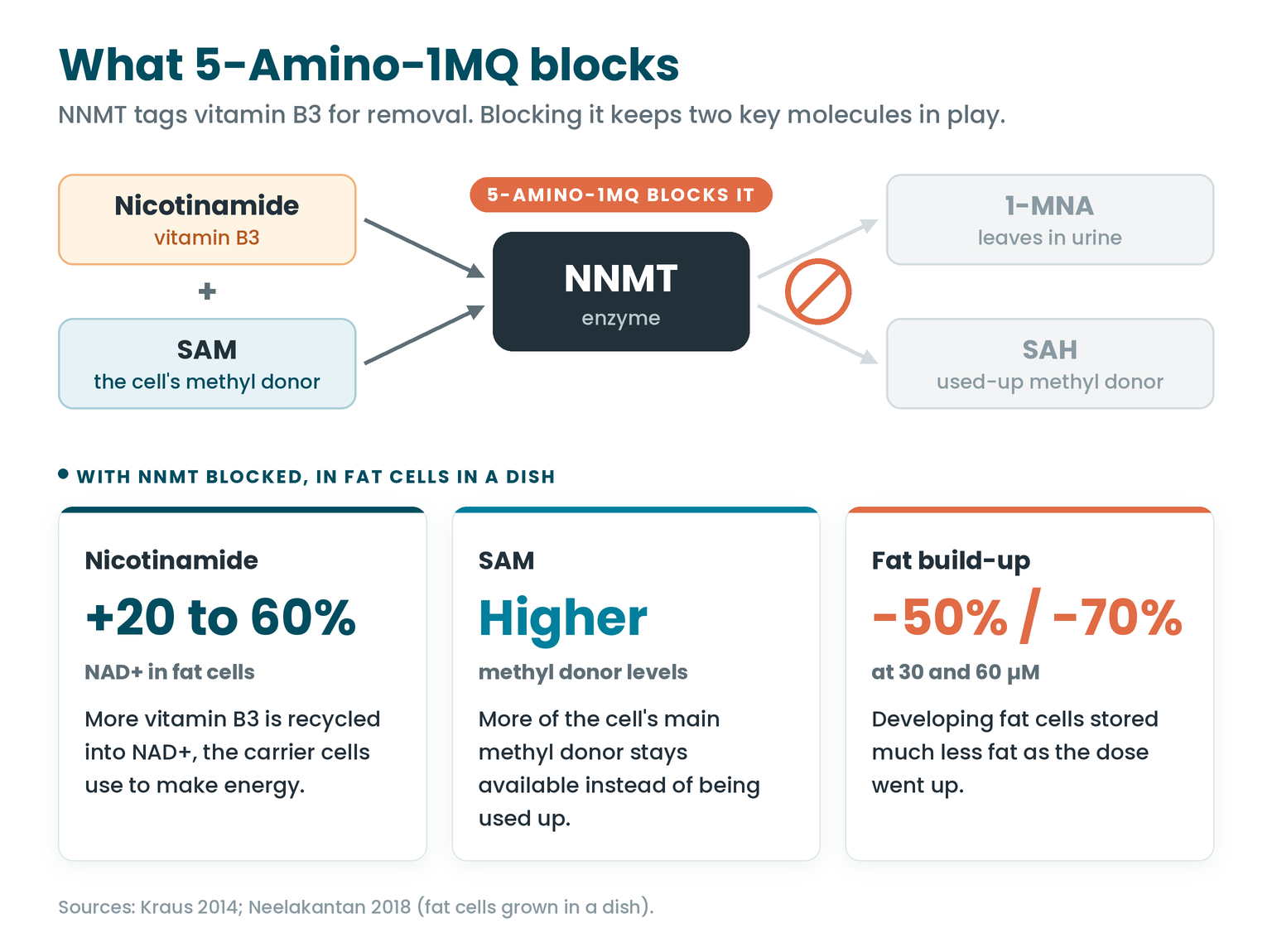
NNMT takes nicotinamide, a form of vitamin B3, and attaches a methyl group borrowed from SAM, your cells’ main methyl donor. The product, 1-methylnicotinamide (1-MNA), mostly leaves in urine. For decades NNMT was filed under vitamin B3 clean-up.
That changed in 2014, when a Nature paper found NNMT running high in the fat and liver of obese and diabetic mice. Knocking it down in those tissues protected mice from diet-induced obesity by raising the energy their fat cells burned.
What Blocking It Does
In fat cells grown in a dish, 5-Amino-1MQ cut 1-MNA, lifted NAD+ by roughly 20 to 60% and raised SAM. Fat build-up inside developing fat cells dropped by half at 30 µM and by 70% at 60 µM.
It was also picky. It left two related methylating enzymes (DNMT1 and PRMT3) alone, barely touched COMT, and didn’t block the enzymes that turn nicotinamide back into NAD+.
Side Effects Seen in the Mouse Studies
Every study below gave 5-Amino-1MQ as an injection under the skin, to obese mice or old ones, for anywhere from 11 days to 8 weeks. Here’s what moved, system by system.
Appetite and Body Weight
Appetite held steady. In the first obese-mouse study, treated mice ate 26.2 g of food over 11 days against 28.1 g for untreated mice, a gap the statistics counted as no difference. They still lost 5.1% of their body weight while the untreated group gained 1.4%, and their belly fat pads shrank by about 35%.
A 2024 study ran a month of daily injections. The higher dose held weight gain to 0.9 g against 5.4 g for untreated mice, and fat gain to 1.3 g against 4.7 g, with lean mass and food intake unchanged.
Paired with a switch to a lighter diet, treated mice shed weight and fat faster than diet alone and finished with the body composition of mice that had never been fat. Their lean-mass-to-body-weight ratio rose 6.4%. For how this compares with the human fat-loss data on other compounds, see Fat Loss and Body Composition: Reading the Trial Data.
Liver and Cholesterol
The liver readings all moved toward a healthier liver. In the month-long study, untreated obese mice ended with enlarged livers averaging 2.1 g; the higher dose brought that down to 1.4 g. Small fat droplets inside liver cells fell 73%, inflammation and cell swelling scores dropped, and the liver enzymes ALT and AST came down.
In the diet study, liver fat came in more than 45% lower than with the diet switch alone. Total cholesterol in the first study ended about 30% lower than in untreated obese mice, close to the level of mice on normal chow.
Blood Sugar and Insulin
Untreated obese mice saw their insulin climb 112% over the month. On the higher dose it fell 9%. Glucose tolerance improved after a sugar load, while everyday fed blood sugar stayed where it was.
White Blood Cells
One reading stands apart from the metabolic ones. At the higher dose, total white blood cells fell, driven by lymphocytes (down 31%) and monocytes (down 50%).
Obesity pushes white cell counts up, and the authors read the drop as inflammation settling, which fits the calmer livers they saw. It’s still the number I’d keep an eye on in a blood test.
Gut Bacteria
In the diet study, treated mice developed their own gut bacteria pattern, with more Lactobacillus and less Erysipelatoclostridium than mice on the diet alone. Both genera are tied to body weight and metabolism.
Full Blood Chemistry
Two studies ran complete chemistry panels. In 24-month-old mice given 10 mg/kg twice a day, enzymes from the liver, pancreas, gut, kidneys and endocrine system, plus lipids, proteins and electrolytes, showed no significant differences from untreated mice. After about seven weeks of injections in the diet study, serum chemistry again matched the controls.
The very first study also ran a small dose-escalation in two obese mice, from 10 up to 150 mg/kg a day. At 60 mg/kg a day, it was well tolerated with no observable adverse effects.
Muscle and Strength
In old mice, the effects showed up as strength. After a muscle injury, two weeks of treatment produced regenerating muscle fibers about 1.8 times larger and roughly 67% more torque from the injured muscle.
In a separate study, eight weeks of daily injections gave sedentary 22-month-old mice about 40% more grip strength. Intense weighted wheel running managed 20%, and doing both added up to about 60%.
5-Amino-1MQ Side Effect Explorer
Pick a body system to see every reading the studies took on it, what moved, and the matching blood test.
All readings are from mice given 5-Amino-1MQ by injection under the skin, except where a row says otherwise. Your last pick is remembered in this browser.
Three Things Worth Watching
It Also Blocks MAO-A
When the 2024 team screened 5-Amino-1MQ against a broad panel of human targets, it also blocked MAO-A (monoamine oxidase A). That’s the enzyme that breaks down serotonin, noradrenaline and dietary tyramine, and the one MAOI antidepressants switch off. MAOIs carry warnings about other serotonin-raising drugs and tyramine-rich foods like aged cheese and cured meats.
The paper gives no potency figure, so the size of this effect at the doses people use is an open question. The authors suggest it may even contribute to the better glucose handling.
NNMT’s Product Has Jobs of Its Own
1-MNA does more than carry vitamin B3 out of the body. In rats it acted as an anti-clotting signal, cutting platelet-driven clot formation through the COX-2/prostacyclin pathway.
In the liver, NNMT helps keep SIRT1 protein stable. When researchers switched NNMT off only in mouse livers, SIRT1 protein fell and both blood and liver cholesterol went up; adding 1-MNA to a high-fat diet lowered them. In 41 people, livers with more NNMT went with lower total and LDL cholesterol.
The inhibitor studies have pointed the other way so far, with cholesterol and liver fat falling. In the month-long study, 5-Amino-1MQ reached the liver at modest levels and cut liver 1-MNA by 39%, a partial block rather than a full switch-off.
Methyl Balance
NNMT burns through SAM, and blocking it raised SAM in fat cells, which is part of how it works. In liver cells, knocking NNMT down only shifted methyl balance when a second methylating enzyme, GNMT, was knocked down too. Mice born without the NNMT gene showed no obvious problems on a standard diet.
Capsules vs Injections: How Much Gets In
Most 5-Amino-1MQ is sold as capsules, while the mouse studies injected it. The absorption data splits sharply by species.
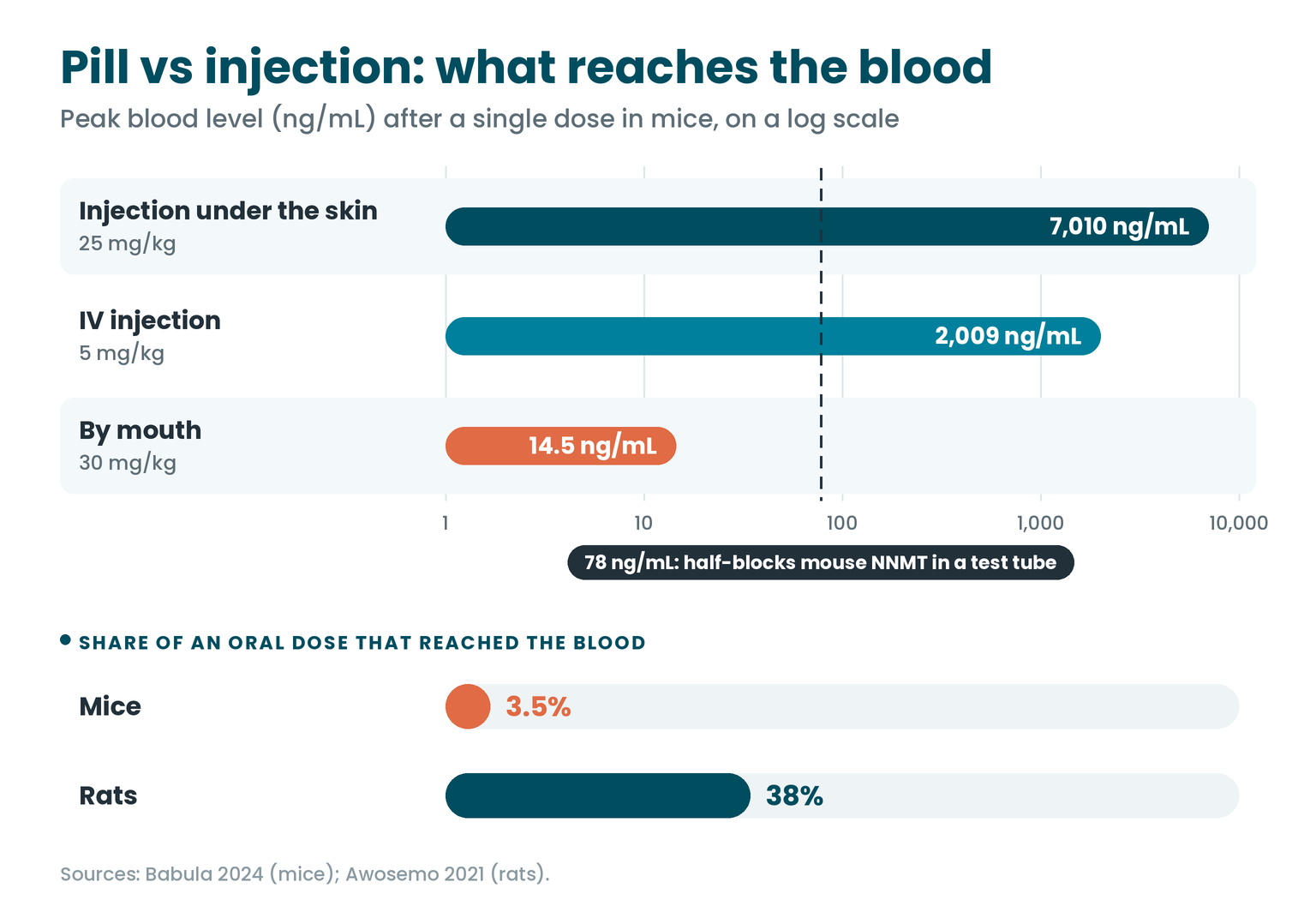
In mice, a 30 mg/kg oral dose peaked at just 14.5 ng/mL after four hours, an oral bioavailability of 3.5%. That peak sat below the 78 ng/mL needed to block half of mouse NNMT in a test tube. A 25 mg/kg injection under the skin peaked at 7,010 ng/mL within 15 minutes, nearly 500 times higher.
The likely reason is the liver. Mouse liver cells cleared the compound with a half-life under seven minutes, so much of an oral dose gets broken down on its first pass.
Rats absorbed it far better, with about 38% of an oral dose reaching the blood. In the blood, its half-life ran about 4 hours after IV dosing and 7 hours after oral dosing in rats, and about 6 to 15 hours in mice depending on the route. Daily injections didn’t make it build up.
Doses Used in the Research
| Study | Mice | Dose under the skin | Length |
|---|---|---|---|
| Neelakantan 2018 | Obese | 20 mg/kg, 3 times a day | 11 days |
| Neelakantan 2019 | 24 months old | 5 or 10 mg/kg, twice a day | 2 to 4 weeks |
| Sampson 2021 | Obese, on a lighter diet | 40 mg/kg per dose | About 7 weeks |
| Babula 2024 | Obese | 10 or 32 mg/kg, once a day | 30 days |
| Dimet-Wiley 2024 | 22 months old, female | 10 mg/kg, once a day | 8 weeks |
Our 5-Amino-1MQ dosing guide covers the capsule side.
Who Should Be Careful
Going by what the studies turned up, a few groups have extra reason for caution:
- Anyone on antidepressants or other drugs that raise serotonin, because of the MAO-A finding.
- Anyone with liver disease or on cholesterol medication, since NNMT and 1-MNA help run cholesterol handling in the liver.
- Anyone whose white cell count already runs low, given the drop in lymphocytes and monocytes.
If you’re on any prescription medication, run it past your doctor first. Bloodwork before starting and a few weeks in will tell you more than any article: a lipid panel, ALT and AST, fasting insulin and glucose, and a complete blood count. Those are the same markers that moved in the mice.
FAQ
Is 5-Amino-1MQ a peptide?
5-Amino-1MQ is a small molecule, a methylquinolinium of about 159 daltons, that works by blocking the NNMT enzyme. It’s grouped with peptides because the same vendors sell it.
Does 5-Amino-1MQ suppress appetite?
Obese mice ate the same amount whether treated or not. Their weight loss came from changes in metabolism.
Is 5-Amino-1MQ hard on the liver?
In obese mice it lowered liver weight, liver fat, ALT and AST. Because liver NNMT also helps manage cholesterol, liver enzymes and a lipid panel are the tests to watch.
Can 5-Amino-1MQ be taken with antidepressants?
Screening showed it also blocks MAO-A, the target of MAOI antidepressants. Anyone on an antidepressant or another serotonin-acting drug should clear it with their doctor first.
How long does 5-Amino-1MQ stay in the body?
Its half-life ranged from about 4 to 15 hours across rat and mouse studies, depending on species and route. Daily dosing didn’t lead to build-up.
Does 5-Amino-1MQ cause muscle loss?
Lean mass held steady in obese mice, and old mice gained grip strength and larger muscle fibers.
Does 5-Amino-1MQ affect cancer cells?
NNMT runs high in many tumors. In lab dishes, 5-Amino-1MQ slowed cervical, bone and Merkel cell cancer lines, and in one study it left a non-cancer kidney cell line unaffected.
References
- Kraus D, et al. Nicotinamide N-methyltransferase knockdown protects against diet-induced obesity. Nature. 2014;508(7495):258-262. DOI
- Pissios P. Nicotinamide N-methyltransferase: more than a vitamin B3 clearance enzyme. Trends Endocrinol Metab. 2017;28(5):340-353. DOI
- Neelakantan H, et al. Structure-activity relationship for small molecule inhibitors of nicotinamide N-methyltransferase. J Med Chem. 2017;60(12):5015-5028. DOI
- Neelakantan H, et al. Selective and membrane-permeable small molecule inhibitors of nicotinamide N-methyltransferase reverse high fat diet-induced obesity in mice. Biochem Pharmacol. 2018;147:141-152. DOI
- Neelakantan H, et al. Small molecule nicotinamide N-methyltransferase inhibitor activates senescent muscle stem cells and improves regenerative capacity of aged skeletal muscle. Biochem Pharmacol. 2019;163:481-492. DOI
- Sampson CM, et al. Combined nicotinamide N-methyltransferase inhibition and reduced-calorie diet normalizes body composition and enhances metabolic benefits in obese mice. Sci Rep. 2021;11(1):5637. DOI
- Dimet-Wiley A, et al. Reduced calorie diet combined with NNMT inhibition establishes a distinct microbiome in DIO mice. Sci Rep. 2022;12(1):484. DOI
- Babula JJ, et al. Nicotinamide N-methyltransferase inhibition mitigates obesity-related metabolic dysfunction. Diabetes Obes Metab. 2024;26(11):5272-5282. DOI
- Dimet-Wiley AL, et al. Nicotinamide N-methyltransferase inhibition mimics and boosts exercise-mediated improvements in muscle function in aged mice. Sci Rep. 2024;14(1):15554. DOI
- Awosemo O, et al. Development and validation of LC-MS/MS assay for 5-amino-1-methyl quinolinium in rat plasma: application to pharmacokinetic and oral bioavailability studies. J Pharm Biomed Anal. 2021;204:114255. DOI
- Hong S, et al. Nicotinamide N-methyltransferase regulates hepatic nutrient metabolism through Sirt1 protein stabilization. Nat Med. 2015;21(8):887-894. DOI
- Chlopicki S, et al. 1-Methylnicotinamide (MNA), a primary metabolite of nicotinamide, exerts anti-thrombotic activity mediated by a cyclooxygenase-2/prostacyclin pathway. Br J Pharmacol. 2007;152(2):230-239. DOI
- Hong S, Zhai B, Pissios P. Nicotinamide N-methyltransferase interacts with enzymes of the methionine cycle and regulates methyl donor metabolism. Biochemistry. 2018;57(40):5775-5779. DOI
- Brachs S, et al. Genetic nicotinamide N-methyltransferase (Nnmt) deficiency in male mice improves insulin sensitivity in diet-induced obesity but does not affect glucose tolerance. Diabetes. 2019;68(3):527-542. DOI
- Akar S, et al. Small molecule inhibitor of nicotinamide N-methyltransferase shows anti-proliferative activity in HeLa cells. J Obstet Gynaecol. 2021;41(8):1240-1245. DOI
- Pompei V, et al. Small molecule inhibitors of nicotinamide N-methyltransferase enzyme for the treatment of osteosarcoma and Merkel cell carcinoma: potential for the development of a targeted therapeutic strategy. Biomolecules. 2025;15(11):1553. DOI
Stay sharp,
Joe Mars
The Peptide Report
P.S. Got bloodwork back on 5-Amino-1MQ, or a question this didn’t cover? Post it in the Peptides and Biohacking Hub on Skool, our free community, and compare notes with people running the same compounds. Join here.