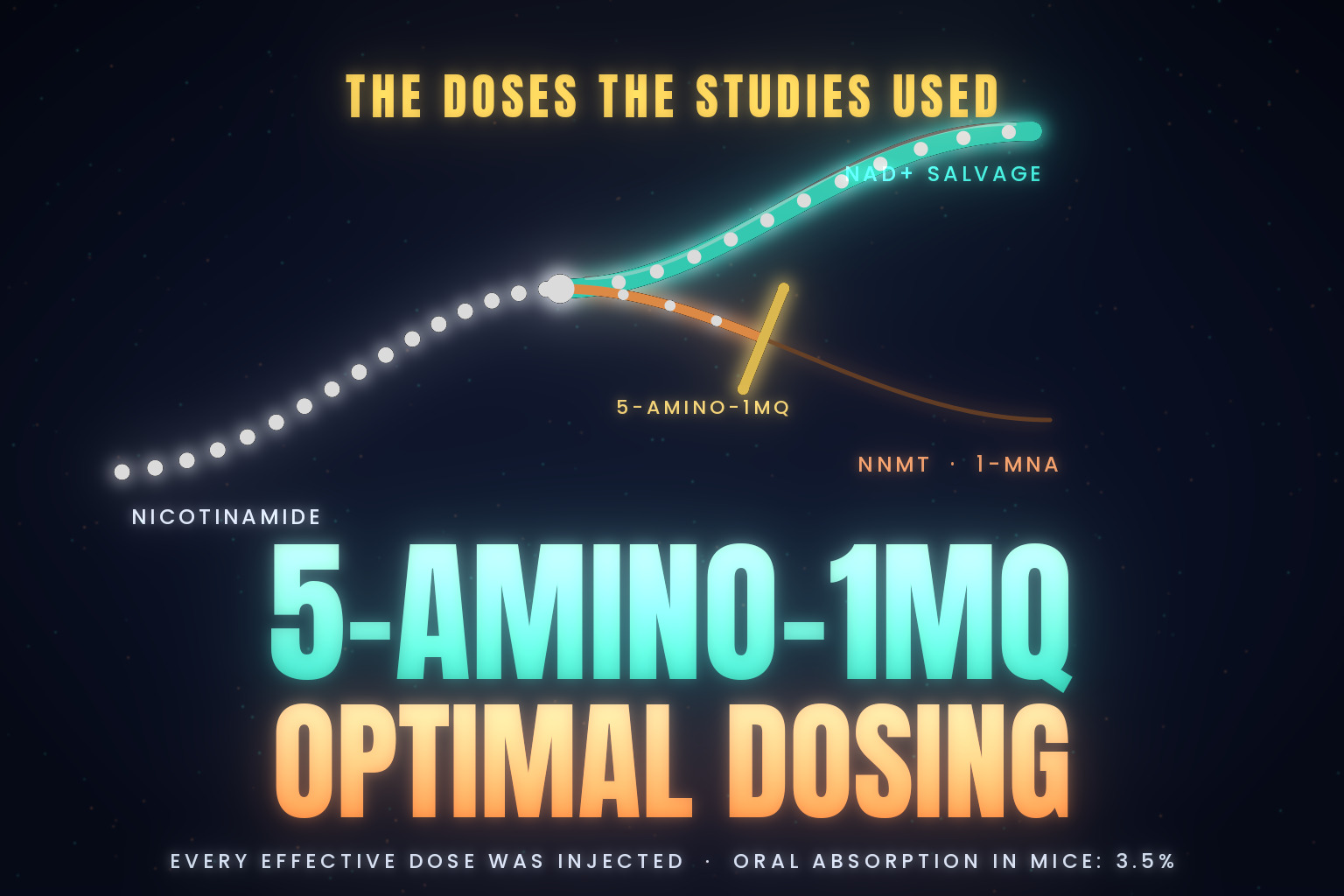
Here is the number that belongs at the top of any page about 5-amino-1MQ dosing: 3.5 percent.
That is how much of an oral dose reached the bloodstream when the group that invented this molecule finally measured it in mice, in 2024. Every result you have read about, the weight loss, the smaller fat pads, the stronger old muscles, came from injections. Not one of the studies fed the compound to an animal and got an effect.
So “optimal dosing” has two honest answers. One is the list of doses that worked in the lab, which I will give you in full. The other is what those doses say about the oral milligram numbers floating around the internet, which is: nothing, because nobody tested them.
What 5-amino-1MQ is
It is not a peptide. 5-amino-1-methylquinolinium is a small, flat, positively charged molecule, a quinoline ring with a methyl group on the nitrogen and an amine hanging off position five. The name gets shortened to 5-amino-1MQ, 5A1MQ, 5-MQ or 5-AMQ depending on the paper.
It came out of a screening program in Galveston, Texas. In 2017, Harshini Neelakantan, Stanley Watowich and their colleagues tested a series of N-methylated quinolinium, isoquinolinium, pyridinium and benzimidazolium analogues against one enzyme, nicotinamide N-methyltransferase, and found that the quinoliniums were the scaffold worth keeping. Their activities spanned more than a thousand-fold, the best of them inhibited the enzyme at around 1 micromolar, and computer docking into the enzyme’s nicotinamide pocket predicted the potency well. That paper, in the Journal of Medicinal Chemistry, is where the family came from.
The 2018 follow-up picked out the amino-substituted versions because they could get into cells. 5-amino-1MQ and 7-amino-1MQ crossed artificial membranes and Caco-2 cell layers by both passive and active transport with no detectable efflux, while the parent 1-methylquinolinium and the enzyme’s own product, 1-MNA, did not cross at all. A compound that cannot get inside a fat cell cannot block an enzyme that lives there, so permeability is the whole reason this particular analogue became the lead.
The enzyme it blocks, and why fat cells care
NNMT does one job. It takes nicotinamide, the vitamin B3 molecule your cells recycle back into NAD+, and sticks a methyl group on it. The methyl group comes from S-adenosylmethionine, SAM, the cell’s universal methyl donor. The product, 1-methylnicotinamide or 1-MNA, cannot be turned back into NAD+ and leaves the body in urine.
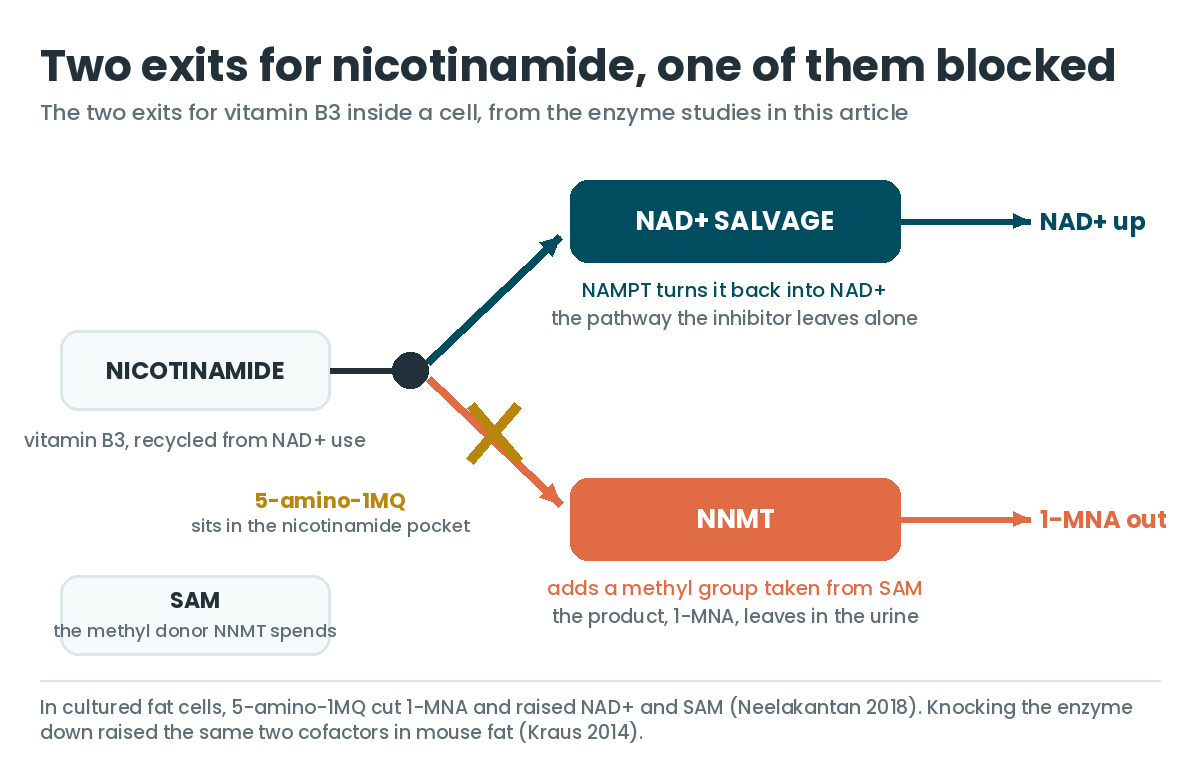
So every time NNMT fires, the cell loses one nicotinamide it could have salvaged and one methyl group it could have spent elsewhere. In a cell with a lot of NNMT, that drain adds up.
Fat cells in obesity have a lot of NNMT. The 2014 Nature paper by Daniel Kraus and colleagues found Nnmt was the single most strongly reciprocally regulated gene when they compared white fat from mice engineered to have too little or too much of the Glut4 glucose transporter. Expression was up in the fat and liver of obese and diabetic mice. When they knocked the gene down in those two tissues with antisense oligonucleotides, high-fat-fed mice were protected from obesity, and the protection came from burning more energy, not eating less. Inside the fat, SAM and NAD+ rose, histone methylation shifted, and the enzymes that drive polyamine flux switched on, which raised oxygen consumption in the adipocytes.
The human data line up with the mouse data. Aimo Kannt and colleagues measured NNMT in fat biopsies from 199 surgical patients and found expression roughly two-fold higher in both omental and subcutaneous fat in people with type 2 diabetes. Plasma 1-MNA tracked the fat-tissue enzyme level in those patients, and in insulin-resistant people it tracked how insulin-resistant they were. Exercise programs and bariatric surgery both lowered fat NNMT, and surgery lowered plasma 1-MNA. A separate study by Ming Liu’s group of 1,160 people in Dali, China found serum 1-MNA rising with body mass index and waist size and falling with HDL, with higher levels carrying two to six times the odds of being overweight and 1.6 to 1.9 times the odds of diabetes.
That is the case for the target. Now the caveats, because this enzyme is not a villain everywhere.
In the liver, where NNMT expression is highest, Shangyu Hong and colleagues found in 2015 that the product does useful work: 1-MNA stabilizes the SIRT1 protein, and feeding 1-MNA to mice on a high-fat diet lowered their blood and liver cholesterol and liver triglycerides. And in muscle, a Swedish study by Kristoffer Ström and colleagues of 15 men put through four days of severe calorie restriction plus exercise found NNMT was the most consistently switched-on gene in their muscle biopsies, circulating 1-MNA doubled, and in culture 1-MNA made fat cells release their stores. Plasma 1-MNA peaked around 18 hours into a fast and bottomed out about three hours after a meal. The enzyme’s product looks like a normal “we are short on fuel” signal, which is a strange thing to want to block in a healthy person. Annalisa Roberti’s 2021 review in Molecular Metabolism puts it plainly: NNMT acts physiologically or pathologically depending on where it is expressed.
Keep that tissue picture in mind, because it changes how you read the mouse dosing numbers. The doses that follow are what it took to get the compound into fat and muscle at useful levels for weeks at a time.
Every dose used in the research
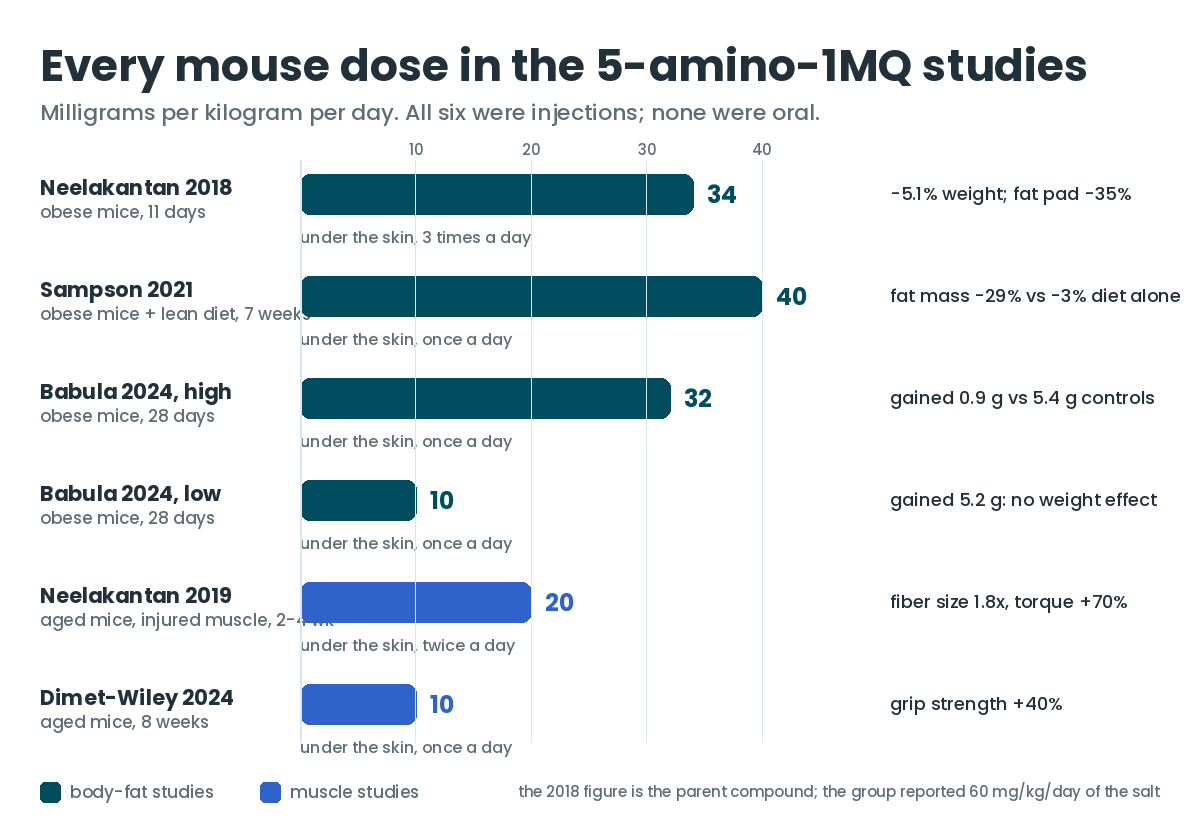
Six mouse experiments have dosed 5-amino-1MQ in living animals. All six injected it under the skin. Here they are, lowest to highest total daily dose.
Doses Used in the Research
- 10 mg/kg once daily, 28 days, obese mice (Babula 2024): no effect on weight gain. Mice gained 5.2 g, the same as controls.
- 10 mg/kg once daily, 8 weeks, 22-month-old mice (Dimet-Wiley 2024): grip strength about 40 percent above untreated sedentary mice, and 60 percent above when combined with a weighted-wheel exercise program.
- 5 or 10 mg/kg twice daily, 2 to 4 weeks, 24-month-old mice with an injured leg muscle (Neelakantan 2019): at the higher dose, regenerating fibers were 1.8 times the cross-sectional area of controls and peak torque was about 70 percent higher. The lower dose did not change fiber size.
- 32 mg/kg once daily, 28 days, obese mice (Babula 2024): weight gain limited to 0.9 g against 5.4 g in controls; fat mass gain 1.3 g against 4.7 g; fed-state insulin fell 9 percent while it rose 112 percent in controls.
- 20 mg/kg three times daily, 11 days, obese mice (Neelakantan 2018): about 34 mg/kg per day of the parent compound, or 60 mg/kg of the salt as weighed. Treated mice lost 2.0 g, about 5.1 percent of body weight, while controls gained 0.6 g; the epididymal fat pad was 35 percent smaller and total cholesterol about 30 percent lower.
- 40 mg/kg once daily, about 7 weeks, obese mice switched to a lean diet (Sampson 2021): 29.3 percent fat mass loss against 2.9 percent on the lean diet alone; body composition ended up indistinguishable from mice that had never been obese.
Two patterns jump out. First, 10 mg/kg a day was enough for muscle but did nothing for body weight; the fat results needed roughly three to four times that. Second, the obesity doses cluster between 32 and 40 mg/kg a day, which is where the Galveston group has settled across three separate experiments.
The 2018 dose was not pulled from the air. The paper describes an escalation study first, from 10 to 150 mg/kg a day in obese mice, with 60 mg/kg a day of the salt tolerated with no observable adverse effects. That pilot used two mice, which tells you how early-stage this field still is.
What the fat-loss studies looked like
The three obesity experiments are worth reading as experiments, not just as headline percentages, because the designs differ in ways that matter.
The 2018 study was a reversal design: 17-week-old male mice already fattened on 11 weeks of high-fat diet, kept on that diet, injected three times a day at about 9:30, 13:30 and 17:30 for 11 days. The compound produced progressive weight loss while food intake stayed the same. Adipocytes in the fat pad were more than 30 percent smaller by area. Triglycerides were not reported because the blood samples hemolyzed. It was 11 days and the weight change was two grams, which is real in a mouse but is also a short, small, first-pass study.
The 2024 study by JoAnne Babula and colleagues was a prevention design run by contract research organizations: 18-week-old obese males kept on the high-fat diet and injected once a day for 28 days, eight mice per group. The high dose did not make them lose weight; it stopped them gaining it. Lean mass and food intake were unchanged. The more interesting results were metabolic. Fed-state blood glucose did not move, but plasma insulin, which rose 112 percent over four weeks in controls as the mice slid toward insulin resistance, fell 9 percent in the high-dose group, and the difference held after adjusting for body weight and fat mass. Livers were 1.4 g in the high-dose group against 2.1 g in controls, with 73 percent less microvesicular steatosis, lower ALT and AST, and normalized ketone bodies.
The 2021 study combined the compound with a diet switch, which is the design closest to how anyone would actually use an anti-obesity drug. Twenty-two-week-old obese mice moved from a Western diet to a lean diet, then got either saline or 40 mg/kg a day for about seven weeks. The diet switch alone took off fat for three and a half weeks and then the mice regained it, finishing with a net fat loss of half a gram. The diet switch plus the compound took off 6.3 g of body weight and 29 percent of fat mass, and the ratio of lean mass to body weight rose 6.4 percent. The 2022 follow-up on the same animals found their gut microbiome had shifted too, with less Erysipelatoclostridium and more Lactobacillus than vehicle-treated mice on the same diet, though the authors are careful to call that a foundation for future work rather than a mechanism.
If you want a wider view of what fat-loss compounds have and have not shown in trials, our guide to reading fat-loss trial data covers the ones with human numbers.
The muscle studies
The second line of work is aging muscle, and it is arguably stronger than the fat work because the effect sizes are larger and two different designs point the same way.
In 2019 the Galveston group injured one tibialis anterior muscle in 24-month-old mice with barium chloride and dosed them twice a day for a week before and one or three weeks after. NNMT protein was about three-fold higher in aged muscle than in young muscle to begin with. Treatment raised the proportion of proliferating muscle stem cells by 60 percent at 5 mg/kg and 75 percent at 10 mg/kg, and at the higher dose the regenerating fibers were 1.8 times the size of those in saline-treated mice. Peak torque of the repaired muscle was about 70 percent higher. The same group’s cultured C2C12 myoblasts differentiated faster with the compound and showed a shift in their NAD+/NADH ratio.
In 2024 Andrea Dimet-Wiley and colleagues ran the sarcopenia version. Thirty-five 22-month-old female mice, split four ways: sedentary or on a progressive weighted running wheel, with daily saline or 10 mg/kg. After six weeks, the treated sedentary mice had about 40 percent more grip strength than untreated sedentary mice; exercise alone gave 20 percent; the two together gave 60 percent, which the authors call additive. Treated runners were still running 1.8 km a day more than their week-one baseline at week eight, while untreated runners had drifted back to baseline. Pooled gastrocnemius fiber area was at least 25 percent larger in the treated runners than in every other group. Peak plantarflexor torque, though, did not change with either treatment, and fatigue resistance was a trend rather than a result.
A third muscle study, by Gengfu Dong, Terence Ryan and colleagues in 2025, tested an NNMT inhibitor in a mouse model of peripheral artery disease, after first confirming NNMT is elevated in muscle biopsies from patients with the disease. Daily treatment after hindlimb ischemia did not improve blood flow recovery, capillary density, muscle mass or fiber size, but it did improve strength, power and total work in the ischemic limb. The abstract does not name the inhibitor, so I am not attributing that one to 5-amino-1MQ specifically.
For the broader question of what the growth-hormone secretagogues do for aging muscle, our MK-677 versus ipamorelin comparison walks through the human strength data.
Route changes everything: what the 2024 pharmacokinetics found
This is the section the old version of this article did not have, and it is the one that matters most for a dosing page.
Babula’s 2024 paper is the first and so far only published pharmacokinetic profile of 5-amino-1MQ. Lean mice got it three ways: 5 mg/kg into a vein, 25 mg/kg under the skin, and 30 mg/kg by mouth.
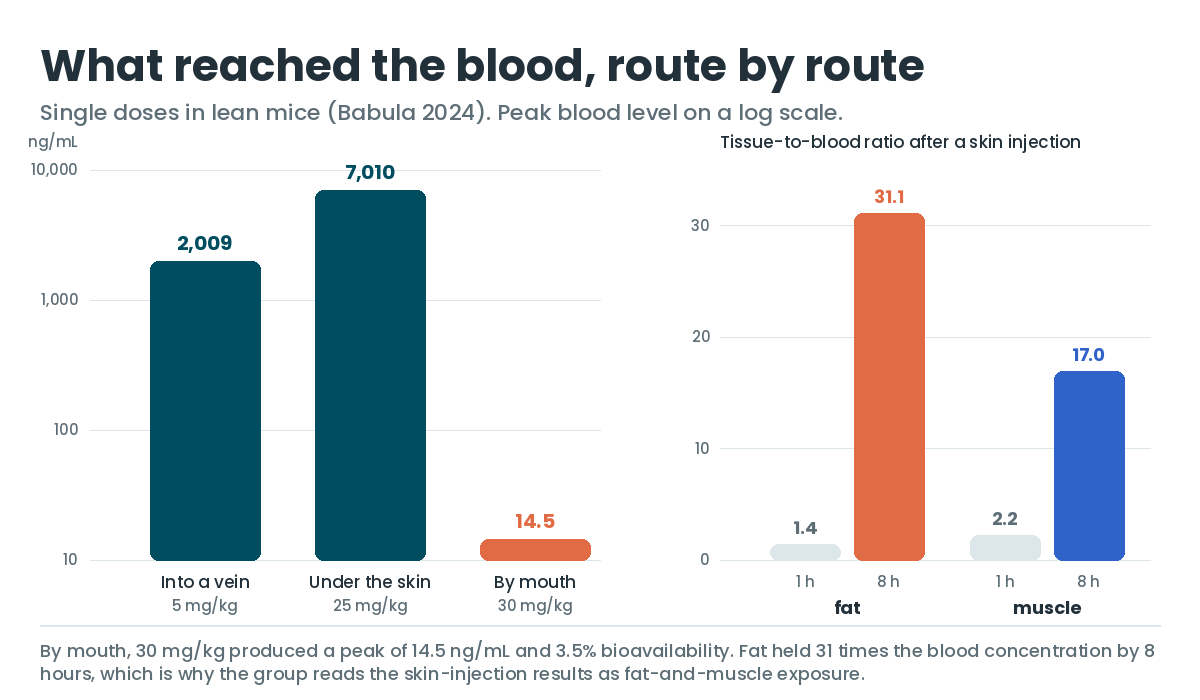
Under the skin, the compound was absorbed fast. Peak plasma concentration was 7,010 ng/mL about 15 minutes after a single dose, and 5,130 ng/mL after five daily doses, with a terminal half-life of around 13 hours either way, so it did not accumulate. The muscle paper from the same year reported a shorter half-life of about 7 hours in its own animals; the two studies used different mice and assays, so take the range rather than either number.
By mouth, 30 mg/kg produced a peak of 14.5 ng/mL, four hours after dosing. The area under the curve worked out to 3.5 percent oral bioavailability. That is not a solubility problem: the compound dissolves at more than 100 mg/mL in saline and more than 10 mg/mL in simulated gastric fluid, and only 7 percent of it binds plasma protein. The authors attribute the loss to limited absorption across the gut wall combined with heavy first-pass metabolism in the liver, where cryopreserved mouse hepatocytes cleared it with a half-life under seven minutes.
Then there is where it goes. After a skin injection, the fat-to-plasma concentration ratio climbed from 1.4 at one hour to 31.1 at eight hours, and muscle went from 2.2 to 17.0. The compound leaves the blood quickly and parks in exactly the two tissues the efficacy studies care about, which is the group’s explanation for why once-daily injections keep working despite a plasma half-life measured in hours.
Put the two findings together and the picture is clear. The doses in the list above were chosen and tested for a route that delivers the compound to fat and muscle. A capsule delivers, in mice, about one thirtieth as much to the blood, and nobody has measured what that does to body weight because nobody has run the experiment.
What the mouse numbers do and do not tell you
A reader who arrives here wanting a milligram figure deserves a straight answer, so here it is.
The effective range for body fat in mice is 32 to 40 mg/kg a day, injected. Mouse-to-human dose conversion does not go by body weight; it goes by body surface area, and that scaling shrinks a mouse mg/kg figure considerably before you get anywhere near a person. Then the oral absorption problem cuts whatever is left by a further factor of roughly 30, if mice and humans absorb it alike, which is itself unknown. Any specific oral human number you see online has been built on top of two unmeasured conversions. The 2026 review by Noah Puleo, Ernst Lengyel and colleagues in Trends in Pharmacological Sciences describes the state of the field honestly: the first generation of NNMT inhibitors has been held back by insufficient target engagement, reduced bioavailability and unknown safety, and the newer compounds now coming through are the ones built to fix that.
What the mouse data do tell you is the shape of the response. Below about 10 mg/kg a day nothing happened to body weight. Between 10 and 32 mg/kg a day the weight effect appeared, and it was a prevention of gain rather than a melt. Muscle responded at lower doses than fat. The compound did not change food intake in any of the studies, which separates it from appetite-driven drugs. The 2018 paper reported no observable adverse effects at its dose. The later studies did not set out to measure safety, each used a few dozen mice, the longest ran eight weeks, and none involved a person.
The rest of the NNMT inhibitor field
5-amino-1MQ is one molecule in a wider effort, and the others help calibrate expectations.
Aimo Kannt, Sridharan Rajagopal and colleagues published JBSNF-000088 in 2018, a nicotinamide analogue that lowered body weight and normalized glucose tolerance in high-fat-fed mice to the level of lean controls. Its best feature was a knockout control: the effects disappeared in mice lacking the NNMT gene, which proved the drug worked through the enzyme. In 2022 Sven Ruf and the same team published a tricyclic lead, JBSNF-000028, from a screen of hundreds of analogues. It lowered 1-MNA in plasma, liver and fat and improved insulin sensitivity, but its glucose benefit showed up in NNMT-knockout mice too, so part of its action runs through something other than the enzyme. A third molecule, AMO-NAM, tested by Sunhuo Li and colleagues in a 2025 heart-failure model in aged female mice, cut 1-MNA in heart tissue by 77 percent and reduced left-ventricular hypertrophy and fibrosis without changing NAD levels at all.
Two things to take from those. NNMT inhibition as a strategy has now been reproduced by several independent groups using chemically unrelated molecules, which is more than most compounds in this space can say. And the readout that matters for any of them is 1-MNA, the product that falls when the enzyme is blocked; the 5-amino-1MQ studies measured it in cells and tissues, but no one has reported what it does to 1-MNA in a human.
The newest direction is kidneys. A 2026 Cell Reports paper led by Lucie Chanvillard, with Watowich among the authors, links NNMT to senescent, fibrotic tubules in human chronic kidney disease biopsies and shows that inhibiting the enzyme protects kidney cells, organoids and mice. A 2021 cell-culture study by Serra Akar and colleagues found 5-amino-1MQ slowed HeLa cervical cancer cells in a dish at 0.1 to 500 micromolar without touching a non-cancer cell line, which fits the long-standing observation that NNMT is overexpressed in many tumors.
If your interest is the NAD+ side of this story rather than the enzyme, our injectable NAD+ and MOTS-c guide and the NMN side-effects review cover the precursor approach, where human trial data actually exist.
Try the budget yourself
The simplest way to see what the enzyme costs a cell is to count. Slide the enzyme level up to where an obese fat cell sits, watch what happens to the NAD+ and SAM budgets, then switch the inhibitor on.
The methyl budget: where 100 units of nicotinamide go
Slide the enzyme level, then switch the inhibitor on. Made-up units; the directions come from the fat-cell experiments.
Teaching model, not a measurement. In cultured fat cells the inhibitor lowered 1-MNA and raised NAD+ and SAM (Neelakantan 2018); enzyme knockdown did the same in mouse fat (Kraus 2014). Real shares depend on the tissue, the diet and the dose.
Frequently asked questions
What is the optimal dose of 5-amino-1MQ?
In mice, body-fat effects needed 32 to 40 mg/kg a day injected under the skin, and muscle effects appeared at 10 mg/kg a day. No human dose has been tested or published.
Does 5-amino-1MQ work orally?
The only pharmacokinetic study, in mice, found 3.5 percent oral bioavailability. All of the published efficacy results came from injections.
How much weight did mice lose on it?
About 5 percent of body weight in 11 days in the 2018 study. In the 28-day 2024 study it prevented weight gain rather than causing loss, and combined with a lean diet in 2021 it produced a 29 percent drop in fat mass over seven weeks.
Is 5-amino-1MQ a peptide?
No. It is a small aromatic molecule, a methylated quinolinium salt, that blocks the enzyme NNMT.
What does NNMT do?
It methylates nicotinamide, the vitamin B3 molecule cells recycle into NAD+, using a methyl group from SAM. The product, 1-MNA, leaves in urine. Fat-tissue NNMT runs roughly two-fold higher in people with type 2 diabetes.
Are there human studies?
There are human studies of the enzyme and its product, including a 1,160-person Chinese cohort and a 199-patient German biopsy series, but no human study of the inhibitor itself.
What side effects were reported?
None were observed at the doses used in the mouse studies, which ran up to eight weeks. None of them was designed as a safety study.
How does it compare with NMN or NAD+?
Precursors add nicotinamide-family molecules to the pool; 5-amino-1MQ stops one route by which the pool is drained. Both raised NAD+ in cells, but only the precursors have human trial data.
Stay sharp,
Joe Mars
The Peptide Report
P.S. If you want to talk through any of these studies with people who read them too, the Peptides & Biohacking Hub on Skool is where those conversations happen.
References
- Neelakantan H, Wang HY, Vance V, Hommel JD, McHardy SF, Watowich SJ. Structure-activity relationship for small molecule inhibitors of nicotinamide N-methyltransferase. J Med Chem. 2017;60(12):5015-5028. doi:10.1021/acs.jmedchem.7b00389
- Neelakantan H, Vance V, Wetzel MD, et al. Selective and membrane-permeable small molecule inhibitors of nicotinamide N-methyltransferase reverse high fat diet-induced obesity in mice. Biochem Pharmacol. 2018;147:141-152. doi:10.1016/j.bcp.2017.11.007
- Neelakantan H, Brightwell CR, Graber TG, et al. Small molecule nicotinamide N-methyltransferase inhibitor activates senescent muscle stem cells and improves regenerative capacity of aged skeletal muscle. Biochem Pharmacol. 2019;163:481-492. doi:10.1016/j.bcp.2019.02.008
- Sampson CM, Dimet AL, Neelakantan H, et al. Combined nicotinamide N-methyltransferase inhibition and reduced-calorie diet normalizes body composition and enhances metabolic benefits in obese mice. Sci Rep. 2021;11(1):5637. doi:10.1038/s41598-021-85051-6
- Dimet-Wiley A, Wu Q, Wiley JT, et al. Reduced calorie diet combined with NNMT inhibition establishes a distinct microbiome in DIO mice. Sci Rep. 2022;12(1):484. doi:10.1038/s41598-021-03670-5
- Dimet-Wiley AL, Latham CM, Brightwell CR, et al. Nicotinamide N-methyltransferase inhibition mimics and boosts exercise-mediated improvements in muscle function in aged mice. Sci Rep. 2024;14(1):15554. doi:10.1038/s41598-024-66034-9
- Babula JJ, Bui D, Stevenson HL, Watowich SJ, Neelakantan H. Nicotinamide N-methyltransferase inhibition mitigates obesity-related metabolic dysfunction. Diabetes Obes Metab. 2024;26(11):5272-5282. doi:10.1111/dom.15879
- Dong G, Choi J, Li Y, et al. Nicotinamide N-methyltransferase inhibition improves limb function in experimental peripheral artery disease. Physiol Rep. 2025;13(20):e70615. doi:10.14814/phy2.70615
- Kraus D, Yang Q, Kong D, et al. Nicotinamide N-methyltransferase knockdown protects against diet-induced obesity. Nature. 2014;508(7495):258-262. doi:10.1038/nature13198
- Kannt A, Pfenninger A, Teichert L, et al. Association of nicotinamide-N-methyltransferase mRNA expression in human adipose tissue and the plasma concentration of its product, 1-methylnicotinamide, with insulin resistance. Diabetologia. 2015;58(4):799-808. doi:10.1007/s00125-014-3490-7
- Liu M, Li L, Chu J, et al. Serum N1-methylnicotinamide is associated with obesity and diabetes in Chinese. J Clin Endocrinol Metab. 2015;100(8):3112-3117. doi:10.1210/jc.2015-1732
- Hong S, Moreno-Navarrete JM, Wei X, et al. Nicotinamide N-methyltransferase regulates hepatic nutrient metabolism through Sirt1 protein stabilization. Nat Med. 2015;21(8):887-894. doi:10.1038/nm.3882
- Ström K, Morales-Alamo D, Ottosson F, et al. N1-methylnicotinamide is a signalling molecule produced in skeletal muscle coordinating energy metabolism. Sci Rep. 2018;8(1):3016. doi:10.1038/s41598-018-21099-1
- Roberti A, Fernández AF, Fraga MF. Nicotinamide N-methyltransferase: at the crossroads between cellular metabolism and epigenetic regulation. Mol Metab. 2021;45:101165. doi:10.1016/j.molmet.2021.101165
- Puleo N, Allega MF, Niemann CU, Lengyel E. Emerging opportunities for nicotinamide N-methyltransferase (NNMT) inhibitor clinical translation. Trends Pharmacol Sci. 2026;47(6):638-654. doi:10.1016/j.tips.2026.04.002
- Kannt A, Rajagopal S, Kadnur SV, et al. A small molecule inhibitor of nicotinamide N-methyltransferase for the treatment of metabolic disorders. Sci Rep. 2018;8(1):3660. doi:10.1038/s41598-018-22081-7
- Ruf S, Rajagopal S, Kadnur SV, et al. Novel tricyclic small molecule inhibitors of nicotinamide N-methyltransferase for the treatment of metabolic disorders. Sci Rep. 2022;12(1):15440. doi:10.1038/s41598-022-19634-2
- Li S, Rodrigues PG, Chakraborty AD, et al. Nicotinamide-N-methyltransferase inhibition improves cardiac function and structure in a heart failure with preserved ejection fraction mouse model. Pharmacol Res. 2025;217:107820. doi:10.1016/j.phrs.2025.107820
- Chanvillard L, Lantermans HC, Wall C, et al. NNMT inhibition counteracts tubular senescence and fibrosis in early stages of chronic kidney disease. Cell Rep. 2026;45(1):116823. doi:10.1016/j.celrep.2025.116823
- Akar S, Duran T, Azzawri AA, Koçak N, Çelik Ç, Yıldırım Hİ. Small molecule inhibitor of nicotinamide N-methyltransferase shows anti-proliferative activity in HeLa cells. J Obstet Gynaecol. 2021;41(8):1240-1245. doi:10.1080/01443615.2020.1854696