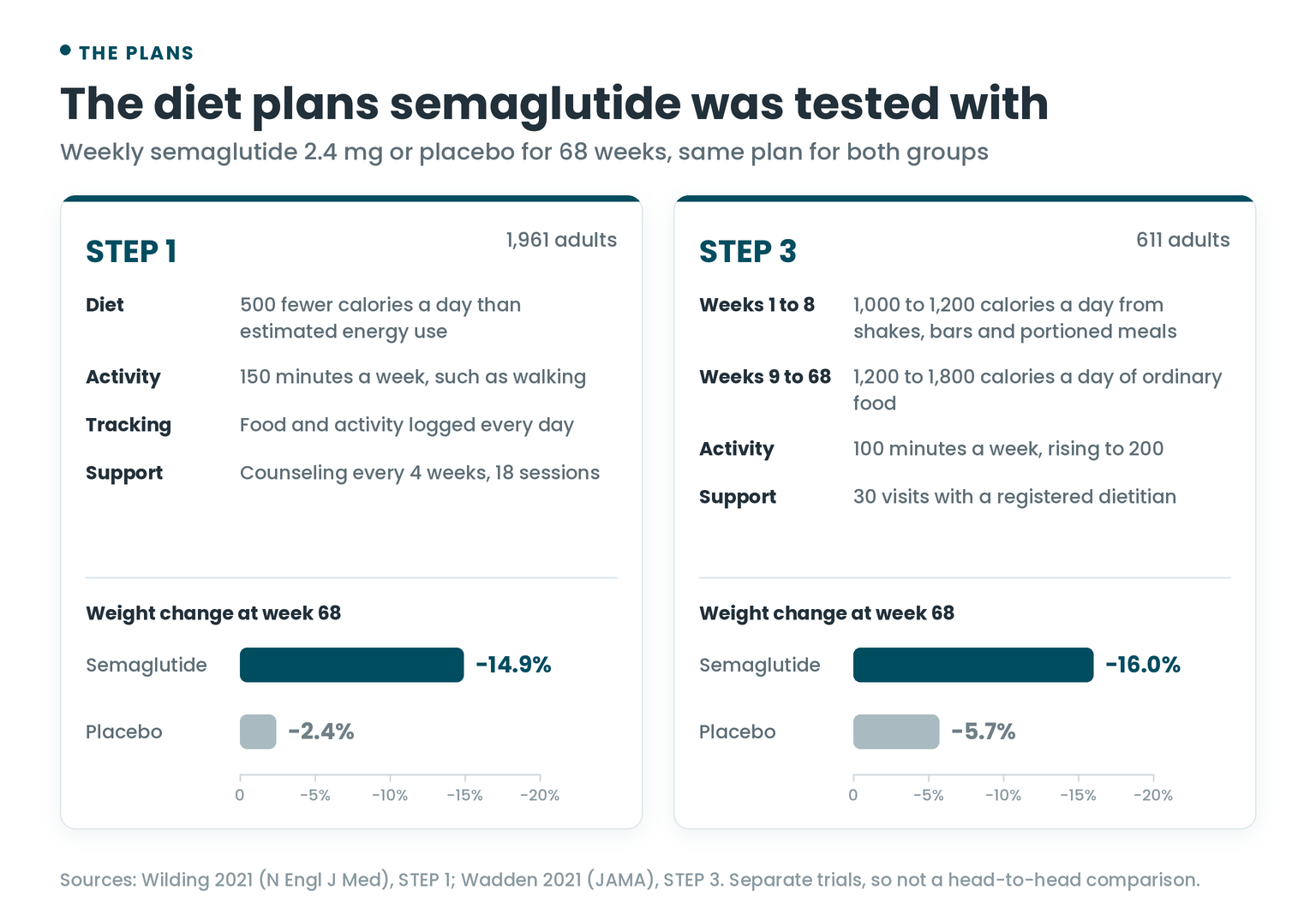
Here’s the diet plan semaglutide was tested with in its biggest weight-loss trial: 500 fewer calories a day than your body burns, 150 minutes of activity a week, a daily food and activity log, and a counseling session every four weeks.
The drug changes how much you want to eat. The plan around it decides what those smaller meals are made of. Here’s what the trials and a 2025 nutrition advisory say about both.
The Diet Plans Used in the Semaglutide Trials
That was STEP 1, which put 1,961 adults with overweight or obesity on weekly semaglutide 2.4 mg or placebo for 68 weeks, with the same lifestyle program for everyone. The calorie deficit was measured against the energy expenditure estimated at the start, activity such as walking was encouraged, and the logs were reviewed at each counseling session, 18 in all.
On that plan, the semaglutide group lost 14.9% of their body weight, about 15.3 kg, against 2.4% on placebo. Weight kept coming off until week 60.
STEP 3 tested a much stricter version with 611 adults:
- Weeks 1 to 8: a low-calorie diet of 1,000 to 1,200 calories a day, delivered as meal replacements (shakes, meal bars and portion-controlled meals)
- Weeks 9 to 68: 1,200 to 1,800 calories a day of ordinary food, set by body weight
- Activity: 100 minutes a week to start, rising by 25 minutes every four weeks to 200
- Support: 30 one-to-one visits with a registered dietitian
That group lost 16.0% on semaglutide and 5.7% on placebo. The STEP 3 authors noted that the heavier program may not add much beyond what semaglutide and the lighter STEP 1 program achieved, and called for more study of the best lifestyle program to pair with it. They were separate trials, so the comparison is a loose one.
What Semaglutide Does to Your Appetite
The STEP 1 authors put the weight loss down to eating less because of a smaller appetite, and two small studies measured how much less.
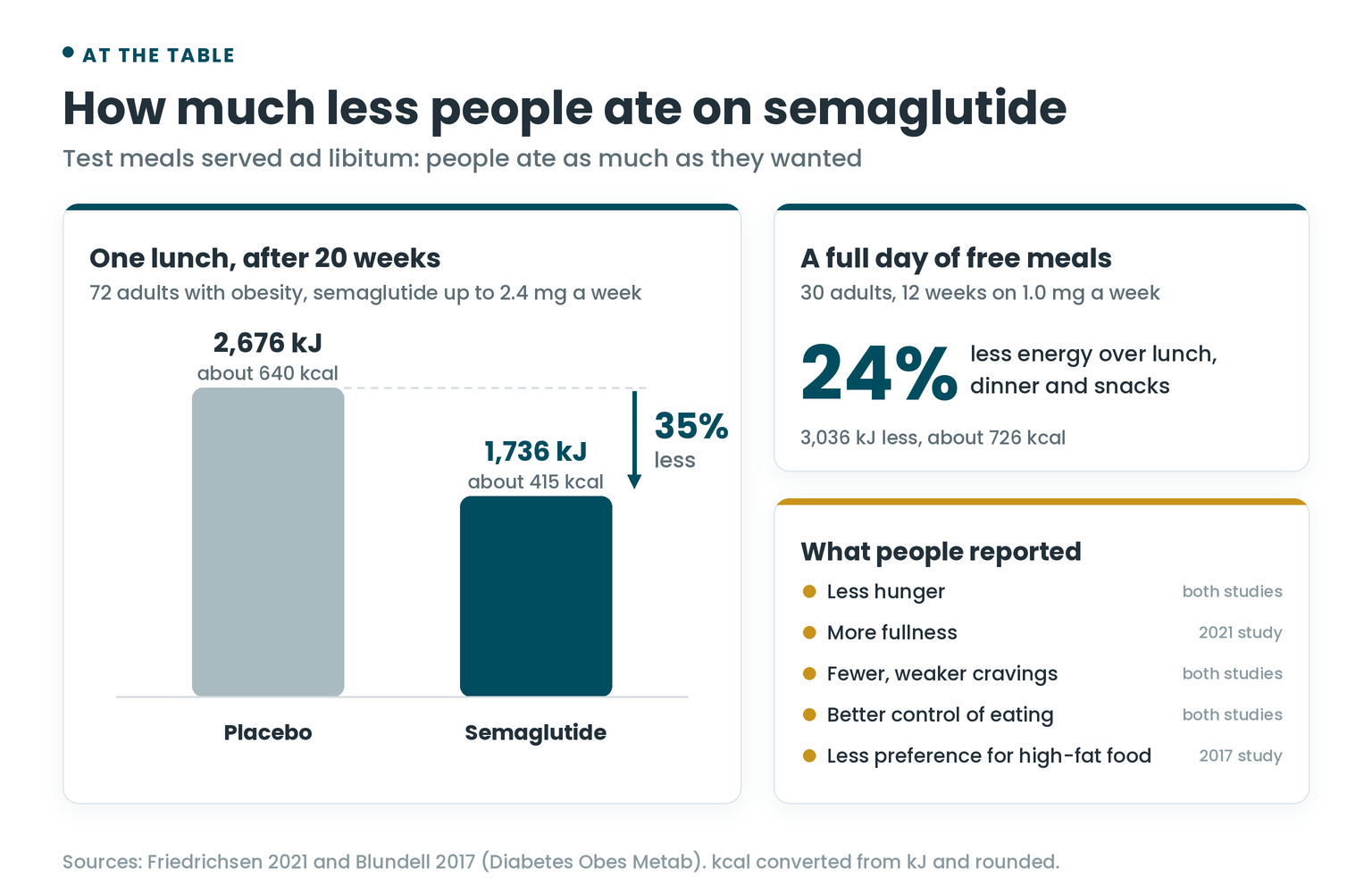
In a 2021 study, 72 adults with obesity took semaglutide escalated to 2.4 mg or placebo for 20 weeks and then sat down to an all-you-can-eat lunch. The semaglutide group ate 35% less: 1,736 kJ against 2,676 kJ, roughly 415 versus 640 calories. They reported less hunger, more fullness, and fewer and weaker food cravings, and they’d lost 9.9% of their body weight to placebo’s 0.4%. Using a paracetamol test after a standard breakfast, the researchers found no evidence that the stomach was emptying more slowly at week 20.
A 2017 crossover study gave 30 people with obesity 12 weeks of semaglutide at 1.0 mg and 12 weeks of placebo. Across a full day of free meals (lunch, dinner and snacks), they ate 24% less on semaglutide. They also preferred high-fat foods less, and resting metabolic rate, adjusted for lean mass, didn’t change. The 5.0 kg they lost came mostly from fat.
The oral tablet points the same way. In a small crossover study of adults with type 2 diabetes, 12 weeks of oral semaglutide cut a day’s free-meal intake by 38.9%, and after a fat-rich breakfast people felt fuller and less hungry than on placebo.
What to Eat on Semaglutide
In 2025, the American College of Lifestyle Medicine, the American Society for Nutrition, the Obesity Medicine Association and The Obesity Society published a joint advisory on nutrition alongside GLP-1 drugs. Their starting point: people on these drugs eat 16% to 39% fewer calories, so every meal has to carry more nutrition. The core of their food guidance:
- Build meals from minimally processed foods: vegetables, fruits, whole grains, beans and lentils, lean proteins, nuts and seeds.
- Keep refined grains and added sugars, sugary drinks, red and processed meats, fast food, and ultra-processed sweets and snacks to a minimum.
- Eat the protein on your plate first.
- Drink enough fluid through the day.
Protein first, and why
STEP 1 scanned the body composition of 140 participants. Lean mass dropped in kilograms even as its share of body weight went up. The advisory breaks it down: of an average 13.6 kg lost, 8.3 kg was fat and 5.3 kg, or 38%, was lean mass. Muscle is about half of lean mass, so the advisory puts muscle at around 20% of the weight lost. Joe digs into the lean mass question in Fat Loss and Body Composition: Reading the Trial Data.
The general adult protein allowance is 0.8 g per kg of body weight a day. For active weight loss, the advisory cites proposals of 1.2 to 1.6 g/kg. It’s unclear whether that should be based on actual weight, adjusted weight or lean mass. The advisory also offers a fixed target of 80 to 120 g a day as easier to stick to.
With a smaller appetite, low-volume protein foods do the heavy lifting: fish, eggs, Greek yogurt, cottage cheese, nuts and seeds and their butters, with shakes or bars when food falls short. Protein on its own probably isn’t enough, though. The advisory pairs it with structured resistance training, which protects lean mass better than cardio alone during fast weight loss.
When you barely feel like eating
Small, frequent meals can help when hunger and interest in food are low. Smoothies and protein drinks made with fruit, vegetables and unsweetened milk or yogurt, cottage cheese and soups are often more appealing than red meat, cold cuts or hard cheese, and a phone reminder helps if you forget to eat. Even without feeling hungry, eat at regular times rather than drifting into accidental fasting.
Below about 1,200 calories a day for women or 1,800 for men, it gets hard to cover vitamins and minerals from food. The advisory lists the warning signs (fatigue beyond what you’d expect, heavy hair loss, flaky or itchy skin, muscle weakness, slow wound healing, easy bruising) and suggests considering supplements for at-risk nutrients such as vitamin D, calcium and B12.
Eating Around the Side Effects
A pooled analysis of STEP 1 to 3 (2,117 people on semaglutide and 1,262 on placebo) counted the gut side effects:
- Nausea: 43.9% vs 16.1% on placebo
- Diarrhea: 29.7% vs 15.9%
- Vomiting: 24.5% vs 6.3%
- Constipation: 24.2% vs 11.1%
Almost all of these events (98.1%) were mild to moderate. They passed, and they were most common during or just after dose escalation; 4.3% of people on semaglutide stopped treatment because of them. People with and without gut side effects lost similar amounts of weight. Less than one percentage point of the extra weight loss ran through those side effects.
The advisory’s food tactics for each one:
- Nausea often hits in the morning or after long gaps without food. In the first few days of treatment, smaller, more frequent meals and skipping fatty or high-fiber foods can help. If nausea is putting you off food, eat breakfast, then small meals every three to four hours with fluids. Ginger or peppermint tea can also help.
- Vomiting is more likely after large meals.
- Constipation calls for fluids and fiber from food. Foods high in protein, fat or fiber slow the stomach further and can make constipation worse, so they may need limiting for a while.
- Diarrhea calls for avoiding large or high-fat meals.
Fluids matter most when symptoms are heavy: dehydration from severe vomiting or diarrhea can injure the kidneys.
Alcohol on Semaglutide
The advisory recommends keeping alcohol minimal because it can make nausea and reflux worse.
A 2025 trial looked at drinking itself. It gave 48 adults with alcohol use disorder low-dose semaglutide or placebo for nine weeks. In a lab drinking session at the end of treatment, on the 0.5 mg dose, the semaglutide group drank less alcohol and reached lower peak breath-alcohol levels. Over the nine weeks, average drinks per day and the number of drinking days didn’t change, but they had fewer drinks on the days they did drink, less weekly craving and a bigger drop in heavy drinking than the placebo group. Among smokers, cigarettes per day fell more on semaglutide than on placebo.
Guess the Numbers
Before the last section, test your instincts. Slide to your best guess, lock it in, and see what the trials found.
When the Injections Stop
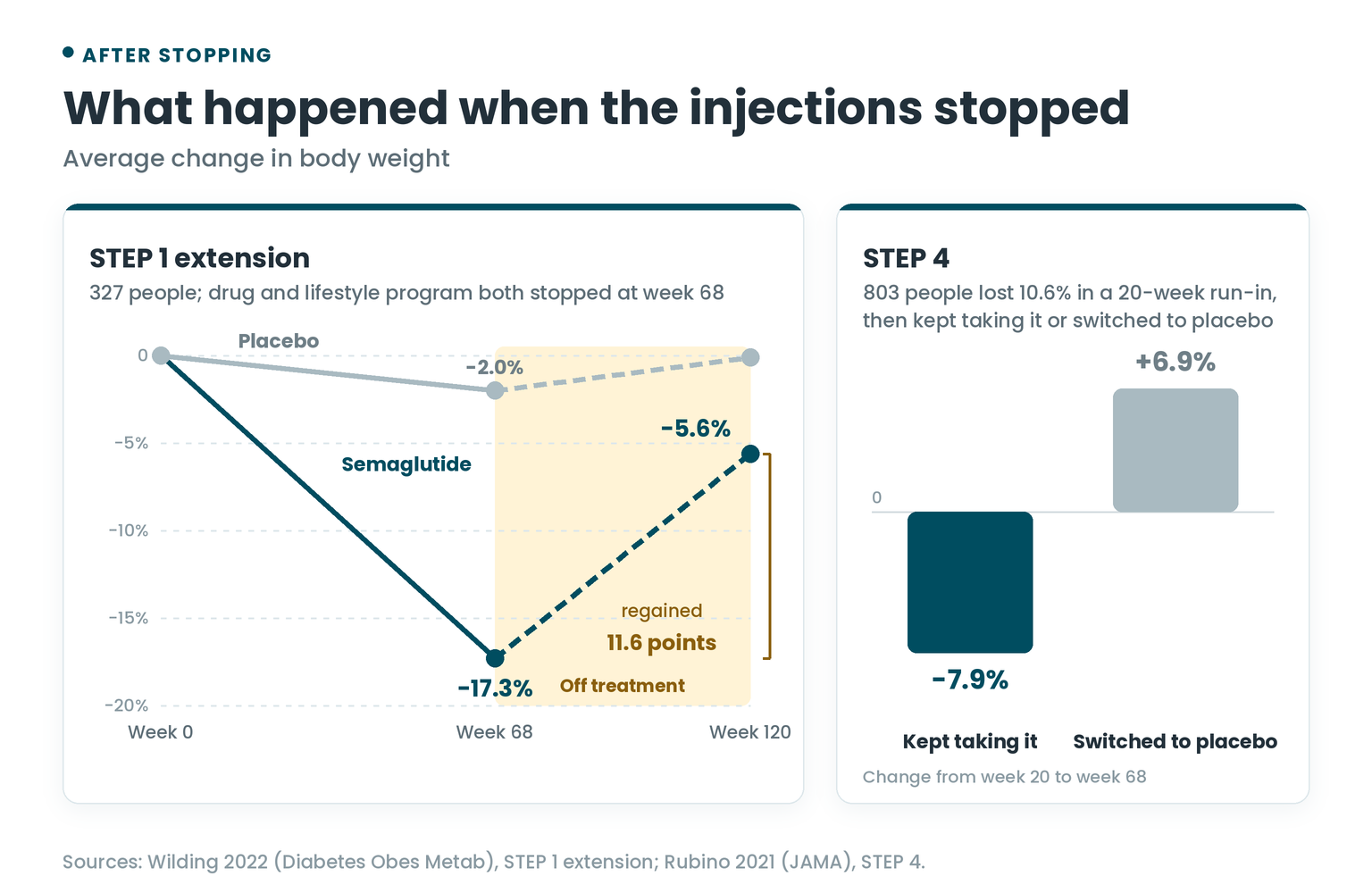
STEP 1 ended both the drug and the lifestyle program at week 68, then followed 327 participants for another year. In that subset, the semaglutide group had lost an average of 17.3% by week 68. By week 120 they’d regained 11.6 percentage points, about two-thirds of what they lost, for a net loss of 5.6%. Most heart and metabolic markers drifted back towards their starting values.
STEP 4 showed the same thing from the other side. After a 20-week run-in on semaglutide, 803 people who’d reached 2.4 mg and lost an average of 10.6% were split up. Those who stayed on it lost another 7.9% by week 68, and those switched to placebo regained 6.9%.
For holding on to the loss, the advisory points to the habits linked with long-term maintenance in the National Weight Control Registry: eating at regular times, eating breakfast, choosing minimally processed foods higher in fiber and protein, cutting back on sugary drinks and snack foods, and allowing portion-controlled treats over strict restriction. The non-food habits include an hour or more of activity a day and regular tracking of weight and food. The advisory’s advice is to build those habits before and during treatment, so they’re in place if the drug stops.
Doses Used in the Research
- STEP 1, 3 and 4: 0.25 mg once a week for four weeks, stepped up every four weeks to 2.4 mg by week 16
- 2021 appetite study: escalated to 2.4 mg once a week, 20 weeks
- 2017 appetite study: escalated to 1.0 mg once a week, 12 weeks
- 2021 oral study: 3 mg, then 7 mg, then 14 mg by mouth once a day, 12 weeks
- 2025 alcohol trial: 0.25 mg a week for four weeks, 0.5 mg for four weeks, then 1.0 mg for one week
For the full dose ladder, see the Semaglutide Dosage Chart.
FAQ
What diet did people follow in the semaglutide trials?
In STEP 1, a 500-calorie daily deficit, 150 minutes of activity a week, a daily log and counseling every four weeks. STEP 3 used a stricter plan: eight weeks of 1,000 to 1,200-calorie meal replacements, then 1,200 to 1,800 calories a day, with 30 dietitian visits.
How much less do people eat on semaglutide?
About 35% less at an all-you-can-eat lunch after 20 weeks on 2.4 mg, and 24% less across a full day of free meals after 12 weeks on 1.0 mg.
How much protein should you eat on semaglutide?
The 2025 advisory cites 1.2 to 1.6 g per kg a day during active weight loss, or a simpler 80 to 120 g a day, paired with resistance training.
What should you eat when semaglutide makes you nauseous?
Small meals every three to four hours, starting with breakfast, plenty of fluids, and fewer fatty or high-fiber foods in the first few days of treatment. Ginger or peppermint tea can help.
Can you drink alcohol on semaglutide?
The 2025 advisory recommends keeping alcohol minimal because it can worsen nausea and reflux.
Does the weight come back after stopping semaglutide?
In the STEP 1 extension, people regained, on average, about two-thirds of their lost weight within a year of stopping both the drug and the lifestyle program.
References
- Wilding JPH, et al. Once-weekly semaglutide in adults with overweight or obesity. N Engl J Med. 2021;384(11):989-1002. DOI
- Wadden TA, et al. Effect of subcutaneous semaglutide vs placebo as an adjunct to intensive behavioral therapy on body weight in adults with overweight or obesity: the STEP 3 randomized clinical trial. JAMA. 2021;325(14):1403-1413. DOI
- Rubino D, et al. Effect of continued weekly subcutaneous semaglutide vs placebo on weight loss maintenance in adults with overweight or obesity: the STEP 4 randomized clinical trial. JAMA. 2021;325(14):1414-1425. DOI
- Wilding JPH, et al. Weight regain and cardiometabolic effects after withdrawal of semaglutide: the STEP 1 trial extension. Diabetes Obes Metab. 2022;24(8):1553-1564. DOI
- Friedrichsen M, et al. The effect of semaglutide 2.4 mg once weekly on energy intake, appetite, control of eating, and gastric emptying in adults with obesity. Diabetes Obes Metab. 2021;23(3):754-762. DOI
- Blundell J, et al. Effects of once-weekly semaglutide on appetite, energy intake, control of eating, food preference and body weight in subjects with obesity. Diabetes Obes Metab. 2017;19(9):1242-1251. DOI
- Gibbons C, et al. Effects of oral semaglutide on energy intake, food preference, appetite, control of eating and body weight in subjects with type 2 diabetes. Diabetes Obes Metab. 2021;23(2):581-588. DOI
- Wharton S, et al. Gastrointestinal tolerability of once-weekly semaglutide 2.4 mg in adults with overweight or obesity, and the relationship between gastrointestinal adverse events and weight loss. Diabetes Obes Metab. 2022;24(1):94-105. DOI
- Hendershot CS, et al. Once-weekly semaglutide in adults with alcohol use disorder: a randomized clinical trial. JAMA Psychiatry. 2025;82(4):395-405. DOI
- Mozaffarian D, et al. Nutritional priorities to support GLP-1 therapy for obesity: a joint advisory from the American College of Lifestyle Medicine, the American Society for Nutrition, the Obesity Medicine Association, and the Obesity Society. Obes Pillars. 2025;15:100181. DOI
Stay sharp,
Joe Mars
The Peptide Report
P.S. Got a question about eating around GLP-1s, or a study you’d like a second pair of eyes on? Bring it to the Peptides and Biohacking Hub on Skool and let’s work through it. See you inside.