Here are two Melanotan 1 doses from the published research. One is 0.16 mg per kilogram a day for ten days, which for a 70 kg man adds up to 112 mg in two weeks. The other is a single 16 mg implant meant to last two months.
Same molecule, same goal of darker skin, and the second number is about a seventh of the first. This is how the dose shrank, what each schedule actually did to skin, and what the studies measured along the way.
The Dose That Shrank
The arithmetic first, because it is the whole story in miniature. The workhorse dose in the injection studies was 0.16 mg/kg a day. Multiply by 70 kg and you get 11.2 mg a day. Ten of those is 112 mg. That weight is my example, not a figure from any paper, but the per-kilogram dose is straight out of the trials.
The implant is a different animal: 16 mg in one go, released slowly instead of all at once.
When Minder, Barman-Aksoezen and Schneider-Yin reviewed the pharmacology in 2017, they put it plainly: the controlled-release formulation is effective at a lower dose than the daily injections. So the drop from 112 mg to 16 mg is not a typo or a different compound. It is the same peptide, delivered slowly instead of in daily spikes.
The rest of this article walks through how researchers got from one number to the other.
What Melanotan 1 Is, in Dosing Terms
Melanotan 1 is the research name for afamelanotide, a lab-made version of alpha-MSH, the hormone your body uses to tell pigment cells to make melanin. You will also see it written as NDP-MSH in older papers. Same thing.
It was first made in 1980. Sawyer, Sanfilippo, Hruby and colleagues swapped two of the building blocks in natural alpha-MSH and got a molecule that serum enzymes could not chew up. In their cell assay it was 26 times as potent as the natural hormone, and its effect on frog skin lasted far longer.
That potency is why the doses are small and why they are written per kilogram of body weight. You are dosing a signal, not a nutrient.
Hadley and Dorr, two of the researchers behind it, described Melanotan 1 in a 2006 review as a straight-chain peptide, unlike its cousin Melanotan 2, which is a shorter ring-shaped molecule. That structural difference matters for side effects and for how each one behaves, and we laid the two side by side in our Melanotan 1 vs Melanotan 2 comparison.
Melanotan 1 works through one receptor in particular, MC1R, which sits on pigment cells. According to the Minder review, switching MC1R on increases melanin production, turns up antioxidant activity and boosts DNA repair in the skin.
The Injection Years: 0.08 to 0.21 mg/kg a Day
The first human tanning trial was published in 1991. Levine and colleagues gave 28 healthy white men ten injections under the skin over 12 days, either the peptide or saline. Some of the men were poor tanners (skin types I or II) and the rest were good tanners (types III or IV). Everyone wore high-potency sunscreen for the whole trial.
Both skin-type groups darkened on the peptide. Nobody darkened on saline. The skin color was measured with a chromaticity meter, not by eye, and the change followed a curve that rose and then fell.
Six years later, Ugwu and colleagues ran the first proper dose and route study, in just three men. They gave 0.16 mg/kg by vein and by mouth, and a range of 0.08 to 0.21 mg/kg by injection under the skin. Each course was five consecutive days a week for two weeks, ten doses in all, and each man rotated through the routes in random order.
Then Dorr and colleagues settled on a schedule that later trials kept coming back to: 0.16 mg/kg a day, Monday to Friday, for two weeks. In their 2000 study of seven volunteers with skin types III or IV, three of eight body sites darkened, including the face, neck and forearm.
They also took small skin samples before and after. One week after the last injection, eumelanin, the brown-black pigment, had risen by 98% in forearm skin. In the forehead samples from three of the volunteers, it rose by 49%. Pheomelanin, the red-yellow pigment, did not change, so the ratio of brown-black to red-yellow pigment in the forearm moved from 51:1 to 86:1.
Half the Dose Against the Full Dose
The closest thing to a dose comparison came in a set of three small trials Dorr and colleagues published in 2004.
In the first, four people got 0.08 mg/kg a day for ten days and four got saline, followed by a measured dose of UV-B light to the neck. Three of the four on the peptide tanned, and their irradiated skin showed 47% fewer sunburn cells, the damaged skin cells that show up after a burn.
In the second, twelve people got the full 0.16 mg/kg a day for ten days. More skin sites darkened at that dose than at the lower one.
That is not a formal dose-response curve. The groups were tiny and the trials were open-label. But it is the reason 0.16 mg/kg became the default in the bigger trials that followed.
Why It Had to Be a Needle
The Ugwu study answered a question people still ask: can you just swallow it?
No. After oral doses, there was no detectable Melanotan 1 in the blood at all. Injected under the skin, it was completely bioavailable, meaning the body got the same exposure as it did from the vein. The 2017 Minder review adds that transdermal application, through the skin, also produced no measurable blood levels and no pigment response.
So the human studies that followed used injections, and later an implant.
The same study also showed how briefly the peptide hangs around. After an injection under the skin, the absorption half-life ranged from 0.07 to 0.79 hours, and the elimination half-life from 0.8 to 1.7 hours. Clearance ran at 0.12 to 0.19 liters per kilogram per hour, and 3.9% or less of each dose turned up in the urine.
In plain terms: each injection is mostly gone within a few hours. That is why the early schedules needed a shot every weekday, and it is the problem the implant was built to solve.
When the Tan Shows Up, and How Long It Stays
Here is the odd part. The drug clears in hours, but the tan does not peak until well after the last dose.

In Levine’s trial, the peak changes showed up one to three weeks after the injections were finished. The men were followed for seven weeks after the course.
In Ugwu’s three volunteers, tanning of the forehead, arms and neck peaked one week after the last dose and was still there three weeks after the ten-dose course ended.
The way to think about it: Melanotan 1 is a switch, not a dye. While it is in the blood it tells pigment cells to make more eumelanin. The pigment takes time to build up, and it stays long after the peptide is gone.
That gap between the drug clock and the skin clock is also why the Dorr team measured on day 14 and again on day 21. If you only looked on the last day of injections, you would miss part of the effect.
Longer Courses: Three Cycles in Three Months
The biggest injection trial was published in 2006. Barnetson and colleagues had 65 people complete a randomized, placebo-controlled study of 0.16 mg/kg injected into the abdomen for three 10-day cycles over three months. That is 30 injections, three times the length of the earlier courses.
Melanin density, measured with reflectance spectroscopy, went up in every single person on the peptide.
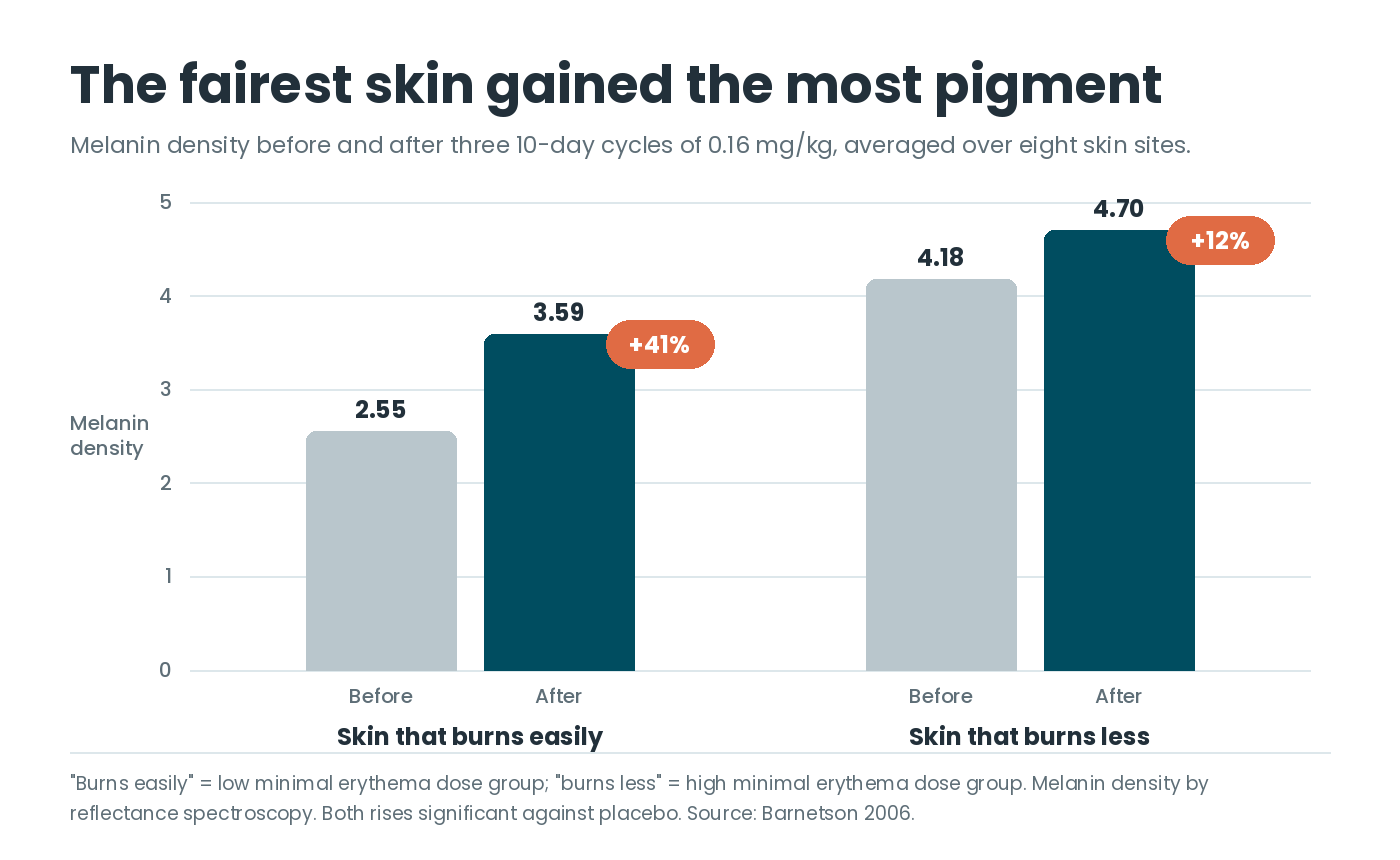
The people who started with the least pigment gained the most. Volunteers with a low minimal erythema dose, the skin types that burn easily, saw melanin rise by an average of 41%, from 2.55 to 3.59, across eight skin sites. Volunteers whose skin burns less readily rose by 12%, from 4.18 to 4.70. Both changes were significant against placebo.
The protection showed up under the microscope too. After a dose of UV light equal to three times what it takes to make the skin go pink, sunburn cells were down by more than half in the easy-burners. Thymine dimers, a marker of UV damage to DNA, were down by 59% in the deepest layer of the epidermis.
A separate trial asked whether genetics would get in the way. Fitzgerald and colleagues enrolled 77 Caucasian volunteers and checked their MC1R gene. Some MC1R variants, common in fair-skinned people, respond poorly to the body’s own alpha-MSH, and lab work had suggested they might blunt Melanotan 1 as well. In the trial, Melanotan 1 raised melanin density against placebo overall, and it raised it more in people carrying those variants than in people without them.
The Minder review sums up both volunteer trials: neither MC1R variants nor fair skin reduced the pigment response.
With Sunlight on Top
The third of the 2004 Dorr trials added real sun. Eight volunteers were randomized to three to five days of sunlight on half of the back, either alone or with 0.16 mg/kg of Melanotan 1 five days a week for four weeks, which works out to 20 injections.
The peptide group tanned more on the back, and the tan held at least three weeks longer than in the sunlight-only group. The sunlight-only group needed 50% more time in the sun to reach the same tan. The authors described the two as acting synergistically, and they found no abnormal skin changes at any of the light-exposed sites.
The 16 mg Implant: One Dose Every Two Months
Daily injections at 0.16 mg/kg work, but nobody wants a needle every weekday for months. The fix was a biodegradable implant placed under the skin that releases the peptide slowly. Kim and Garnock-Jones describe it as a controlled-release implant containing 16 mg of afamelanotide, and 16 mg is the implant dose in the studies below.
The largest test of the implant was not about cosmetic tanning at all. It was in erythropoietic protoporphyria, or EPP, an inherited condition where light on the skin causes severe burning pain within minutes. People with EPP spend their lives avoiding the sun, which made them the obvious group to show whether more melanin buys more time outdoors.
Langendonk and colleagues ran two randomized, double-blind trials, one in Europe with 74 patients and one in the United States with 94. Each patient got a 16 mg implant or a placebo implant every 60 days: five implants over 270 days in Europe, three over 180 days in the US.
The main outcome was simple and very practical: hours spent in direct sunlight without pain.
- In the US trial, the median after six months was 69.4 hours on the implant against 40.8 hours on placebo.
- In the European trial, it was 6.0 hours against 0.8 hours after nine months, and the implant group had 77 painful reactions to light against 146 in the placebo group.
Quality of life improved in both trials. The gap between the two sets of numbers is worth noticing. The two trials ran in different places for different lengths of time, so the hours compare within each trial, not across them.
The Kim and Garnock-Jones review adds that in one of these phase III trials the implant also lengthened the time before symptoms appeared under a standardized test light.
Why 60 Days?
You would assume the 60-day gap came from careful testing of shorter and longer gaps. It did not. Wensink, Wagenmakers and Langendonk, who treat EPP patients themselves, wrote in 2021 that the 60-day interval was not based on effectiveness studies, and that for some of their patients that spacing is not enough.
Other studies have used other gaps. Arisi and colleagues, who followed moles in EPP patients, used two implants 50 days apart. The pigment-loss trials covered in the next section used one a month.
Years of Implants
The long-term numbers come from specialist clinics.
Biolcati and colleagues tracked 115 EPP patients in Rome and Zurich who received a total of 1,023 implants over up to eight years. Their quality-of-life score, measured on an EPP-specific questionnaire, sat at 31% of the maximum before treatment, rose to 74% after starting and stayed there. Only three patients said the implant did not meet their expectations. Another 23% stopped for other reasons, mostly things like pregnancy or cost.
At Erasmus MC, Wensink and colleagues followed 117 patients for a median of two years. Ninety-eight percent kept going. Time spent outside rose by an average of 6.1 hours a week compared with before treatment, and quality of life rose by 14%. Light reactions became less painful, though their number and length did not change significantly.
The most striking figure comes from Switzerland. Barman-Aksözen and colleagues looked at 39 patients and the longest stretch each could spend in sunlight before a reaction. Before treatment the median was 10 minutes. On treatment it was 180 minutes. Individual protection ranged from 1.8-fold to 180-fold, with a median of 15-fold, and adherence to treatment was 97.4%.
Monthly Implants and Single-Implant Pilots
Outside EPP, the same 16 mg implant has been tried on a monthly schedule and as a one-off.
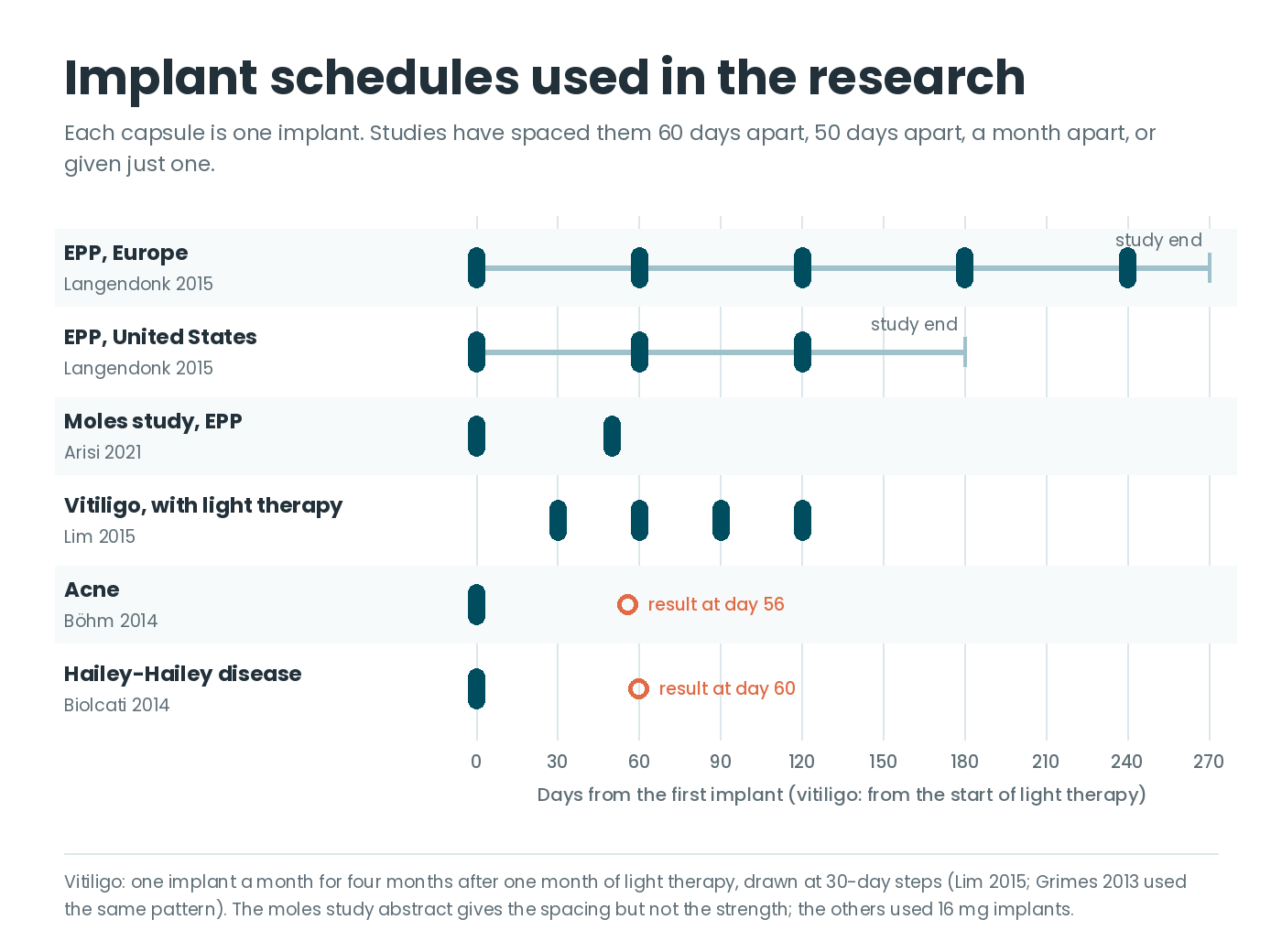
The monthly schedule comes from vitiligo, a condition where patches of skin lose their pigment cells. Lim and colleagues randomized 55 adults to narrowband UV-B light therapy alone or light therapy plus the implant. After one month of light therapy, the combination group got a 16 mg implant every month for four months.
The combination group repigmented faster. On the face, repigmentation appeared at 41 days against 61 days with light alone. On the arms, 46 days against 69. By day 168, repigmentation reached 48.6% in the combination group against 33.3% with light alone. The benefit was clear in skin types IV to VI, but there was no significant difference in skin type III.
An earlier case series from Grimes and colleagues used the same pattern, four monthly 16 mg implants starting in the second month of light therapy, in four patients. Repigmentation began between two days and four weeks after the first implant.
Two tiny pilots used a single 16 mg implant. Böhm, Ehrchen and Luger gave one each to three people with mild-to-moderate facial acne, and the number of spots fell in all three by day 56. Biolcati and colleagues gave one each to two patients with Hailey-Hailey disease, a rare blistering skin condition, and both had their skin lesions clear completely by day 60.
Those last two studies had five people between them, so treat them as interesting, not settled.
Side Effects Reported at These Doses
Across the injection studies, the side effects were mild. Ugwu and colleagues saw occasional stomach upset and facial flushing. The 2004 Dorr trials reported nausea and flushing that passed.
The implant studies list a similar short set. The Kim and Garnock-Jones review names headache and reactions at the implant site as the common ones. Wensink and colleagues saw nausea, fatigue and headache that resolved by themselves. Biolcati’s long-term group mostly reported nausea. In the Lim vitiligo trial, both groups had skin redness, and the implant group also had nausea and minor infections.
Then there is the obvious one: the darkening is not limited to the spots being treated. All four of the Grimes patients developed diffuse darkening of the skin, and the Wu and Cotliar review says almost all patients experience it. In the acne pilot, the extra pigment showed up especially on the face.
Moles change as well. Arisi and colleagues examined 103 moles in 15 EPP patients before treatment and at 5 and 12 months after the first implant. At five months, every mole with a net-like or two-part pattern showed patches of thicker pigment network under the dermatoscope, and pigment dots were more numerous. By twelve months they had gone back to how they looked at the start. No mole developed features suggesting cancer, and no new moles appeared.
One effect people expect but did not find: more vitamin D. Kluijver and colleagues pooled 1,774 vitamin D measurements from 230 EPP patients and found the implant alone did not raise vitamin D on average. Vitamin D deficiency stayed common, with 71.8% below 50 nmol/L, while vitamin D3 supplements did raise levels.
On the long view, the Minder review reports no late effects in volunteers 25 years after their first exposure, or in EPP patients using the implant continuously for up to eight years.
If you want the side of the story that comes from unsupervised use and case reports, we covered it in our Melanotan 2 dosage guide and the comparison, and our post on skin, hair and aesthetics puts tanning peptides alongside the other cosmetic options.
Fill In the Protocol
Each card below is one study from this article with a few numbers blanked out. Tap a blank, pick the value you think the researchers used, and check your card. It is a quick way to see how much the schedules differ from each other.
Doses Used in the Research
Every amount on this list is what a published study gave, with the people it was given to.
- 10 injections under the skin over 12 days, 28 healthy white men (Levine, 1991)
- 0.08 to 0.21 mg/kg under the skin, and 0.16 mg/kg by vein and by mouth, five days a week for two weeks, 3 healthy men (Ugwu, 1997)
- 0.16 mg/kg a day under the skin, Monday to Friday for two weeks, 7 volunteers with skin types III or IV (Dorr, 2000)
- 0.08 mg/kg a day under the skin for 10 days, then UV-B to the neck, 4 volunteers (Dorr, 2004)
- 0.16 mg/kg a day under the skin for 10 days, with UV-B to a buttock site, 12 volunteers (Dorr, 2004)
- 0.16 mg/kg under the skin five days a week for four weeks, with sunlight to half of the back, 8 volunteers (Dorr, 2004)
- 0.16 mg/kg into the abdomen, three 10-day cycles over three months, 65 fair-skinned volunteers completing (Barnetson, 2006)
- 16 mg implant every 60 days, five implants over 270 days or three over 180 days, adults with EPP (Langendonk, 2015)
- Two implants 50 days apart, adults with EPP (Arisi, 2021)
- 16 mg implant monthly for four months alongside light therapy, adults with vitiligo (Grimes, 2013; Lim, 2015)
- A single 16 mg implant, adults with acne (Böhm, 2014) and with Hailey-Hailey disease (Biolcati, 2014)
Frequently Asked Questions
What dose of Melanotan 1 did the tanning studies use?
The most common dose was 0.16 mg per kilogram of body weight a day, injected under the skin for ten weekdays. The earliest dose study explored 0.08 to 0.21 mg/kg, and the largest trial ran three 10-day cycles at 0.16 mg/kg over three months.
What is the dose of the Melanotan 1 implant?
The implant holds 16 mg. In the EPP trials one was placed every 60 days, and in the vitiligo trial one was placed every month for four months.
How long does a Melanotan 1 tan take to show up?
In the injection studies, the tan peaked one to three weeks after the last dose, not during the course. It was still measurable three weeks after a ten-dose course ended.
Can Melanotan 1 be taken by mouth or through the skin?
Oral doses produced no detectable blood levels, and transdermal application produced neither blood levels nor a pigment response. The human research used injections under the skin and, later, the implant.
Is Melanotan 1 the same as afamelanotide?
Yes. Afamelanotide is the drug name for the peptide researchers called Melanotan 1, and older papers also call it NDP-MSH.
Does Melanotan 1 work on very fair skin?
In the trials, yes. The biggest melanin gains were in people with the least pigment to start with, and people carrying MC1R variants gained more than those without.
Does Melanotan 1 raise vitamin D levels?
Not in the data so far. In 230 EPP patients the implant alone did not raise vitamin D on average, while vitamin D3 supplements did.
Stay sharp,
Joe Mars
The Peptide Report
P.S. If you want to talk any of this through with people who read the same papers, come and find us at the Peptides & Biohacking Hub.
References
- Sawyer, Sanfilippo, Hruby and colleagues (1980). 4-Norleucine, 7-D-phenylalanine-alpha-melanocyte-stimulating hormone: a highly potent alpha-melanotropin with ultralong biological activity. Proc Natl Acad Sci U S A, 77(10), 5754-5758.
- Levine, Sheftel, Eytan and colleagues (1991). Induction of skin tanning by subcutaneous administration of a potent synthetic melanotropin. JAMA, 266(19), 2730-2736.
- Ugwu, Blanchard, Dorr and colleagues (1997). Skin pigmentation and pharmacokinetics of melanotan-I in humans. Biopharm Drug Dispos, 18(3), 259-269.
- Dorr, Dvorakova, Brooks and colleagues (2000). Increased eumelanin expression and tanning is induced by a superpotent melanotropin [Nle4-D-Phe7]-alpha-MSH in humans. Photochem Photobiol, 72(4), 526-532.
- Dorr, Ertl, Levine and colleagues (2004). Effects of a superpotent melanotropic peptide in combination with solar UV radiation on tanning of the skin in human volunteers. Arch Dermatol, 140(7), 827-835.
- Barnetson, Ooi, Zhuang and colleagues (2006). [Nle4-D-Phe7]-alpha-melanocyte-stimulating hormone significantly increased pigmentation and decreased UV damage in fair-skinned Caucasian volunteers. J Invest Dermatol, 126(8), 1869-1878.
- Fitzgerald, Fryer, Dwyer and colleagues (2006). Effect of MELANOTAN, [Nle(4), D-Phe(7)]-alpha-MSH, on melanin synthesis in humans with MC1R variant alleles. Peptides, 27(2), 388-394.
- Hadley and Dorr (2006). Melanocortin peptide therapeutics: historical milestones, clinical studies and commercialization. Peptides, 27(4), 921-930.
- Grimes, Hamzavi, Lebwohl and colleagues (2013). The efficacy of afamelanotide and narrowband UV-B phototherapy for repigmentation of vitiligo. JAMA Dermatol, 149(1), 68-73.
- Böhm, Ehrchen and Luger (2014). Beneficial effects of the melanocortin analogue Nle4-D-Phe7-alpha-MSH in acne vulgaris. J Eur Acad Dermatol Venereol, 28(1), 108-111.
- Biolcati, Aurizi, Barbieri and colleagues (2014). Efficacy of the melanocortin analogue Nle4-D-Phe7-alpha-melanocyte-stimulating hormone in the treatment of patients with Hailey-Hailey disease. Clin Exp Dermatol, 39(2), 168-175.
- Langendonk, Balwani, Anderson and colleagues (2015). Afamelanotide for erythropoietic protoporphyria. N Engl J Med, 373(1), 48-59.
- Lim, Grimes, Agbai and colleagues (2015). Afamelanotide and narrowband UV-B phototherapy for the treatment of vitiligo: a randomized multicenter trial. JAMA Dermatol, 151(1), 42-50.
- Biolcati, Marchesini, Sorge and colleagues (2015). Long-term observational study of afamelanotide in 115 patients with erythropoietic protoporphyria. Br J Dermatol, 172(6), 1601-1612.
- Kim and Garnock-Jones (2016). Afamelanotide: a review in erythropoietic protoporphyria. Am J Clin Dermatol, 17(2), 179-185.
- Minder, Barman-Aksoezen and Schneider-Yin (2017). Pharmacokinetics and pharmacodynamics of afamelanotide and its clinical use in treating dermatologic disorders. Clin Pharmacokinet, 56(8), 815-823.
- Wensink, Wagenmakers, Barman-Aksözen and colleagues (2020). Association of afamelanotide with improved outcomes in patients with erythropoietic protoporphyria in clinical practice. JAMA Dermatol, 156(5), 570-575.
- Barman-Aksözen, Nydegger, Schneider-Yin and colleagues (2020). Increased phototoxic burn tolerance time and quality of life in patients with erythropoietic protoporphyria treated with afamelanotide: a three years observational study. Orphanet J Rare Dis, 15(1), 213.
- Wensink, Wagenmakers and Langendonk (2021). Afamelanotide for prevention of phototoxicity in erythropoietic protoporphyria. Expert Rev Clin Pharmacol, 14(2), 151-160.
- Arisi, Rossi, Rovati and colleagues (2021). Clinical and dermoscopic changes of acquired melanocytic nevi of patients treated with afamelanotide. Photochem Photobiol Sci, 20(2), 315-320.
- Wu and Cotliar (2021). Afamelanotide: an orphan drug with potential for broad dermatologic applications. J Drugs Dermatol, 20(3), 290-294.
- Kluijver, Nekouei Shahraki, Wagenmakers and colleagues (2024). The effects of cholecalciferol and afamelanotide on vitamin D levels in erythropoietic protoporphyria: a multicentre cohort study. Br J Dermatol, 191(3), 357-364.