Capsules
Keep them in the original container, somewhere cool, dry and out of direct light. Leave any desiccant packet in with them.

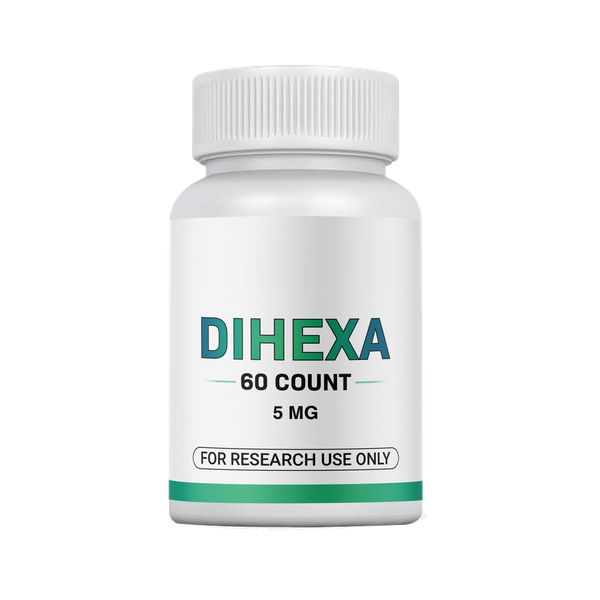
The reported range is 10 to 30 mg of Dihexa a day by mouth. The capsules are 5 mg each, so that works out to 2 to 6 capsules a day. No controlled human dose has been established, and no human trial of this compound has ever been run, so treat that range as what people report rather than as a studied amount.
Keep them in the original container, somewhere cool, dry and out of direct light. Leave any desiccant packet in with them.
Moisture is the thing that degrades a capsule. Close the container properly and do not decant them into something else.
Dihexa came out of Washington State University, from Joseph Harding's group. They had been working on angiotensin IV, a fragment that improved learning and memory in animal models, and Dihexa is the analog that came from that line of work.
The interesting part is the proposed mechanism. Rather than acting on classical angiotensin receptors, it is described as potentiating hepatocyte growth factor, binding HGF and strengthening its activation of the c-Met receptor. That is an unusual way for a small molecule to work, and it is also the part that has not been independently confirmed.
The thread the whole line of research sits in, going back to angiotensin IV improving learning and memory in animal models.
The specific claim: that it drives new connections between neurons rather than acting on a neurotransmitter system.
There is no human evidence for any use. No trial, no pharmacokinetics, no safety data.
Weeks. The mechanism is about building new connections between neurons, and that is not a same-day effect. Give it a full cycle before deciding.
Harding's group at Washington State University worked on angiotensin IV, a fragment that improved learning and memory in animal models. They reported that the effects ran through HGF and c-Met rather than through classical angiotensin receptors, and Dihexa is the analog built from that work.
It is described as a potentiator rather than a direct agonist. The idea is that it binds HGF and strengthens HGF's activation of c-Met, instead of switching c-Met on by itself.
The group's patents report that Dihexa increased c-Met phosphorylation in adult rat hippocampal slices and boosted HGF's effect on c-Met in HEK293 cells. Knocking down c-Met abolished the effects of the angiotensin IV analogs, which the authors read as confirmation that the pathway runs through HGF and c-Met.
Two commercial sites state that the 2014 paper in the Journal of Pharmacology and Experimental Therapeutics, the one that established the HGF and c-Met explanation, was retracted in 2025. I could not confirm that against the journal or find a retraction notice, and both sites sell the compound. Worth knowing the claim exists and that it is unverified either way.
None of it. Dihexa has never been tested in a human clinical trial and is not approved. There are no human pharmacokinetic, safety or efficacy data for it at all.
c-Met is a common target for cancer drugs, which are designed to block it. A compound whose proposed mechanism is strengthening c-Met activation is pointing the other way, and no long-term study has looked at what chronic c-Met activation does. That is the specific unknown here, not a general caution.
Quality varies a lot between sellers. I have been around research peptides for 10 years, and BioEdge is the supplier I send my readers to. Here is why.
The Peptide Report has a business relationship with BioEdge Research Labs. BioEdge sells this product for laboratory research only. BioEdge shipping policy
The reported range is 10 to 30 mg a day by mouth. At 5 mg a capsule that is 2 to 6 capsules a day. No controlled human dose has been established.
Because this is a capsule product. There is no vial to reconstitute and no syringe to read, so there is no units math to do. The other guides on this site are for vials.
The capsules are 5 mg, so 10 mg is two capsules and 30 mg is six.
No cycle length is established. There is no human research to take one from.
The proposed mechanism is that it binds hepatocyte growth factor and strengthens its activation of the c-Met receptor. That comes from one research group's rodent and cell work and has not been independently confirmed.
None. It has never been tested in a human clinical trial, and there are no human pharmacokinetic or safety data.
If you have the vial rather than the capsules, no. Dihexa is hydrophobic and does not dissolve readily in bacteriostatic water, so a cloudy or chunky appearance is expected. DMSO improves solubility.