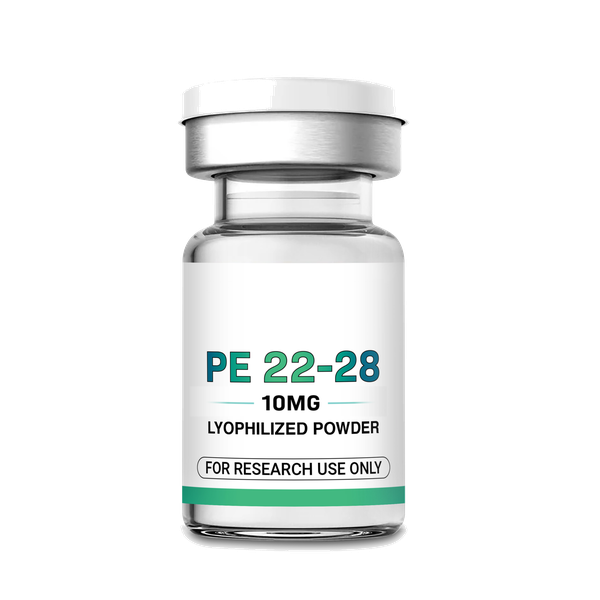
Powder vials
Store at −20 °C (−4 °F) in dry, dark conditions and keep them in the original packaging.

The reported figure is 400 mcg of PE 22-28 by injection, over 8 to 16 weeks. With a 10 mg vial mixed with 2.5 mL of water, 400 mcg is 10 units on a U-100 syringe. The 400 mcg figure comes from a practitioner interview rather than a trial, and around 800 mcg was associated with lethargy in that same account.
The amounts in this chart come from online communities. The vial label shows the total peptide in milligrams (mg). The Amount column shows a portion of that total in micrograms (mcg). The syringe mark shows how much liquid corresponds to that amount.
Syringe marks below are based on a 10 mg vial with 2.5 mL of water added. Change vial size or water in the calculator
| Reported | Amount | Volume | Syringe mark (U-100) | Draws per vial |
|---|
Convert your vial to mcg, because 1 mg is the same as 1,000 mcg.
Divide by your water to see how much is in 1 mL.
Find what one unit holds. A U-100 syringe has 100 units in 1 mL.
Divide your amount by what one unit holds.
Follow one step at a time. The steps use the water amount from your calculator.
Find the mg printed on your vial and enter it in the calculator. Let a frozen vial reach room temperature first.
Clean the top of the peptide vial and the water vial with an alcohol swab. Let them dry.
Draw bacteriostatic water with a sterile syringe.
Let the water run down the inside wall of the vial. This helps prevent foaming.
Roll the vial until the powder fully dissolves. Do not shake it hard.
Write today's date on the vial and refrigerate it at 2–8 °C (35.6–46.4 °F), away from light.
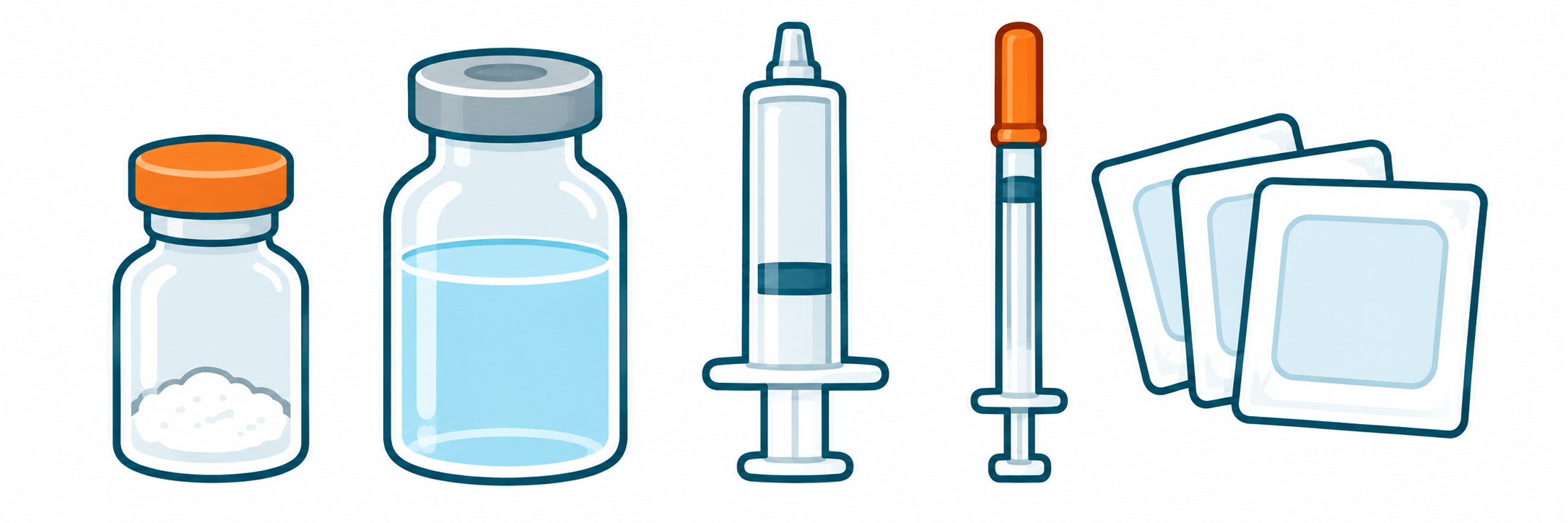
Pick how many weeks you will run it and how many shots you take each week. The list below shows everything you need.
Store at −20 °C (−4 °F) in dry, dark conditions and keep them in the original packaging.
Keep them refrigerated and away from light. How long a mixed vial lasts depends on the product, so check its stability data.
PE 22-28 is a synthetic seven amino acid peptide derived from spadin. It blocks TREK-1, a potassium channel, and that block is the whole mechanism.
The reason it gets attention is potency. In lab testing it blocked TREK-1 at about 0.1 nanomolar against about 40 nanomolar for spadin, so roughly four hundred times more potent than the molecule it came from. Its half-life is about 23 hours, where spadin's animal effects lasted about six.
The research direction, going back to TREK-1 knockout mice in 2006 that were resistant to depression-like behaviour.
What the practitioner account describes, at 400 mcg without lethargy.
The specific animal finding: a hippocampal neurogenesis marker at about 1,736 cells against about 899 in untreated mice after four days.
Days for mood, weeks for anything structural. In the animal work the neurogenesis marker moved after four days, which is quick for this kind of mechanism.
Djillani et al., 2017, Frontiers in Pharmacology. PE 22-28 blocked TREK-1 at about 0.1 nM against about 40 nM for spadin.
In that 2017 study, forced-swim immobility was about 162 seconds in untreated mice against about 92 seconds with PE 22-28, a reduction of about 43 percent.
A hippocampal neurogenesis marker showed about 899 cells in untreated mice against about 1,736 in the treated group after four days.
2006, when knockout mice lacking the channel showed resistance to depression-like behaviour. A 2019 review in Pharmacology and Therapeutics covers the line of work.
Published human trials. Human safety data is described as extremely limited. It is not approved for depression and has not been tested in published human trials.
Quality varies a lot between sellers. I have been around research peptides for 10 years, and BioEdge is the supplier I send my readers to. Here is why.
The Peptide Report has a business relationship with BioEdge Research Labs. BioEdge sells this product for laboratory research only. BioEdge shipping policy
Pick a tool and try it. Each one uses the numbers from your calculator.
Use the same four steps. Once you can solve these, you can work out the units for any vial you ever pick up.
Your score: 0 correct.
Each line on the syringe is a unit of liquid. A unit measures volume, so the amount of peptide in it depends on your mix.
Tap the syringe or move the slider. The numbers use the vial you entered above. Read the line at the top edge of the plunger.
More water makes the mix weaker, so the same amount takes up more units. The amount of peptide in the vial stays the same.
A draw under 5 units is harder to read accurately. Tap a row to use that water amount.
The reported figure is 400 mcg, from a practitioner interview rather than a trial, over 8 to 16 weeks. Around 800 mcg was associated with lethargy in that same account.
With a 10 mg vial and 2.5 mL of water, 400 mcg is 10 units on a U-100 syringe and 800 mcg is 20 units. Use the calculator if your mix is different.
Not in the one account that exists. 400 mcg was described as working for cognition without lethargy, and around 800 mcg brought lethargy with it.
A potassium channel. Mice lacking it showed resistance to depression-like behaviour in 2006, which is where the research interest started.
The parent molecule. PE 22-28 is derived from it and is roughly four hundred times more potent at blocking TREK-1.
No, and it has not been tested in published human trials.
Most charts assume one vial size and one water amount. If your mix is different, every unit number changes, so run your own numbers.