Powder vials
Store at −20 °C (−4 °F) in dry, dark conditions and keep them in the original packaging.

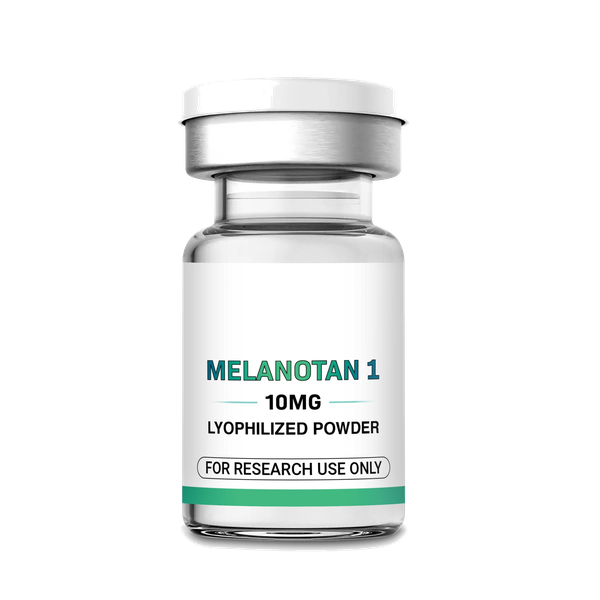
Melanotan 1 is afamelanotide, and its numbers come from clinical trials rather than from practice. The workhorse schedule was 0.16 mg per kg a day, subcutaneous, Monday to Friday for two weeks. For a 70 kg person that is 11.2 mg a day, which is more than a whole 10 mg vial per daily dose. With a 10 mg vial mixed with 1 mL of water, that works out above a full U-100 syringe. Read that twice before you order.
The amounts in this chart come from online communities. The vial label shows the total peptide in milligrams (mg). The Amount column shows a portion of that total in micrograms (mcg). The syringe mark shows how much liquid corresponds to that amount.
Syringe marks below are based on a 10 mg vial with 1 mL of water added. Change vial size or water in the calculator
| Reported | Amount | Volume | Syringe mark (U-100) | Draws per vial |
|---|
Convert your vial to mcg, because 1 mg is the same as 1,000 mcg.
Divide by your water to see how much is in 1 mL.
Find what one unit holds. A U-100 syringe has 100 units in 1 mL.
Divide your amount by what one unit holds.
Follow one step at a time. The steps use the water amount from your calculator.
Find the mg printed on your vial and enter it in the calculator. Let a frozen vial reach room temperature first.
Clean the top of the peptide vial and the water vial with an alcohol swab. Let them dry.
Draw bacteriostatic water with a sterile syringe.
Let the water run down the inside wall of the vial. This helps prevent foaming.
Roll the vial until the powder fully dissolves. Do not shake it hard.
Write today's date on the vial and refrigerate it at 2–8 °C (35.6–46.4 °F), away from light.
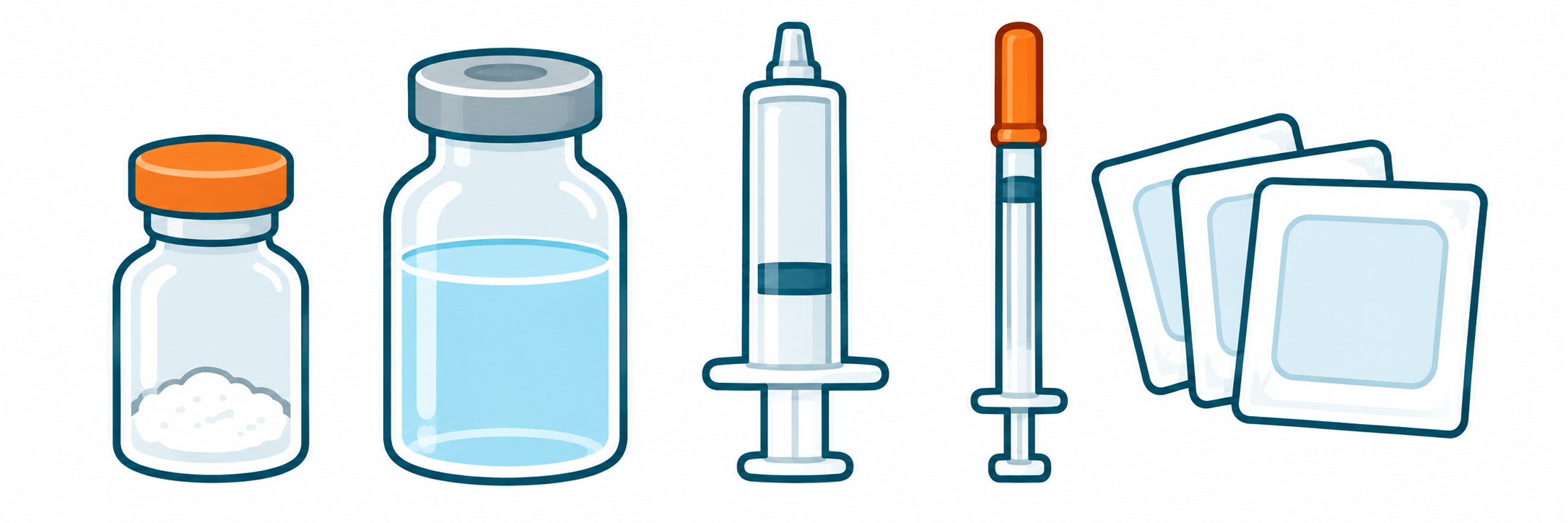
Pick how many weeks you will run it and how many shots you take each week. The list below shows everything you need.
Store at −20 °C (−4 °F) in dry, dark conditions and keep them in the original packaging.
Keep them refrigerated and away from light. How long a mixed vial lasts depends on the product, so check its stability data.
Melanotan 1 is afamelanotide, first made in 1980 and reported as 26 times as potent as natural alpha-MSH in a cell assay. It acts on MC1R, the receptor that controls which kind of pigment your skin makes.
Unlike almost everything else on this site, it has a real clinical history, with published trials going back to 1991 and an approved use in erythropoietic protoporphyria. That also means the numbers here are trial numbers, with everything that implies about supervision and context.
The whole mechanism. Dorr 2000 reported eumelanin up 98 percent in forearm skin a week after the last injection.
The approved use, and where the strongest trial evidence sits.
Studied with the implant alongside narrowband UV-B.
Nothing here establishes it as protection against UV damage. Skin going darker and skin being protected are different claims.
The tan peaks 1 to 3 weeks after the last dose. The elimination half-life is short, 0.8 to 1.7 hours, so the effect long outlasts the molecule.
Levine et al., JAMA 1991, gave ten subcutaneous injections over 12 days in 28 men. Ugwu et al. 1997 and Dorr et al. 2000 followed.
Dorr et al. 2000 used it daily, Monday to Friday for two weeks, and reported eumelanin up 98 percent in forearm skin one week after the last injection. The 2004 trials used 0.08 and 0.16 mg/kg over 10 days, and 0.16 mg/kg five days a week for four weeks.
Barnetson et al. 2006, 65 completers, 0.16 mg/kg into the abdomen as three 10 day cycles over three months. Melanin density rose 41 percent in easy-burning skin and 12 percent in the others against placebo.
Langendonk et al., NEJM 2015, ran two trials in erythropoietic protoporphyria with one 16 mg implant every 60 days. Median time in sunlight without pain was 69.4 hours against 40.8 on placebo in the US trial at six months, and 6.0 against 0.8 hours in the European trial at nine months.
Ugwu et al. tested oral dosing alongside intravenous and subcutaneous. Oral gave no detectable blood levels at all.
In 15 implant patients with 103 moles, net-like patterns and pigment dots increased at 5 months and returned to baseline at 12 months, with no mole showing features suggesting cancer and no new moles. No late effects were reported at 25 years in volunteers or up to eight years in implant users.
Quality varies a lot between sellers. I have been around research peptides for 10 years, and BioEdge is the supplier I send my readers to. Here is why.
The Peptide Report has a business relationship with BioEdge Research Labs. BioEdge sells this product for laboratory research only. BioEdge shipping policy
The comparison people want is against the other tanning peptide, which is a very different compound.
| Stack | Ingredients | Why people stack them |
|---|---|---|
| Melanotan 1 vs Melanotan 2Two vials, not run together | Melanotan 1 in one vial. Melanotan 2 in the second. | Same family, different compoundMelanotan 1 is more selective for MC1R. Melanotan 2 also hits MC3R, MC4R and MC5R, which is where its extra effects come from, wanted and unwanted. Melanotan 1 has the clinical trial record and the approved use. Melanotan 2 has the case reports. See the Melanotan 2 dosage guide. |
Pick a tool and try it. Each one uses the numbers from your calculator.
Use the same four steps. Once you can solve these, you can work out the units for any vial you ever pick up.
Your score: 0 correct.
Each line on the syringe is a unit of liquid. A unit measures volume, so the amount of peptide in it depends on your mix.
Tap the syringe or move the slider. The numbers use the vial you entered above. Read the line at the top edge of the plunger.
More water makes the mix weaker, so the same amount takes up more units. The amount of peptide in the vial stays the same.
A draw under 5 units is harder to read accurately. Tap a row to use that water amount.
The trial schedule is 0.16 mg per kg a day, subcutaneous, Monday to Friday for two weeks. For a 70 kg person that is 11.2 mg a day.
At 70 kg it is 11.2 mg. With a 10 mg vial and 1 mL of water that is more than the whole vial and more than a full U-100 syringe. Use the calculator with your own weight and mix.
Yes, for a 70 kg person on the injection schedule. This surprises people, and it is the main reason to understand what protocol you are actually being sold.
A 16 mg controlled-release implant, one every 60 days in the main trials. It delivers far less per day than the injection schedule, and the published review notes it works at a lower dose.
No. In the trial that tested it, oral dosing gave no detectable blood levels.
Nothing on this page establishes that. Getting darker and being protected are different claims.
It peaks 1 to 3 weeks after the last dose.
Most charts assume one vial size and one water amount. If your mix is different, every unit number changes, so run your own numbers.