Powder vials
Store at −20 °C (−4 °F) in dry, dark conditions and keep them in the original packaging.

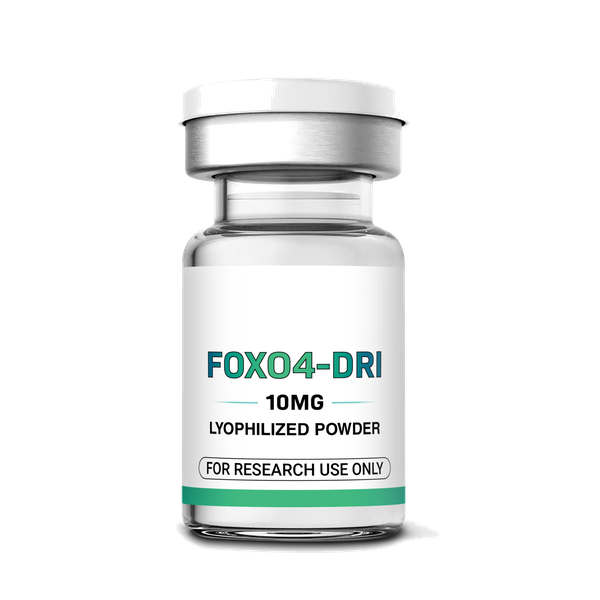
FOXO4-DRI is run as a short course, not a cycle. The circulating protocols are 1 mg every other day for 3 doses as a conservative entry, or 2 mg every other day for 3 doses as the standard, repeated once or twice a year. With a 10 mg vial mixed with 1 mL of water, 2 mg is 20 units on a U-100 syringe. A continuous 12 week run misunderstands what this is.
The amounts in this chart come from online communities. The vial label shows the total peptide in milligrams (mg). The Amount column shows a portion of that total in micrograms (mcg). The syringe mark shows how much liquid corresponds to that amount.
Syringe marks below are based on a 10 mg vial with 1 mL of water added. Change vial size or water in the calculator
| Reported | Amount | Volume | Syringe mark (U-100) | Draws per vial |
|---|
Convert your vial to mcg, because 1 mg is the same as 1,000 mcg.
Divide by your water to see how much is in 1 mL.
Find what one unit holds. A U-100 syringe has 100 units in 1 mL.
Divide your amount by what one unit holds.
Follow one step at a time. The steps use the water amount from your calculator.
Find the mg printed on your vial and enter it in the calculator. Let a frozen vial reach room temperature first.
Clean the top of the peptide vial and the water vial with an alcohol swab. Let them dry.
Draw bacteriostatic water with a sterile syringe.
Let the water run down the inside wall of the vial. This helps prevent foaming.
Roll the vial until the powder fully dissolves. Do not shake it hard.
Write today's date on the vial and refrigerate it at 2–8 °C (35.6–46.4 °F), away from light.

Pick how many weeks you will run it and how many shots you take each week. The list below shows everything you need.
Store at −20 °C (−4 °F) in dry, dark conditions and keep them in the original packaging.
Keep them refrigerated and away from light. How long a mixed vial lasts depends on the product, so check its stability data.
Senescent cells, the ones people call zombie cells, have stopped dividing but have not died. They sit there leaking inflammatory signals, named in the research as IL-6, IL-8 and IL-1 alpha, along with enzymes that break down collagen. Leonard Hayflick described the division limit behind this back in 1961.
FOXO4-DRI is a decoy. In a senescent cell, FOXO4 holds p53 in the nucleus and keeps the cell alive. The peptide is a short mirror-image copy of the binding part, which releases p53 and lets the cell die. DRI stands for D-Retro-Inverso, meaning mirror-image amino acids in reversed order, which is what stops enzymes chewing it up.
The whole purpose. Everything else follows from whether that works in a person, which nobody has shown.
The framing in the mouse work, where clearing these cells delayed age-related problems.
The model is clear out, then stop. It is not a signalling peptide you keep topped up.
This one is pulsed rather than daily, so judge it across pulses instead of inside one. In the fast-aging mice fur regrew within ten days and wheel running roughly doubled by three weeks. In a person, think months.
Darren Baker's group built INK-ATTAC mice that let senescent cells be cleared on command. A 2011 Nature paper showed clearance delayed age-related problems. A 2016 follow-up reported median survival up 27 percent in one mouse background and 24 percent in another, though with no measurable change in motor coordination, memory or muscle strength.
Peter de Keizer's team at Erasmus MC, published in Cell in March 2017 (Baar and colleagues, Cell 2017, volume 169, pages 132 to 147). It used naturally aged mice and fast-aging mice with a DNA repair defect. The fast-aging mice regrew fur within ten days and ran about twice the wheel distance by three weeks. A group given doxorubicin recovered better with the peptide.
Thinner. The CALERIE trial, 199 adults on two years of calorie restriction, lowered 9 of 28 senescence-related proteins at 12 months, while p16 and p21 did not move in an 18 week trial. A human tissue study counted senescent cells across ten organs and age groups. Research on the peptide itself remains preclinical.
Senescent cells are not purely harmful. They play roles in wound healing and in suppressing tumours. Clearing them is not obviously a one-way good, and that argument has not been settled.
A small study of 19 people with no control group, on dasatinib plus quercetin, reported first-generation epigenetic age markers rising. Stacking senolytics is not supported.
Quality varies a lot between sellers. I have been around research peptides for 10 years, and BioEdge is the supplier I send my readers to. Here is why.
The Peptide Report has a business relationship with BioEdge Research Labs. BioEdge sells this product for laboratory research only. BioEdge shipping policy
Pick a tool and try it. Each one uses the numbers from your calculator.
Use the same four steps. Once you can solve these, you can work out the units for any vial you ever pick up.
Your score: 0 correct.
Each line on the syringe is a unit of liquid. A unit measures volume, so the amount of peptide in it depends on your mix.
Tap the syringe or move the slider. The numbers use the vial you entered above. Read the line at the top edge of the plunger.
More water makes the mix weaker, so the same amount takes up more units. The amount of peptide in the vial stays the same.
A draw under 5 units is harder to read accurately. Tap a row to use that water amount.
The standard course is 2 mg every other day for 3 doses, repeated one to two times a year. A conservative entry is 1 mg every other day for 3 doses, and an extended version is 2 mg every other day for 5 doses once a year.
With a 10 mg vial and 1 mL of water, 2 mg is 20 units on a U-100 syringe and 1 mg is 10 units. Use the calculator if your mix is different.
One week, once or twice a year. Running it continuously for 12 weeks misunderstands the compound.
D-Retro-Inverso. The peptide is built from mirror-image D-amino acids in reversed order, which makes it resist being broken down.
Anyone with cancer, in treatment, or recently finished. The mechanism runs through p53, which is central to tumour suppression.
Not supported. A small uncontrolled study on dasatinib plus quercetin reported epigenetic age markers going the wrong way.
No. The research is preclinical.
Most charts assume one vial size and one water amount. If your mix is different, every unit number changes, so run your own numbers.