Powder vials
Store at −20 °C (−4 °F) in dry, dark conditions and keep them in the original packaging.

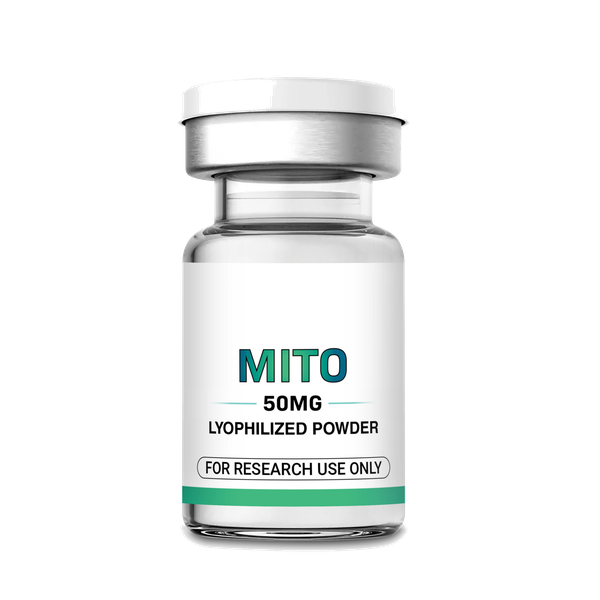
Reported amounts run 1 to 15 mg of SS-31 a day for about 6 weeks, injected under the skin. With a 50 mg vial mixed with 2 mL of water, 5 mg is 20 units on a U-100 syringe and 15 mg is 60 units. The trials and the approved product use 40 mg, which is a much bigger number and worth understanding before you buy. BioEdge sells this one as Mito.
The amounts in this chart come from online communities. The vial label shows the total peptide in milligrams (mg). The Amount column shows a portion of that total in micrograms (mcg). The syringe mark shows how much liquid corresponds to that amount.
Syringe marks below are based on a 50 mg vial with 2 mL of water added. Change vial size or water in the calculator
| Reported | Amount | Volume | Syringe mark (U-100) | Draws per vial |
|---|
Convert your vial to mcg, because 1 mg is the same as 1,000 mcg.
Divide by your water to see how much is in 1 mL.
Find what one unit holds. A U-100 syringe has 100 units in 1 mL.
Divide your amount by what one unit holds.
Follow one step at a time. The steps use the water amount from your calculator.
Find the mg printed on your vial and enter it in the calculator. Let a frozen vial reach room temperature first.
Clean the top of the peptide vial and the water vial with an alcohol swab. Let them dry.
Draw bacteriostatic water with a sterile syringe.
Let the water run down the inside wall of the vial. This helps prevent foaming.
Roll the vial until the powder fully dissolves. Do not shake it hard.
Write today's date on the vial and refrigerate it at 2–8 °C (35.6–46.4 °F), away from light.

Pick how many weeks you will run it and how many shots you take each week. The list below shows everything you need.
Store at −20 °C (−4 °F) in dry, dark conditions and keep them in the original packaging.
Keep them refrigerated and away from light. How long a mixed vial lasts depends on the product, so check its stability data.
SS-31 is a four amino acid peptide, D-Arg-Dmt-Lys-Phe-NH2, where Dmt is a modified tyrosine. The SS stands for Szeto-Schiller, after Hazel Szeto's group at Weill Cornell, where the family was developed. You will also see it as elamipretide, MTP-131 and Bendavia.
What makes it unusual is where it goes. The two positive charges on it pull it to the negatively charged inner mitochondrial membrane, and the aromatic rings shield those charges enough that it crosses cell membranes to get there. It concentrates inside mitochondria without needing a transporter.
Once there it binds cardiolipin, a fat found almost nowhere else in the cell. Cardiolipin shapes the folds of the inner membrane and holds the respiratory complexes together in clusters. Szeto's work describes SS-31 as stopping cardiolipin from turning cytochrome c into a peroxidase while leaving its electron carrying job intact.
In September 2025 the FDA gave accelerated approval to a prescription form of it for Barth syndrome, a rare genetic condition. That makes it the only compound covered on this site with an approved human product behind it, and the approval is narrower than most people assume.
The whole file. Everything people run it for sits downstream of this one thing.
The one place a regulator was convinced. The Barth syndrome approval rests on knee extensor strength.
What most people actually run it for, on the back of the mechanism rather than a trial in healthy people.
The longevity crowd picked it up because cardiolipin damage is one of the better documented things that happens to mitochondria with age.
Weeks, not days. This works on mitochondrial structure, and that is not something you feel switch on. The marker to watch is your energy through the afternoon across a month. The one thing you will notice immediately is the injection site.
The FDA granted accelerated approval in September 2025 for Barth syndrome, in patients weighing at least 30 kg, to improve muscle strength. Accelerated approval means it was cleared on an intermediate marker rather than a hard outcome, and a confirmatory trial is still required. It is not approved for anything else.
Every published human trial used 40 mg a day, and so does the prescribing information for the approved product. The circulated range of 1 to 15 mg does not come from a study. The two large protocol reference sites that publish 5 to 10 mg both say so themselves, one calling its range a judgment drawn from scanning forums and blogs, the other stating outright that its figures do not establish a clinical dose, and both carry supplier promotion. The only human arm below 40 mg anywhere is a 4 mg arm in a heart failure study, and it did nothing. Worth knowing too that 40 mg from a 50 mg vial in 2 mL would be 160 units, which does not fit a U-100 syringe. The approved product gets around that by being a ready-made solution at 80 mg per mL.
The Barth syndrome trial. 12 males, 40 mg daily for 12 weeks against placebo in a crossover. It missed both of its main endpoints. Walking distance and fatigue were no better than placebo. The signal that survived was knee extensor strength, and the open-label extension that followed showed walking distance up 96 metres at week 168 in the 8 people still in it. An open-label extension with no control group cannot prove effect on its own, and that is the evidence the approval rests on.
218 people with primary mitochondrial myopathy, 40 mg daily for 24 weeks. Walking distance came out 3.2 metres worse than placebo and fatigue showed no difference. The authors classified it as Class I evidence of no benefit, which is the strongest way a trial can say a drug did not work. The smaller MMPOWER-2 before it had missed its endpoint too, at a p-value of 0.08.
71 people with reduced ejection fraction, randomised to placebo, 4 mg or 40 mg daily for 28 days. The 40 mg arm missed on left ventricular volume and showed no improvement in ejection fraction. The 4 mg arm did nothing at all. This is the only published human data below 40 mg.
An open-label Phase 1 in dry macular degeneration looked promising on vision letters. The controlled Phase 2 that followed, 176 people over 48 weeks, missed both of its primary endpoints. A secondary measure of photoreceptor layer loss came out better by 43 and 47 percent, which the investigators want to use as the main endpoint next time. Secondary findings from a failed trial are a reason to run another trial, not a result.
Szeto's 2014 review describes selective cardiolipin binding that protects the shape of the mitochondrial folds and supports oxidative phosphorylation. The downstream claims people repeat, better complex I, III and IV activity, less electron leakage, fewer reactive oxygen species, come from animal and cell work. There is no quantitative human data on any of them.
A well-supported mechanism that has mostly not translated. One narrow accelerated approval on an intermediate endpoint in a rare disease, and clear misses in muscle disease, heart failure and eye disease. That is a mixed file, and it is more mixed than most pages about this peptide will tell you.
In studies running 30 days or longer, eosinophil counts rose, peaking around day 90, then returned to baseline after six to twelve months of continuous use or after stopping. No clinical problem was attached to it, but it is a documented blood change over time and it is in the label.
Quality varies a lot between sellers. I have been around research peptides for 10 years, and BioEdge is the supplier I send my readers to. Here is why.
The Peptide Report has a business relationship with BioEdge Research Labs. BioEdge sells this product for laboratory research only. BioEdge shipping policy
SS-31 works on the mitochondria themselves rather than on a receptor, so it sits in a different lane from most things on this site.
| Stack | Ingredients | Why people stack them |
|---|---|---|
| SS-31 + MOTS-cTwo vials | SS-31 in one vial. MOTS-c in the second. | Two angles on the mitochondriaMOTS-c is encoded in mitochondrial DNA and behaves like a metabolic signal. SS-31 is a structural intervention at the inner membrane. Different mechanisms, same organelle, and no study of the pair. |
| SS-31 + HumaninTwo vials | SS-31 in one vial. Humanin in the second. | Same family of thinkingHumanin is another mitochondria-derived peptide. The reasoning is the same as the MOTS-c pairing and the evidence is the same too, which is none. |
| SS-31 + NAD+Two vials | SS-31 in one vial. NAD+ in the second. | Membrane and substrateThe theory is that NAD+ supports the substrate side of the electron transport chain while SS-31 works on the membrane that chain sits in. A reasonable story with no trial behind it. |
Pick a tool and try it. Each one uses the numbers from your calculator.
Use the same four steps. Once you can solve these, you can work out the units for any vial you ever pick up.
Your score: 0 correct.
Each line on the syringe is a unit of liquid. A unit measures volume, so the amount of peptide in it depends on your mix.
Tap the syringe or move the slider. The numbers use the vial you entered above. Read the line at the top edge of the plunger.
More water makes the mix weaker, so the same amount takes up more units. The amount of peptide in the vial stays the same.
A draw under 5 units is harder to read accurately. Tap a row to use that water amount.
The circulated range is 1 to 15 mg a day under the skin for about 6 weeks. The studied amount in every human trial is 40 mg a day. Those are two different numbers and the page explains why.
With a 50 mg vial and 2 mL of water, 5 mg is 20 units on a U-100 syringe. 1 mg is 4 units and 15 mg is 60 units. Use the calculator if your mix is different.
Because the 5 mg figure did not come from a trial. The protocol sites that publish it say so themselves, one calling it a judgment from forum reading and the other saying its figures do not establish a clinical dose. There is no study at 5 mg.
At 50 mg in 2 mL that is 160 units, which does not fit a U-100 syringe. It is also the amount that failed in three separate controlled trials, so copying it is not a shortcut to a result.
A prescription form of it is, since September 2025, for Barth syndrome only, in people weighing at least 30 kg, to improve muscle strength. It is an accelerated approval on an intermediate endpoint and a confirmatory trial is still required. Nothing else it was tried for was approved.
Yes. Also MTP-131 and Bendavia. BioEdge lists it as Mito.
It concentrates in the inner mitochondrial membrane and binds cardiolipin, a fat that shapes the membrane folds and holds the respiratory complexes together. The proposed effect is protecting that structure so oxidative phosphorylation runs better.
In Barth syndrome, partly, on muscle strength, and it missed on walking distance and fatigue. In mitochondrial myopathy it clearly did not work, with the authors calling it Class I evidence of no benefit. In heart failure and dry macular degeneration it missed its endpoints too.
Probably. Every participant on the drug in the Barth trial had redness at the site. Rotate sites and expect it rather than treating it as a sign something is wrong.
2 mL is the sensible choice. It puts the whole 1 to 15 mg range between 4 and 60 units, all readable on one syringe. More water pushes the top of the range past what a syringe holds.
About 6 weeks is what gets reported, and the sheet records that as unresolved. Trials ran anywhere from 4 weeks to 48, so there is no studied cycle length to copy.
Most charts assume one vial size and one water amount. Change either and every unit number changes, so run your own numbers.