Powder vials
Store at −20 °C (−4 °F) in dry, dark conditions and keep them in the original packaging.

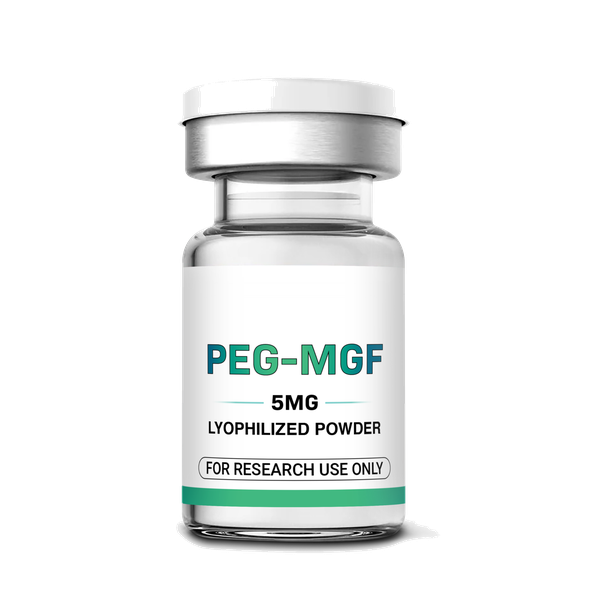
The reported protocol is 150 mcg of PEG-MGF per injection, 2 to 3 times a week, for 8 to 10 weeks. With a 5 mg vial mixed with 3 mL of water, 150 mcg is 9 units on a U-100 syringe. There are no controlled human trials of MGF in any form, and the PEGylated version is a commercial modification rather than a studied drug.
The amounts in this chart come from online communities. The vial label shows the total peptide in milligrams (mg). The Amount column shows a portion of that total in micrograms (mcg). The syringe mark shows how much liquid corresponds to that amount.
Syringe marks below are based on a 5 mg vial with 3 mL of water added. Change vial size or water in the calculator
| Reported | Amount | Volume | Syringe mark (U-100) | Draws per vial |
|---|
Convert your vial to mcg, because 1 mg is the same as 1,000 mcg.
Divide by your water to see how much is in 1 mL.
Find what one unit holds. A U-100 syringe has 100 units in 1 mL.
Divide your amount by what one unit holds.
Follow one step at a time. The steps use the water amount from your calculator.
Find the mg printed on your vial and enter it in the calculator. Let a frozen vial reach room temperature first.
Clean the top of the peptide vial and the water vial with an alcohol swab. Let them dry.
Draw bacteriostatic water with a sterile syringe.
Let the water run down the inside wall of the vial. This helps prevent foaming.
Roll the vial until the powder fully dissolves. Do not shake it hard.
Write today's date on the vial and refrigerate it at 2–8 °C (35.6–46.4 °F), away from light.

Pick how many weeks you will run it and how many shots you take each week. The list below shows everything you need.
Store at −20 °C (−4 °F) in dry, dark conditions and keep them in the original packaging.
Keep them refrigerated and away from light. How long a mixed vial lasts depends on the product, so check its stability data.
MGF stands for mechano growth factor, and it is a splice variant of IGF-1, also written IGF-1Ec. It is a 24 amino acid peptide derived from the C-terminal end of IGF-1, and it turns up when muscle is loaded or damaged.
PEG-MGF is that peptide with a polyethylene glycol chain attached. Native MGF has a half-life of around five minutes, which is the problem the PEGylation is meant to solve. That modification is a commercial one rather than something a clinical programme developed.
The thread the research sits in. IGF-1 and MGF are upregulated in exercised and damaged skeletal muscle.
The specific finding people cite: a 2002 study reported MGF promoted proliferation of myoblasts while mature IGF-1 promoted differentiation.
There are no controlled human trials of MGF. It is not approved and it is banned in sport.
Weeks, and tied to your training rather than to the vial. MGF works on repair after muscle damage, so what you notice is recovery between sessions, not anything on a rest day.
A splice variant of IGF-1, known as IGF-1Ec, described as a 24 amino acid C-terminal fragment. It is produced naturally in response to mechanical loading, which is where the name comes from.
Yang and Goldspink reported that MGF promoted proliferation of myoblasts, the precursor cells, while mature IGF-1 promoted their differentiation. That split is the basis for the interest.
A 2003 biopsy study found exercise raised MGF mRNA in younger men but not in older men, in small groups. That is gene expression, not an outcome.
A 2014 study found no apparent effect of the synthetic MGF peptide on myoblasts or primary muscle stem cells, which cuts directly against the earlier findings. That one tends not to appear on vendor pages.
Native MGF has a half-life of about five minutes. Vendor pages give much longer figures for the PEGylated form, but those are not from controlled studies, so treat them as estimates rather than measurements.
Quality varies a lot between sellers. I have been around research peptides for 10 years, and BioEdge is the supplier I send my readers to. Here is why.
The Peptide Report has a business relationship with BioEdge Research Labs. BioEdge sells this product for laboratory research only. BioEdge shipping policy
Pick a tool and try it. Each one uses the numbers from your calculator.
Use the same four steps. Once you can solve these, you can work out the units for any vial you ever pick up.
Your score: 0 correct.
Each line on the syringe is a unit of liquid. A unit measures volume, so the amount of peptide in it depends on your mix.
Tap the syringe or move the slider. The numbers use the vial you entered above. Read the line at the top edge of the plunger.
More water makes the mix weaker, so the same amount takes up more units. The amount of peptide in the vial stays the same.
A draw under 5 units is harder to read accurately. Tap a row to use that water amount.
The reported protocol is 150 mcg per injection, 2 to 3 times a week, for 8 to 10 weeks.
With a 5 mg vial and 3 mL of water, 150 mcg is 9 units on a U-100 syringe. Use the calculator if your mix is different.
No. PEG-MGF has a polyethylene glycol chain attached to slow it down. Native MGF has a half-life of about five minutes.
No. MGF is a splice variant of IGF-1, a 24 amino acid piece from its C-terminal end. They are not interchangeable.
No controlled human trials exist. The human work is small biopsy studies on gene expression.
No. It is banned.
Most charts assume one vial size and one water amount. If your mix is different, every unit number changes, so run your own numbers.