Powder vials
Store at −20 °C (−4 °F) in dry, dark conditions and keep them in the original packaging.

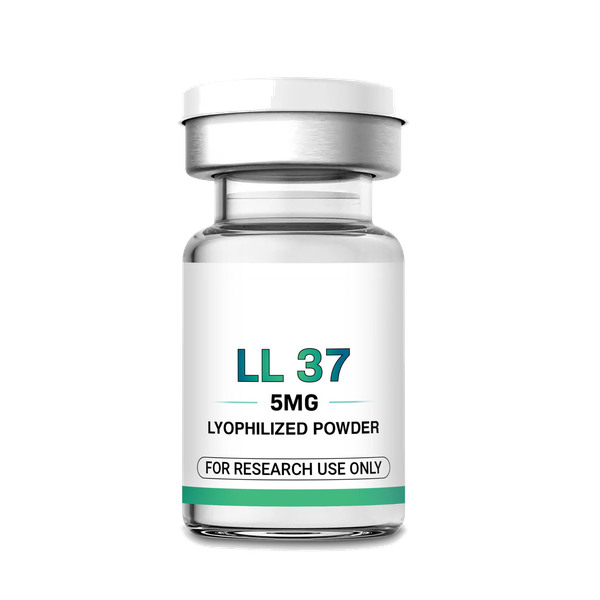
LL-37 runs on two patterns. For maintenance it is 50 to 100 mcg by subcutaneous injection, 3 to 5 times a week, in 4 week cycles with 2 weeks off. If something is coming on, it goes to 100 to 125 mcg daily for up to 4 weeks. With a 5 mg vial mixed with 3 mL of water, 100 mcg is 6 units on a U-100 syringe. These amounts come from practice, not from a dosing trial.
The amounts in this chart come from online communities. The vial label shows the total peptide in milligrams (mg). The Amount column shows a portion of that total in micrograms (mcg). The syringe mark shows how much liquid corresponds to that amount.
Syringe marks below are based on a 5 mg vial with 3 mL of water added. Change vial size or water in the calculator
| Reported | Amount | Volume | Syringe mark (U-100) | Draws per vial |
|---|
Convert your vial to mcg, because 1 mg is the same as 1,000 mcg.
Divide by your water to see how much is in 1 mL.
Find what one unit holds. A U-100 syringe has 100 units in 1 mL.
Divide your amount by what one unit holds.
Follow one step at a time. The steps use the water amount from your calculator.
Find the mg printed on your vial and enter it in the calculator. Let a frozen vial reach room temperature first.
Clean the top of the peptide vial and the water vial with an alcohol swab. Let them dry.
Draw bacteriostatic water with a sterile syringe.
Let the water run down the inside wall of the vial. This helps prevent foaming.
Roll the vial until the powder fully dissolves. Do not shake it hard.
Write today's date on the vial and refrigerate it at 2–8 °C (35.6–46.4 °F), away from light.
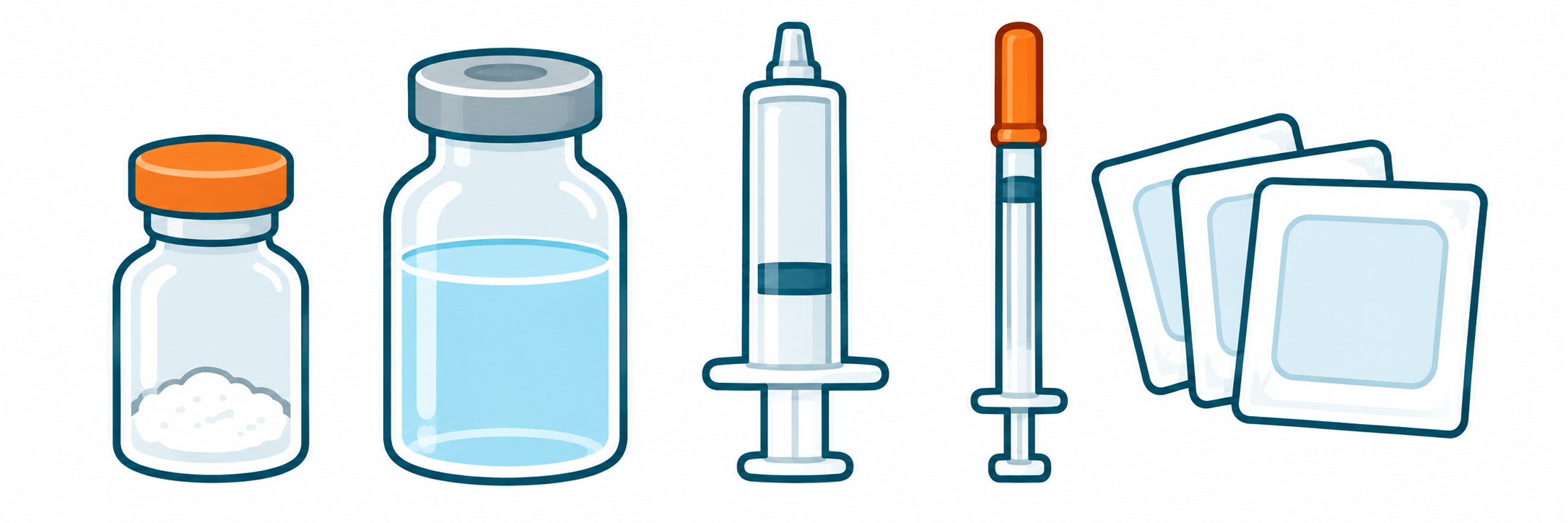
Pick how many weeks you will run it and how many shots you take each week. The list below shows everything you need.
Store at −20 °C (−4 °F) in dry, dark conditions and keep them in the original packaging.
Keep them refrigerated and away from light. How long a mixed vial lasts depends on the product, so check its stability data.
LL-37 is the only cathelicidin antimicrobial peptide found in humans. Your own neutrophils and epithelial cells make it, cut from a larger precursor called hCAP18. It is 37 amino acids long, and the name comes from the two leucines at the start.
Its structure is the whole story. One face is hydrophobic and the other carries a positive charge, and that charge is what lets it stick to bacterial membranes, which are negatively charged. Your own cell membranes are not, which is the basis of how it tells them apart.
The core of the research. Early work found activity against several bacteria including Pseudomonas aeruginosa and Staphylococcus aureus.
Reviews describe anti-biofilm activity against both Gram-positive and Gram-negative organisms along with wound healing effects, which is what drives interest in it as a topical treatment.
Beyond acting on bacteria directly, it modulates immune response and promotes angiogenesis, the growth of new blood vessels.
It has been tested against influenza A strains in vitro and in animals.
Weeks. This is an immune peptide, not a stimulant, so there is no day-one feeling to wait for. Run the cycle and judge it on how often you get sick.
Its positive charge pulls it onto negatively charged bacterial membranes. One study describes it inactivating bacteria by forming discrete lesions in the membrane, and the activity depends on the peptide assembling into a helical oligomer rather than acting alone.
Mostly in cells and animals. A 2025 study reported susceptibility across all the clinical isolates it tested, though it was small and preliminary in design.
Most of the published work applies the peptide to cells or to a wound. This page calculates a subcutaneous injection. That is a different route from the one the evidence sits in, and it is the main reason the amounts here come from practice rather than from a study.
Shorter pieces of the molecule are being developed, including KR-12, residues 18 to 29, which is the shortest fragment with confirmed antibacterial activity. Those are different molecules and their amounts are not interchangeable with full-length LL-37.
A 2025 review concluded that more work is needed on peptide design, on producing it cost-effectively, and on long-term safety and efficacy. That last one is the gap that matters for anyone using it, and it has not been filled.
Quality varies a lot between sellers. I have been around research peptides for 10 years, and BioEdge is the supplier I send my readers to. Here is why.
The Peptide Report has a business relationship with BioEdge Research Labs. BioEdge sells this product for laboratory research only. BioEdge shipping policy
LL-37 is rarely run on its own. It sits in the immune stack alongside two others.
| Stack | Ingredients | Why people stack them |
|---|---|---|
| LL-37 + Thymosin Alpha 1Two vials, both in the morning | LL-37 in one vial. Thymosin Alpha 1 in the second. | The pair that runs togetherThese two move on the same schedule. On maintenance it is LL-37 at 50 to 100 mcg 3 to 5 times a week with Thymosin Alpha 1 at 1.6 mg 2 to 3 times a week. When something is coming on, both go daily. See the Thymosin Alpha 1 dosage guide. |
| LL-37 + Thymosin Alpha 1 + ThymulinThree vials, Thymulin front-loaded | LL-37, Thymosin Alpha 1 and Thymulin in three vials. | The full immune stackThymulin does not run the whole way alongside the other two. It goes first as a 10 day course, then you maintain LL-37 and Thymosin Alpha 1 for 4 to 8 weeks after it. See the Thymulin dosage guide. |
Pick a tool and try it. Each one uses the numbers from your calculator.
Use the same four steps. Once you can solve these, you can work out the units for any vial you ever pick up.
Your score: 0 correct.
Each line on the syringe is a unit of liquid. A unit measures volume, so the amount of peptide in it depends on your mix.
Tap the syringe or move the slider. The numbers use the vial you entered above. Read the line at the top edge of the plunger.
More water makes the mix weaker, so the same amount takes up more units. The amount of peptide in the vial stays the same.
A draw under 5 units is harder to read accurately. Tap a row to use that water amount.
For maintenance, 50 to 100 mcg by subcutaneous injection 3 to 5 times a week, in 4 week cycles with 2 weeks off. If something is coming on, 100 to 125 mcg daily for up to 4 weeks.
With a 5 mg vial and 3 mL of water, 100 mcg is 6 units on a U-100 syringe, 50 mcg is 3 units and 125 mcg is 7.5 units. Use the calculator if your mix is different.
On this one, yes to both. The amount goes up to 100 to 125 mcg and the frequency goes to daily. That is different from Thymosin Alpha 1, where only the frequency changes.
It is an antimicrobial peptide your own body makes, which is not the same thing as an antibiotic you would be prescribed. Nothing published supports using it to treat an infection, and that decision belongs with a doctor.
A shorter fragment of LL-37, residues 18 to 29, and the shortest piece with confirmed antibacterial activity. It is a different molecule, so amounts do not carry over.
4 weeks, then 2 weeks off, on the maintenance pattern. The daily pattern runs up to 4 weeks. You will see an 8 week straight run quoted elsewhere, with no break in it.
Thymosin Alpha 1 is the usual partner, with Thymulin run first as a 10 day course.
Most charts assume one vial size and one water amount. If your mix is different, every unit number changes, so run your own numbers.