Powder vials
Store at −20 °C (−4 °F) in dry, dark conditions and keep them in the original packaging.

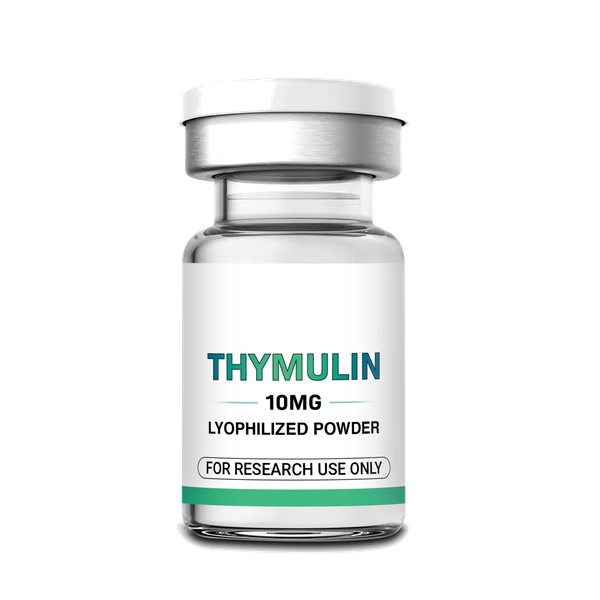
The research protocol people follow is 5 to 10 mg of Thymulin a day by subcutaneous injection for 10 days, then a break. With a 10 mg vial mixed with 1 mL of water, 5 mg is 50 units on a U-100 syringe. People repeat the course two to four times a year rather than running it continuously.
The amounts in this chart come from online communities. The vial label shows the total peptide in milligrams (mg). The Amount column shows a portion of that total in micrograms (mcg). The syringe mark shows how much liquid corresponds to that amount.
Syringe marks below are based on a 10 mg vial with 1 mL of water added. Change vial size or water in the calculator
| Reported | Amount | Volume | Syringe mark (U-100) | Draws per vial |
|---|
Convert your vial to mcg, because 1 mg is the same as 1,000 mcg.
Divide by your water to see how much is in 1 mL.
Find what one unit holds. A U-100 syringe has 100 units in 1 mL.
Divide your amount by what one unit holds.
Follow one step at a time. The steps use the water amount from your calculator.
Find the mg printed on your vial and enter it in the calculator. Let a frozen vial reach room temperature first.
Clean the top of the peptide vial and the water vial with an alcohol swab. Let them dry.
Draw bacteriostatic water with a sterile syringe.
Let the water run down the inside wall of the vial. This helps prevent foaming.
Roll the vial until the powder fully dissolves. Do not shake it hard.
Write today's date on the vial and refrigerate it at 2–8 °C (35.6–46.4 °F), away from light.
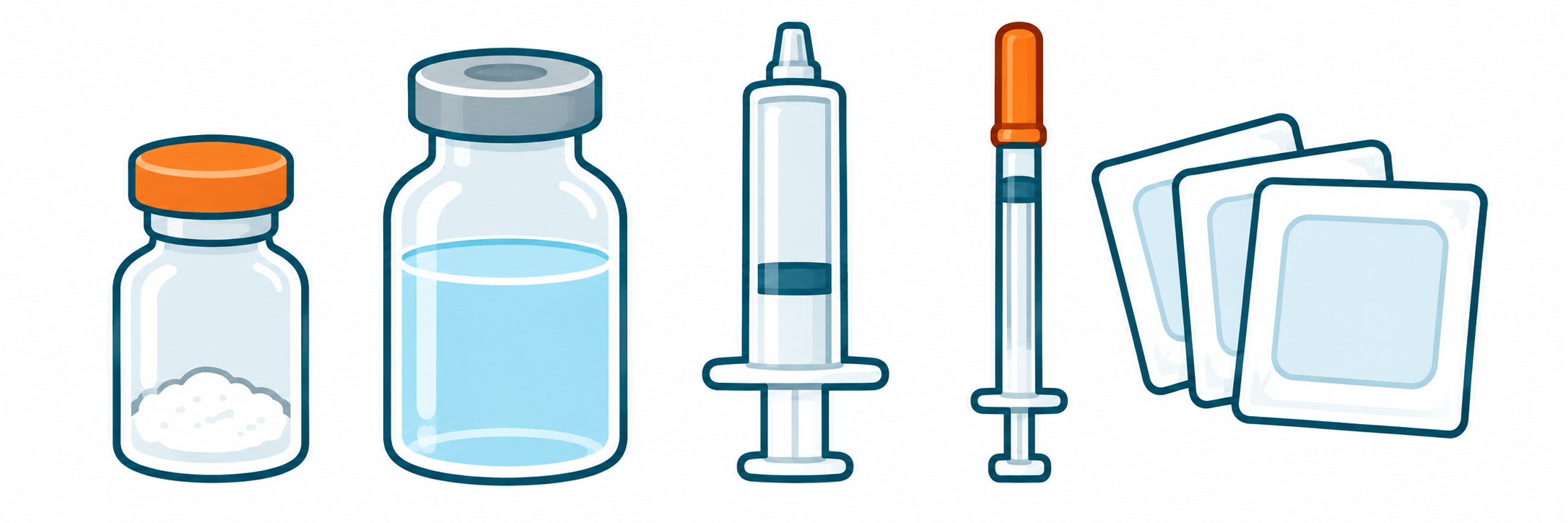
Pick how many weeks you will run it and how many shots you take each week. The list below shows everything you need.
Store at −20 °C (−4 °F) in dry, dark conditions and keep them in the original packaging.
Keep them refrigerated and away from light. How long a mixed vial lasts depends on the product, so check its stability data.
Thymulin is not a Russian bioregulator, even though it gets shelved next to them. It is a hormone your own thymus makes, nine amino acids long, and it was being studied in France in the 1970s under the name FTS, for facteur thymique serique.
The thing that makes it unusual is zinc. Thymulin only works when it is bound to zinc. The zinc-free peptide is considered largely inactive. That is not a marketing angle, it is the central finding about the molecule.
The established role. It drives T cell differentiation and boosts functions of T cell subsets.
The link between zinc and immune function runs partly through this hormone, which is the most interesting thing about it.
The thymus shrinks with age and so does its hormone output, which is the reason people look this up.
Weeks. Immune peptides do not give you a day-one signal. Run the full course and judge it on how the winter went, not on how you feel on a Tuesday.
A nonapeptide produced by thymic epithelial cells. It is a well defined thymic hormone, not a synthetic analog, and its biological activity depends on zinc.
Synthetic FTS prepared free of metals was reported inactive in the bioassay used at the time. Zinc is not optional to how this molecule works.
In mice on a marginally zinc-deficient diet, blood thymulin fell significantly as early as two months in, before the thymus itself had shrunk. Adding zinc chloride in vitro brought the levels back. The authors also proposed a feedback loop controlling its release.
A patent on the molecule notes the obvious obstacle: it breaks down fast in the body. That is the reason a well characterized hormone from the 1970s never became a treatment.
The core papers, Bach and Dardenne and Cung and colleagues in 1988, are decades old. I found no recent clinical trial results. This is a well studied molecule whose study mostly stopped.
Quality varies a lot between sellers. I have been around research peptides for 10 years, and BioEdge is the supplier I send my readers to. Here is why.
The Peptide Report has a business relationship with BioEdge Research Labs. BioEdge sells this product for laboratory research only. BioEdge shipping policy
Thymulin is the front-loaded part of the immune stack. It does not run the whole way alongside the others.
| Stack | Ingredients | Why people stack them |
|---|---|---|
| Thymulin, then Thymosin Alpha 1 + LL-37Three vials, Thymulin first | Thymulin in one vial. Thymosin Alpha 1 and LL-37 in the other two. | Order matters hereThymulin goes first as a 10 day course. Once that is done you maintain the other two for 4 to 8 weeks. Running all three the whole way is not how the stack is built. See the Thymosin Alpha 1 dosage guide and the LL-37 dosage guide. |
| Thymulin + zincOne vial plus an oral mineral | Thymulin in the vial. Zinc taken by mouth. | The one that is not optionalThymulin only works bound to zinc. The zinc-free peptide is considered largely inactive, and in zinc-deficient animals blood thymulin falls before the thymus itself shrinks. This is the rare case where a stack partner is part of the mechanism rather than an add-on. |
Pick a tool and try it. Each one uses the numbers from your calculator.
Use the same four steps. Once you can solve these, you can work out the units for any vial you ever pick up.
Your score: 0 correct.
Each line on the syringe is a unit of liquid. A unit measures volume, so the amount of peptide in it depends on your mix.
Tap the syringe or move the slider. The numbers use the vial you entered above. Read the line at the top edge of the plunger.
More water makes the mix weaker, so the same amount takes up more units. The amount of peptide in the vial stays the same.
A draw under 5 units is harder to read accurately. Tap a row to use that water amount.
The reported protocol is 5 to 10 mg a day by subcutaneous injection for 10 days, then a break before repeating two to four times a year.
With a 10 mg vial and 1 mL of water, 5 mg is 50 units on a U-100 syringe and 5 mg is 50 units. Use the calculator if your mix is different.
10 days. This is not a 12-week cycle.
Two to four times a year is what the protocol describes. The model is cumulative rather than continuous.
Thinner than the numbers make it look. The core papers are from the 1970s and 1980s and the research largely stopped. The molecule itself is well characterized, which is more than most of its shelf-mates can say.
1 mL is the usual choice, which makes 10 mg per mL and puts 5 mg at 50 units.
Most charts assume one vial size and one water amount. If your mix is different, every unit number changes, so run your own numbers.