Powder vials
Store at −20 °C (−4 °F) in dry, dark conditions and keep them in the original packaging.

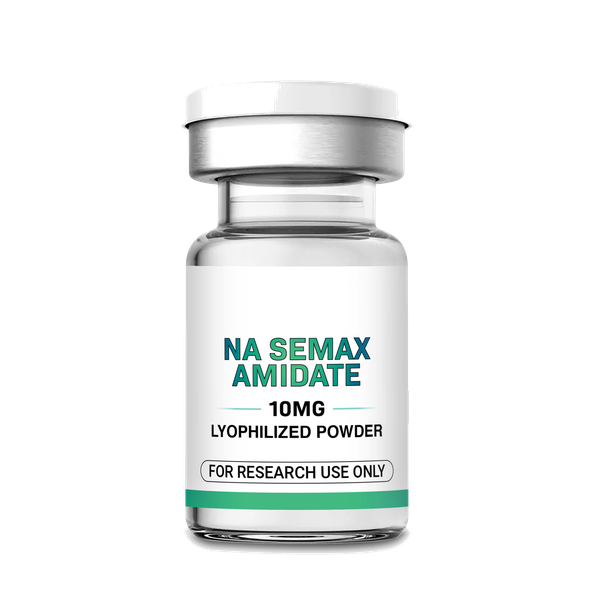
Most people use 250 to 450 mcg of N-acetyl Semax Amidate once a day by subcutaneous injection. With a 10 mg vial mixed with 3 mL of water, 300 mcg is 9 units on a U-100 syringe. No course length has been established for this modified form.
The amounts in this chart come from online communities. The vial label shows the total peptide in milligrams (mg). The Amount column shows a portion of that total in micrograms (mcg). The syringe mark shows how much liquid corresponds to that amount.
Syringe marks below are based on a 10 mg vial with 3 mL of water added. Change vial size or water in the calculator
| Reported | Amount | Volume | Syringe mark (U-100) | Draws per vial |
|---|
Convert your vial to mcg, because 1 mg is the same as 1,000 mcg.
Divide by your water to see how much is in 1 mL.
Find what one unit holds. A U-100 syringe has 100 units in 1 mL.
Divide your amount by what one unit holds.
Follow one step at a time. The steps use the water amount from your calculator.
Find the mg printed on your vial and enter it in the calculator. Let a frozen vial reach room temperature first.
Clean the top of the peptide vial and the water vial with an alcohol swab. Let them dry.
Draw bacteriostatic water with a sterile syringe.
Let the water run down the inside wall of the vial. This helps prevent foaming.
Roll the vial until the powder fully dissolves. Do not shake it hard.
Write today's date on the vial and refrigerate it at 2–8 °C (35.6–46.4 °F), away from light.
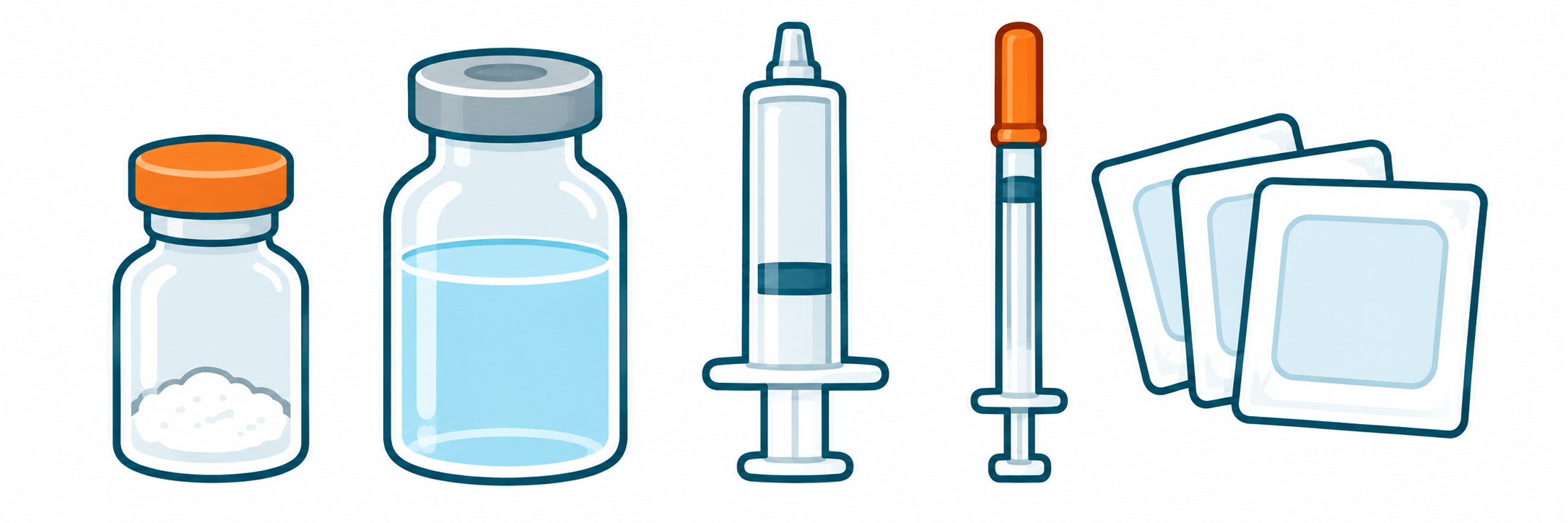
Pick how many weeks you will run it and how many shots you take each week. The list below shows everything you need.
Store at −20 °C (−4 °F) in dry, dark conditions and keep them in the original packaging.
Keep them refrigerated and away from light. How long a mixed vial lasts depends on the product, so check its stability data.
Semax comes from ACTH 4-10, a fragment of adrenocorticotropic hormone, modified so that the hormonal activity is gone and the nervous system activity is what remains. It is studied for attention, cognition and neuroprotection.
N-acetyl Semax Amidate is the modified version, built to resist being broken down as quickly. That matters for this page, because almost all of the published human work was done on the parent compound given intranasally. The amount in the vial and the amounts in the papers are not the same kind of number.
The measured human work on the parent fragment looked at attention, which is the oldest thread in this research.
The clinical trials were in stroke and motor neuron disease rather than in healthy people looking for an edge.
Angioprotective, antihypoxic and neurotrophic activity is the range of effects described in the experimental groundwork.
Inside the first hour for focus and mood, which is what this family is known for. The amidated form is built to last longer than plain Semax, so the effect tends to hold through the day instead of fading in two hours.
Gusev and colleagues published a trial in 30 people in the acute period of hemispheric ischemic stroke, against 80 patients matched for severity and lesion location on conventional therapy. The most effective daily amounts reported were 12 mg for moderate strokes and more for severe ones.
Serdiuk and colleagues ran a randomized controlled trial in 27 people with motor neuron disease. The daily amount was 12 mg as a 1% solution, intranasally, in two ten-day courses with a two-week break between them. This is the most completely specified protocol in the human record, because it gives both the concentration and the amount.
Every one of those numbers is parent Semax given intranasally. This vial holds the N-acetyl amidate form, given subcutaneously, at roughly a fortieth of the amount. Same family, different molecule, different route, different scale. Reading one across to the other is exactly the mistake worth avoiding.
A 1% solution means 10 mg per millilitre and 0.1% means 1 mg per millilitre. That is a concentration. To get from a concentration to an amount you need the volume actually delivered, which is why so many Semax figures online do not add up.
One milligram is 1,000 micrograms. A 2018 figure of 6,000 mcg a day is 6 mg a day, half of the 12 mg in the earlier trials. Written in the same unit they are obviously related. Written in different units they look unrelated, which is how a lot of confusion starts.
Quality varies a lot between sellers. I have been around research peptides for 10 years, and BioEdge is the supplier I send my readers to. Here is why.
The Peptide Report has a business relationship with BioEdge Research Labs. BioEdge sells this product for laboratory research only. BioEdge shipping policy
Pick a tool and try it. Each one uses the numbers from your calculator.
Use the same four steps. Once you can solve these, you can work out the units for any vial you ever pick up.
Your score: 0 correct.
Each line on the syringe is a unit of liquid. A unit measures volume, so the amount of peptide in it depends on your mix.
Tap the syringe or move the slider. The numbers use the vial you entered above. Read the line at the top edge of the plunger.
More water makes the mix weaker, so the same amount takes up more units. The amount of peptide in the vial stays the same.
A draw under 5 units is harder to read accurately. Tap a row to use that water amount.
250 to 450 mcg once a day by subcutaneous injection, for the N-acetyl amidate form. No course length has been established for this form.
With a 10 mg vial and 3 mL of water, 300 mcg is 9 units on a U-100 syringe. 250 mcg is 7.5 units and 450 mcg is 13.5 units. Use the calculator if your mix is different.
Because they are not the same thing. The trials used parent Semax intranasally. This is the N-acetyl amidate form by subcutaneous injection. Different molecule, different route, and about forty times the amount.
No. The amidate form is modified to resist being broken down as fast. Amounts reported for one should not be assumed to apply to the other, so check what your vial says.
10 mg per millilitre. 0.1% is 1 mg per millilitre. That is a concentration, not a dose. You need the volume delivered to turn it into an amount.
Nothing published establishes one for this form. The two ten-day courses with a two-week break in the trial record belong to parent Semax given intranasally.
Most charts assume one vial size and one water amount. If your mix is different, every unit number changes, so run your own numbers.