

The hardest part of testing a memory drug in healthy people is that healthy people vary. In one of the trials below, the spread inside a group of 14 students was wide enough on its own to swallow any change the treatment might have made. In 1985 one research group dealt with that problem by running their vasopressin experiment on twins, so that every volunteer was compared against their own co-twin rather than against a stranger.
That is how seriously this question was once taken. For two decades, vasopressin and the molecules built from it were the closest thing this field had to a cognitive enhancer, and they were tested on students, on older adults, on people with memory disorders, and on people whose bodies make almost none of the hormone at all. Here is what those trials measured and what actually moved.
Where the Idea Came From
Vasopressin is a nine-amino-acid hormone released from the back of the pituitary, and its day job is holding on to water. The reason it ended up in memory research is that it does other things on the way. David de Wied spent the 1960s and 1970s reporting the behavioral actions of the pituitary’s own peptides in rats, a series that later authors summed up as showing vasopressin can influence the memory process in that animal, and that he gathered in the Proceedings of the Royal Society in 1980. Legros and Timsit-Berthier, reviewing the clinical side in 1988, date the central nervous system effects to de Wied’s rat experiments in 1965.
The human record opens on a single day. On 7 January 1978 The Lancet carried two short reports back to back: Legros and colleagues on vasopressin and learning and memory, and Oliveros and colleagues on vasopressin in amnesia. Three years later Weingartner and colleagues published the result that made the idea travel, in Science in 1981. They gave desmopressin for several days to adults who were cognitively unimpaired and to adults who were impaired, and reported that both groups learned information more effectively, measured by the completeness, the organization and the consistency of what they recalled.
Two things about that sentence are worth holding on to, because the next fifteen years turn on them. The measure was not simply how many items came back. And the molecule was not vasopressin itself but desmopressin, one of several analogs built to keep the brain effects while dropping as much of the water effect as possible. The other one you will meet below is desglycinamide-arginine-vasopressin, usually shortened to DGAVP, which is vasopressin with the terminal glycinamide taken off, as the name says.
What a Memory Trial Actually Measures
Almost every study in this literature comes down to a short battery of pencil-and-paper and reaction-time tasks. If you have read a modern peptide study and wondered what “improved memory” meant in practice, it meant one of these.
| Test | What the volunteer does | What it is read as |
|---|---|---|
| Digit span | Repeats back a string of digits that gets longer each trial | How much can be held at once |
| Word list learning | Hears a list of 15 or 16 unrelated words, usually five times over, and recalls as many as possible each time | Learning across repetition |
| Delayed recall | Recalls the same list after a gap of minutes, a day or a week | What survived the gap |
| Forced-choice recognition | Picks the word or face that was shown earlier out of a pair | Recognition, which survives when recall does not |
| Prose or sentence recall | Reads or hears passages or sentences, then reproduces them | Memory for connected meaning |
| Sternberg memory comparison | Decides, as fast as possible, whether a digit was in a set just memorized | Speed of searching memory, not its size |
Those last two columns matter more than they look. A peptide can leave the number of recalled words untouched and still change which words come back, or how fast the answer arrives. Several of the trials below did exactly that, and the arguments about what vasopressin does to the brain are mostly arguments about how to read that kind of result.
The Trials That Moved a Score
Two names recur through the early healthy-volunteer work: Beckwith and Till, and Bruins.
Beckwith and colleagues reported in Peptides in 1984 that healthy young men given desmopressin remembered implicational sentences better than control subjects did, and that the same treatment did nothing for women doing the same task. Till and Beckwith followed it in 1985 with a crossover design, 60 micrograms of intranasal desmopressin with a week between sessions. Immediate memory improved in the first session but not the second, and mostly in volunteers who scored low on verbal ability; delayed recall a week later improved in the opposite group. Their reading was that the effect sat at retrieval, and that individual differences were going to matter.
Millar and colleagues, in Psychological Medicine in 1987, found that desmopressin improved short-term recall in healthy men and reduced the memory damage done by alcohol, while leaving semantic retrieval and simple reaction time alone. They put the benefit at the front end, in learning and early consolidation.
The DGAVP studies pointed the same way. Bruins and colleagues, in Neuropsychobiology in 1990, gave 12 healthy students a single 2 milligram intranasal dose and tested them with the Buschke restrictive reminding method, which separates what gets stored from what gets retrieved. Storage improved; retrieval moved less; attention and mood did not move at all. Five years later, in Peptides in 1995, Bruins and colleagues ran both an acute 2 milligram dose and two weeks at 1 milligram a day in men and women. Initial storage of abstract words improved in the men after the two-week course and not in the women, and the improvement outlasted the treatment. Concrete words did not budge. In both sexes, chronic dosing cut the reaction time for scanning digits in the Sternberg task, while visual memory, vigilance, attention, mood and blood pressure stayed where they were.
Look at what moved in each of those results and it is always narrow: one class of material, one sex, one phase of the task, or the speed of a search rather than its depth.
The Trials That Did Not
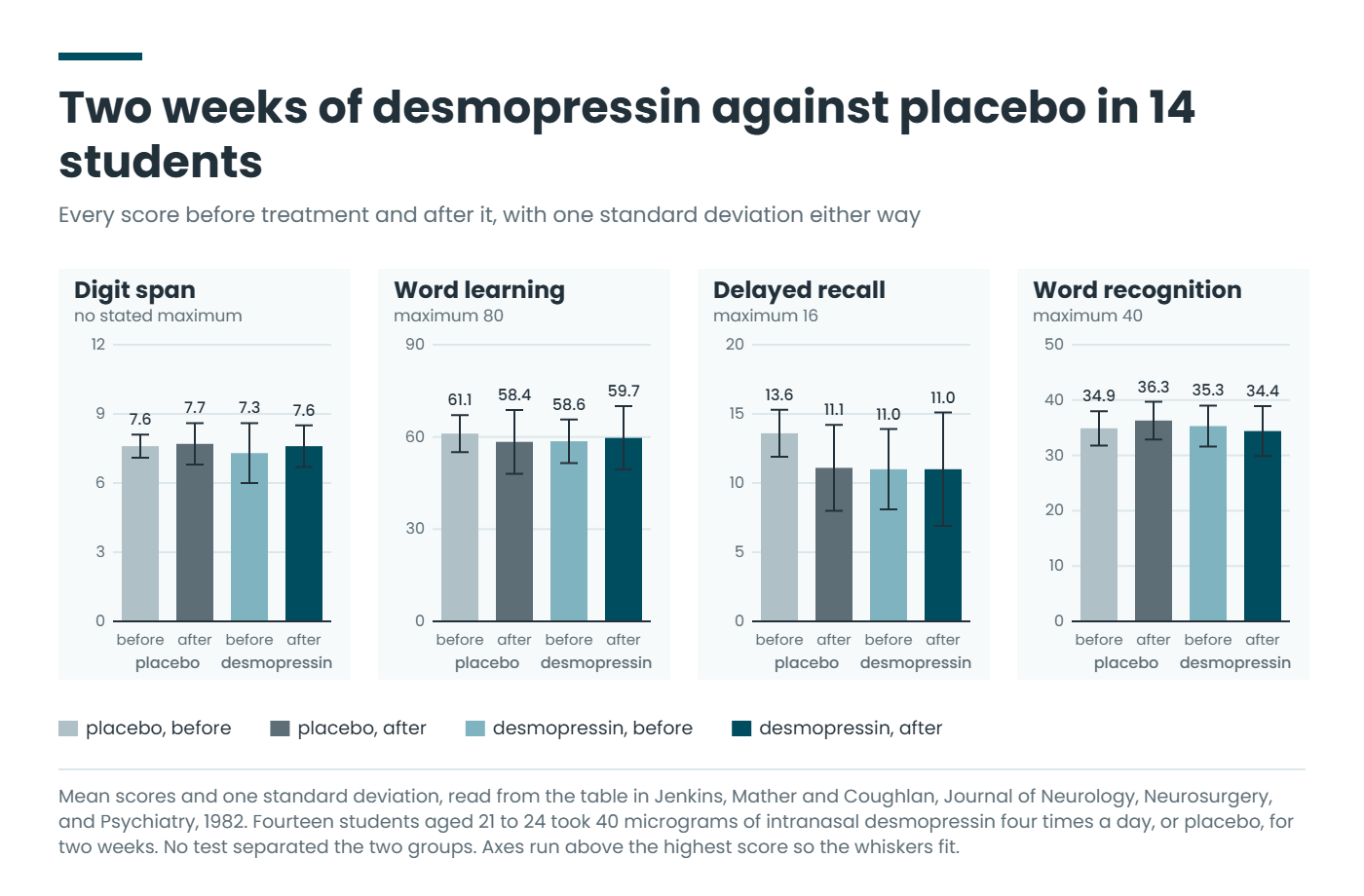
The clearest of these is small, old and worth reading in full. Jenkins, Mather and Coughlan published a short report in the Journal of Neurology, Neurosurgery, and Psychiatry in 1982. Fourteen students aged 21 to 24, ten men and four women, were tested on digit span, learning a list of 16 words over five trials, delayed recall of those words, and forced-choice recognition against 40 word pairs. Half were randomized to 40 micrograms of intranasal desmopressin four times a day for two weeks, half to placebo on the same schedule, and everyone was retested on a second version of each task. Every student was held to one liter of fluid a day, which tells you how much of the hormone’s day job was still in play.
Nothing separated the groups on any of the four tests. The figure above is their own table: the bars move a little in both directions, and the spread within each group swallows the difference. The same paper ran a double-blind crossover in four patients with memory disorders, a week of desmopressin against a week of placebo a month apart, with three versions of every test rotated through a restricted Latin square. None of the patients improved on any procedure. The authors’ conclusion was that desmopressin reaches the cerebrospinal fluid well enough, and that the pair of them were of little practical use where memory loss was the main problem.
Guard and colleagues, in Neuropsychobiology in 1986, ran a larger version with the parent hormone included. Forty healthy students: ten took 23 international units of lysine vasopressin a day in three divided doses for 15 days, ten took 20 micrograms of desmopressin a day for 15 days, twenty took placebo, all by the nasal route. Verbal span, verbal retention, visual retention, visual learning and verbal learning were tested before and after, with the contents of the tests changed to stop familiarity doing the work. No comparison reached significance, in either direction.
Then the twins. Fehm-Wolfsdorf and colleagues, in Peptides in 1985, used the co-twin control method precisely to get more power out of a small sample, with lysine vasopressin, two tasks, and an electroencephalogram (EEG) recording alongside blood pressure and heart rate. No specific memory measure improved. The electrical activity of the brain did change, while blood pressure and heart rate did not, which told them the peptide was reaching the brain and doing something there. Their own summary was that interpreting those effects in terms of memory processing did not seem justified.
Two alcohol experiments close the set. Eisenhofer and colleagues, in Life Sciences in 1985, gave 26 volunteers intranasal desmopressin or placebo before alcohol and found the memory deficit unchanged. Sahgal and colleagues, in Psychopharmacology in 1986, used an hour-long visual search task, hunting target digits in a long stream of characters. A low dose of alcohol tended to improve performance and a higher dose disrupted it, and 20 or 60 micrograms of desmopressin did nothing whatsoever. The task was sensitive enough to catch alcohol moving in both directions. The peptide left it alone.
What Changed When the Total Did Not
Give someone a list of 15 words and the position of a word in that list predicts whether it comes back. The first words of the list do well, an effect called primacy. So do the last few, called recency. The middle sags. Draw the recall rate against position and you get a U.
Pietrowsky and colleagues, in Peptides in 1988, gave DGAVP or placebo to 13 healthy men and read them ten lists of 15 words each for free recall. The total number of words recalled was no different between the two conditions. The shape of the curve was. Primacy was flattened and recency was lifted. The authors wrote that the pattern may be consistent with an effect on general arousal, and were careful to add that the experiment had not been built to test that. That reading was not new in their group: a single-case study in Neuropsychobiology in 1984 by Fehm-Wolfsdorf and colleagues, twelve sessions of vasopressin or placebo with classic laboratory tasks, introspective reports and electrophysiology side by side, had already placed the action at the earlier stages of information processing and called the memory enhancement an indirect effect.
Nine years later the same question got a much longer run. Perras and colleagues, in Psychoneuroendocrinology in 1997, gave 26 healthy older people 40 international units of intranasal vasopressin a day for three months, randomized, placebo-controlled and double-blind, with the Auditory Verbal Learning Test and its repeated 15-word lists as the outcome. Three months of a peptide produced no general effect on memory. Two specific things did change. Recall of an interfering second list improved, which is less proactive interference: the first list got in the way less. And the serial position curve moved again, this time in the other direction: primacy up, recency down. Their reading was better semantic encoding, which is to say an effect that starts in attention.
So the two serial-position results point opposite ways, and both groups reached past memory itself for the explanation. Something is happening early, in how the material is taken in.
Shape the curve, keep the total
Fifteen words, read out once. Pick a condition and watch which positions come back, and what the total does.
A teaching model with made-up recall rates, not measured data. The two shift directions are the ones reported in healthy volunteers: primacy flattened and recency lifted after DGAVP (Pietrowsky 1988), primacy lifted and recency lowered after three months of vasopressin (Perras 1997). Both trials reported no change in the total number of words recalled, which is why the total here does not move either.
Before Learning or After It
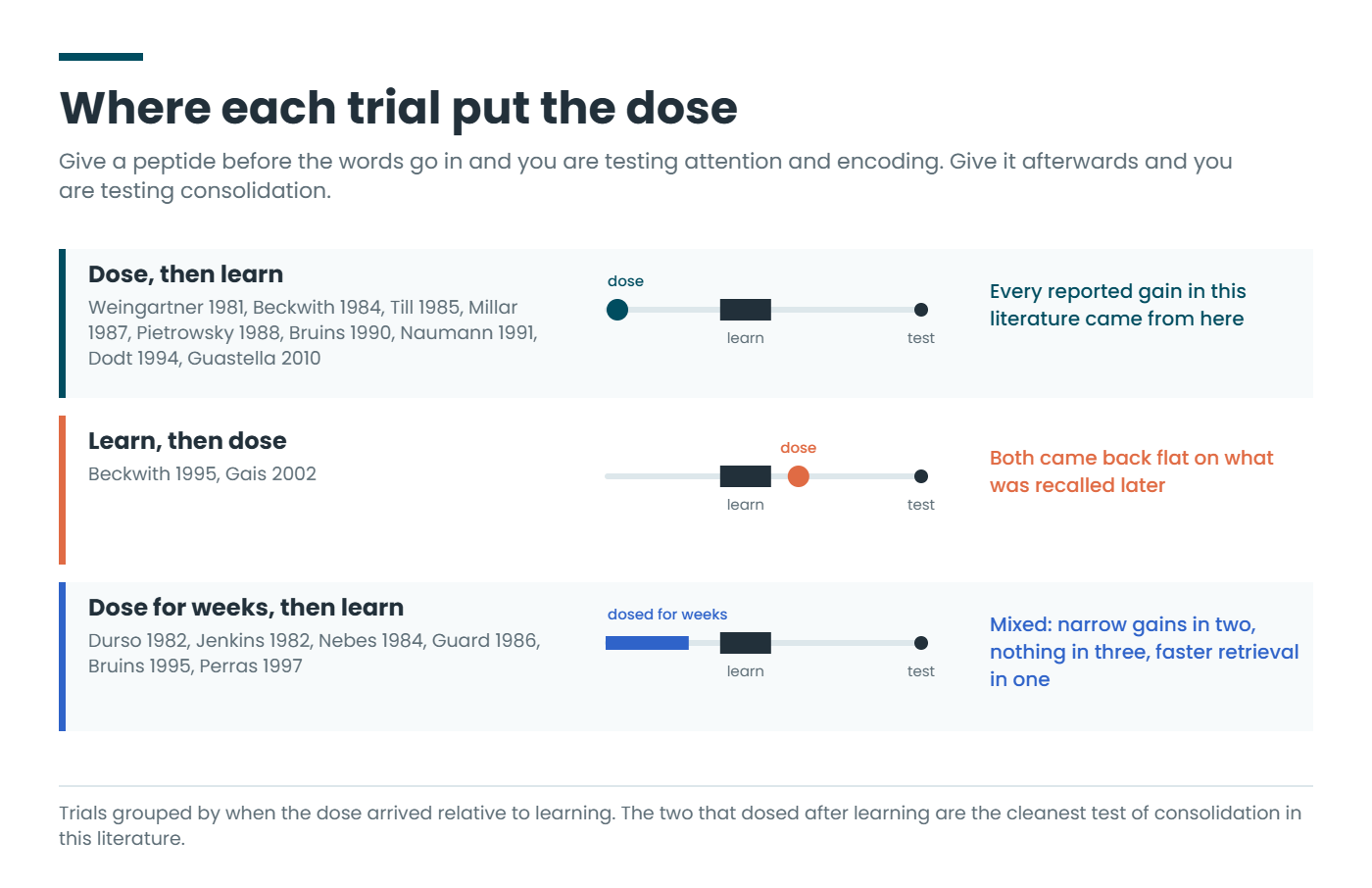
There is a cleaner way to ask the same question, and it comes from animal work. If a compound still changes memory when it is given after the learning is finished, it is acting on consolidation, the slow filing process that runs for hours afterwards. If it only works when given beforehand, it is acting on encoding, or on something even earlier like attention.
Beckwith and colleagues ran that test in Peptides in 1995. Healthy young men learned prose passages first, and only then received 60 micrograms of intranasal desmopressin or saline, double-blind. Recall was measured 24 hours later and was no different. Their conclusion was that vasopressin acts on acquisition rather than consolidation.
Gais and colleagues pushed it further in Peptides in 2002, giving 40 international units of intranasal vasopressin after learning and then tracking declarative memory across different intervals of sleep and waking. Consolidation was untouched. The electroencephalogram, again, was not: it showed a clear arousing influence. Same split as the twin study seventeen years earlier. The brain registers the peptide. The memory score does not.
What the Electrodes Saw
If the action is early, the place to look is the electrical response to a stimulus rather than the recall score afterwards. Event-related potentials pick out components a few hundred milliseconds after a sound or an image, and two of them come up repeatedly here, the N2 and the P3, both tied in this work to how the brain handles novel, unexpected or salient events.
Naumann and colleagues, in Peptides in 1991, ran two experiments, one with three doses of 10 international units of nasal vasopressin and one with 20 international units. Memory performance improved in the first. The potential evoked by the plain oddball task did not move at all, while the response during an encoding task using emotional adjectives did, and in both studies the scalp distribution of the P3 shifted. At the lower dose, emotionally loaded adjectives, pleasant and unpleasant alike, drew a larger P3 than neutral ones. Their conclusion was that vasopressin changes how the emotional content of a stimulus gets processed.
Dodt and colleagues, in the Journal of Gerontology in 1994, brought age into it with 22 older and 28 younger healthy volunteers tested on two consecutive days. Everyone had placebo on day one; on day two, 11 of the older and 15 of the younger got vasopressin, three doses of 10 international units in each nostril, spread over the day before testing. The aging signature was there in the baseline: N2 and P3 latencies were longer in the older group and P3 amplitude was smaller, at a p-value below 0.01. Vasopressin enlarged the N2 in both age groups at a p-value below 0.05, but it only enlarged the N2 to P3 difference in the young, and the age-related signs in the potentials stayed exactly where they were.
Born, Pietrowsky and Fehm pulled the human work together in Progress in Brain Research in 1998. Their summary was that vasopressin can improve declarative memory formation, that the effect centers on encoding, and that the electrical findings are consistent: mismatch negativity and P3 both increase, and both are tied to how the hippocampus handles novel, unexpected and salient events. They also concluded that voluntary selective attention and arousal are not the primary targets, which sits against the arousal readings offered elsewhere in the same literature, including by some of the same people.
Older Adults and Memory Disorders
Nebes and colleagues, in Psychiatry Research in 1984, took the speed route instead of the recall route. Young and older men took 60 micrograms of vasopressin a day for a week and placebo for another week, in a double-blind crossover, and were timed retrieving from short-term, long-term and semantic memory. Semantic retrieval time and simple vocal reaction time did not change. Memory comparison time, perceptual-motor time and long-term retrieval time all dropped, and the size of the gain was much the same in the young as in the old.
Durso and colleagues, in Neurology in 1982, ran lysine vasopressin at 16 units a day for ten days against placebo in two groups of seven patients with Alzheimer’s disease. Learning, memory and perception did not separate the groups. Reaction time improved significantly more in the treated group, although the authors noted it arrived late and might have had causes other than the peptide.
Legros and Timsit-Berthier, reviewing clinical practice in 1988, read the same record as a stimulant effect in healthy people, most visible in middle-aged men, with the best chance of helping memory problems of recent onset, which they put at less than two years, and no major neurological damage behind them. They also flagged changes in sociability and mood that ran independently of memory, and thought those deserved their own trials.
The People Who Make Too Little of It
There is a natural experiment sitting underneath all of this. In central diabetes insipidus the body makes or releases too little vasopressin, and the obvious prediction is that memory should suffer.
Laczi and colleagues tested it twice. In Psychoneuroendocrinology in 1982 they reported that patients with central diabetes insipidus were impaired on short-term and long-term memory compared with healthy individuals, but not on attention and concentration, and that a single intramuscular injection or a sub-chronic nasal course of either lysine vasopressin or desmopressin normalized those memory scores, while also improving memory in the healthy group. In Acta Endocrinologica in 1983 they ran DGAVP the same way: an acute intramuscular dose improved some aspects of short-term memory, the nasal course did it more consistently and reached long-term memory too, and the gains outlasted the treatment. Attention improved only in the people without diabetes insipidus. Nothing moved in water and electrolyte handling, blood pressure or pulse, which is the point of using that analog.
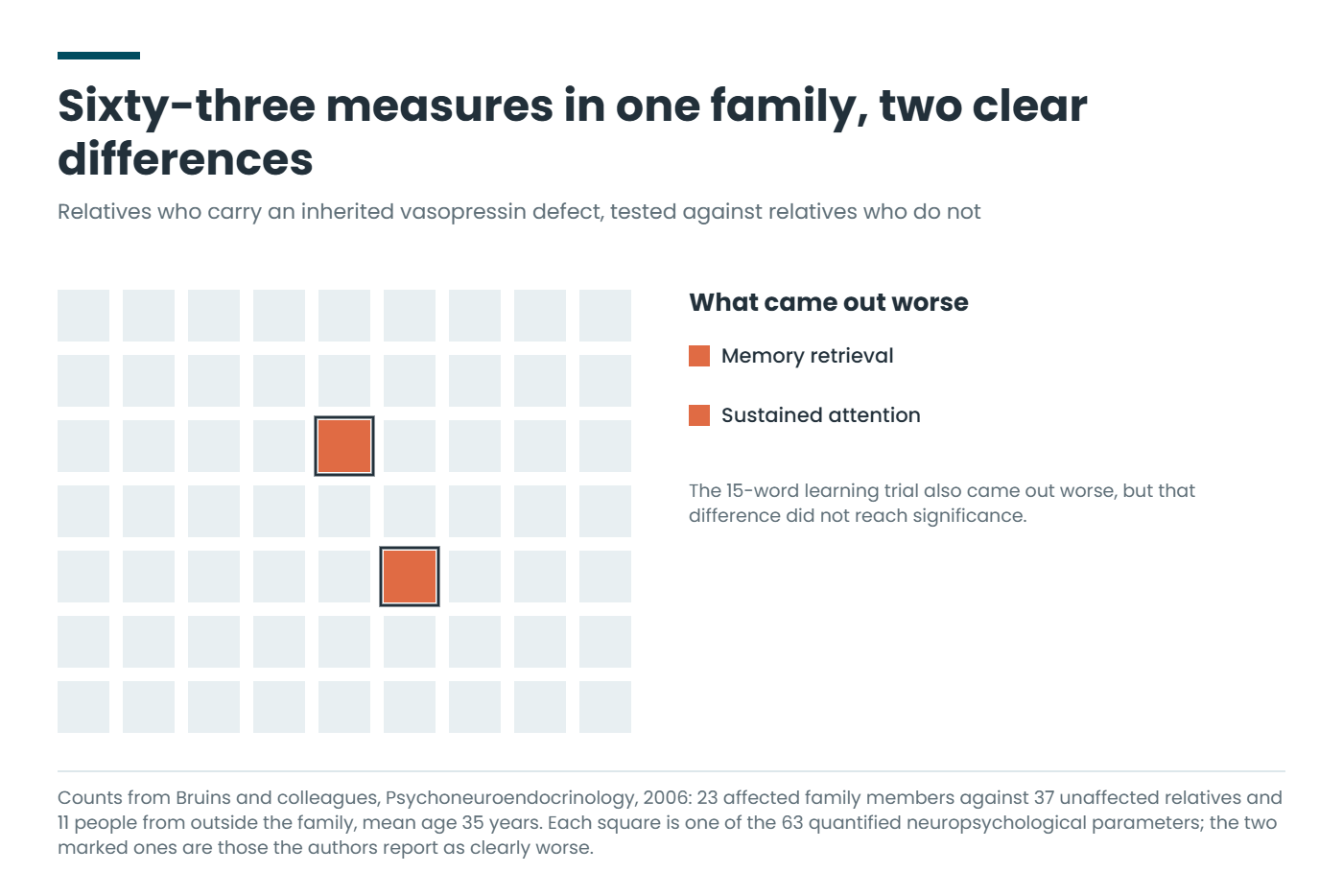
The biggest of them came from a family. Bruins and colleagues, in Psychoneuroendocrinology in 2006, studied a large family carrying an inherited defect in the vasopressin prohormone gene: 23 affected members against 37 adult volunteers from the same family and 11 people from outside it, mean age 35 years. They quantified 63 neuropsychological parameters. Few of them differed. Memory retrieval and sustained attention came out worse in the affected members, and performance on the 15-word learning trial was worse without reaching significance. Relatives did report noticing forgetfulness and slow recall in daily life. The authors’ own reading was that the brain’s vasopressin supply is probably less affected in this condition than the supply that handles water balance.
Nabe and colleagues put the hypothesis on the record in Medical Hypotheses in 2007, arguing that cognitive function is worth testing when central diabetes insipidus is diagnosed. That is a proposal rather than a finding.
Where the Same Molecule Went Next
The memory program wound down, and vasopressin reappeared in social neuroscience. Guastella and colleagues, in Biological Psychiatry in 2010, gave 20 international units of intranasal vasopressin or placebo to 48 healthy men, showed them 54 happy, angry and neutral faces, and brought them back the next day to judge 108 faces as remembered, known or new. The treated men were more likely to report knowing previously seen happy and angry faces than neutral ones, and the peptide did nothing to judgments about faces they had never seen. It did not make memory bigger. It changed which faces earned a place in it.
That is the same shape as the serial-position results and the emotional-adjective potentials from two decades earlier. If you want the rest of the current landscape, our review of nootropic peptides and what the human studies measured covers the molecules now carrying this question, and the work on peptides and creativity picks up the thread where the outcome is originality rather than recall. For single compounds studied the modern way, there is Selank and what the intranasal studies measured, and our guide to Semax and the brain research behind it.
Doses Used in the Research
Every amount below comes from a human study, with the route the investigators used.
- Desmopressin, healthy students: 40 micrograms intranasally four times a day for two weeks (Jenkins 1982); 20 micrograms a day intranasally for 15 days (Guard 1986).
- Desmopressin, healthy young men: 60 micrograms intranasally as a single dose, before learning (Till 1985) or straight after it (Beckwith 1995).
- Desmopressin, healthy young adults on a vigilance task: 20 or 60 micrograms intranasally as a single dose (Sahgal 1986).
- Desmopressin, patients with memory disorders: 40 micrograms intranasally four times a day for one week, crossed over against placebo (Jenkins 1982).
- Lysine vasopressin, healthy students: 23 international units a day intranasally in three divided doses for 15 days (Guard 1986).
- Lysine vasopressin, people with Alzheimer’s disease: 16 units a day for ten days; the report does not give the route (Durso 1982).
- Vasopressin, young and older healthy men: 60 micrograms a day for a week; the report does not give the route (Nebes 1984).
- Vasopressin, healthy older adults: 40 international units a day intranasally for three months (Perras 1997).
- Vasopressin, healthy adults after learning: 40 international units intranasally (Gais 2002).
- Vasopressin, healthy young and older adults: three doses of 10 international units in each nostril spread over the preceding day (Dodt 1994).
- Vasopressin, healthy adults in event-related potential work: three doses of 10 international units nasally in one experiment, 20 international units in the other (Naumann 1991).
- Vasopressin, healthy men viewing faces: 20 international units intranasally as a single dose (Guastella 2010).
- DGAVP, healthy men and women: 2 milligrams intranasally as a single dose, and 1 milligram a day intranasally for two weeks (Bruins 1990, Bruins 1995).
Frequently Asked Questions
Do peptides improve memory in healthy people?
In this family of molecules the healthy-volunteer trials split. Several found narrow gains in storage, in sentence recall, or in the speed of searching memory, and several carefully run trials found nothing at all on a standard battery. What held up best was not an increase in how much came back, but a change in which material came back.
What is DDAVP, and why does it keep coming up?
DDAVP is desmopressin, an analog of vasopressin built to keep the central effects while limiting the water-handling ones. It runs through a large share of this literature because it was available, it was given as a nasal spray, and the investigators had evidence it reached the cerebrospinal fluid.
Did vasopressin help in Alzheimer’s disease?
No learning, memory or perception measure separated the treated patients from placebo in the trial by Durso and colleagues, and none of the four patients with memory disorders in the Jenkins crossover improved on any procedure. Reaction time was the single measure that moved, and the authors who saw it were cautious about the cause.
What does the serial position curve tell you?
It separates two things that a single recall total hides. If a treatment lifts the last few words of a list, arousal is a reasonable bet; if it lifts the first few, encoding and attention are the better explanation. Two trials in this literature moved that curve in opposite directions.
Does the effect differ between men and women?
Two separate groups reported gains in men and not in women on the same task, one with desmopressin and sentence memory, one with DGAVP and the storage of abstract words. Neither study was built to explain the difference, and both had small samples.
Does vasopressin act on consolidation?
The two trials that gave it after learning found nothing, one on prose recall a day later and one on declarative memory across sleep and waking. Both groups read that as evidence the peptide acts at encoding rather than during the filing that happens afterwards.
Do people who make too little vasopressin have worse memories?
A little worse, in the studies that have looked. Patients with central diabetes insipidus scored below healthy controls on memory but not on attention in the trials by Laczi and colleagues, and in a large family carrying an inherited defect, memory retrieval and sustained attention were the two measures out of 63 that came out clearly worse.
Stay sharp,
Joe Mars
The Peptide Report
P.S. If you want to argue about any of these trials with people who have read them, the conversation is at https://www.skool.com/peptides-biohacking-hub.
References
- de Wied D. Behavioural actions of neurohypophysial peptides. Proc R Soc Lond B Biol Sci. 1980;210(1178):183-195. DOI
- Legros JJ, Timsit-Berthier M. Vasopressin and vasopressin analogues for treatment of memory disorders in clinical practice. Prog Neuropsychopharmacol Biol Psychiatry. 1988;12 Suppl:S71-S86. DOI
- Legros JJ, Gilot P, Seron X, Claessens J, Adam A, Moeglen JM, Audibert A, Berchier P. Influence of vasopressin on learning and memory. Lancet. 1978;1(8054):41-42. DOI
- Oliveros JC, Jandali MK, Timsit-Berthier M, Remy R, Benghezal A, Audibert A, Moeglen JM. Vasopressin in amnesia. Lancet. 1978;1(8054):42. DOI
- Weingartner H, Gold P, Ballenger JC, Smallberg SA, Summers R, Rubinow DR, Post RM, Goodwin FK. Effects of vasopressin on human memory functions. Science. 1981;211(4482):601-603. DOI
- Beckwith BE, Till RE, Schneider V. Vasopressin analog (DDAVP) improves memory in human males. Peptides. 1984;5(4):819-822. DOI
- Till RE, Beckwith BE. Sentence memory affected by vasopressin analog (DDAVP) in cross-over experiment. Peptides. 1985;6(3):397-402. DOI
- Millar K, Jeffcoate WJ, Walder CP. Vasopressin and memory: improvement in normal short-term recall and reduction of alcohol-induced amnesia. Psychol Med. 1987;17(2):335-341. DOI
- Bruins J, Kumar A, Schneider-Helmert D. Influence of desglycinamide-(arg8) vasopressin on memory in healthy subjects. Neuropsychobiology. 1990;23(2):82-88. DOI
- Bruins J, Hijman R, Van Ree JM. Effect of acute and chronic treatment with desglycinamide-[Arg8]vasopressin in young male and female volunteers. Peptides. 1995;16(2):179-186. DOI
- Jenkins JS, Mather HM, Coughlan AK. Effect of desmopressin on normal and impaired memory. J Neurol Neurosurg Psychiatry. 1982;45(9):830-831. DOI
- Guard O, Marchal G, Graule A, Dumas R, D’Athis P. Effects of vasopressin and desmopressin on memory. A double-blind study in 40 healthy volunteers. Neuropsychobiology. 1986;15(2):80-83. DOI
- Fehm-Wolfsdorf G, Born J, Elbert T, Voigt KH, Fehm HL. Vasopressin does not enhance memory processes: a study in human twins. Peptides. 1985;6(2):297-300. DOI
- Fehm-Wolfsdorf G, Born J, Voigt KH, Fehm HL. Behavioral effects of vasopressin. Neuropsychobiology. 1984;11(1):49-53. DOI
- Eisenhofer G, Lambie DG, Robinson BJ. No improvement in ethanol-induced memory deficits after administration of a vasopressin analog. Life Sci. 1985;37(26):2499-2505. DOI
- Sahgal A, Wright C, Ferrier IN. Desamino-D-arg8-vasopressin (DDAVP), unlike ethanol, has no effect on a boring visual vigilance task in humans. Psychopharmacology (Berl). 1986;90(1):58-63. DOI
- Pietrowsky R, Fehm-Wolfsdorf G, Born J, Fehm HL. Effects of DGAVP on verbal memory. Peptides. 1988;9(6):1361-1366. DOI
- Perras B, Droste C, Born J, Fehm HL, Pietrowsky R. Verbal memory after three months of intranasal vasopressin in healthy old humans. Psychoneuroendocrinology. 1997;22(6):387-396. DOI
- Beckwith BE, Petros TV, Bergloff PJ, Swenson RR, Paulson R. Failure of posttrial administration of vasopressin analogue (DDAVP) to influence memory in healthy, young, male volunteers. Peptides. 1995;16(8):1327-1328. DOI
- Gais S, Sommer M, Fischer S, Perras B, Born J. Post-trial administration of vasopressin in humans does not enhance memory formation. Peptides. 2002;23(3):581-583. DOI
- Naumann E, Bartussek D, Kaiser W, Fehm-Wolfsdorf G. Vasopressin and cognitive processes: two event-related potential studies. Peptides. 1991;12(6):1379-1384. DOI
- Dodt C, Pietrowsky R, Sewing A, Zabel A, Fehm HL, Born J. Effects of vasopressin on event-related potential indicators of cognitive stimulus processing in young and old humans. J Gerontol. 1994;49(4):M183-M188. DOI
- Born J, Pietrowsky R, Fehm HL. Neuropsychological effects of vasopressin in healthy humans. Prog Brain Res. 1998;119:619-643. DOI
- Nebes RD, Reynolds CF 3rd, Horn LC. The effect of vasopressin on memory in the healthy elderly. Psychiatry Res. 1984;11(1):49-59. DOI
- Durso R, Fedio P, Brouwers P, Cox C, Martin AJ, Ruggieri SA, Tamminga CA, Chase TN. Lysine vasopressin in Alzheimer disease. Neurology. 1982;32(6):674-677. DOI
- Laczi F, Valkusz Z, László FA, Wagner A, Járdánházy T, Szász A, Szilárd J, Telegdy G. Effects of lysine-vasopressin and 1-deamino-8-D-arginine-vasopressin on memory in healthy individuals and diabetes insipidus patients. Psychoneuroendocrinology. 1982;7(2-3):185-193. DOI
- Laczi F, van Ree JM, Wagner A, Valkusz Z, Járdánházy T, Kovács GL, Telegdy G, Szilárd J, László FA, de Wied D. Effects of desglycinamide-arginine-vasopressin (DG-AVP) on memory processes in diabetes insipidus patients and non-diabetic subjects. Acta Endocrinol (Copenh). 1983;102(2):205-212. DOI
- Bruins J, Kovács GL, Abbes AP, Burbach JPH, van den Akker ELT, Engel H, Franken AAM, de Wied D. Minor disturbances in central nervous system function in familial neurohypophysial diabetes insipidus. Psychoneuroendocrinology. 2006;31(1):80-91. DOI
- Nabe K, Honjo S, Ikeda H, Wada Y, Nomura K, Hamamoto Y, Koh T, Tatsuoka Y, Koshiyama H. Diabetes insipidus and cognitive function. Med Hypotheses. 2007;69(4):764-766. DOI
- Guastella AJ, Kenyon AR, Alvares GA, Carson DS, Hickie IB. Intranasal arginine vasopressin enhances the encoding of happy and angry faces in humans. Biol Psychiatry. 2010;67(12):1220-1222. DOI