Powder vials
Store at −20 °C (−4 °F) in dry, dark conditions and keep them in the original packaging.


Most people use 5 mg of TB-500 twice a week. With a 10 mg vial mixed with 1 mL of water, that is 50 units on a U-100 syringe. Most people run it for 12 weeks alongside BPC-157, once or twice a year.
The amounts in this chart come from online communities. The vial label shows the total peptide in milligrams (mg). The Amount column shows a portion of that total in micrograms (mcg). The syringe mark shows how much liquid corresponds to that amount.
Syringe marks below are based on a 10 mg vial with 1 mL of water added. Change vial size or water in the calculator
| Reported | Amount | Volume | Syringe mark (U-100) | Draws per vial |
|---|
Convert your vial to mcg, because 1 mg is the same as 1,000 mcg.
Divide by your water to see how much is in 1 mL.
Find what one unit holds. A U-100 syringe has 100 units in 1 mL.
Divide your amount by what one unit holds.
Most people inject it twice a week, such as Monday and Thursday. Spacing the shots three or four days apart keeps the schedule easy to follow.
Most people inject under the skin of the belly. TB-500 travels through the whole body, so the shot does not need to go near the injury.
Most people run TB-500 together with BPC-157. BPC-157 is taken every day, and TB-500 is added twice a week.
Most people run it for 12 weeks, once or twice a year as needed.
Follow one step at a time. The steps use the water amount from your calculator.
Find the mg printed on your vial and enter it in the calculator. Let a frozen vial reach room temperature first.
Clean the top of the peptide vial and the water vial with an alcohol swab. Let them dry.
Draw bacteriostatic water with a sterile syringe.
Let the water run down the inside wall of the vial. This helps prevent foaming.
Roll the vial until the powder fully dissolves. Do not shake it hard.
Write today's date on the vial and refrigerate it at 2–8 °C (35.6–46.4 °F), away from light.
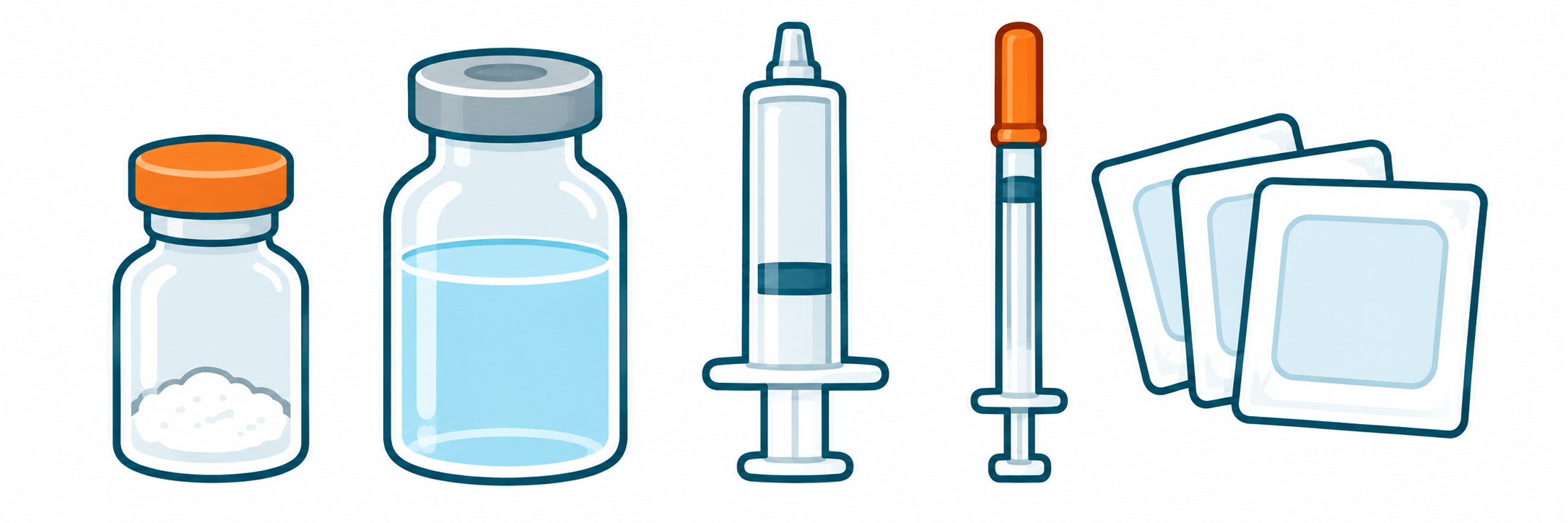
Pick how many weeks you will run it and how many shots you take each week. The list below shows everything you need.
Store at −20 °C (−4 °F) in dry, dark conditions and keep them in the original packaging.
Keep them refrigerated and away from light. How long a mixed vial lasts depends on the product, so check its stability data.
TB-500 is the name people use for thymosin beta-4, a protein made of 43 amino acids. Your body makes it naturally, and it is found in almost every cell. It helps cells move into a damaged area and start repairs.
TB-500 is one of the most popular recovery peptides. Most people use it for injuries, sore joints, and stiffness, and it is almost always paired with BPC-157.
People use it with BPC-157 for problems like a sore Achilles, tennis elbow, or a strained ligament.
People use it to help a pulled or torn muscle recover after training or a sports injury.
People with stiff shoulders, knees, or backs use it to move more freely.
Athletes and lifters use it during heavy training blocks to bounce back between sessions.
Thymosin beta-4 is studied for wound healing, and people use it after cuts, scrapes, and surgery.
Most people report less stiffness within two to four weeks. Bigger injuries usually take most of the 12-week cycle.
Pick a topic to see what has been studied.
A 1999 rat study in the Journal of Investigative Dermatology found that thymosin beta-4 sped up wound healing. Treated wounds had 42% more new skin by day 4 and 61% more by day 7.
A rat study of cut Achilles tendons compared BPC-157, TB-500, and both together for 30 days. The TB-500 group did better than the control group on all seven tendon measures, and it was the only group with a stronger tendon when pulled to failure.
A 2004 mouse study in Nature found that thymosin beta-4 helped heart cells survive and move after a heart attack. This study is a big reason the molecule drew research interest.
Thymosin beta-4 holds actin, the protein cells use to move. When a cell needs to crawl into a wound, it releases that actin to build the parts it moves with.
A randomized study in healthy volunteers gave intravenous thymosin beta-4 in single and repeated doses from 42 to 1,260 mg (Ruff et al., 2010, PMID 20536472). Eye drops made with thymosin beta-4 have also been tested in people with dry eye.
Quality varies a lot between sellers. I have been around research peptides for 10 years, and BioEdge is the supplier I send my readers to. Here is why.
The Peptide Report has a business relationship with BioEdge Research Labs. BioEdge sells this product for laboratory research only. BioEdge shipping policy
These are the stacks people use most with TB-500, and what each one adds.
| Stack | Ingredients | Why people stack them |
|---|---|---|
| TB-500 + BPC-1572 vials | TB-500 at 5 mg twice a week. BPC-157 at 400 mcg daily | Injury and tissue recoveryBPC-157 works mostly at the injury and in the gut. TB-500 works throughout the whole body and helps with flexibility and inflammation. This is the pairing people use most for tendon, ligament, and muscle injuries, usually for 12 weeks, once or twice a year. See the BPC-157 dosage guide. |
| TB-500 + CJC-1295 / Ipamorelin2 vials | TB-500 at 5 mg twice a week. CJC-1295 / Ipamorelin at 250 mcg each, 5 days on and 2 days off | Recovery plus deeper sleepCJC-1295 (no DAC) and Ipamorelin raise growth hormone and deepen sleep. Your body does most of its repair during deep sleep, so people add this pair to a recovery cycle. |
| GLOW blendOne vial | GLOW blend at BPC-157, TB-500, and GHK-Cu in one vial | Skin, hair, and tissue (GLOW)GLOW puts BPC-157, TB-500, and the copper peptide GHK-Cu in one vial. People use it when they want skin and collagen support on top of recovery. See the GLOW dosage guide. |
| KLOW blendOne vial | KLOW blend at BPC-157, TB-500, GHK-Cu, and KPV in one vial | Gut and inflammation (KLOW)KLOW adds KPV to the GLOW blend. People use KPV to calm inflammation, especially in the gut. See the KLOW dosage guide. |
Pick a tool and try it. Each one uses the numbers from your calculator.
Use the same four steps. Once you can solve these, you can work out the units for any vial you ever pick up.
Your score: 0 correct.
Each line on the syringe is a unit of liquid. A unit measures volume, so the amount of peptide in it depends on your mix.
Tap the syringe or move the slider. The numbers use the vial you entered above. Read the line at the top edge of the plunger.
More water makes the mix weaker, so the same amount takes up more units. The amount of peptide in the vial stays the same.
A draw under 5 units is harder to read accurately. Tap a row to use that water amount.
Most people use 5 mg twice a week. Some start lower, at 2 to 2.5 mg twice a week.
With a 10 mg vial and 1 mL of water, 2 mg is 20 units and 5 mg is 50 units. Use the calculator if your mix is different.
Many people use 1 mL, which makes 10 mg per mL. That keeps a 5 mg dose at 50 units, so it fits in one insulin syringe.
Most people run it for 12 weeks with BPC-157, once or twice a year as needed.
No. TB-500 travels through the whole body, so most people inject it under the skin of the belly.
They are separate peptides. BPC-157 has 15 amino acids and works mostly near the injury and in the gut. TB-500 has 43 amino acids and works throughout the body, which is why people often run the two together.
No. It is sold as a research peptide.
Most charts assume one vial size and one water amount. If your mix is different, every unit number changes, so run your own numbers.