If you compete in a sport that follows the World Anti-Doping Code, the peptides people talk about most for recovery and growth hormone are banned by name, in competition and out of it. BPC-157, TB-500, CJC-1295, ipamorelin and AOD-9604 all appear on WADA’s 2026 Prohibited List.
Here’s what the list says, how labs find these molecules, what happens after a positive test, and what the research on athletes and ethics shows.
One Year of Peptide Testing, by the Numbers
Start with WADA’s own lab tally for 2022, published in 2024. It reads like a printout:
- Samples analyzed: 256,769 urine and blood samples.
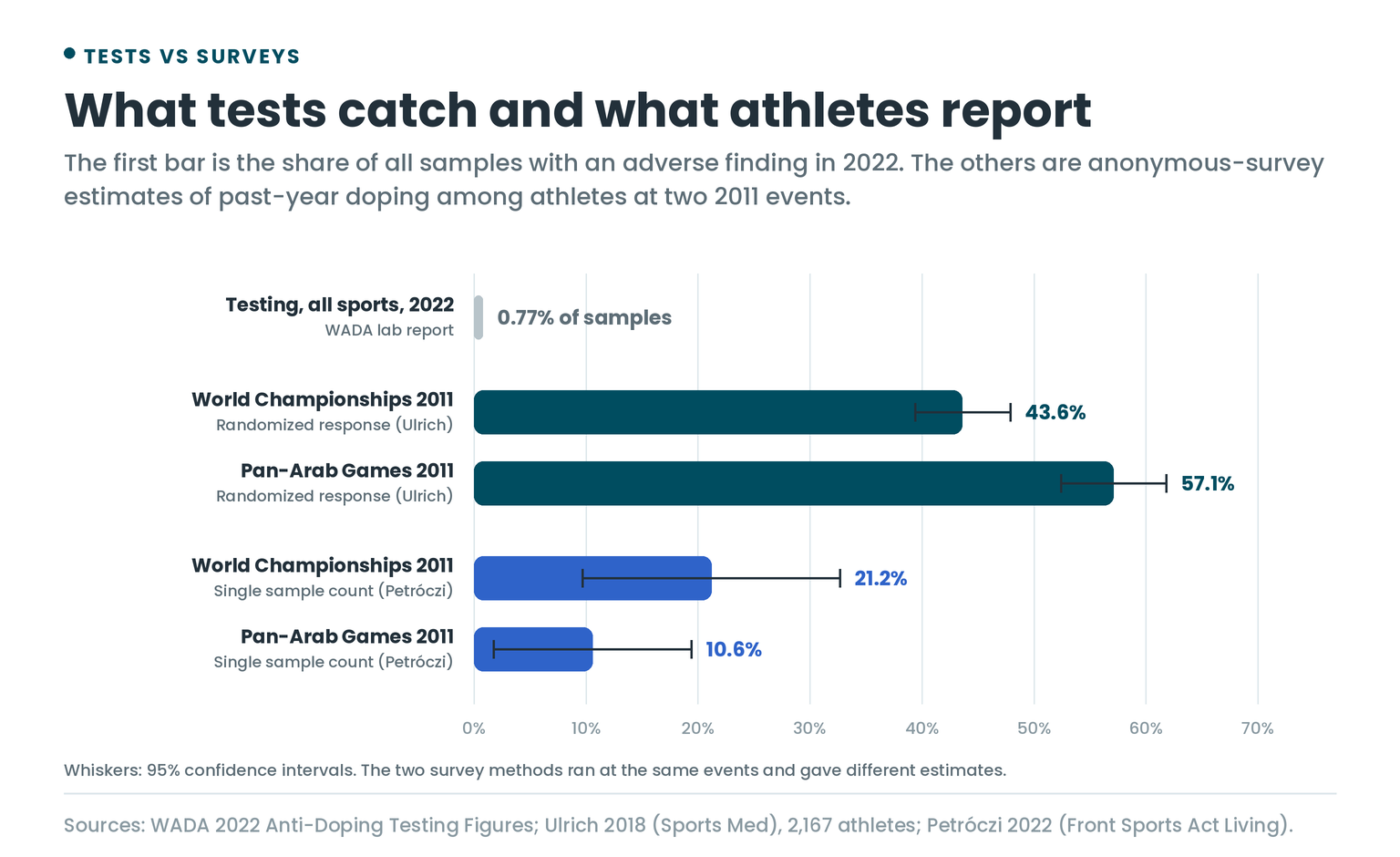
- Adverse findings, all banned substances: 1,986, or 0.77% of samples.
- Peptide hormones and growth factors: 113 findings, counted by substance.
- Blood boosters: EPO 61, darbepoetin 11, CERA 2, roxadustat 1.
- Testosterone-stimulating peptides: hCG 14, leuprorelin 1.
- Growth hormone and its releasers: ibutamoren (MK-677) 9, GHRP-2 5, growth hormone 5, ipamorelin 2, capromorelin 1, GHRP-6 1.
- Growth hormone tests: 16,680 isoform tests with 5 positives, and 4,500 biomarker tests with 0 positives.
By group, the blood boosters lead with 75, the growth hormone group is next with 23, and the testosterone-stimulating peptides follow with 15. The rest of this article is the rulebook and the science behind those lines.
Are Peptides Banned in Sport?
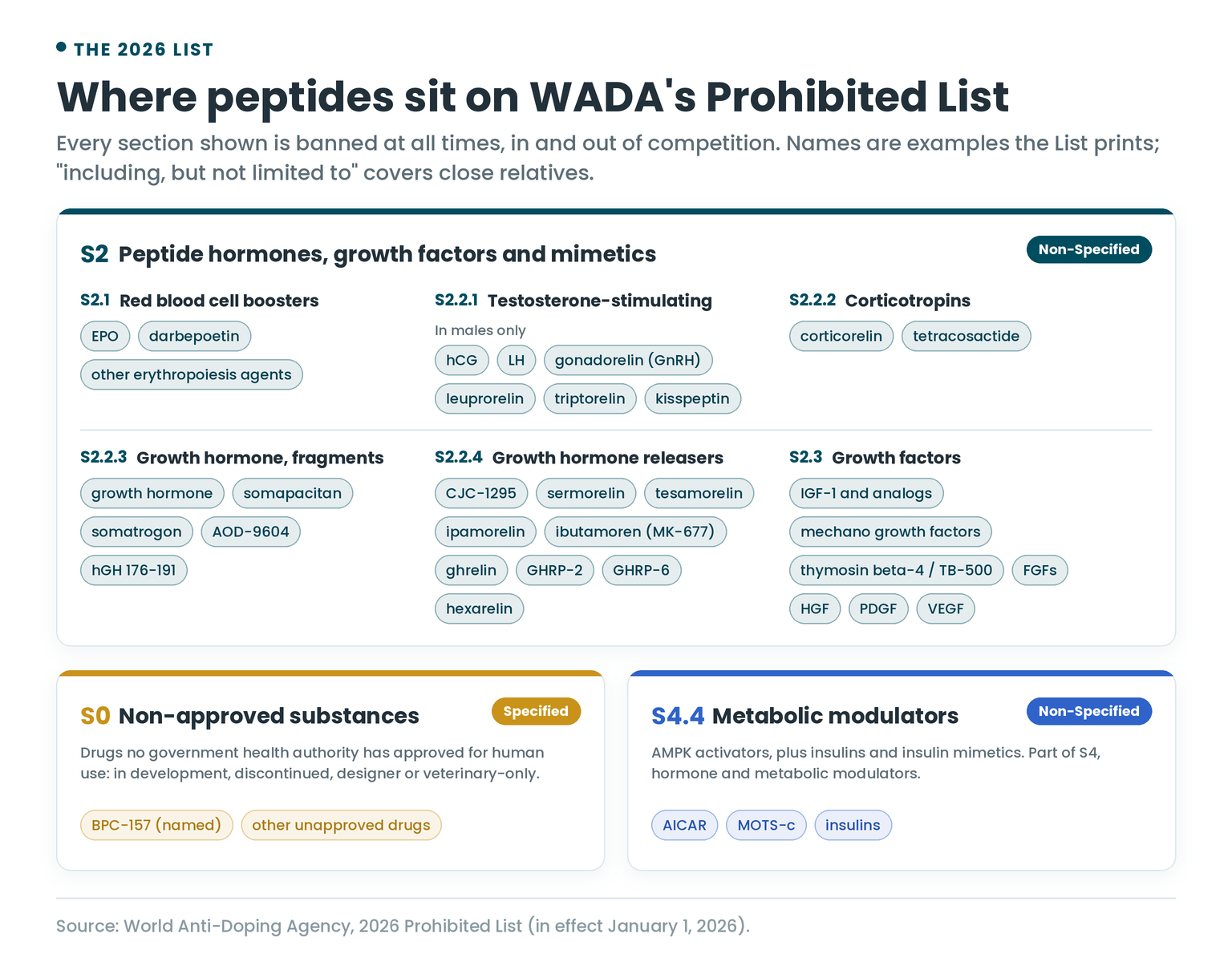
For athletes bound by the World Anti-Doping Code, yes. WADA updates the Prohibited List every year, and the 2026 version came into effect on January 1, 2026.
WADA can add a substance when it meets any two of three criteria: it enhances or can enhance performance, it poses an actual or potential health risk, or its use violates the spirit of sport. Many entries introduce their examples with “including, but not limited to,” so a close relative of a named peptide is covered even when its name isn’t printed.
S2: Peptide Hormones, Growth Factors and Mimetics
This is the main peptide section. Every substance in it is non-Specified, which matters for the sanction (more below).
- S2.1, red blood cell boosters: EPO, darbepoetin and other agents that raise red blood cell production.
- S2.2.1, testosterone-stimulating peptides, in males: hCG, LH, gonadorelin (GnRH) and analogs such as leuprorelin and triptorelin, and kisspeptin and its agonist analogs. I compared two of these in Kisspeptin vs HCG.
- S2.2.2, corticotropins: corticorelin and tetracosactide.
- S2.2.3, growth hormone, its analogs and fragments: long-acting growth hormones such as somapacitan and somatrogon, plus AOD-9604 and hGH 176-191, the fragment covered in HGH Fragment 176-191 Dosage.
- S2.2.4, growth hormone releasing factors: GHRH analogs (CJC-1295, sermorelin, tesamorelin), ghrelin mimetics (ipamorelin, ibutamoren, anamorelin and others) and the GHRPs (GHRP-1 to GHRP-6, hexarelin, alexamorelin).
- S2.3, growth factors: IGF-1 and its analogs, mechano growth factors, thymosin beta-4 and its derivatives such as TB-500, and FGFs, HGF, PDGF and VEGF.
S0: The Catch-All That Names BPC-157
S0 covers drugs that no government health authority has approved for human use and that no other section of the List covers: compounds still in development, discontinued drugs, designer drugs and veterinary-only products. BPC-157 is printed as an example. Unapproved peptides that fit a specific section, such as TB-500 in S2.3, are listed there instead. In the 2026 List, everything in S0 is a Specified Substance.
S4: AICAR, MOTS-c and Insulin
The metabolic modulators sit in S4.4 and are non-Specified. AMPK activators, a group that names AICAR and the mitochondrial peptide MOTS-c, are banned at all times, and so are insulins and insulin mimetics.
How Labs Find Peptides
Small synthetic peptides are mostly a mass spectrometry problem. In 2016, Andreas Thomas, Mario Thevis and colleagues published a single urine screen for peptides under 2 kDa, covering the GHRPs, ipamorelin, hexarelin, gonadorelin analogs, AOD-9604 and TB-500. It detected them at 50 to 500 pg/mL, below WADA’s minimum required level of 2 ng/mL. A 2024 method from the same group extended one urine test to larger peptides: insulins, sermorelin, CJC-1295 and tesamorelin with their breakdown products, IGF-1 analogs and mechano growth factors.
Breakdown products often outlast the parent peptide. In a 2015 study, one volunteer per compound took a GHRP nasally:
- GHRP-2 and two of its metabolites were detectable in urine for up to 47 hours.
- GHRP-6 came out mostly unchanged and was detectable for 23 hours.
- GHRP-1 never showed up intact; one of its metabolites lasted 27 hours.
- Hexarelin and ipamorelin metabolites were still found after the parent peptides were gone.
The authors note that the window depends on the person’s metabolism, the preparation and the route.
The newer peptides get the same treatment. BPC-157 is a 15-amino-acid peptide identified in confiscated vials. In lab incubations with plasma it formed a stable metabolite the authors expect to show up in urine, and their 2017 urine method detected BPC-157 itself at 0.1 ng/mL; the peptide stayed stable in urine for at least 4 days. A 2023 method that tracks BPC-157 and five of its metabolites pushed detection down to 0.01 to 0.11 ng/mL. TB-500’s active ingredient was identified in 2012 as Ac-LKKTETQ, amino acids 17 to 23 of thymosin beta-4 with an acetyl cap on the front; the structure story is in Is TB-500 a Steroid? AOD-9604 has a validated urine test at 50 pg/mL and a stable metabolite that may lengthen the window.
Growth Hormone: The Hard One
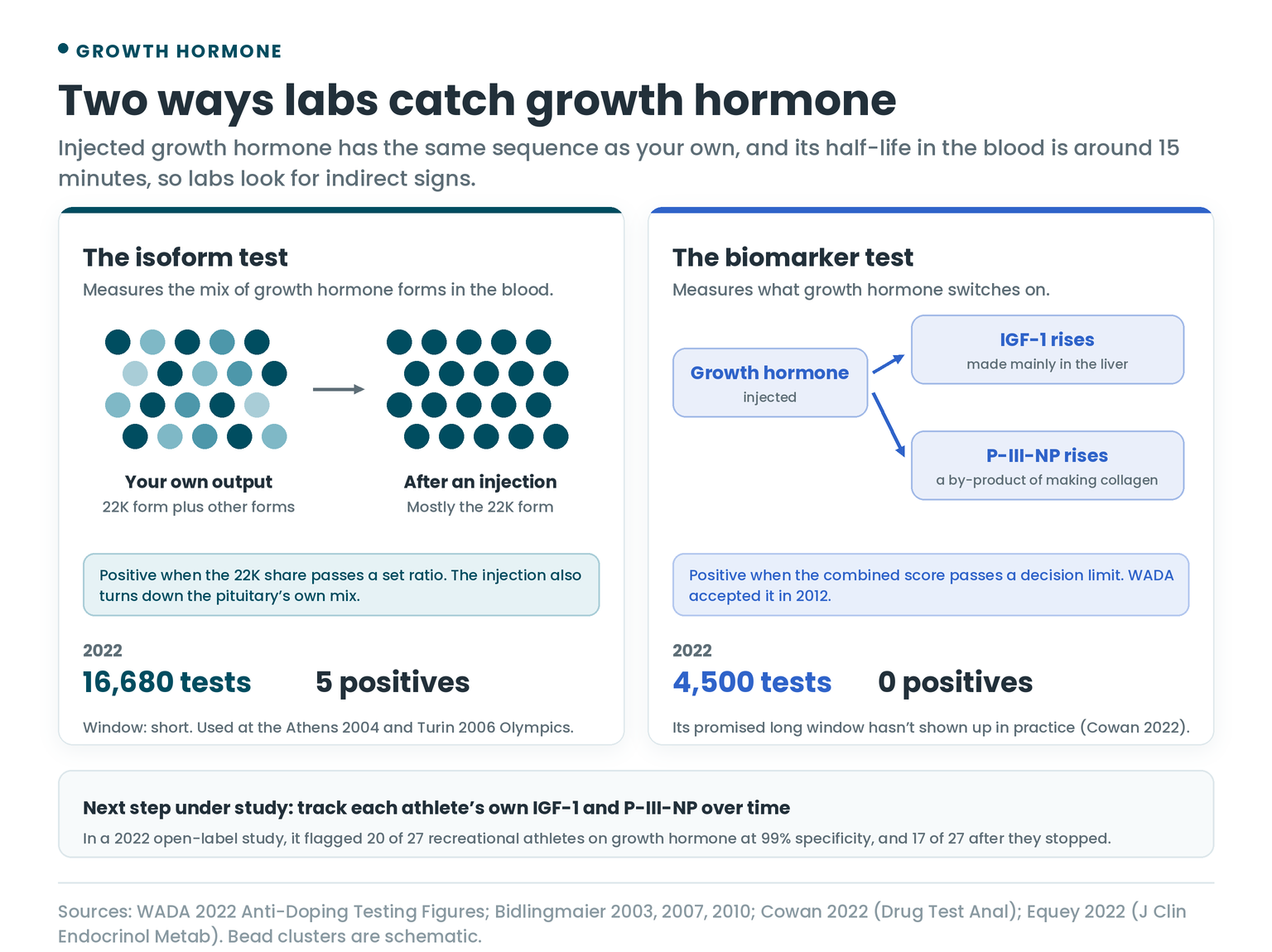
Injected growth hormone has the same amino acid sequence as the 22,000-dalton form the pituitary makes, its half-life in the blood is around 15 minutes, and natural levels swing with each pulse, so a single reading can’t prove an injection. Labs use two indirect tests:
- The isoform test. The pituitary releases a mix of growth hormone forms; the injected drug is only the 22K form, and it also suppresses the pituitary’s own output. When the 22K share climbs past a set ratio, the test is positive. It was used at the Athens 2004 and Turin 2006 Olympics, and its window is short.
- The biomarker test. Growth hormone raises IGF-1 and P-III-NP, a fragment released when collagen is made. WADA accepted this test in 2012. A 2022 review by David Cowan’s group says the long detection window it promised hasn’t shown up in practice, perhaps partly because the decision limits were set too high.
WADA has been considering tracking each athlete’s own IGF-1 and P-III-NP over time, the way the biological passport tracks blood. In a 2022 open-label study, that approach flagged 20 of 27 recreational athletes given growth hormone at a 99% specificity setting, and 17 of the 27 after they’d stopped.
If you want the pharmacology of the releasers themselves, Sermorelin vs CJC-1295 and Tesamorelin vs Ipamorelin cover them in depth.
What Happens After a Positive Test
Anti-doping runs on strict liability. Under Article 2.1.1 of the Code (2021 edition), athletes are responsible for any banned substance found in their sample, and a violation doesn’t require proof of intent, fault or negligence. Those questions only come in when the sanction is set.
The ban length hinges on the substance’s category:
- Non-Specified substances (all of S2, and S4.4): the standard ban is four years. It drops to two only if the athlete shows the violation wasn’t intentional. After a positive for one of these, a provisional suspension is mandatory while the case runs, with narrow exceptions.
- Specified substances (all of S0, including BPC-157, in the 2026 List): four years only if the anti-doping organization proves intent; otherwise two.
“Intentional” covers knowing it was a violation and knowingly ignoring a significant risk that it was. A revised Code takes effect on January 1, 2027, and keeps four years as the standard for intentional doping.
Athletes with a medical need have a route: a Therapeutic Use Exemption. With a TUE granted under WADA’s standard, use of the substance for a diagnosed medical condition isn’t a violation. International-level athletes apply through their international federation, and everyone else through their national anti-doping organization.
Essendon: 34 Players Banned Without a Positive Test
Between about January and September 2012, players at Essendon, an Australian Football League club, received a program of injections; the consent forms listed AOD-9604 and “Thymosin”. In March 2015, the AFL’s anti-doping tribunal cleared all 34 players, saying it wasn’t comfortably satisfied they’d been given thymosin beta-4.
WADA appealed to the Court of Arbitration for Sport. In January 2016, a majority of the CAS panel found that each of the 34 had been injected with thymosin beta-4 at least once and that all were significantly at fault, and it banned them for two years, backdated. The case was about use rather than a positive sample, and CAS applied the “comfortable satisfaction” standard, which it described as more than a balance of probabilities but less than proof beyond reasonable doubt.
Does Growth Hormone Improve Performance? What the Trials Found
For growth hormone, there are randomized trials in healthy, fit people. A 2008 systematic review led by Hau Liu pooled 27 randomized study groups with 303 people on growth hormone, average age 27. Lean body mass rose 2.1 kg, but strength and exercise capacity didn’t seem to improve. Lactate during exercise was higher in 2 of the 3 studies that measured it, and swelling and fatigue were more common.
A 2010 trial funded by WADA tested it in athletes. Udo Meinhardt and colleagues ran a blinded, placebo-controlled trial in 96 recreationally trained athletes in Sydney for 8 weeks. The men were randomized to placebo, growth hormone (2 mg a day), testosterone or both; the women to placebo or growth hormone.
- Fat mass fell, and lean mass rose through extra water outside the cells.
- Sprint capacity on a cycling sprint test rose 3.9% on growth hormone (men and women together) and 8.3% in men on growth hormone plus testosterone.
- Endurance, strength in the deadlift and jump height didn’t change significantly.
- The sprint gain was gone 6 weeks after stopping.
The authors note that athletes using it covertly may take higher doses. IGF-1, the hormone growth hormone works through, has its own human data in IGF-1 Dosing for Maximum Anabolic Effect.
The Ethics: Fair Play, Health and the Team Doctor
The Code builds its case on “the spirit of sport,” which it defines as the ethical pursuit of human excellence through the dedicated perfection of each athlete’s natural talents. It lists 12 values under that, starting with health and with ethics, fair play and honesty.
Doctors have their own rules. The World Medical Association’s declaration on sports medicine, last revised in 2021, says a physician’s duty is to the athlete’s health, not to performance alone, and that the athlete’s health and safety override the interests of any third party. Physicians must refuse to administer any substance, or condone any means, that conflicts with medical ethics or could harm the athlete, and must explain the health risks. The same declaration protects the confidentiality of the athlete’s medical information and asks for a harm-reduction approach with amateur and teenage athletes.
Would Athletes Trade Their Health to Win?
A much-repeated claim, the Goldman dilemma, held that about half of the elite athletes asked would take a drug that guaranteed success but killed them in five years. In a 2013 paper, James Connor and colleagues reported putting the same question to 212 athletes at an elite track and field meet in North America. Two said yes. Without the death clause and with no consequences, 25 of the 212 would take the drug, and 13 would take it with the death clause if it were legal.
How Many Athletes Dope?
Testing and surveys give very different answers. When Rolf Ulrich’s group surveyed 2,167 athletes at the 2011 World Championships in Athletics and the 2011 Pan-Arab Games with a randomized response method, which keeps each answer anonymous, the estimates of past-year doping were 43.6% and 57.1%.
A second method run at the same two events, the single sample count, gave 21.2% and 10.6%. Its authors, led by Andrea Petróczi, detected survey non-compliance, mostly at the World Championships, and urged caution in reading any of these estimates as true prevalence; Ulrich’s group replied in 2023 that the second method’s data are also compatible with a high rate.
Look Up a Peptide on the 2026 List
Type a name or tap a section to see where a molecule sits, whether it’s banned for everyone or only for men, its Specified status and what WADA’s 2022 lab report counted.
2026 Prohibited List lookup
Where does it sit on the List?
Search a name or browse by section. Each card shows the List section, whether it's banned for everyone or only for men, its Specified status, and what WADA's 2022 lab report counted.
The List changes every January 1. Entries marked "including, but not limited to" also cover close relatives that aren't printed by name. Counts are adverse findings in WADA's 2022 Anti-Doping Testing Figures.
Doses Used in the Research
- Growth hormone (Liu review): an average of 36 µg/kg a day; in studies that gave it for more than a day, for an average of 20 days.
- Growth hormone (Meinhardt trial): 2 mg a day under the skin for 8 weeks.
- Testosterone (Meinhardt trial): 250 mg a week into the muscle for 8 weeks.
- TB-500 (horse detection study): a single dose containing 10 mg of Ac-LKKTETQ.
Frequently Asked Questions
Is BPC-157 banned in sport?
Yes. WADA’s 2026 Prohibited List names BPC-157 in section S0, non-approved substances, which is banned at all times. In 2026, S0 substances are Specified.
Is TB-500 banned by WADA?
Yes. Thymosin beta-4 and its derivatives, with TB-500 named as an example, are in section S2.3 and banned at all times as non-Specified substances.
Are peptides allowed out of competition?
Not the listed ones. S0, S2 and the S4.4 metabolic modulators are prohibited in and out of competition, with the S2.2.1 testosterone-stimulating peptides banned in males.
Can an athlete use a banned peptide with a prescription?
Only with a Therapeutic Use Exemption granted under WADA’s standard. International-level athletes apply to their international federation, others to their national anti-doping organization.
How long can peptides be detected in urine?
It varies by peptide, dose, route and person. In a 2015 study with one volunteer per compound and a nasal dose, GHRP-2 and its metabolites were detectable for up to 47 hours and GHRP-6 for 23 hours.
Is MK-677 banned in sport?
Yes. Ibutamoren (MK-677) is listed by name under S2.2.4 as a growth hormone secretagogue, and anti-doping labs reported it 9 times in 2022.
What is the ban for a positive peptide test?
For S2 peptides, the standard is four years, reduced to two if the athlete shows the violation wasn’t intentional. For S0 substances such as BPC-157, four years applies only if the anti-doping organization proves intent; otherwise it’s two.
Stay sharp,
Joe Mars
The Peptide Report
P.S. Got a question about where a peptide sits on the list? Bring it to the Peptides & Biohacking Hub on Skool and we’ll look it up together.
References
- World Anti-Doping Agency. 2022 Anti-Doping Testing Figures. Montreal: WADA; 2024. PDF
- World Anti-Doping Agency. The 2026 Prohibited List, in effect January 1, 2026. wada-ama.org
- World Anti-Doping Agency. World Anti-Doping Code 2021. PDF
- Thomas A, Görgens C, Guddat S, et al. Simplifying and expanding the screening for peptides <2 kDa by direct urine injection, liquid chromatography, and ion mobility mass spectrometry. J Sep Sci. 2016;39(2):333-341. doi:10.1002/jssc.201501060
- Thomas A, Walpurgis K, Thevis M. Chromatographic-mass spectrometric analysis of peptidic analytes (2-10 kDa) in doping control urine samples. J Mass Spectrom. 2024;59(1):e4996. doi:10.1002/jms.4996
- Semenistaya E, Zvereva I, Thomas A, et al. Determination of growth hormone releasing peptides metabolites in human urine after nasal administration of GHRP-1, GHRP-2, GHRP-6, Hexarelin, and Ipamorelin. Drug Test Anal. 2015;7(10):919-925. doi:10.1002/dta.1787
- Cox HD, Miller GD, Eichner D. Detection and in vitro metabolism of the confiscated peptides BPC 157 and MGF R23H. Drug Test Anal. 2017;9(10):1490-1498. doi:10.1002/dta.2152
- Tian T, Jing J, Li Y, et al. Stable isotope labeling-based nontargeted strategy for characterization of the in vitro metabolic profile of a novel doping BPC-157 in doping control by UHPLC-HRMS. Molecules. 2023;28(21):7345. doi:10.3390/molecules28217345
- Esposito S, Deventer K, Goeman J, et al. Synthesis and characterization of the N-terminal acetylated 17-23 fragment of thymosin beta 4 identified in TB-500, a product suspected to possess doping potential. Drug Test Anal. 2012;4(9):733-738. doi:10.1002/dta.1402
- Cox HD, Smeal SJ, Hughes CM, et al. Detection and in vitro metabolism of AOD9604. Drug Test Anal. 2015;7(1):31-38. doi:10.1002/dta.1715
- Bidlingmaier M, Wu Z, Strasburger CJ. Problems with GH doping in sports. J Endocrinol Invest. 2003;26(9):924-931. doi:10.1007/BF03345245
- Bidlingmaier M, Strasburger CJ. Growth hormone. Handb Exp Pharmacol. 2010;(195):187-200. doi:10.1007/978-3-540-79088-4_8
- Bidlingmaier M, Strasburger CJ. Technology insight: detecting growth hormone abuse in athletes. Nat Clin Pract Endocrinol Metab. 2007;3(11):769-777. doi:10.1038/ncpendmet0644
- Cowan DA, Moncrieffe DA. Procollagen type III amino-terminal propeptide and insulin-like growth factor I as biomarkers of growth hormone administration. Drug Test Anal. 2022;14(5):808-819. doi:10.1002/dta.3155
- Equey T, Pastor A, de la Torre Fornell R, et al. Application of the Athlete Biological Passport approach to the detection of growth hormone doping. J Clin Endocrinol Metab. 2022;107(3):649-659. doi:10.1210/clinem/dgab799
- Bird & Bird. The 2027 World Anti-Doping Code: navigating the new legal landscape. 2025. twobirds.com
- Sports Integrity Initiative. Essendon supplements case: analysis and timeline. sportsintegrityinitiative.com
- Court of Arbitration for Sport. CAS 2015/A/4059 World Anti-Doping Agency v. Thomas Bellchambers et al., AFL & ASADA. Award, 2016. PDF
- Liu H, Bravata DM, Olkin I, et al. Systematic review: the effects of growth hormone on athletic performance. Ann Intern Med. 2008;148(10):747-758. doi:10.7326/0003-4819-148-10-200805200-00215
- Meinhardt U, Nelson AE, Hansen JL, et al. The effects of growth hormone on body composition and physical performance in recreational athletes: a randomized trial. Ann Intern Med. 2010;152(9):568-577. doi:10.7326/0003-4819-152-9-201005040-00007
- World Medical Association. WMA Declaration on Principles of Health Care in Sports Medicine. Adopted 1981; last revised October 2021. wma.net
- Connor J, Woolf J, Mazanov J. Would they dope? Revisiting the Goldman dilemma. Br J Sports Med. 2013;47(11):697-700. doi:10.1136/bjsports-2012-091826
- Ulrich R, Pope HG Jr, Cléret L, et al. Doping in two elite athletics competitions assessed by randomized-response surveys. Sports Med. 2018;48(1):211-219. doi:10.1007/s40279-017-0765-4
- Petróczi A, Cruyff M, de Hon O, et al. Hidden figures: revisiting doping prevalence estimates previously reported for two major international sport events in the context of further empirical evidence and the extant literature. Front Sports Act Living. 2022;4:1017329. doi:10.3389/fspor.2022.1017329
- Ulrich R, Cléret L, Comstock RD, et al. Assessing the prevalence of doping among elite athletes: an analysis of results generated by the single sample count method versus the unrelated question method. Sports Med Open. 2023;9(1):112. doi:10.1186/s40798-023-00658-5
- Ho EN, Kwok WH, Lau MY, et al. Doping control analysis of TB-500, a synthetic version of an active region of thymosin β4, in equine urine and plasma by liquid chromatography-mass spectrometry. J Chromatogr A. 2012;1265:57-69. doi:10.1016/j.chroma.2012.09.043
- Thomas A, Krombholz S, Wolf C, et al. Determination of ghrelin and desacyl ghrelin in human plasma and urine by means of LC-MS/MS for doping controls. Drug Test Anal. 2021;13(11-12):1862-1870. doi:10.1002/dta.3176