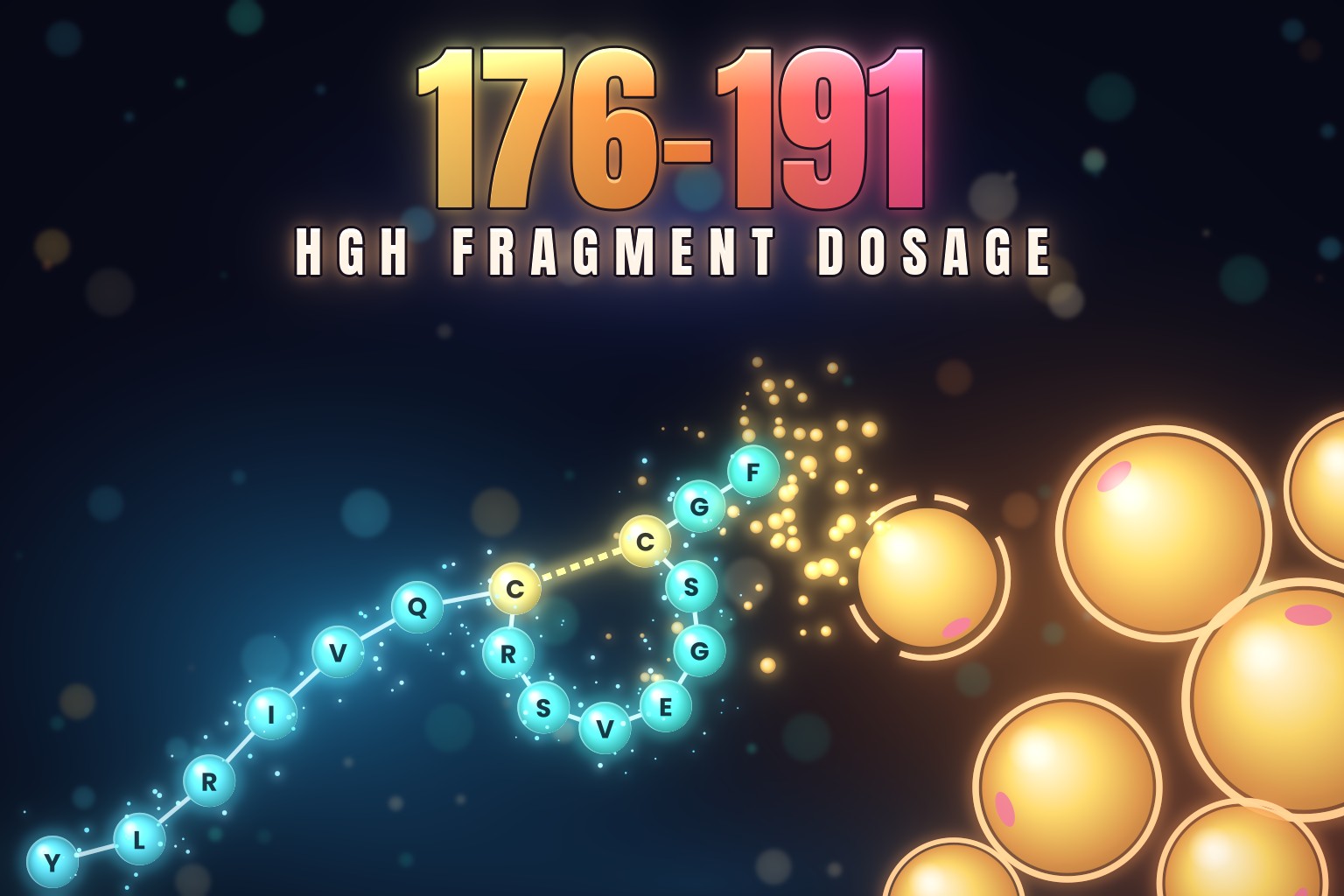
HGH Fragment 176-191 is the fat-burning tail of growth hormone, cut loose from the rest of the molecule. In fat tissue it turns up fat breakdown and blocks new fat storage, and it does it without going through the growth hormone receptor.
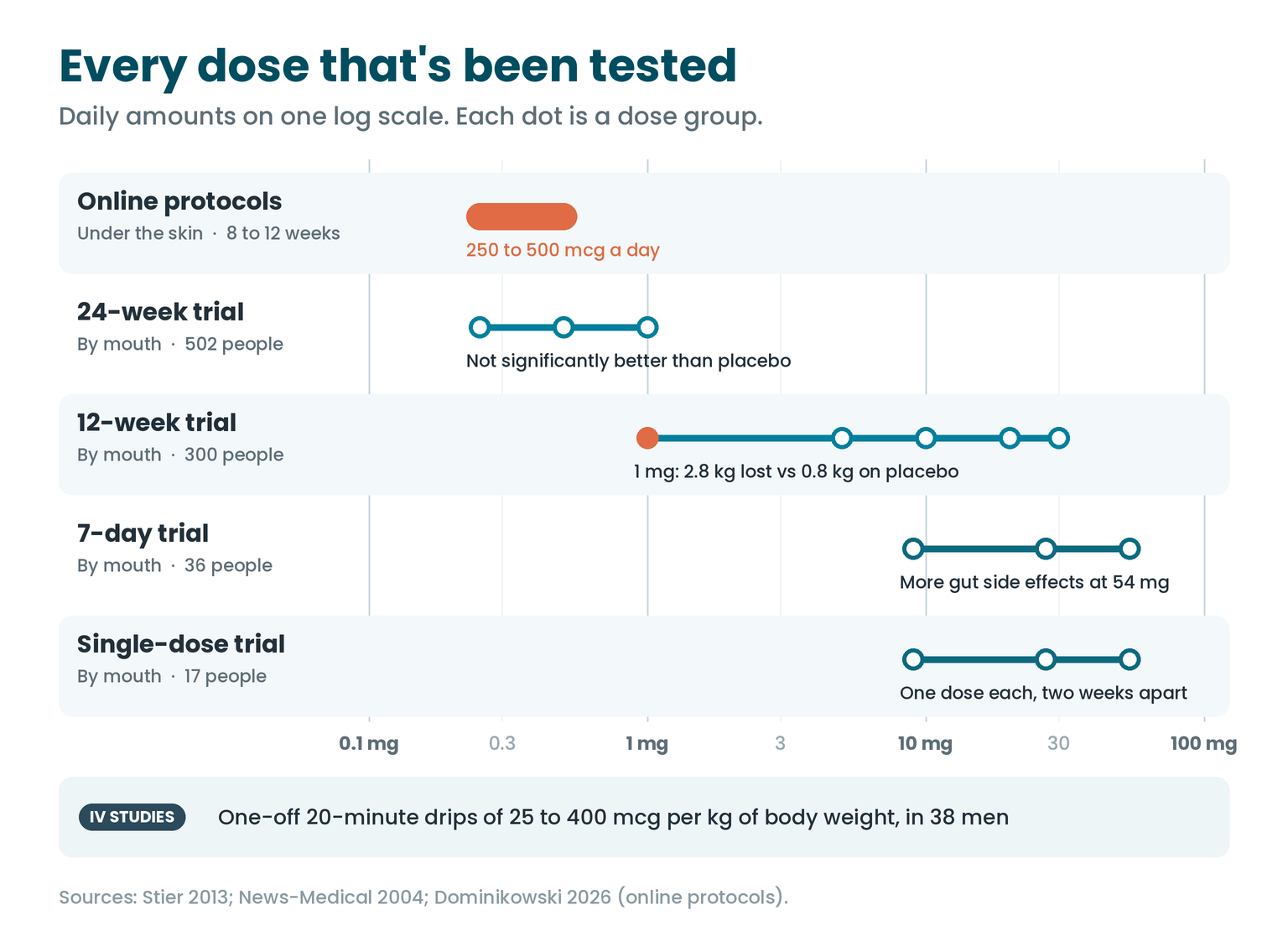
The dosing picture has two halves. The human trials gave it by IV drip and by mouth, while most protocols online inject it under the skin.
Here’s every dose that’s been tested, the protocol most people follow, and a planner that does the vial math for you.
HGH Fragment 176-191 Dosage at a Glance
| HGH Fragment 176-191 | |
|---|---|
| What it is | AOD9604: amino acids 177 to 191 of growth hormone plus a tyrosine at the front, 16 amino acids |
| What it does to fat | Turns up fat breakdown and blocks new fat storage inside fat tissue |
| IGF-1 and blood sugar | No change in IGF-1 or glucose tolerance across six human trials |
| Half-life | About 3 to 4 minutes in animal studies |
| Doses in human trials | 25 to 400 mcg/kg as a single IV drip, and 0.25 to 54 mg a day by mouth |
| Common online protocol | 250 to 500 mcg a day under the skin, split into 2 or 3 injections, for 8 to 12 weeks |
| Best trial result | 1 mg a day by mouth for 12 weeks: 2.8 kg lost vs 0.8 kg on placebo, as reported by the company |
| Longest trial | 24 weeks, 502 people: weight loss not significantly different from placebo |
What Is HGH Fragment 176-191?
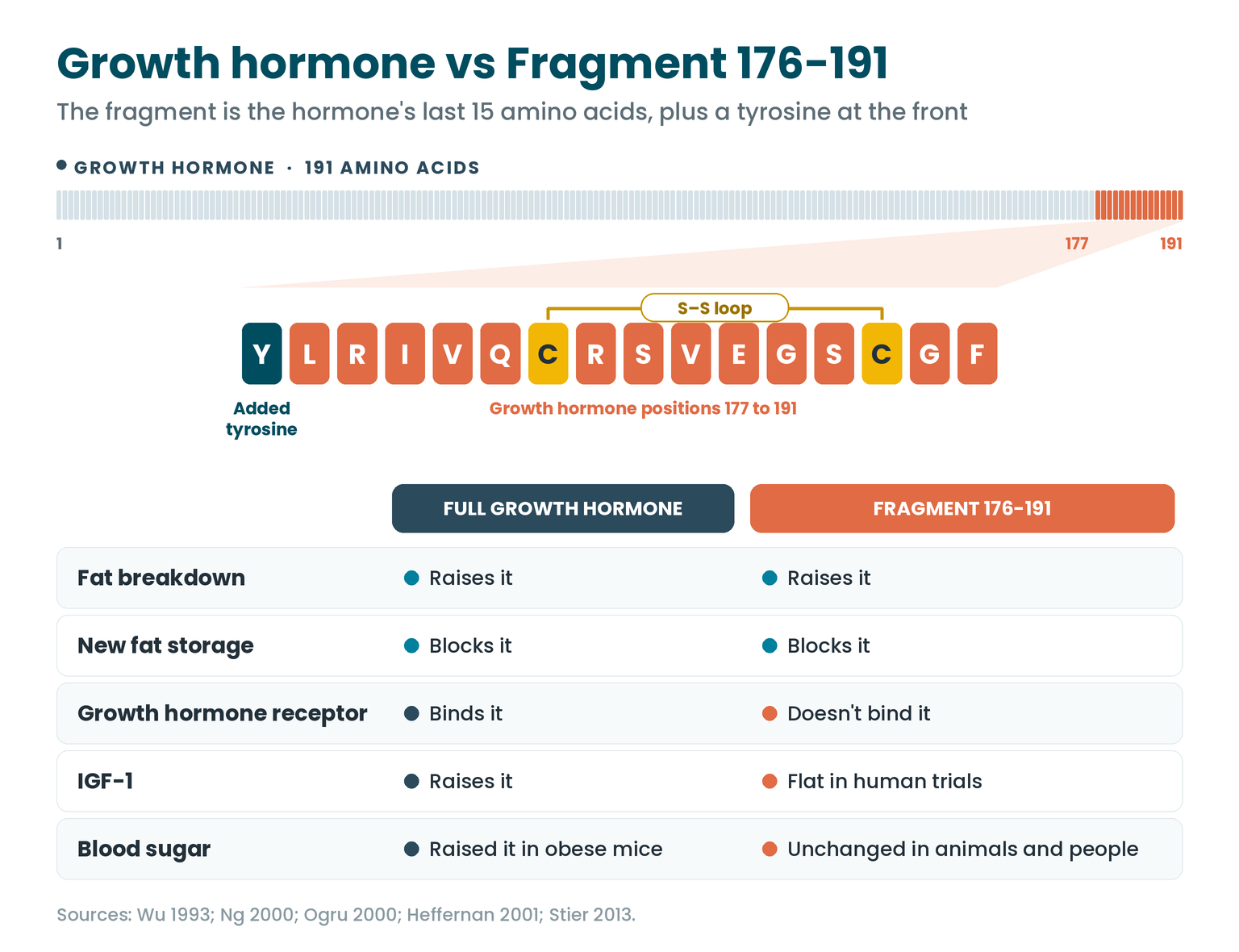
Growth hormone is a chain of 191 amino acids. In the early 1990s, Frank Ng’s group at Monash University in Melbourne showed that its fat-blocking action lives in the last 15 of them, positions 177 to 191. In rat fat tissue, that short tail blocked fat storage as well as the whole hormone did.
The version that went into human trials is AOD9604: those 15 amino acids with a tyrosine added at the front, 16 in all. That extra amino acid takes the 176 slot, which is where the “176-191” name comes from. The full sequence is Tyr-Leu-Arg-Ile-Val-Gln-Cys-Arg-Ser-Val-Glu-Gly-Ser-Cys-Gly-Phe, and the two cysteines bond to each other, pulling the middle of the chain into a loop.
A Melbourne company, Metabolic Pharmaceuticals, took AOD9604 through six placebo-controlled trials in about 900 people. Every human study of the fragment is one of those six.
For what it does outside fat loss, see my breakdown of Fragment 176-191 benefits beyond weight loss.
How HGH Fragment 176-191 Burns Fat
It works directly on fat tissue. The rodent studies point to four parts of how it does that.
It Turns On Fat Breakdown
In rat fat tissue, it switched on hormone-sensitive lipase, the enzyme that releases stored fat from fat cells. In obese mice given it for 14 days, fat oxidation rose, and so did blood glycerol, a marker of fat being broken down. It had the same effect on samples of human fat tissue in the lab.
It Blocks New Fat Storage
It also shut down acetyl-CoA carboxylase, the enzyme that starts the process of building new fat. In isolated fat cells from obese rats, it cut how much glucose the cells pulled in, which leaves less raw material for making fat.
It Raises Beta-3 Receptors
Beta-3 adrenergic receptors are the main fat-releasing receptors on rodent fat cells, and obese mice have fewer of them. Two weeks of the fragment brought their levels back up to those of lean mice.
In mice bred without beta-3 receptors, long-term treatment lost its effect on body weight and fat breakdown. A single dose still raised their energy expenditure and fat burning, so the receptor boost looks like one piece of the mechanism.
It Works Without the Growth Hormone Receptor
In cell tests, it didn’t compete with growth hormone for its receptor or make receptor-carrying cells multiply. Over weeks of treatment in obese rats and mice, full growth hormone raised blood sugar and pushed the animals toward insulin resistance, while the fragment left insulin sensitivity intact. In the human trials, IGF-1 and glucose tolerance stayed flat.
What the Animal Studies Found
The fat-loss results come from obese rats and mice:
- Weight gain cut by more than half: obese rats given 500 mcg/kg by mouth every day for 19 days gained 15.8 g, against 35.6 g for untreated rats.
- Smaller fat cells: after 20 days of treatment, average fat cell diameter in obese rats dropped from 110 to 80 micrometers.
- Same food, less weight: obese mice given it by mouth for 30 days gained less weight from day 16 onward, while eating the same amount as untreated mice.
- Less fat tissue: long-term treatment of obese mice with the 177-191 peptide cut both weight gain and fat tissue mass.
What the Human Trials Found
A 2013 safety paper pooled all six trials. Two of them, the phase IIb trials, were built to measure weight loss.
In the 12-week trial, the company reported that 1 mg a day, the lowest dose tested, produced the most weight loss: 2.8 kg on average, against 0.8 kg on placebo. Those numbers came from a company announcement rather than a peer-reviewed paper.
The 24-week trial was the biggest of the six. Weight loss on AOD9604 wasn’t significantly better than placebo on its main endpoint, and in February 2007 the company ended its obesity program.
HGH Fragment 176-191 Dosage
Doses Used in the Human Trials
All of the human dosing was by IV drip or by mouth, and the IV doses were set per kilogram of body weight:
| Trial | Who | Route and dose | Length |
|---|---|---|---|
| Phase I | 15 healthy men | IV drip, 25 to 400 mcg/kg | Single doses |
| Phase IIa | 23 obese men | IV drip, 25 to 100 mcg/kg | Single doses |
| Phase IIa | 17 obese men | By mouth, 9 to 54 mg | Single doses |
| Phase IIa | 36 obese men | By mouth, 9 to 54 mg a day | 7 days |
| Phase IIb | 300 obese adults | By mouth, 1 to 30 mg a day | 12 weeks |
| Phase IIb | 502 obese adults | By mouth, 0.25 to 1 mg a day | 24 weeks |
The Common Online Protocol
A 2026 review of growth hormone peptides compared the trial data with the protocols posted on bodybuilding forums. For Fragment 176-191, the typical pattern was:
- Daily amount: 250 to 500 mcg.
- Route: injected under the skin.
- Split: 2 or 3 injections a day.
- Timing: in the morning on an empty stomach, or before exercise.
- Cycle: 8 to 12 weeks.
Why the Timing and the Split
The fragment is gone within minutes. Its half-life was about 3 minutes after an IV dose in pigs and about 4 minutes in rat plasma, where enzymes trim it down one amino acid at a time from the front. The first trimmed pieces keep a weaker version of the fat-storage block.
That short window is why protocols split the daily amount. The fasted timing comes from how fat release works: insulin is the main brake on hormone-sensitive lipase, the same enzyme the fragment switches on, and insulin is lowest when you haven’t eaten.
Mixing and Measuring
A 5 mg vial mixed with 2 mL of bacteriostatic water gives 2.5 mg per mL. At that strength, 250 mcg is 0.1 mL, or 10 units on a U-100 insulin syringe. My guide to reconstituting peptides walks through the mixing itself.
Plug in your own vial, water and daily amount here, and the planner works out each injection and how many vials a full cycle takes:
Fragment 176-191 Cycle Planner
Enter your vial, water and daily amount. See each injection on a U-100 syringe and how many vials a full cycle takes.
The 250 to 500 mcg range is the common forum protocol compiled in a 2026 review. The human trials gave it by mouth and by IV drip. This tool does the math only. It saves your last settings in this browser.
Side Effects Seen in the Trials
The 2013 safety paper described the side effect profile across all six trials as indistinguishable from placebo:
- Headache was the most common complaint in the IV studies.
- Mild or moderate euphoria was reported by 5 of 23 men in one IV study, and never during placebo. One man in that study felt chest tightness, judged possibly related.
- At the top oral dose, 54 mg a day, headaches, diarrhea and gas were more common.
- In the 24-week trial, 75.6% of people on 0.25 mg reported at least one side effect, against 83.2% on placebo.
- Serious events: the 12-week trial logged five, including three skin cancers. Investigators judged none of them related to AOD9604.
- No antibodies against AOD9604 showed up in anyone tested.
The paper was written by authors with financial ties to the sponsor, which funded all six trials. For a closer look at each reaction, see HGH Fragment 176-191 side effects.
Long-Term Animal Testing
The toxicology program found no genetic toxicity in bacterial and cell tests. Rats took up to 100 mg/kg a day by mouth for 6 months, and monkeys up to 50 mg/kg a day for 9 months, with no treatment-related findings of toxicological concern.
What’s in the Vial
Fragment 176-191 sold online is made outside pharmaceutical quality control. Drug-testing labs have identified AOD9604 in products seized in Belgium and in confiscated vials in the United States. A certificate of analysis that confirms identity and purity is the minimum. My guide on how to judge a peptide supplier covers what to look for.
Beyond Fat Loss: Cartilage
In rabbits with damaged knee cartilage, weekly injections of 0.25 mg into the joint led to less cartilage damage and a shorter spell of lameness than saline. Adding hyaluronic acid to the same injections worked better than either one alone.
Fragment 176-191 vs Growth Hormone Boosters
Growth hormone boosters like ipamorelin and sermorelin, CJC-1295 and MK-677 raise your own growth hormone, and IGF-1 rises with it across the whole body. Fragment 176-191 skips that step and acts on fat tissue directly.
For how it stacks up against the other fat-loss options, see the best peptides for weight loss and my read of the fat loss trial data.
FAQ
Is HGH Fragment 176-191 the same as AOD9604?
AOD9604 is the version that went through human trials: growth hormone’s amino acids 177 to 191 with a tyrosine at the front, which is why it’s also labeled hGH 176-191.
How much HGH Fragment 176-191 is used per day?
Forum protocols typically use 250 to 500 mcg a day under the skin. The human trials used 0.25 to 30 mg a day by mouth for 12 to 24 weeks, with the best 12-week result at 1 mg a day.
When is HGH Fragment 176-191 taken?
Most protocols split the daily amount into 2 or 3 injections, in the morning on an empty stomach or before exercise. Its half-life is only a few minutes.
How long is an HGH Fragment 176-191 cycle?
Forum cycles typically run 8 to 12 weeks. The longest human trial ran for 24 weeks.
Does HGH Fragment 176-191 raise IGF-1?
No. IGF-1 stayed flat across all six human trials, including the 24-week trial.
Does HGH Fragment 176-191 affect blood sugar?
Glucose tolerance tests showed no change in the human trials, and in obese rats it left insulin sensitivity intact.
Does HGH Fragment 176-191 reduce appetite?
In a 30-day mouse study, treated mice ate the same amount as untreated mice and still gained less weight. The effect came from how their fat tissue handled fat.
Can HGH Fragment 176-191 be taken by mouth?
Every large human trial gave it by mouth, as capsules or tablets. In rats, about 40% of an oral dose was estimated to reach the body.
References
- Wu Z, Ng FM. Antilipogenic action of synthetic C-terminal sequence 177-191 of human growth hormone. Biochem Mol Biol Int. 1993;30(1):187-196. PubMed
- Wijaya E, Ng FM. Effect of an antilipogenic fragment of human growth hormone on glucose transport in rat adipocytes. Biochem Mol Biol Int. 1993;31(3):543-552. PubMed
- Natera SH, Jiang WJ, Ng FM. Reduction of cumulative body weight gain and adipose tissue mass in obese mice: response to chronic treatment with synthetic hGH 177-191 peptide. Biochem Mol Biol Int. 1994;33(5):1011-1021. PubMed
- Heffernan MA, Jiang WJ, Thorburn AW, Ng FM. Effects of oral administration of a synthetic fragment of human growth hormone on lipid metabolism. Am J Physiol Endocrinol Metab. 2000;279(3):E501-E507. DOI
- Ng FM, et al. Molecular and cellular actions of a structural domain of human growth hormone (AOD9401) on lipid metabolism in Zucker fatty rats. J Mol Endocrinol. 2000;25(3):287-298. DOI
- Ng FM, et al. Metabolic studies of a synthetic lipolytic domain (AOD9604) of human growth hormone. Horm Res. 2000;53(6):274-278. DOI
- Ogru E, et al. The conformational and biological analysis of a cyclic anti-obesity peptide from the C-terminal domain of human growth hormone. J Pept Res. 2000;56(6):388-397. DOI
- Heffernan MA, et al. Increase of fat oxidation and weight loss in obese mice caused by chronic treatment with human growth hormone or a modified C-terminal fragment. Int J Obes Relat Metab Disord. 2001;25(10):1442-1449. DOI
- Heffernan M, et al. The effects of human GH and its lipolytic fragment (AOD9604) on lipid metabolism following chronic treatment in obese mice and beta(3)-AR knock-out mice. Endocrinology. 2001;142(12):5182-5189. DOI
- Stier H, Vos E, Kenley D. Safety and tolerability of the hexadecapeptide AOD9604 in humans. J Endocrinol Metab. 2013;3(1-2):7-15. Journal
- Obesity drug codenamed AOD9604 highly successful in trials. News-Medical. 16 December 2004. News-Medical
- Development of AOD-9604 in obesity terminated following phase IIb results. BioWorld. 26 February 2007. BioWorld
- Dominikowski A, et al. The emerging landscape of performance-enhancing peptides modulating GH-IGF1 axis: bridging the gap between clinical evidence and patient self-administration. Front Endocrinol (Lausanne). 2026;17:1822475. DOI
- Moré MI, Kenley D. Safety and metabolism of AOD9604, a novel nutraceutical ingredient for improved metabolic health. J Endocrinol Metab. 2014;4(3):64-77. Journal
- Vanhee C, et al. Identification and characterization of peptide drugs in unknown pharmaceutical preparations seized by the Belgian authorities: case report on AOD9604. Drug Test Anal. 2014;6(9):964-968. DOI
- Cox HD, et al. Detection and in vitro metabolism of AOD9604. Drug Test Anal. 2015;7(1):31-38. DOI
- Kwon DR, Park GY. Effect of intra-articular injection of AOD9604 with or without hyaluronic acid in rabbit osteoarthritis model. Ann Clin Lab Sci. 2015;45(4):426-432. PubMed
Stay sharp,
Joe Mars
The Peptide Report
P.S. Running Fragment 176-191 or planning a cut? Bring your protocol questions to the Peptides and Biohacking Hub on Skool. Free community, real protocols, and people actually running this stuff. Join here.