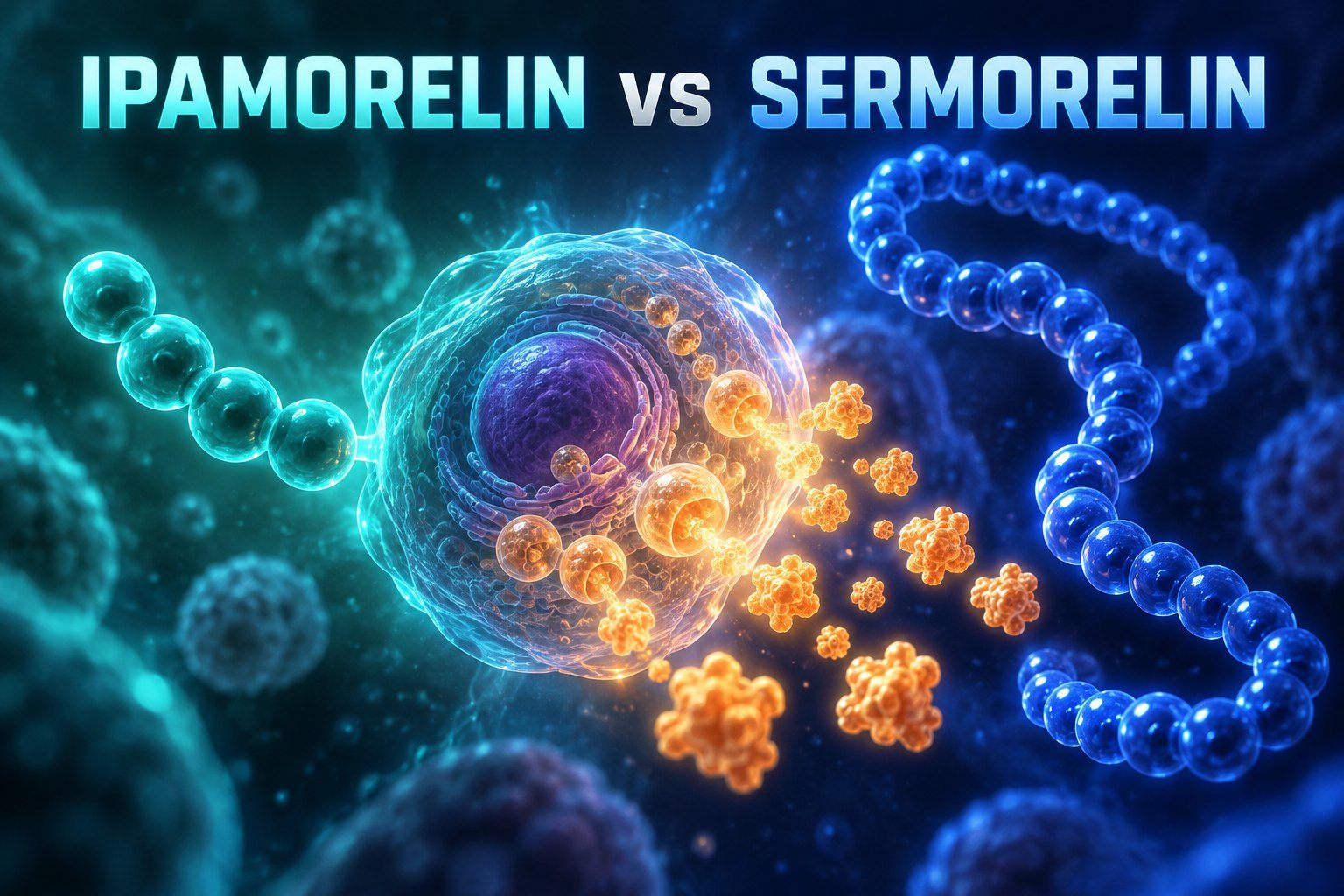
Sermorelin and Ipamorelin both get your pituitary to release more of its own growth hormone.
That’s where the similarity ends.
They work through different receptors. One clears out of your body in minutes, the other lasts for hours. One was an FDA-approved drug for nearly two decades. The other never got past Phase 2.
So which one is better comes down to what you care about most. Here’s how they compare, and how to choose.
How Your Body Controls Growth Hormone
Your pituitary doesn’t release growth hormone (GH) on its own schedule. It takes orders from three signals:
- GHRH (growth hormone-releasing hormone) comes from the hypothalamus and says release.
- Somatostatin, also from the hypothalamus, says stop.
- Ghrelin, the hunger hormone made mostly in your stomach, works through its own receptor and makes each release bigger.
Sermorelin copies the first signal. Ipamorelin copies the third.
Same target cells, two different receptors. That’s the root of almost every difference between them.
What Is Sermorelin?
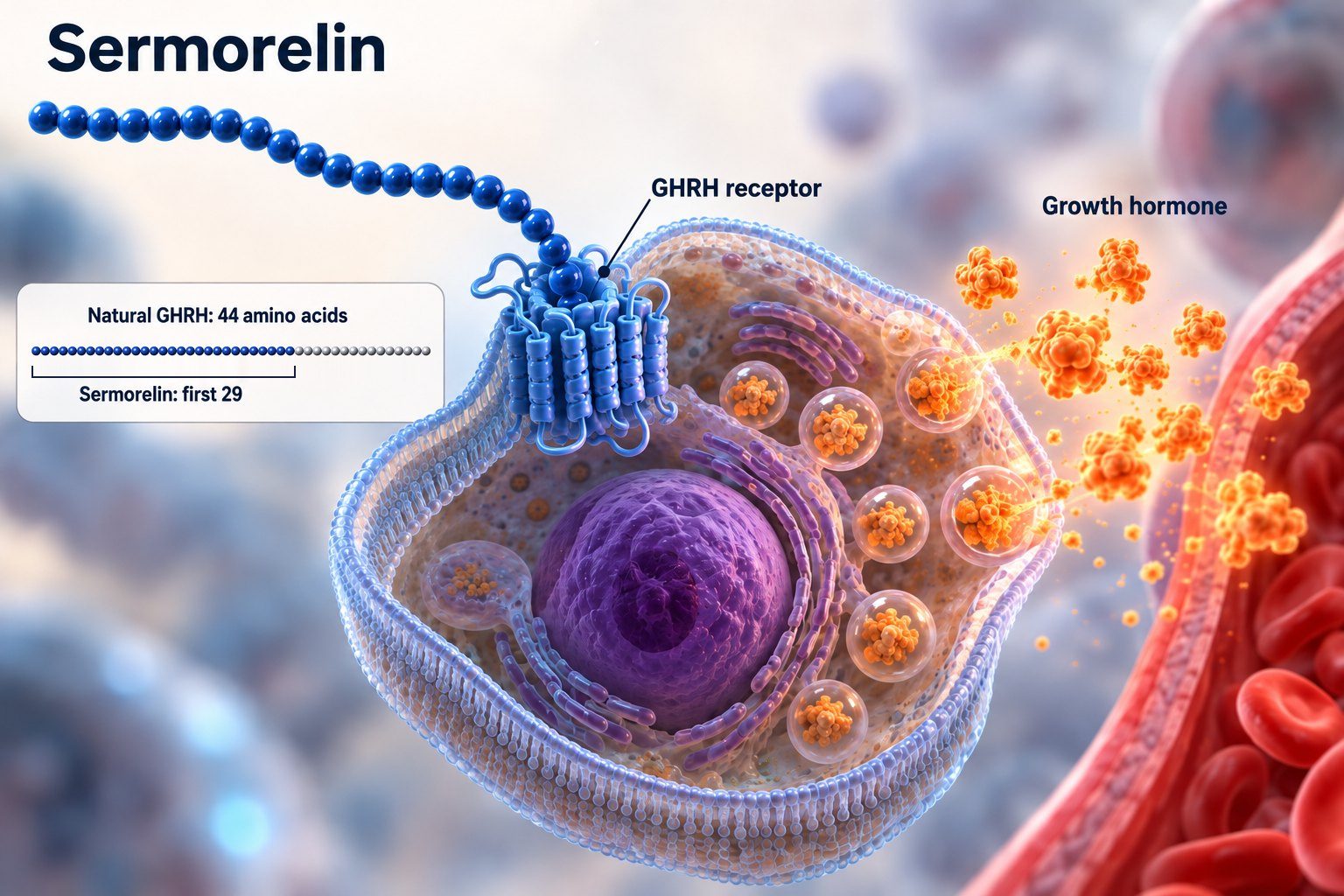
Natural GHRH is 44 amino acids long. Sermorelin is the first 29 of them, the shortest piece that still does the full job. It binds the GHRH receptor on the pituitary cells that make GH and sends the same “release” message your hypothalamus would.
Sermorelin also has a real drug history.
It was sold in the US as Geref. The FDA approved it in 1990 as a test of pituitary function, and in 1997 as a treatment for children with growth hormone deficiency. In the main pediatric trial, kids dosed once nightly nearly doubled their growth rate, from 4.1 to 8.0 cm per year at six months.
The manufacturer, Serono, discontinued Geref in 2008, and the approvals were formally withdrawn in 2009. In 2013 the FDA determined it was not taken off the market for reasons of safety or effectiveness.
It doesn’t last long. After an IV dose, half of it is gone in about 6 to 7 minutes. GH peaks around 30 minutes later, and the effect fades over 2 to 3 hours. Most of the trials dosed it at bedtime, which lines up with the body’s largest natural GH release early in deep sleep.
Sermorelin Studies in Healthy Older Adults
Sermorelin has also been tested in healthy older adults.
In 10 healthy older men, twice-daily injections for two weeks brought 24-hour GH and IGF-1 back up to the levels seen in young men.
In 19 men and women aged 55 to 71, a nightly dose of a close sermorelin analog for 16 weeks raised IGF-1. The men gained lean mass, improved their insulin sensitivity, and reported better well-being and libido. Skin got thicker in both sexes. IGF-1 drifted back toward baseline by the end of the trial.
In 11 men aged 64 to 76, a nightly dose for six weeks raised nighttime GH, but IGF-1 and body composition didn’t change.
Small trials and short timelines, but real human data in healthy adults.
What Is Ipamorelin?
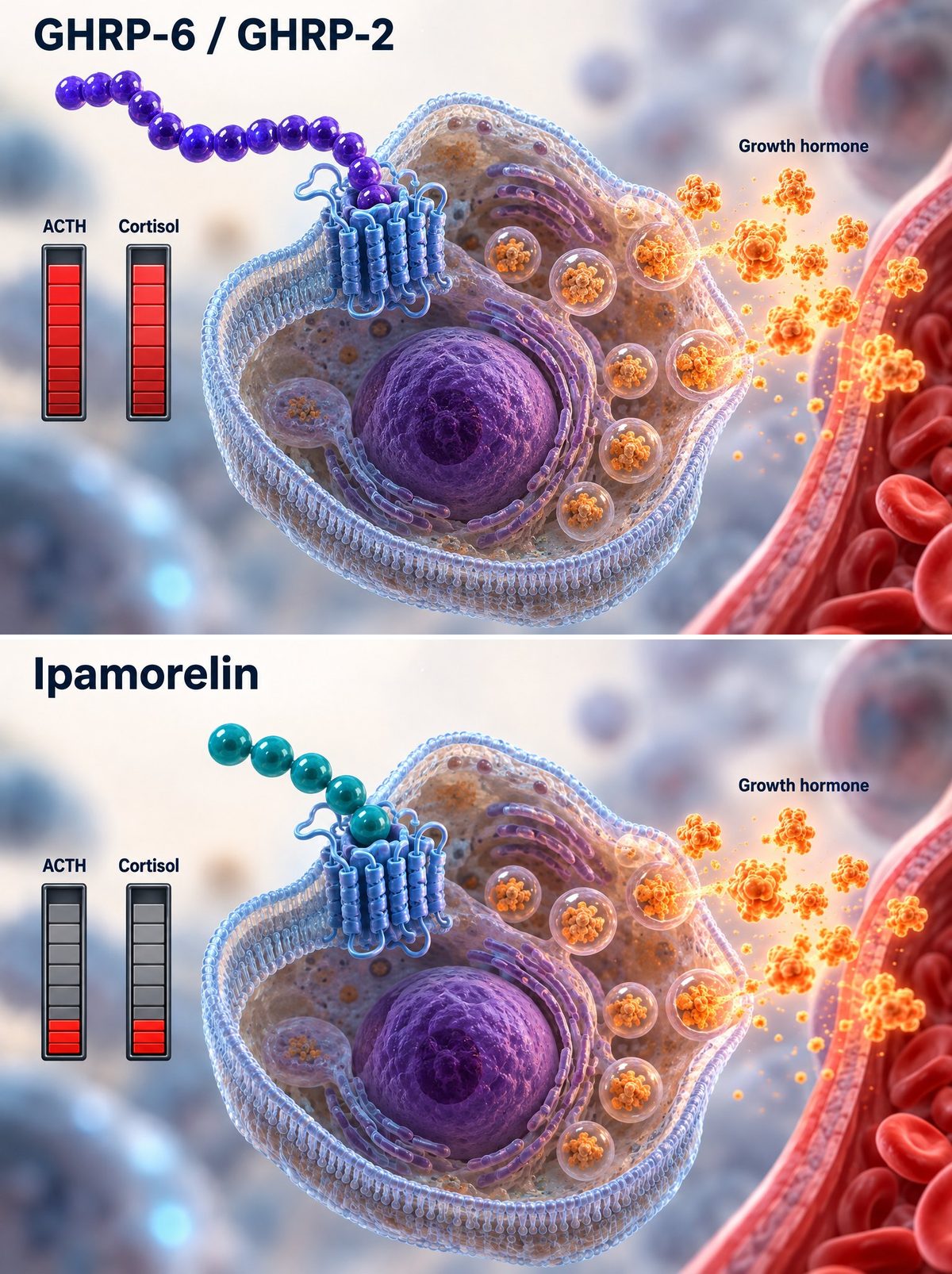
Ipamorelin is a five-amino-acid peptide developed at Novo Nordisk in the 1990s. It binds the ghrelin receptor, also called the growth hormone secretagogue receptor, and triggers a GH pulse through that route.
Its whole selling point is selectivity.
The ghrelin-mimicking peptides that came before it, GHRP-6 and GHRP-2, raise GH but also push up ACTH and cortisol, your stress-hormone axis. They stimulate appetite too. In one small study, GHRP-2 raised how much men ate by about 36%.
In the study that introduced Ipamorelin, done in pigs, GHRP-6 and GHRP-2 raised ACTH and cortisol. Ipamorelin didn’t, even at more than 200 times the dose needed for a GH response. On that measure it behaved like GHRH itself. That’s an animal finding. Ipamorelin’s effect on cortisol hasn’t been measured in people.
So the appeal isn’t that Ipamorelin releases more GH. It’s that it releases GH with less going on around it.
In healthy men, an IV dose produces a single GH pulse that peaks about 40 minutes later. Ipamorelin’s half-life is about 2 hours, many times longer than Sermorelin’s.
Its clinical program focused on postoperative ileus, the gut shutdown that can follow bowel surgery. In the published Phase 2 trial of 114 patients, those on Ipamorelin tolerated a meal somewhat sooner than those on placebo (25.3 versus 32.6 hours), but the difference wasn’t statistically significant. Development stopped there, and Ipamorelin has never been approved anywhere.
Ipamorelin vs Sermorelin: Side-by-Side Comparison
| Sermorelin | Ipamorelin | |
|---|---|---|
| What it mimics | GHRH, the “release” signal | Ghrelin, the “amplify” signal |
| Receptor | GHRH receptor | Ghrelin receptor (GH secretagogue receptor) |
| Size | 29 amino acids | 5 amino acids |
| Half-life | About 6 to 7 minutes (IV) | About 2 hours (IV) |
| Approval history | FDA-approved as Geref, 1990 to 2009 | Never approved |
| Human trials | Children with GH deficiency; healthy older adults | One dosing study in healthy men; Phase 2 in bowel surgery patients |
| ACTH and cortisol | No rise | No rise in pig studies, even at very high doses |
| Reported side effects | Facial flushing, injection-site pain | No more common than placebo in the surgery trial |
Which Is Better for You?
It depends on what you’re after.
Sermorelin if you want the most human data. It was an approved drug, it worked in children with GH deficiency, and it’s been tested in healthy older adults. It works upstream, through the same signal your hypothalamus uses. The trade-off is that short half-life, which is why it’s dosed at night.
Ipamorelin if you want a cleaner, longer signal. It hits the ghrelin receptor without the ACTH and cortisol bump of the older GHRPs, at least in animal studies, and it stays active for hours instead of minutes. The trade-off is a thinner human record: one dosing study in healthy men and one published trial in surgery patients.
Neither if your pituitary can’t make GH. Both ask your pituitary to release its own growth hormone. That’s exactly why Geref worked as a diagnostic test. No response pointed to a problem in the pituitary itself.
If you want the dosing details, I covered them in my Ipamorelin and Sermorelin dosage guide.
Can You Stack Ipamorelin and Sermorelin?
This is where the different receptors pay off.
GHRH and ghrelin signals amplify each other. Hit both and you get far more GH than either one alone. In one human study, ghrelin plus GHRH (1-29), the same sequence as Sermorelin, produced a GH peak of about 134 µg/L, compared with 92 for ghrelin alone and 27 for GHRH alone.
That’s the logic behind pairing a GHRH analog with a ghrelin mimetic, and it’s why CJC-1295 + Ipamorelin is one of the most popular GH stacks. I break down that stack and the other GH peptides in my complete guide to growth hormone peptides.
Nobody has run a controlled human trial of Sermorelin plus Ipamorelin specifically, so the case for this exact pair rests on the mechanism.
Why GH Peptide Results Level Off
Both peptides work through your body’s feedback loop, not around it.
When GH goes up, IGF-1 goes up. IGF-1 then raises somatostatin, the “stop” signal, and tells the pituitary directly to ease off. So the response has a ceiling. You’re nudging GH output within its natural range, not pushing it wherever you want.
How you dose matters too. A constant 24-hour GHRH infusion cut the pituitary’s response to the next dose by more than half. Nightly dosing held up better: in the 16-week trial, the GH response stayed steady. On the ghrelin side, twice-daily hexarelin, an older GHRP, lost nearly half its GH effect by week 16, then fully recovered after four weeks off. Ipamorelin hasn’t been studied with long-term repeat dosing in humans.
That ceiling is also the main argument for these peptides over injected HGH. Synthetic HGH bypasses the loop entirely. Sermorelin and Ipamorelin keep the brake connected, and GH still comes out in your body’s natural pulses.
Ipamorelin and Sermorelin Side Effects
Sermorelin’s labeled side effects are mostly minor: facial flushing or a feeling of warmth, and pain at the injection site.
Ipamorelin’s human safety record is small. In the Phase 2 surgery trial, side effects were no more common than with placebo (87.5% of patients on Ipamorelin reported at least one, versus 94.8% on placebo). These were patients recovering from bowel surgery, so side effects were common in both groups.
Bottom Line
Sermorelin and Ipamorelin both get your own pituitary to release more GH, from opposite sides of the system. Sermorelin copies the hypothalamus’s release signal and comes with nearly two decades as an approved drug. Ipamorelin copies ghrelin’s amplifying signal, with a cleaner hormone profile in animal studies and a much longer half-life.
Want the deepest human data? Sermorelin. Want a selective, longer-acting signal? Ipamorelin. Want the biggest GH response? The biology points to pairing a GHRH analog with a ghrelin mimetic.
Frequently Asked Questions About Ipamorelin vs Sermorelin
What is the main difference between Ipamorelin and Sermorelin?
Sermorelin mimics GHRH and acts on the GHRH receptor. Ipamorelin mimics ghrelin and acts on the ghrelin receptor. Both make the pituitary release its own growth hormone, but Sermorelin’s half-life is minutes while Ipamorelin’s is about two hours.
Which is better for muscle and fat loss?
Sermorelin has the only body-composition data in healthy adults. In a 16-week trial in older adults, nightly dosing of a close Sermorelin analog increased lean mass in men. Ipamorelin hasn’t been studied for body composition in people.
Can you take Ipamorelin and Sermorelin together?
They act on different receptors, and GHRH and ghrelin signals are synergistic, so pairing a GHRH analog with a ghrelin mimetic releases more GH than either alone. The exact Sermorelin and Ipamorelin combination hasn’t been tested in a controlled human trial.
Which lasts longer, Ipamorelin or Sermorelin?
Ipamorelin. Its half-life is about 2 hours after an IV dose, compared with about 6 to 7 minutes for Sermorelin.
Does Ipamorelin raise cortisol?
Not in animal studies. In pigs, Ipamorelin didn’t raise ACTH or cortisol even at more than 200 times its effective dose, unlike GHRP-6 and GHRP-2. It hasn’t been measured in humans.
Is Sermorelin FDA approved?
Not anymore. Sermorelin was FDA-approved as Geref from 1990 until its approvals were withdrawn in 2009, after the manufacturer discontinued it. The FDA later determined it was not withdrawn for reasons of safety or effectiveness. Ipamorelin has never been approved.
Do Ipamorelin and Sermorelin work if the pituitary is damaged?
No. Both work by getting the pituitary to release its own growth hormone, so they need working GH-producing cells. That’s why Sermorelin was used as a diagnostic test of pituitary function.
References
- Thorner M, et al. Once daily subcutaneous growth hormone-releasing hormone therapy accelerates growth in growth hormone-deficient children during the first year of therapy. J Clin Endocrinol Metab. 1996;81(3):1189-1196. PubMed
- U.S. Food and Drug Administration. Determination that Geref (sermorelin acetate) was not withdrawn from sale for reasons of safety or effectiveness. Federal Register. 2013;78:14095. Federal Register
- Corpas E, et al. Growth hormone (GH)-releasing hormone-(1-29) twice daily reverses the decreased GH and insulin-like growth factor-I levels in old men. J Clin Endocrinol Metab. 1992;75(2):530-535. PubMed
- Khorram O, et al. Endocrine and metabolic effects of long-term administration of [Nle27]growth hormone-releasing hormone-(1-29)-NH2 in age-advanced men and women. J Clin Endocrinol Metab. 1997;82(5):1472-1479. PubMed
- Vittone J, et al. Effects of single nightly injections of growth hormone-releasing hormone (GHRH 1-29) in healthy elderly men. Metabolism. 1997;46(1):89-96. PubMed
- Raun K, et al. Ipamorelin, the first selective growth hormone secretagogue. Eur J Endocrinol. 1998;139(5):552-561. PubMed
- Laferrère B, et al. Growth hormone releasing peptide-2 (GHRP-2), like ghrelin, increases food intake in healthy men. J Clin Endocrinol Metab. 2005;90(2):611-614. PubMed
- Gobburu JV, et al. Pharmacokinetic-pharmacodynamic modeling of ipamorelin, a growth hormone releasing peptide, in human volunteers. Pharm Res. 1999;16(9):1412-1416. PubMed
- Beck DE, et al. Prospective, randomized, controlled, proof-of-concept study of the ghrelin mimetic ipamorelin for the management of postoperative ileus in bowel resection patients. Int J Colorectal Dis. 2014;29(12):1527-1534. DOI
- Arvat E, et al. Endocrine activities of ghrelin, a natural growth hormone secretagogue (GHS), in humans: comparison and interactions with hexarelin, a nonnatural peptidyl GHS, and GH-releasing hormone. J Clin Endocrinol Metab. 2001;86(3):1169-1174. PubMed
- Berelowitz M, et al. Somatomedin-C mediates growth hormone negative feedback by effects on both the hypothalamus and the pituitary. Science. 1981;212(4500):1279-1281. PubMed
- Vance ML, et al. Pulsatile growth hormone secretion in normal man during a continuous 24-hour infusion of human growth hormone releasing factor (1-40). J Clin Invest. 1985;75(5):1584-1590. PubMed
- Rahim A, et al. Growth hormone status during long-term hexarelin therapy. J Clin Endocrinol Metab. 1998;83(5):1644-1649. PubMed
Stay sharp,
Joe Mars
The Peptide Report
P.S. Want to go deeper on GH peptides? I break it all down inside the Peptides and Biohacking Hub on Skool. Free community, real protocols, and people actually running this stuff. Join here.