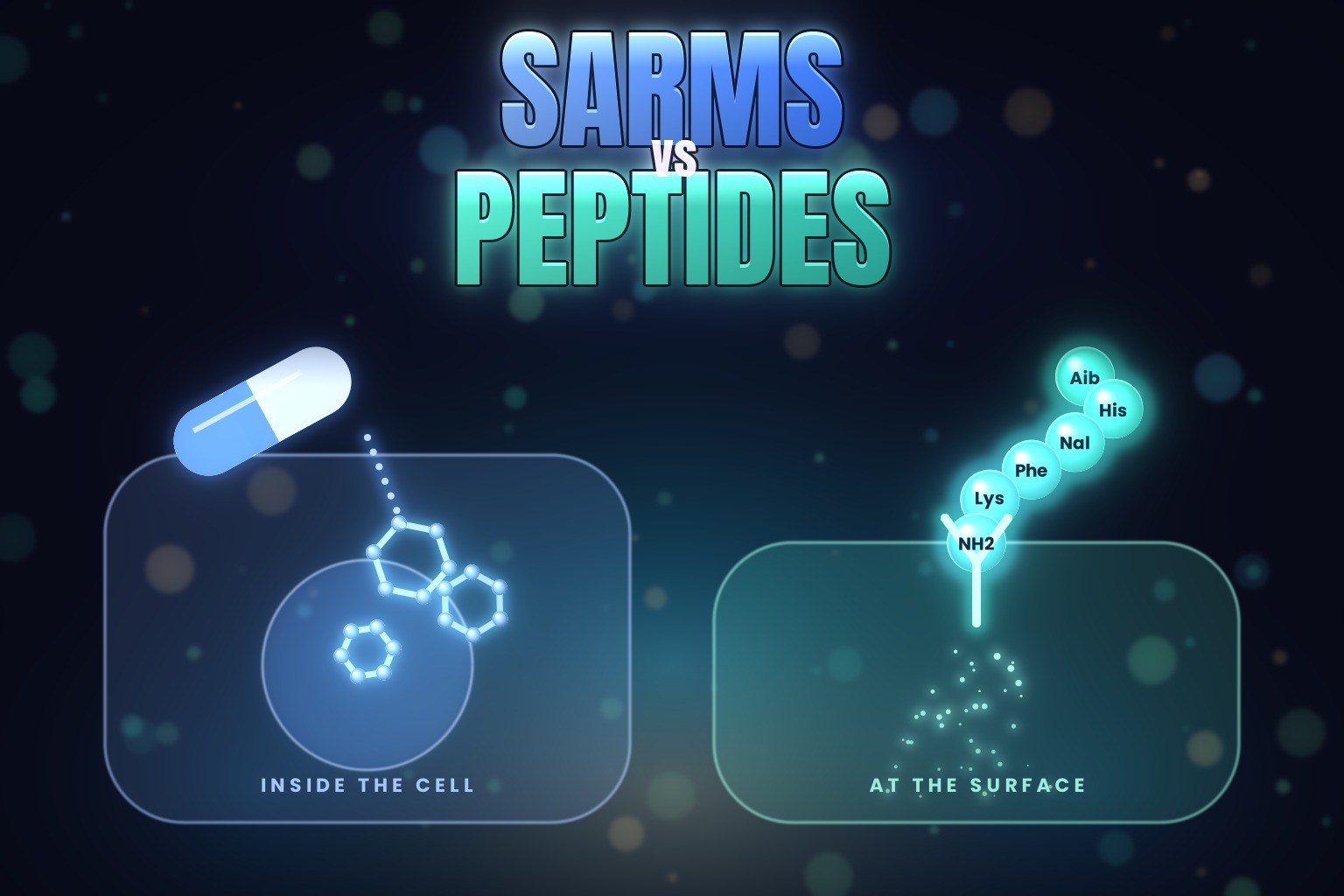
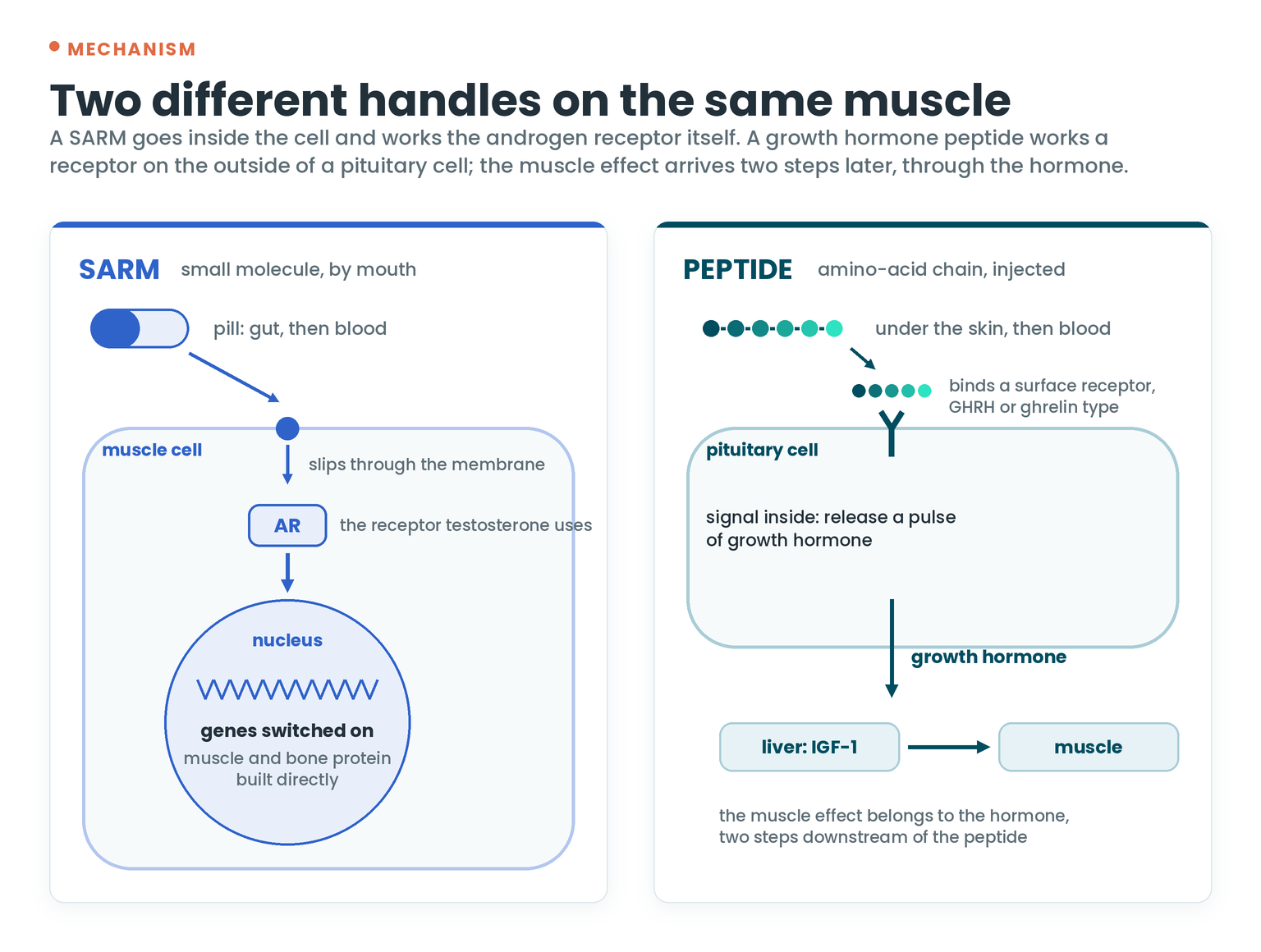
A SARM and a peptide have about as much in common as a key and a phone call. One is a small synthetic molecule that gets inside the cell and switches the androgen receptor on. The other is a short chain of amino acids that knocks on a receptor at the cell surface and asks the body to release something of its own.
That one difference explains nearly everything else people argue about: pill versus injection, days versus minutes in the body, and what moved in the blood tests of the people who actually took them in trials. So that’s how I’ll compare them.
SARMs vs Peptides at a Glance
| SARMs | Peptides | |
|---|---|---|
| What it is | A nonsteroidal small molecule, roughly 340 to 390 daltons, made to bind the androgen receptor | A chain of amino acids, from 5 (ipamorelin) to 44 (tesamorelin), that binds a receptor on the cell surface |
| Where it works | Inside the cell, on the same receptor testosterone uses, with a preference for muscle and bone | At the surface of a pituitary cell or a tissue cell, triggering a signal such as a growth hormone pulse |
| How it’s taken | By mouth | Injected under the skin in every human trial; swallowed hexarelin reached the blood at 0.3% |
| Time in the body | Long: RAD140 half-life 44.7 hours; LGD-4033 accumulates with daily dosing | Short: sermorelin half-time 4.3 minutes, ipamorelin 2 hours; CJC-1295 with DAC 5.8 to 8.1 days only because it rides on albumin |
| Best-studied examples | Enobosarm (ostarine), LGD-4033 (ligandrol), RAD140 | Tesamorelin, sermorelin, CJC-1295, ipamorelin, hexarelin, BPC-157 |
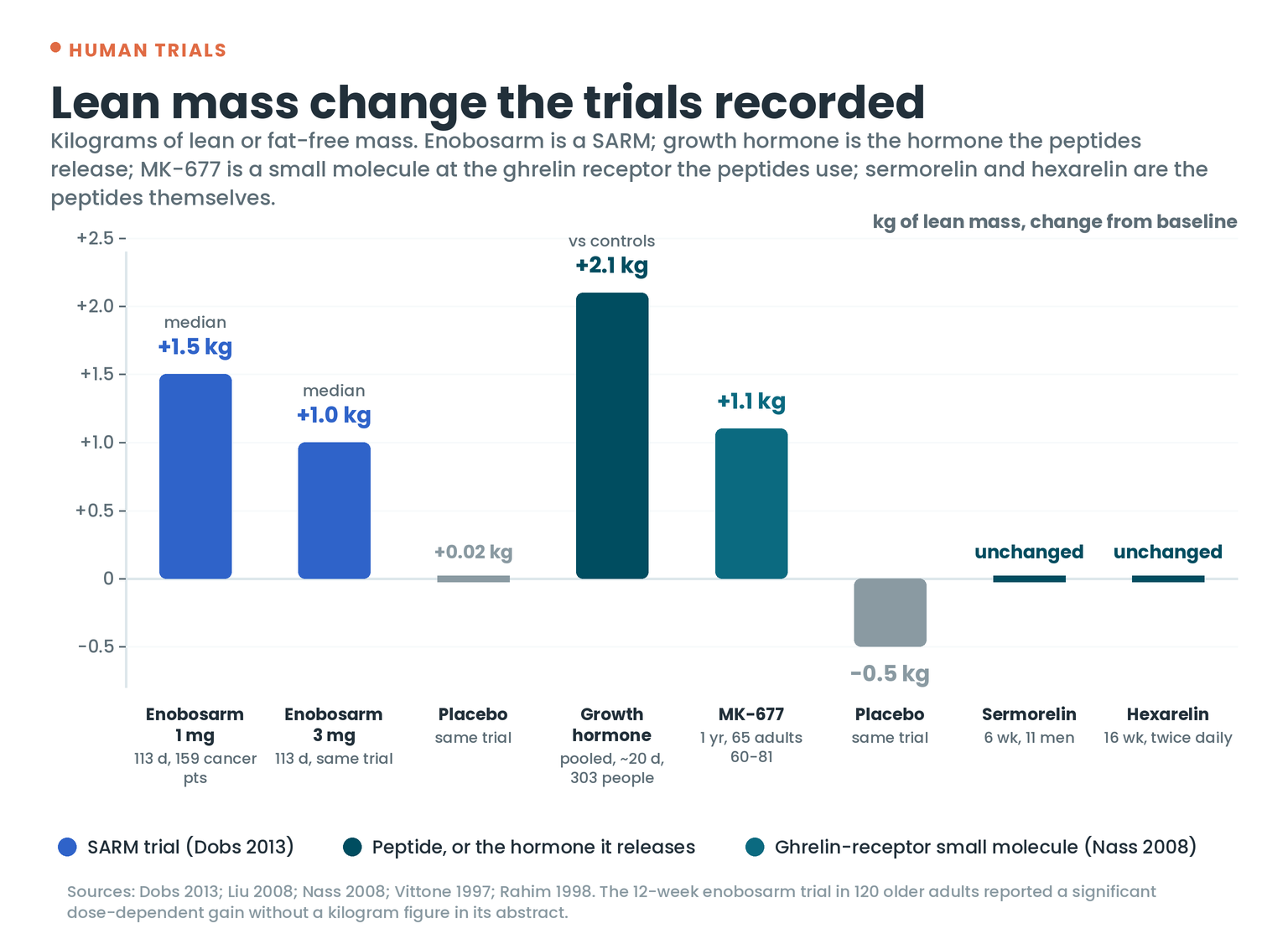
| Lean mass in people | Up in three placebo-controlled trials: median +1.5 kg at 1 mg over 113 days in cancer patients; dose-dependent gains in 120 older adults and 76 young men | Unchanged in the two peptide trials that measured it (sermorelin 6 weeks, hexarelin 16 weeks); the hormone they release added 2.1 kg in pooled growth hormone trials |
| What moved in the blood | Testosterone, SHBG, HDL and triglycerides down; ALT raised in about 7% of trial participants | Growth hormone and IGF-1 up; cortisol and prolactin up with the ghrelin-type peptides; fluid retention and higher fasting glucose on the GH axis |
What a SARM Is
A selective androgen receptor modulator is a small synthetic molecule built to do what testosterone does at the androgen receptor, but with a preference for muscle and bone over the prostate and skin. The first-generation compounds people know by name are enobosarm, which most of the internet calls ostarine, LGD-4033 or ligandrol, and RAD140. They are nonsteroidal, which is the point: the developers wanted testosterone’s effect on lean tissue without its steroid skeleton or its conversion to estrogen and DHT.
Because they’re small, they survive the gut. Every human SARM trial used a daily capsule or solution by mouth. Because they’re built to resist breakdown, they stay around: RAD140’s half-life in its phase 1 study was 44.7 hours, and LGD-4033 had a long elimination half-life with dose-proportional accumulation when taken daily for three weeks. A dose taken on Monday is still at work on Wednesday.
One thing worth clearing up early, because the products get sold side by side: MK-677, or ibutamoren, is neither a SARM nor a peptide. It’s an oral small molecule that mimics ghrelin at the same receptor ipamorelin and hexarelin use. I’ll use its one-year trial below as the best long-term look at that receptor in people, but it belongs in its own box.
What a Peptide Is
A peptide is a short chain of amino acids, the same building blocks proteins are made of, joined in a specific order. Ipamorelin is five of them. Hexarelin is six. BPC-157 is fifteen. Sermorelin is the first 29 amino acids of growth hormone-releasing hormone, and tesamorelin is all 44 with one extra group on the end. More than 60 peptide medicines are in clinical use worldwide, insulin being the first and oldest.
A peptide doesn’t get inside the cell and doesn’t touch the androgen receptor. It binds a receptor on the outside, and that receptor sends a signal inward. For the growth hormone peptides, the cell is a somatotroph in the pituitary and the signal is “release a pulse of growth hormone,” which then raises IGF-1 from the liver. Tesamorelin and sermorelin do this through the GHRH receptor; ipamorelin and hexarelin do it through the ghrelin receptor. The muscle effect, if there is one, is two steps downstream and belongs to the hormone, not the peptide.
Peptides are also fragile. Digestive enzymes cut them up, which is why every human trial of these compounds used injection; when hexarelin was swallowed, 0.3% of it reached the blood. And once in the blood they’re cleared fast: sermorelin’s half-time was 4.3 minutes in men given an infusion, ipamorelin’s terminal half-life was 2 hours, and tesamorelin’s population model gives a clearance of 1,060 liters an hour from a 200-liter distribution volume, which works out to minutes. The one long-lived exception, CJC-1295 with DAC, lasts 5.8 to 8.1 days because it bonds to albumin and borrows albumin’s lifespan.
What the Human Trials Found
This is where the two categories separate most clearly, so I’ll take the measurements one at a time rather than the marketing claims.
Lean mass
SARMs have three placebo-controlled trials with lean mass as the primary endpoint. In 120 healthy men over 60 and postmenopausal women, 12 weeks of enobosarm produced a dose-dependent rise in total lean mass that was significant at 3 mg, along with better physical function and improved insulin resistance. In 159 cancer patients who had already lost weight, 113 days of enobosarm raised lean mass by a median of 1.5 kg at 1 mg and 1.0 kg at 3 mg, against 0.02 kg on placebo. And in 76 healthy men aged 21 to 50, 21 days of LGD-4033 at 0.1, 0.3 or 1 mg raised lean mass dose-dependently without changing fat mass.
For the peptides themselves the record is thinner. Six weeks of 2 mg sermorelin nightly in 11 men aged 64 to 76 raised night-time growth hormone but left DEXA body composition unchanged. Sixteen weeks of twice-daily hexarelin left fat, lean mass and bone density where they started. The CJC-1295 trials measured hormones, not body composition. Tesamorelin’s phase 3 program measured fat, which I’ll come to.
The hormone these peptides release does have a lean-mass record. Across 27 trial samples of growth hormone in fit young adults, lean mass rose 2.1 kg more than in controls, and in 96 recreational athletes the gain came through extracellular water rather than body cell mass. One year of MK-677 at the ghrelin receptor raised fat-free mass by 1.1 kg against a 0.5 kg loss on placebo in 65 adults aged 60 to 81.
Strength and function
Among the SARM trials, the enobosarm study in older adults is the one that showed a functional gain alongside the lean mass, at 3 mg. On the peptide side, the sermorelin study saw 2 of 6 strength tests improve. The growth hormone review found no improvement in strength or exercise capacity despite the extra lean mass, with higher lactate during exercise in two of three studies that measured it, and the MK-677 trial stated plainly that the extra fat-free mass did not change strength or function. The one performance measure that did move was sprint capacity, up 3.9% after 8 weeks of growth hormone in the athlete trial, and it was gone six weeks after stopping.
Fat
Here the order flips. The three-week LGD-4033 trial recorded no change in fat mass, and the enobosarm trials reported weight and insulin resistance rather than fat loss. Tesamorelin, by contrast, has the largest body-composition dataset of any peptide: across two phase 3 trials in 806 people, 26 weeks cut visceral fat by 24 cm² on a CT slice against a 2 cm² gain on placebo, with triglycerides down 37 mg/dL and IGF-1 up 108 ng/mL, while fat under the skin didn’t change. Growth hormone itself reduced fat mass in the athlete trial, and MK-677 did not reduce visceral or total fat over a year.
Recovery and injury
The peptides people reach for here, BPC-157 and TB-500, have a different kind of record. BPC-157’s entire human literature is three small uncontrolled reports from one clinic totaling about 30 people, and a 2026 systematic review rated the certainty of that evidence very low. TB-500 has no human trial at all; its parent protein, thymosin beta-4, has a few. On the SARM side, the human recovery data runs the other way: the safety review of SARM use in healthy adults logged an Achilles tendon rupture and a case of rhabdomyolysis among the case reports.
Sleep
The one controlled look at a ghrelin-type peptide and sleep gave healthy volunteers four 50 µg doses of hexarelin through the night and recorded less stage 4 sleep and less delta power, with growth hormone, ACTH, cortisol and prolactin all up. There is no human sleep study of a SARM.
What Moved in the Blood
Both categories change blood chemistry, in different directions, and the trials were careful about measuring it.
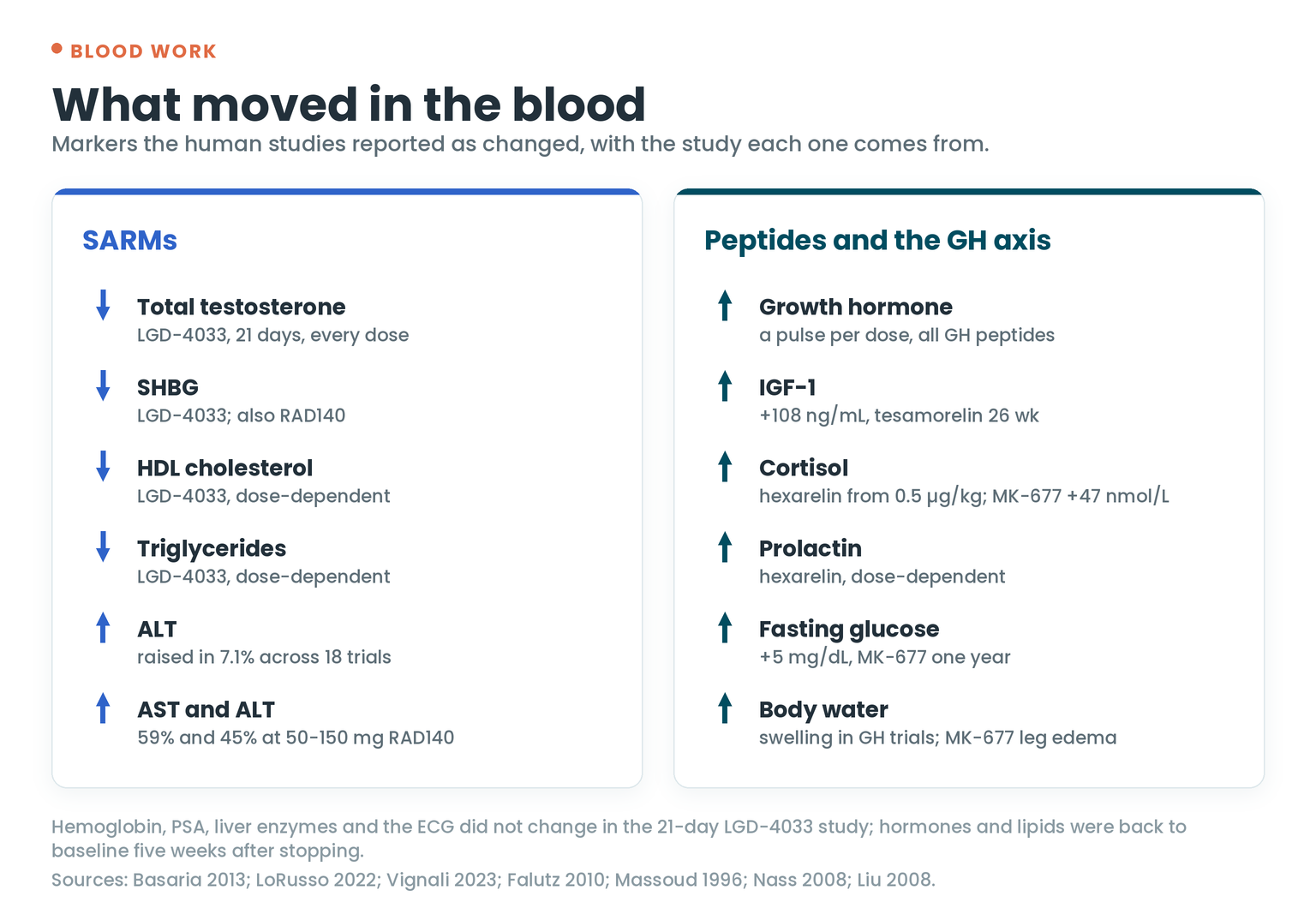
Three weeks of LGD-4033 lowered total testosterone, SHBG, HDL cholesterol and triglycerides in a dose-dependent way, and at 1 mg it lowered free testosterone and FSH as well. Hemoglobin, PSA, liver enzymes and the ECG didn’t change in that study, and hormones and lipids were back to baseline five weeks after stopping. Across the 18 clinical trials pooled in a 2023 safety review, raised ALT was reported in a mean of 7.1% of people exposed to a SARM, and the same review counted 15 published cases of drug-induced liver injury, one Achilles rupture and one rhabdomyolysis, plus two more rhabdomyolysis cases inside a GSK2881078 trial. An Australian case series of 23 liver injuries attributed to anabolic steroids, SARMs and bodybuilding supplements, 14 of them involving a SARM, put the median onset at 58 days after starting, admitted 17 of the 23 to hospital, saw liver tests take a median of 175 days to normalize, and recorded one liver transplant. At the doses used in breast cancer, 50 to 150 mg a day, RAD140 raised AST in 59% and ALT in 45% of patients.
The peptide side reads differently. The ghrelin-type peptides raise cortisol and prolactin with each dose from about 0.5 µg/kg upward, and the growth hormone axis they drive brings its own changes: in the one-year MK-677 trial fasting glucose rose 5 mg/dL, insulin sensitivity fell, cortisol rose 47 nmol/L, and the most common complaints were appetite, mild leg swelling and muscle pain. The pooled growth hormone trials recorded more soft-tissue swelling and fatigue than in controls.
What’s Actually in the Bottle
This matters more for SARMs than for anything else I’ve written about. In 2017, 44 products sold online as SARMs were bought and analyzed with anti-doping laboratory methods. Only 23 of them, 52%, contained a SARM at all. Seventeen, 39%, contained a different drug instead, among them ibutamoren, the metabolic compound GW501516 and SR9009. Four contained nothing active. Eleven contained substances not on the label, and the amount matched the label in just 18 of the 44. The sports-medicine review of SARM case reports noted that the people who ended up in those reports had bought online, often took far more than any trial had tested, and that contamination was likely contributing to what sent them to hospital.
The same question applies to a peptide vial, which is why a certificate of analysis showing identity and purity is the thing to ask for before anything else.
Time Frames in the Studies
You’ll see “cycle lengths” quoted for both categories. Nobody has studied cycles; what exists are trial durations, and they’re worth knowing because they’re the only windows in which anyone measured anything.
SARM trials ran for 21 days (LGD-4033 in young men), 12 weeks (enobosarm in older adults) and up to 113 days (enobosarm in cancer patients). The people in the published SARM case reports had been taking them for a mean of eight weeks. Peptide trials ran from a single injection (CJC-1295, followed for up to 49 days) to 6 weeks (sermorelin), 16 weeks (hexarelin), 26 weeks with a 26-week extension (tesamorelin) and two years (MK-677 at the ghrelin receptor).
Check the Evidence Claim by Claim
Pick a claim below and the meter shows how much human testing sits behind it on each side, what those tests found, and which study it comes from.
Evidence meter, claim by claim
How much human testing sits behind each claim, and what it found
SARMs
Peptides
For the individual peptides, the tesamorelin vs ipamorelin, sermorelin vs CJC-1295 and hexarelin dosage articles go through each trial in detail, and the TB-500 piece covers the peptide-versus-steroid line from the other side.
FAQ
Are SARMs peptides?
No. A SARM is a small synthetic molecule of a few hundred daltons that binds the androgen receptor inside the cell. A peptide is a chain of amino acids that binds a receptor on the cell surface. Different chemistry, different target, different route into the body.
Is MK-677 a peptide?
No. Ibutamoren is an oral small molecule that activates the ghrelin receptor, the same one ipamorelin and hexarelin use. It’s sold alongside both categories and fits neither.
Which has more human evidence for building muscle?
SARMs, by a distance: three placebo-controlled trials with lean mass as the primary outcome, in about 355 people. The peptides’ muscle case rests on the hormone they release, and the growth hormone trials found extra lean mass without extra strength.
Do SARMs lower testosterone?
Yes. In healthy young men, 21 days of LGD-4033 suppressed total testosterone and SHBG at every dose, and free testosterone and FSH at 1 mg. Levels were back to baseline five weeks after stopping in that study.
Why are peptides injected and SARMs swallowed?
Peptides are cut up by digestive enzymes, so very little survives the gut; swallowed hexarelin reached the blood at 0.3% of the injected amount. SARMs are small, stable molecules that absorb well by mouth, which is how every SARM trial dosed them.
Which one is harder on the liver?
The trial and case-report record for liver injury belongs to SARMs: ALT elevations in about 7% of trial participants, 15 published liver-injury cases by 2023, and a 23-case Australian series with one transplant. The peptide trials didn’t record liver enzyme changes as a finding.
References
- Vasireddi N, Hahamyan HA, Gould HP, et al. Athlete selective androgen receptor modulators abuse: a systematic review. Am J Sports Med. 2025;53(4):999-1009. DOI
- Dalton JT, Barnette KG, Bohl CE, et al. The selective androgen receptor modulator GTx-024 (enobosarm) improves lean body mass and physical function in healthy elderly men and postmenopausal women: results of a double-blind, placebo-controlled phase II trial. J Cachexia Sarcopenia Muscle. 2011;2(3):153-161. DOI
- Dobs AS, Boccia RV, Croot CC, et al. Effects of enobosarm on muscle wasting and physical function in patients with cancer: a double-blind, randomised controlled phase 2 trial. Lancet Oncol. 2013;14(4):335-345. DOI
- Basaria S, Collins L, Dillon EL, et al. The safety, pharmacokinetics, and effects of LGD-4033, a novel nonsteroidal oral, selective androgen receptor modulator, in healthy young men. J Gerontol A Biol Sci Med Sci. 2013;68(1):87-95. DOI
- LoRusso P, Hamilton E, Ma C, et al. A first-in-human phase 1 study of a novel selective androgen receptor modulator (SARM), RAD140, in ER+/HER2- metastatic breast cancer. Clin Breast Cancer. 2022;22(1):67-77. DOI
- Vignali JD, Pak KC, Beverley HR, et al. Systematic review of safety of selective androgen receptor modulators in healthy adults: implications for recreational users. J Xenobiot. 2023;13(2):218-236. DOI
- Nash E, Nicoll A, Batt N, et al. Drug-induced liver injury from selective androgen receptor modulators, anabolic-androgenic steroids and bodybuilding supplements in Australia. Aliment Pharmacol Ther. 2024;59(8):953-961. DOI
- Van Wagoner RM, Eichner A, Bhasin S, Deuster PA, Eichner D. Chemical composition and labeling of substances marketed as selective androgen receptor modulators and sold via the internet. JAMA. 2017;318(20):2004-2010. DOI
- Lau JL, Dunn MK. Therapeutic peptides: historical perspectives, current development trends, and future directions. Bioorg Med Chem. 2018;26(10):2700-2707. DOI
- Ghigo E, et al. Growth hormone-releasing activity of hexarelin, a new synthetic hexapeptide, after intravenous, subcutaneous, intranasal, and oral administration in man. J Clin Endocrinol Metab. 1994;78(3):693-698. DOI
- Soule S, et al. Incorporation of D-Ala2 in growth hormone-releasing hormone-(1-29)-NH2 increases the half-life and decreases metabolic clearance in normal men. J Clin Endocrinol Metab. 1994;79(4):1208-1211. DOI
- Gobburu JV, Agersø H, Jusko WJ, Ynddal L. Pharmacokinetic-pharmacodynamic modeling of ipamorelin, a growth hormone releasing peptide, in human volunteers. Pharm Res. 1999;16(9):1412-1416. DOI
- González-Sales M, Barrière O, Tremblay PO, et al. Population pharmacokinetic analysis of tesamorelin in HIV-infected patients and healthy subjects. Clin Pharmacokinet. 2015;54(3):285-294. DOI
- Teichman SL, et al. Prolonged stimulation of growth hormone (GH) and insulin-like growth factor I secretion by CJC-1295, a long-acting analog of GH-releasing hormone, in healthy adults. J Clin Endocrinol Metab. 2006;91(3):799-805. DOI
- Vittone J, et al. Effects of single nightly injections of growth hormone-releasing hormone (GHRH 1-29) in healthy elderly men. Metabolism. 1997;46(1):89-96. DOI
- Rahim A, O’Neill PA, Shalet SM. Growth hormone status during long-term hexarelin therapy. J Clin Endocrinol Metab. 1998;83(5):1644-1649. DOI
- Liu H, Bravata DM, Olkin I, et al. Systematic review: the effects of growth hormone on athletic performance. Ann Intern Med. 2008;148(10):747-758. DOI
- Meinhardt U, Nelson AE, Hansen JL, et al. The effects of growth hormone on body composition and physical performance in recreational athletes: a randomized trial. Ann Intern Med. 2010;152(9):568-577. DOI
- Nass R, Pezzoli SS, Oliveri MC, et al. Effects of an oral ghrelin mimetic on body composition and clinical outcomes in healthy older adults: a randomized trial. Ann Intern Med. 2008;149(9):601-611. DOI
- Falutz J, et al. Effects of tesamorelin (TH9507), a growth hormone-releasing factor analog, in HIV-infected patients with excess abdominal fat: a pooled analysis of two multicenter, double-blind placebo-controlled phase 3 trials with safety extension data. J Clin Endocrinol Metab. 2010;95(9):4291-4304. DOI
- Massoud AF, et al. Hexarelin-induced growth hormone, cortisol, and prolactin release: a dose-response study. J Clin Endocrinol Metab. 1996;81(12):4338-4341. DOI
- Frieboes RM, et al. Hexarelin decreases slow-wave sleep and stimulates the secretion of GH, ACTH, cortisol and prolactin during sleep in healthy volunteers. Psychoneuroendocrinology. 2004;29(7):851-860. DOI
- Lee E, Padgett B. Intra-articular injection of BPC 157 for multiple types of knee pain. Altern Ther Health Med. 2021;27(4):8-13. PubMed
- Poolton JT, Minett J, Kazmi A. Human evidence for BPC-157 in orthopaedic and regenerative medicine: a systematic review of efficacy and safety. Acta Orthop Belg. 2026;92(3). DOI
Stay sharp,
Joe Mars
The Peptide Report
P.S. If you’re holding a bottle and wondering which of the two it actually is, bring the label and the lab sheet to the Peptides and Biohacking Hub on Skool. Going by the JAMA numbers, that’s a question worth asking out loud, and the members are good at reading both. It’s free to join.