Put 1 mL of bacteriostatic water into a 5 mg vial of BPC-157, or put in 3 mL. Either way, if every draw holds 250 mcg, you get exactly twenty draws out of it.
The water decides how big each of those twenty draws looks in the syringe. It never decides how many there are.
That makes the amount of water the one real choice in the whole job. And it moves four separate limits, each of which somebody has measured. Here’s the math, then the four limits, one at a time.
The Number Water Can’t Change
Every bit of vial math comes down to one line: the milligrams in the vial divided by the milliliters of liquid gives you the concentration. Concentration then tells you how much liquid holds the amount you want.
The number of draws comes from a different division entirely. It’s the milligrams in the vial divided by the milligrams in each draw. Water isn’t in that equation at all.
Here’s what that looks like with a 250 mcg draw, which I’m using only because it’s a round number that makes the arithmetic easy to follow.
| Vial | Water added | Concentration | Volume holding 250 mcg | U-100 units | Draws per vial |
|---|---|---|---|---|---|
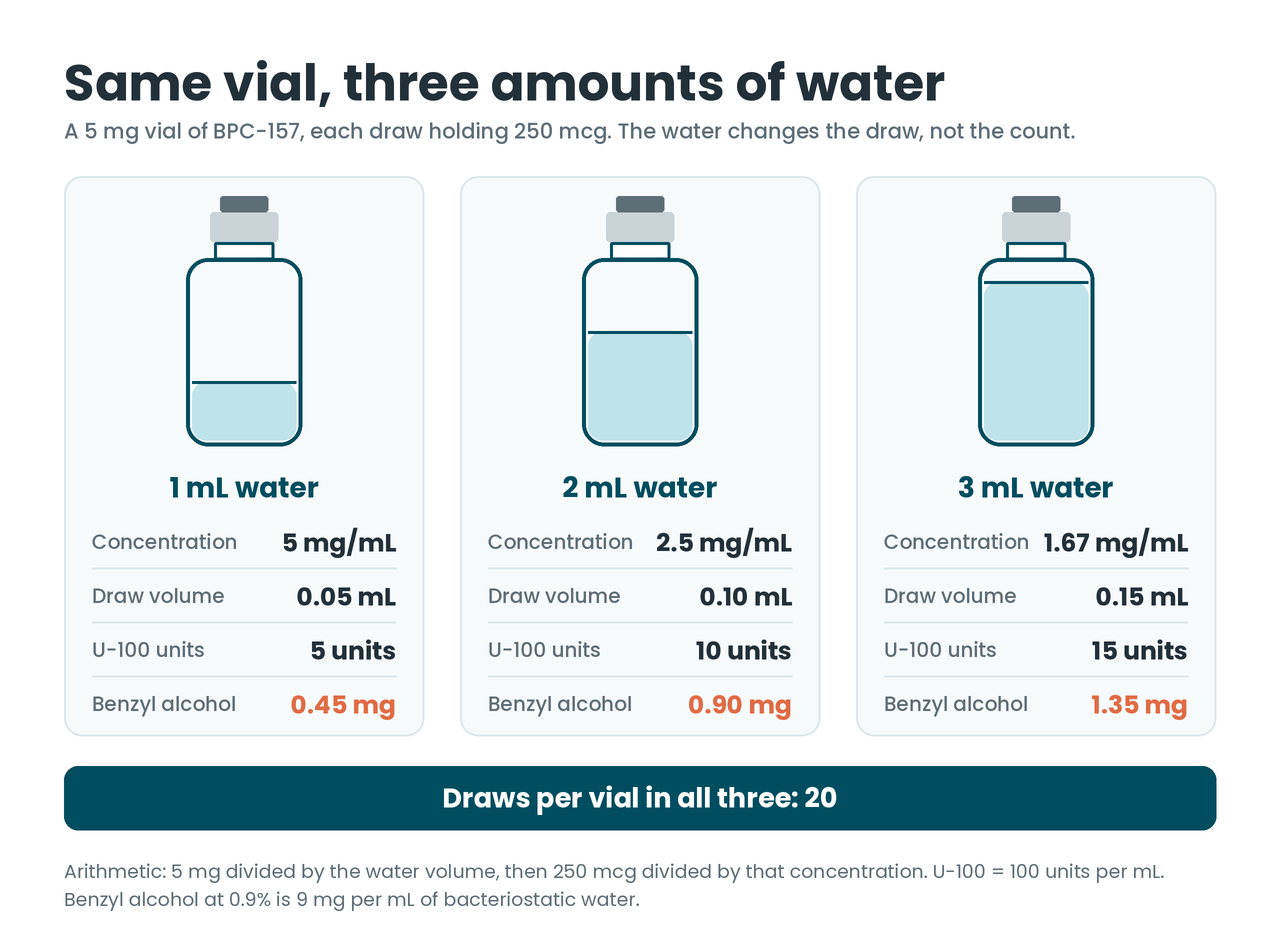
| 5 mg | 1 mL | 5 mg/mL | 0.05 mL | 5 | 20 |
| 5 mg | 2 mL | 2.5 mg/mL | 0.10 mL | 10 | 20 |
| 5 mg | 3 mL | 1.67 mg/mL | 0.15 mL | 15 | 20 |
| 10 mg | 1 mL | 10 mg/mL | 0.025 mL | 2.5 | 40 |
| 10 mg | 2 mL | 5 mg/mL | 0.05 mL | 5 | 40 |
| 10 mg | 3 mL | 3.33 mg/mL | 0.075 mL | 7.5 | 40 |
On a U-100 syringe, 100 units fill 1 mL, so each unit is 0.01 mL. That’s the only conversion you need to go from the volume column to the units column.
Read down the last column and nothing changes within a vial size. Read across any row and you can see what the water did change: the concentration, the volume and the units. Those three move together, and they’re what the four limits below care about.
If you want the same arithmetic laid out for other vial sizes and peptides, our peptide dosage chart has it, and our guide to reconstituting peptides walks through the hands-on steps. This post stays with what the water itself sets in motion.
What’s in Bacteriostatic Water
Bacteriostatic water is water with benzyl alcohol dissolved in it at 0.9%. Minogue and Sun describe bacteriostatic saline the same way, as a physiological salt solution carrying 0.9% benzyl alcohol, and Roy and colleagues call 0.9% weight per volume the “bacteriostatic amount” when they reconstituted a freeze-dried protein with it.
That 0.9% is worth turning into milligrams, because the rest of this post leans on it. Nine-tenths of a gram per 100 mL is 9 mg of benzyl alcohol in every milliliter.
That’s at the top of the range in the growth hormone products Kappelgaard and colleagues reviewed. Their list of preservatives puts benzyl alcohol at 3 to 9 mg/mL, next to phenol at 3 mg/mL and m-cresol at 9 mg/mL. In the toxicology work they summarize, under-the-skin benzyl alcohol at 9 mg/mL caused no or only mild local reactions.
The body doesn’t keep benzyl alcohol around. In McCloskey and colleagues’ mouse study it was absorbed fast and turned into benzaldehyde quickly. LeBel and colleagues followed the later steps in newborns: benzoic acid, which the body then joins to the amino acid glycine to make hippuric acid, and they measured both in urine.
So every draw carries two things: the peptide, and a small, measurable amount of a fast-cleared preservative. The water volume sets how much of each.
Limit One: How Well a Syringe Reads a Small Draw
Here’s the first limit, and it’s the one that bites at the small end of the table.
Silva and colleagues asked 15 caretakers of young children with diabetes to draw small insulin doses over and over, then weighed every draw on a sensitive balance. At a target of 2.5 units they averaged 2.75. At 3.0 units, 3.19. At 3.5 units, 3.70.
Across the board they overdrew by an average of 0.22 units. And the detail that matters most here: that error didn’t change with the dose they were aiming for. It stayed about the same size whether the target was small or a bit bigger.
A miss that stays the same size is a much bigger slice of a small draw. Here’s 0.22 units as a share of the draws in the table.
- 2.5 units: 8.8%
- 5 units: 4.4%
- 7.5 units: 2.9%
- 10 units: 2.2%
- 15 units: 1.5%
Those percentages are my own arithmetic on Silva’s average. The other studies found the same pattern directly.
Lteif and Schwenk had 48 children and parents measure doses of a look-alike solution from vials. Below 5 units, syringes missed by 9.9% on average. Above 5 units, the miss dropped to 3.2%.
Malerba and colleagues had five veterinarians draw doses from 0.5 to 16 units, 25 times each, and weighed them. Precision rose with the dose for every device. At 0.5 units the spread of the draws, measured as the coefficient of variation, was 12.08% with a 30-unit syringe and 9.39% with a 40-unit one.
So the first limit points one way: more water means bigger draws, and bigger draws are easier to measure well. Want to feel why? Try reading a few barrels yourself.
Limit Two: How Much Liquid Goes In
Bigger draws mean more liquid under the skin. That’s the second limit, and it pushes the other way. So how much is too much?
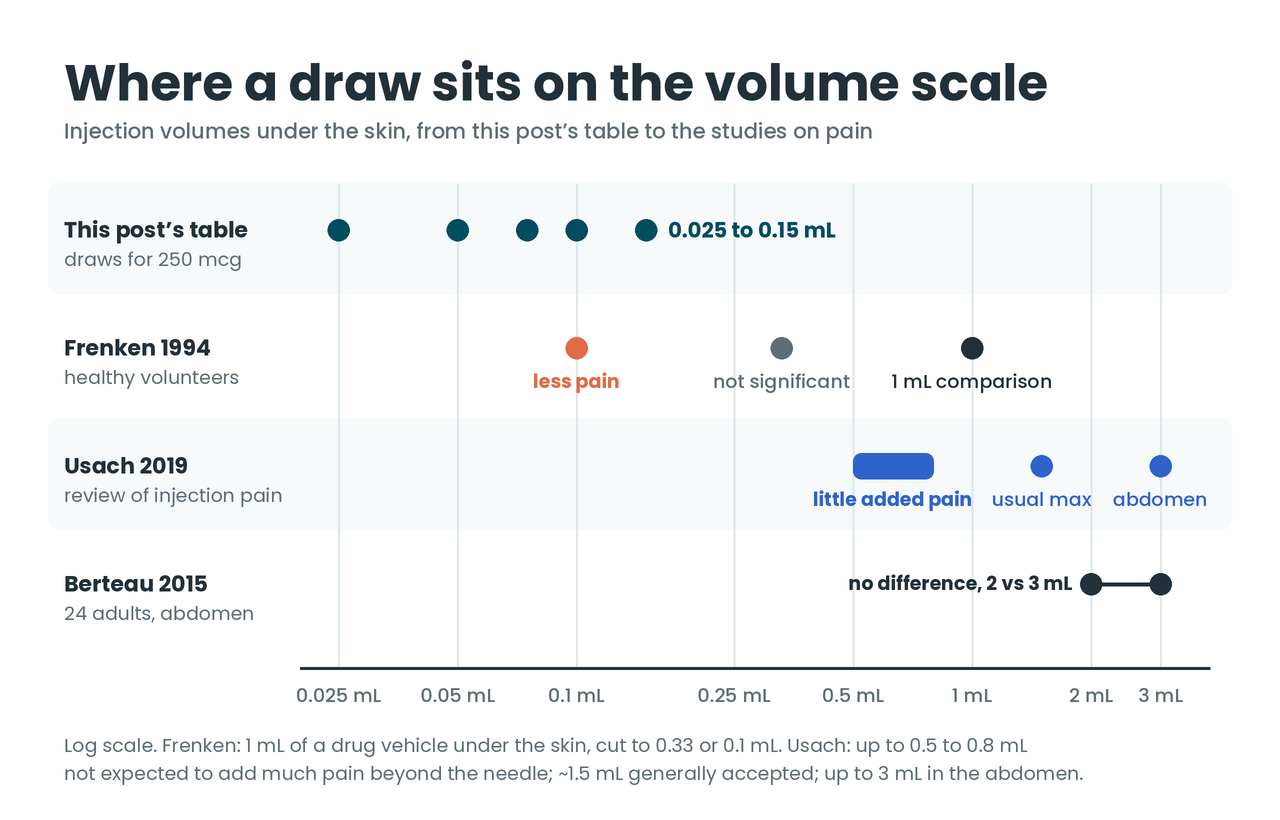
Frenken and colleagues tested it head-on in healthy volunteers. They injected 1 mL of a drug vehicle under the skin, then cut the volume to 0.33 mL or 0.1 mL. Dropping to 0.1 mL brought pain down significantly. Dropping to 0.33 mL didn’t make a statistically significant difference.
Usach and colleagues reviewed the factors behind injection pain under the skin and landed on similar numbers. Volumes up to about 0.5 to 0.8 mL aren’t expected to add much pain beyond the needle going in. Around 1.5 mL is the maximum generally accepted, and up to 3 mL is tolerated in the abdomen.
Berteau and colleagues gave 24 healthy adults abdominal injections of 2 or 3 mL of a placebo solution. The extra milliliter made no significant difference to pain. Thicker solutions actually hurt less than thin ones.
And Mathaes and colleagues point out that the 1.5 mL ceiling is more belief than finding: no controlled clinical studies stand behind it, and they argue volumes above 3.5 mL are worth exploring.
Now put the table back next to those numbers. The biggest draw in it is 0.15 mL. That sits close to the 0.1 mL that hurt less than 1 mL in Frenken’s study, and well under the 0.5 to 0.8 mL that Usach’s review says shouldn’t add much to the needle’s own sting.
There’s one more wrinkle on this side. Kappelgaard and colleagues report that in growth hormone injections, more pain came with larger volumes, and also with solutions holding higher protein concentrations. Less water means a more concentrated solution, so the volume limit doesn’t simply reward you for going small.
Limit Three: The Preservative Rides Along With Every Draw
At 9 mg per milliliter, the benzyl alcohol in each draw is easy to work out. A 0.05 mL draw carries 0.45 mg. A 0.10 mL draw carries 0.9 mg. A 0.15 mL draw carries 1.35 mg.
There’s a neater way to see it. Whatever you do with the vial afterward, every milliliter of water you put in brings 9 mg of benzyl alcohol with it, spread across all the draws. A 5 mg vial made up with 3 mL carries 27 mg in all, about 1.35 mg in each of its twenty draws.
Does that amount do anything you’d notice? It does, and it’s mostly a good thing: benzyl alcohol numbs skin.
Wilson and Martin ran a randomized, double-blind trial in 30 healthy adult volunteers, each getting 1 mL injections into the skin. Benzyl alcohol at 0.9% with epinephrine was 48% less painful to inject than plain saline and 42% less painful than lidocaine with epinephrine. It also numbed the skin for the full 45 minutes, though less effectively than lidocaine did.
Williams and Howe added 0.86% benzyl alcohol to 1% lidocaine in 20 people. The mix was 27% less painful to inject and numbed 29% longer than plain lidocaine.
Minogue and Sun gave 120 patients the anesthetic propofol, which can hurt going into a vein. When bacteriostatic saline went in first, 38% reported pain, against 84% with no pretreatment and 52% when lidocaine was mixed into the propofol.
And the effect shows up under the skin too. St Peter and colleagues gave 28 people on hemodialysis, in a triple-blind crossover, a single-dose form of an injected drug and a multidose form preserved with benzyl alcohol. The multidose form caused less pain at 0, 10 and 15 minutes. Frenken and colleagues found the same thing in healthy volunteers: diluting a stinging vehicle with benzyl alcohol saline brought pain down to about the level of plain saline.
So where has benzyl alcohol caused real harm? In the smallest patients there are.
Menon and colleagues found, by accident, that benzyl alcohol was interfering with a routine blood test in their neonatal intensive care unit. Infants under 1,000 g at birth who tested positive had more brain bleeds, more metabolic acidosis and higher mortality than matched infants who tested negative, and survival in that weight group improved after the benzyl alcohol solutions were stopped.
LeBel and colleagues showed why the tiniest babies are different. Preterm newborns built up far more benzoic acid in their blood than term newborns did, with peak levels about nine times higher, and passed less hippuric acid in their urine. The step that clears it, joining benzoic acid to glycine, isn’t fully working yet in a baby born early.
In adult and newborn mice, McCloskey and colleagues found little effect below 800 mg/kg injected into the abdomen over the first four hours. Half the mice died at 1,000 mg/kg in that window, and by day seven the adult figure was 650 mg/kg. Blocking the breakdown of benzyl alcohol itself made it more toxic, while letting benzaldehyde pile up did not, so the harm came from the alcohol and not its first breakdown product.
Those are numbers from mice, by a different route, so they aren’t a human limit. What they show is the scale: the doses that harmed mice ran to hundreds of milligrams per kilogram of body weight, and the largest draw in the table holds 1.35 mg in total.
Limit Four: What the Preservative and the Peptide Do to Each Other
The fourth limit is chemistry inside the vial, and it runs in both directions.
First, the peptide can weaken the preservative. Heljo and colleagues tested a model peptide with three commonly used preservatives, benzyl alcohol, phenol and m-cresol, using the European Pharmacopoeia’s test of how well a preservative kills microbes. Raising the peptide’s concentration cut the antimicrobial power of all three. Their proposed explanation: preservative molecules stick to clusters of peptide, so fewer are left free in the water to do their job.
That’s another point on the side of more water. By their explanation, a more dilute solution leaves more preservative free.
Second, the preservative can push a peptide to clump. This is where the choice of preservative matters more than the amount. In Heljo’s study, m-cresol clearly grew the peptide clusters, while phenol and benzyl alcohol did so less.
Li and colleagues looked even closer, using NMR on an acylated 31-amino-acid peptide. Benzyl alcohol caused no clumping and no detectable interaction with the peptide at all. Adding 1% m-cresol, by contrast, produced insoluble clumps within 24 hours at room temperature, quantified at 25% of the peptide by weight.
Third, the moment of mixing seems to be the sensitive one. Roy and colleagues freeze-dried a protein and then dissolved it in either plain water or 0.9% benzyl alcohol. The benzyl alcohol caused more clumping during reconstitution, and how much depended on how well the protein had kept its shape through freeze-drying. Once the solution was made, benzyl alcohol did not speed up clumping during storage at room temperature, and the authors suggest storing it at reduced temperature to keep the risk down.
And benzyl alcohol can protect, too. Goyal and colleagues heated the enzyme lysozyme to 75°C for two hours. Without benzyl alcohol, 22% of its activity survived. With 0.5%, 0.9% and 2% benzyl alcohol, 33%, 42% and 75% survived, because it held back the clumping that heat sets off.
Which of these apply to BPC-157? Mateescu and colleagues’ 2026 review of BPC-157 as a formulation problem notes that it has no formal excipient compatibility studies, so every result in this section comes from other peptides and proteins. BPC-157 is a 15-amino-acid peptide, half the length of Li’s and far smaller than the proteins. The same review describes it as unusually stable in gastric juice.
How Long the Vial Has to Last
Here’s where the opening number comes back. Water can’t change how many draws are in the vial, so it can’t change how long the vial lasts either. That’s set by the draws and how often you take one.
Twenty draws taken once a day is twenty days. Taken twice a day, it’s ten. Forty draws once a day is forty days. Each of those draws is also one more trip through the rubber stopper.
How do multi-dose vials hold up over that kind of use? The in-use studies give real numbers.
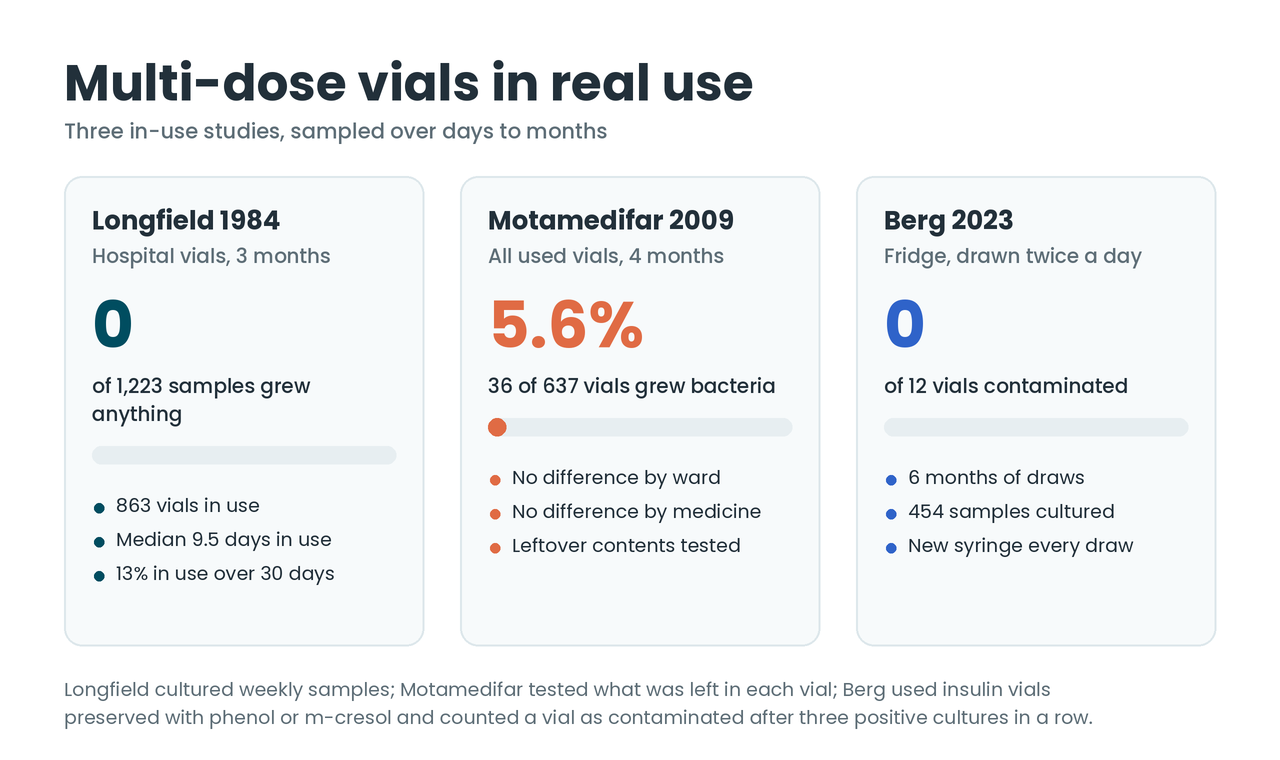
Longfield and colleagues cultured 1,223 weekly samples from 863 multi-dose vials in use across a hospital over three months. None of the samples grew anything. The vials had been in use for a median of 9.5 days, and 13% had been in use for more than 30 days.
Motamedifar and Askarian collected every used multi-dose vial at a large teaching hospital over four months and tested what was left inside. Of 637 vials, 36 grew bacteria, which is 5.6%, with no difference by ward or by medication.
Berg and colleagues ran the closest thing to everyday use. They kept 12 insulin vials in the fridge and drew from each one twice a day for six months, with a new syringe every time. Across 454 cultured samples, no vial became contaminated, and wiping the stopper with alcohol first made no difference to that. Those vials used phenol and m-cresol as preservatives rather than benzyl alcohol.
The stopper has a limit of its own. Chotikawanich and colleagues punctured the stoppers of 50 mL vials with three needle sizes at two angles and looked for rubber fragments. Coring showed up in 17.33% of samples overall. The large 18-gauge needle was the main cause, at 38%, rising to 56% when it went in at 45 degrees.
Where BPC-157 Itself Fits
So far this has been about the water, the syringe and the vial. What do the BPC-157 studies say about the peptide once it’s in solution and in the body?
He and colleagues ran the first full pharmacokinetic study in rats and beagle dogs. After injection into a vein or a muscle, BPC-157’s half-life was under 30 minutes, and blood levels rose in a straight line with the dose. When it was injected into muscle, about 14% to 19% reached the bloodstream in rats and 45% to 51% in dogs. It was broken down quickly into small fragments and then single amino acids, with the radioactive label leaving mainly through urine and bile.
Xu and colleagues ran the preclinical safety work in mice, rats, rabbits and dogs. A local tolerance test found the irritation BPC-157 caused was mild. In repeated dosing, the dogs tolerated it well, with a drop in creatinine at 2 mg/kg that wasn’t seen at lower doses and went away within two weeks of stopping.
The studies also used very different concentrations from the table above. Lee and Burgess gave two adults 10 mg of BPC-157 in 250 cc of normal saline by intravenous drip over an hour, then 20 mg the next day, with no changes in heart, liver, kidney, thyroid or blood sugar markers and no side effects reported. That’s 0.04 mg/mL on the first day, 125 times more dilute than 5 mg/mL. Lee and colleagues’ bladder pilot took a different route again: 10 mg in total, injected around the inflamed area during one procedure, in 12 women.
In rat work, Cerovecki and colleagues gave BPC-157 by injection into the abdominal cavity, in drinking water, and in a cream made with peptide dissolved in distilled water.
And Mateescu’s review counts the human record at fewer than 30 people across three uncontrolled pilot studies, none of which used a standardized pharmaceutical preparation. What the tumor studies and the human data show is in our BPC-157 and cancer post, and the combination evidence in our BPC-157 and TB-500 blend post.
Doses Used in the Research
The BPC-157 studies dose in three different ways: per kilogram of body weight in animals, per infusion or procedure in people, and by concentration in drinking water and cream. Here’s what each study actually used.
BPC-157
- 10 micrograms or 10 nanograms per kg, injected into the abdominal cavity once a day after the medial collateral ligament was cut, in rats (Cerovecki, 2010)
- 0.16 micrograms per mL in drinking water, about 12 mL a day per rat (Cerovecki, 2010)
- 1.0 microgram per gram of cream, applied as a thin layer at the injury (Cerovecki, 2010)
- 2 mg/kg in repeated dosing in dogs, the dose at which creatinine dropped (Xu, 2020)
- 10 mg in 250 cc of normal saline by intravenous drip over one hour, then 20 mg the next day, in two adults (Lee and Burgess, 2025)
- 10 mg in total, injected around the inflamed area of the bladder during a single cystoscopy, in 12 women (Lee, 2024)
Benzyl alcohol
- 0.9% with epinephrine, as 1 mL injections into the skin, in 30 adults (Wilson and Martin, 1999)
- 0.86% mixed into 1% lidocaine, in 20 people (Williams and Howe, 1994)
- 0.9%, as bacteriostatic saline given before propofol, in 39 patients (Minogue and Sun, 2005)
- 3 to 9 mg/mL as the preservative in growth hormone products (Kappelgaard, 2004)
Frequently Asked Questions
How much bacteriostatic water do you add to a 5 mg vial of BPC-157?
The math works with any volume. 1 mL gives 5 mg/mL, 2 mL gives 2.5 mg/mL and 3 mL gives about 1.67 mg/mL. What the volume changes is the size of each draw, which moves syringe accuracy, injection volume and benzyl alcohol per draw.
How many units is 250 mcg of BPC-157?
It depends on the water. In a 5 mg vial, 250 mcg is 5 units with 1 mL, 10 units with 2 mL and 15 units with 3 mL. In a 10 mg vial it’s 2.5, 5 and 7.5 units.
Does adding more water make BPC-157 weaker?
Each milliliter holds less peptide, but the vial holds the same total, so a bigger draw holds the same amount. The number of draws in the vial stays exactly the same.
How much benzyl alcohol is in each draw?
Bacteriostatic water carries 9 mg of benzyl alcohol per mL. That’s 0.45 mg in a 0.05 mL draw, 0.9 mg in 0.10 mL and 1.35 mg in 0.15 mL.
Why does bacteriostatic water sting less than plain saline?
Benzyl alcohol works as a local anesthetic. In Wilson and Martin’s trial, 0.9% benzyl alcohol was 48% less painful to inject than saline, and in St Peter’s crossover a benzyl alcohol-preserved injection caused less pain than the unpreserved form.
Does benzyl alcohol damage BPC-157?
The tests so far are on other peptides and proteins, where benzyl alcohol was one of the gentler preservatives. Li’s team saw no interaction between benzyl alcohol and a 31-amino-acid peptide, while 1% m-cresol made it clump.
How long does a vial of BPC-157 last?
Divide the draws in the vial by the draws you take each day. A 5 mg vial split into 250 mcg draws holds twenty, so once a day it lasts twenty days, however much water went in.
What concentrations have BPC-157 studies used?
They vary enormously. Lee and Burgess’s intravenous pilot used 10 mg in 250 cc of saline, 0.04 mg/mL, while Cerovecki’s rats drank water holding 0.16 micrograms per mL.
References
- Berg AS, Jacob ME, Mamo LB, et al. Refrigerated multi-dose insulin vials remain sterile through 6 months of use. J Small Anim Pract. 2023;64(12):776-780. doi:10.1111/jsap.13664
- Berteau C, Filipe-Santos O, Wang T, et al. Evaluation of the impact of viscosity, injection volume, and injection flow rate on subcutaneous injection tolerance. Med Devices (Auckl). 2015;8:473-484. doi:10.2147/MDER.S91019
- Cerovecki T, Bojanic I, Brcic L, et al. Pentadecapeptide BPC 157 (PL 14736) improves ligament healing in the rat. J Orthop Res. 2010;28(9):1155-1161. doi:10.1002/jor.21107
- Chotikawanich T, Kammee T, Khantee S. The impact of needle size and angle on rubber coring after multiple puncturing of multi-dose propofol vial rubber stoppers. Heliyon. 2022;8(5):e09389. doi:10.1016/j.heliyon.2022.e09389
- Frenken LA, van Lier HJ, Koene RA. Analysis of the efficacy of measures to reduce pain after subcutaneous administration of epoetin alfa. Nephrol Dial Transplant. 1994;9(9):1295-1298. PubMed 7816293
- Goyal MK, Roy I, Banerjee UC, et al. Role of benzyl alcohol in the prevention of heat-induced aggregation and inactivation of hen egg white lysozyme. Eur J Pharm Biopharm. 2009;71(2):367-376. doi:10.1016/j.ejpb.2008.09.012
- He L, Feng D, Guo H, et al. Pharmacokinetics, distribution, metabolism, and excretion of body-protective compound 157, a potential drug for treating various wounds, in rats and dogs. Front Pharmacol. 2022;13:1026182. doi:10.3389/fphar.2022.1026182
- Heljo P, Ross A, Zarraga IE, et al. Interactions between peptide and preservatives: effects on peptide self-interactions and antimicrobial efficiency in aqueous multi-dose formulations. Pharm Res. 2015;32(10):3201-3212. doi:10.1007/s11095-015-1697-z
- Kappelgaard AM, Bojesen A, Skydsgaard K, et al. Liquid growth hormone: preservatives and buffers. Horm Res. 2004;62(Suppl 3):98-103. doi:10.1159/000080507
- LeBel M, Ferron L, Masson M, et al. Benzyl alcohol metabolism and elimination in neonates. Dev Pharmacol Ther. 1988;11(6):347-356. doi:10.1159/000457714
- Lee E, Burgess K. Safety of intravenous infusion of BPC157 in humans: a pilot study. Altern Ther Health Med. 2025;31(5):20-24. PubMed 40131143
- Lee E, Walker C, Ayadi B. Effect of BPC-157 on symptoms in patients with interstitial cystitis: a pilot study. Altern Ther Health Med. 2024;30(10):12-17. PubMed 39325560
- Li M, Falk BT, Lu X, et al. Molecular mechanism of antimicrobial excipient-induced aggregation in parenteral formulations of peptide therapeutics. Mol Pharm. 2022;19(9):3267-3278. doi:10.1021/acs.molpharmaceut.2c00449
- Longfield R, Longfield J, Smith LP, et al. Multidose medication vial sterility: an in-use study and a review of the literature. Infect Control. 1984;5(4):165-169. doi:10.1017/s0195941700059154
- Lteif AN, Schwenk WF. Accuracy of pen injectors versus insulin syringes in children with type 1 diabetes. Diabetes Care. 1999;22(1):137-140. doi:10.2337/diacare.22.1.137
- Malerba E, Fracassi F, Del Baldo F, et al. The accuracy and precision of insulin administration using human and veterinary pen-injectors and syringes for administration of insulin. J Vet Intern Med. 2021;35(3):1255-1264. doi:10.1111/jvim.16126
- Mateescu DM, Gavrilescu DM, Constantinescu FE, et al. BPC-157 as an investigational peptide therapeutic: biopharmaceutical challenges, formulation strategies, and translational development barriers. Pharmaceutics. 2026;18(5):625. doi:10.3390/pharmaceutics18050625
- Mathaes R, Koulov A, Joerg S, Mahler HC. Subcutaneous injection volume of biopharmaceuticals: pushing the boundaries. J Pharm Sci. 2016;105(8):2255-2259. doi:10.1016/j.xphs.2016.05.029
- McCloskey SE, Gershanik JJ, Lertora JJ, et al. Toxicity of benzyl alcohol in adult and neonatal mice. J Pharm Sci. 1986;75(7):702-705. doi:10.1002/jps.2600750718
- Menon PA, Thach BT, Smith CH, et al. Benzyl alcohol toxicity in a neonatal intensive care unit: incidence, symptomatology, and mortality. Am J Perinatol. 1984;1(4):288-292. doi:10.1055/s-2007-1000023
- Minogue SC, Sun DA. Bacteriostatic saline containing benzyl alcohol decreases the pain associated with the injection of propofol. Anesth Analg. 2005;100(3):683-686. doi:10.1213/01.ANE.0000148617.98716.EB
- Motamedifar M, Askarian M. The prevalence of multidose vial contamination by aerobic bacteria in a major teaching hospital, Shiraz, Iran, 2006. Am J Infect Control. 2009;37(9):773-777. doi:10.1016/j.ajic.2008.12.009
- Roy S, Jung R, Kerwin BA, et al. Effects of benzyl alcohol on aggregation of recombinant human interleukin-1-receptor antagonist in reconstituted lyophilized formulations. J Pharm Sci. 2005;94(2):382-396. doi:10.1002/jps.20258
- Silva SR, Clark L, Goodman SN, Plotnick LP. Can caretakers of children with IDDM accurately measure small insulin doses and dose changes? Diabetes Care. 1996;19(1):56-59. doi:10.2337/diacare.19.1.56
- St Peter WL, Lewis MJ, Macres MG. Pain comparison after subcutaneous administration of single-dose formulation versus multidose formulation of epogen in hemodialysis patients. Am J Kidney Dis. 1998;32(3):470-474. doi:10.1053/ajkd.1998.v32.pm9740164
- Usach I, Martinez R, Festini T, Peris JE. Subcutaneous injection of drugs: literature review of factors influencing pain sensation at the injection site. Adv Ther. 2019;36(11):2986-2996. doi:10.1007/s12325-019-01101-6
- Williams JM, Howe NR. Benzyl alcohol attenuates the pain of lidocaine injections and prolongs anesthesia. J Dermatol Surg Oncol. 1994;20(11):730-733. doi:10.1111/j.1524-4725.1994.tb03194.x
- Wilson L, Martin S. Benzyl alcohol as an alternative local anesthetic. Ann Emerg Med. 1999;33(5):495-499. doi:10.1016/s0196-0644(99)70335-5
- Xu C, Sun L, Ren F, et al. Preclinical safety evaluation of body protective compound-157, a potential drug for treating various wounds. Regul Toxicol Pharmacol. 2020;114:104665. doi:10.1016/j.yrtph.2020.104665
Stay sharp,
Joe Mars
The Peptide Report
P.S. Got a vial-math question the table above didn’t cover? Bring it over to the Peptides & Biohacking Hub, where the conversation keeps going.