
Aging does not happen evenly across the body. It happens in coordinated systems that fall out of sync with each other. As we age the pineal gland calcifies, our melatonin drops, and the body’s master timing signal gets weaker. Once that central clock starts to drift, every system downstream of it drifts with it.
There is one compound in the longevity space that targets this whole network at once and has been used clinically in Russia for decades. Epithalon is a synthetic tetrapeptide that activates telomerase, lengthens telomeres in human cells, and restores melatonin signaling in aged subjects. It is also one of the most misunderstood compounds in the western peptide world. Most of what gets repeated about Epithalon dosage is wrong, and almost nobody is running the better-engineered version of the molecule.
This guide covers what Epithalon is, how it works, the proper Epithalon dosage protocol, the difference between Epithalon and NA Epithalon Amidate, and what to look for when sourcing it.
What Is Epithalon? A Synthetic Tetrapeptide With 25 Years of Research
Epithalon (also spelled Epitalon or Epithalone) is a bioregulator. It consists of four amino acids: alanine, glutamic acid, aspartic acid, and glycine. The sequence is Ala-Glu-Asp-Gly, sometimes called the AEDG peptide. It belongs to the same class of compounds as Cartalax and Pinealon, the Khavinson bioregulators developed in Russia starting in the 1980s and used clinically there for decades while the western world largely ignored them.
You cannot talk about Epithalon without talking about Professor Vladimir Khavinson. The man spent over 40 years researching how short peptides influence aging and tissue function and wrote over 775 scientific papers in the process. You might know him as Putin’s personal longevity doctor. He passed last year and the peptide world lost one of its greatest minds. His research program produced a system of bioregulators targeting virtually every organ and tissue type in the body, and Epithalon is the one built for the pineal gland and the systems it coordinates.
The pineal gland is the body’s master clock. It sits at the base of the brain and produces melatonin on a 24-hour cycle, and that signal coordinates everything from sleep to immune function to the timing of cell division. As you age the pineal gland calcifies, melatonin production drops, and the timing signal gets weaker. That signal loss is the upstream cause of a long list of symptoms most people just chalk up to getting older. Epithalon is designed to fix that exact problem.
How Epithalon Works: Telomerase Activation and Telomere Lengthening
The headline finding on Epithalon is that it lengthens telomeres. Most people have heard this and most people do not really understand what it means.
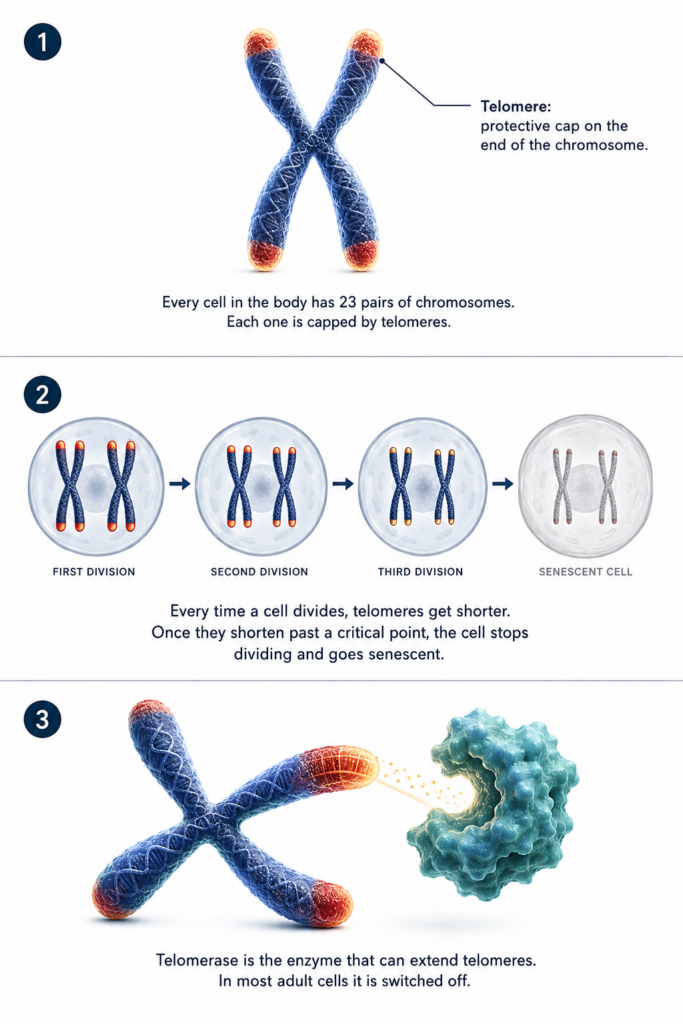
Every cell in your body has a set of chromosomes carrying your DNA, and at the end of each chromosome is a protective cap made of repetitive DNA sequence called a telomere. Think of it like the plastic tip on the end of a shoelace that keeps the lace from fraying. Every time one of your cells divides, the telomere on each chromosome gets a little shorter. Once the telomere shortens past a critical point, the cell stops dividing entirely. It either dies or goes into a state called senescence, where it stops working properly but does not die. Senescent cells are one of the major drivers of inflammation and tissue dysfunction in aging.
Telomere length is one of the most studied biomarkers of biological age. People with shorter telomeres for their chronological age have higher rates of cardiovascular disease, more cognitive decline, weaker immune function, and earlier mortality. Telomere length is a real readout of how worn down your cellular machinery is.
There is one enzyme in the body that can extend telomeres back out. It is called telomerase. In most adult cells telomerase is mostly switched off, which is part of the reason your telomeres shorten as you age.
Epithalon activates telomerase in cells where it is otherwise switched off. In a 2003 study, Khavinson and his colleagues showed that Epithalon induced telomerase activity in cultured human fibroblasts, and the cells went on to divide past the Hayflick limit, the point where normal human cells stop dividing. Their telomeres got longer, not shorter, with each division. This is one of the only compounds with published research showing this effect in human cells.
If telomere shortening is one of the things driving cellular aging, and if Epithalon can turn the telomere shortening process around in cells where it has been switched off, then this compound is operating on one of the most upstream levers in the entire biology of aging. It is acting on the actual process of cellular aging rather than on the symptoms or metabolic downstream of it.
What Aging Does to the Pineal Network
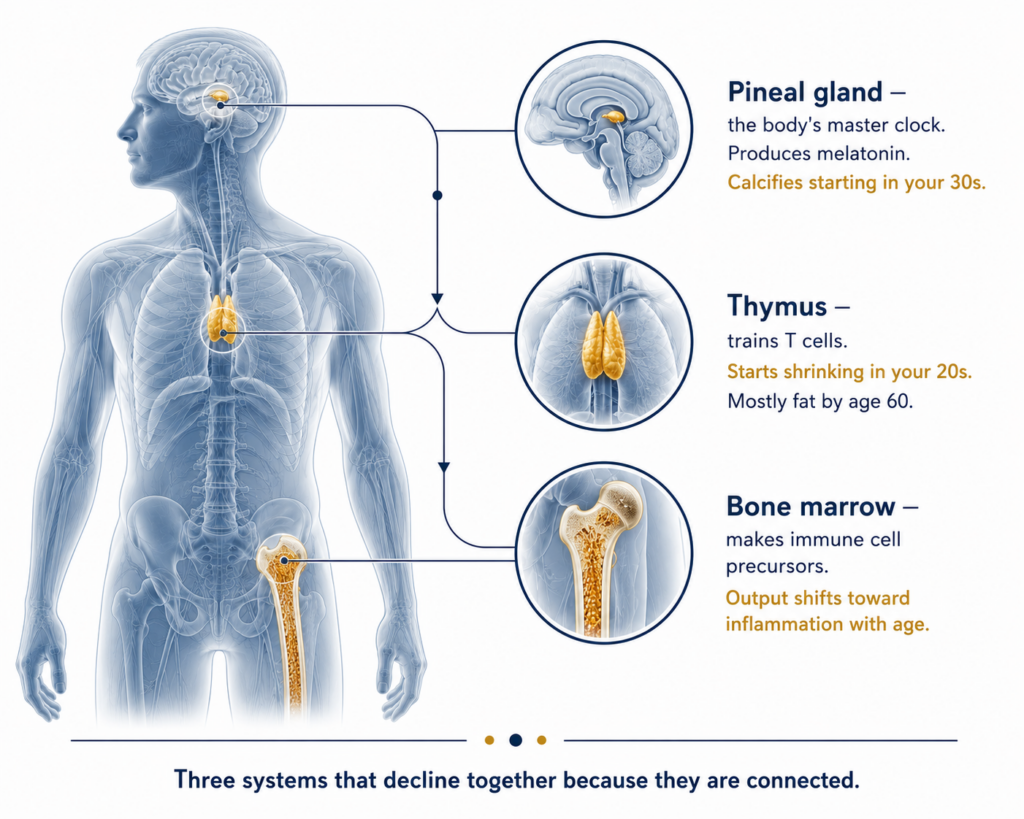
The pineal gland itself calcifies starting in your 30s and continues to calcify through life. Melatonin output drops by roughly 80 percent between age 25 and age 75, and the drop affects more than sleep. Melatonin is the body’s most powerful endogenous antioxidant, it coordinates the immune system, and it tells cells when to divide and when to rest. When the source signal weakens, every downstream rhythm gets fuzzier.
The thymus is the training ground where T cells mature, and it starts shrinking in your 20s. By age 60 most of the functional tissue has been replaced by fat and new T cell production slows to a fraction of what it was. This is one of the major reasons immune response weakens with age.
The bone marrow is the factory making the immune cell precursors that the thymus would otherwise train. The marrow does not stop working with age, but its output shifts toward more inflammatory cell lineages and fewer of the protective lymphoid lineages, so the whole supply chain tilts toward inflammation rather than coordinated immunity.
These three systems decline in coordination because they are connected. The pineal gland sends signals that influence both the thymus and the bone marrow, so when the pineal signal weakens the downstream systems lose coordination too. Khavinson’s group ran a review on pineal peptides and thymus function during aging and concluded that pineal peptides, especially Epithalamin and Epithalon, had a stronger geroprotective effect on thymus involution than the thymic peptides did.
The pineal gland does more than run your sleep clock. It is influencing the supply chain of your immune system. This is the network Epithalon targets.
Epithalon Benefits: Sleep, Skin, Immunity, and Cellular Aging
Beyond the telomere finding, Epithalon research describes a wider set of benefits that show up across cycles. None of these are guaranteed and none are FDA-approved claims, but they appear consistently in the published literature and in what users report.
| What People Notice | What Research Shows |
| Better sleep | Falling asleep faster, sleeping deeper, more vivid dreams, and waking up rested. This is the most reliable effect and usually shows up within the first week. The mechanism is restored melatonin signaling from the pineal gland. |
| Tighter, healthier-looking skin | Skin tightening usually starts around week three or four of a cycle. Lab studies show improvements in skin elasticity, moisture retention, and collagen-related markers. The skin effect comes from the cellular gene-expression changes, not from a direct skin treatment. |
| Steadier energy through the day | Cleaner cortisol patterns across the day, with morning cortisol up and evening cortisol down the way they are supposed to be. Animal studies also show normalization of glucose, insulin, and thyroid hormone rhythms in older subjects. |
| Less oxidative stress on the body | A 2007 paper documented direct antioxidant properties of the peptide. Reduced oxidative stress on the cardiovascular system and other tissues, which compounds over time. |
| Stronger immune function | Improved T-cell function, better cytokine balance, and improved CD4/CD8 ratios in aged subjects. Works through the pineal-thymus axis described above. |
| Lower cancer risk in animal studies | Animal data consistently shows treated animals develop fewer cancers, not more. This is the opposite of what most people assume given that the compound activates telomerase. |
| Longer lifespan in animal studies | Mean lifespan extension of 13.3 percent in aged female rats. Drosophila lifespan extended 11 to 31 percent across studies. A 15-year human follow-up trial showed reduced mortality in elderly cardiac patients treated with Epithalamin. |
The cancer point deserves a fuller note because it is the most common concern raised about telomerase activators. Telomerase activation in adult cells is theoretically a cancer risk because telomerase is one of the things many tumor cells use to keep dividing. Khavinson’s animal work consistently shows the opposite, with treated animals getting fewer tumors rather than more. The proposed mechanism is that healthier non-senescent cells are less prone to malignant transformation in the first place, and that restored immune function clears early cancers more effectively. The Russian clinical data does not show an increased cancer rate in treated patients either.
Epithalon Dosage Protocol: How to Cycle It Properly
Epithalon is an injectable peptide that goes subcutaneous, meaning under the skin rather than into muscle or vein. Pin it at night before bed because you want the melatonin signal to land during the body’s natural sleep window.
| Epithalon Dose | Cycle Length | Cycles Per Year | Timing |
| 1 to 2 mg daily | 10 to 20 days | 1 to 2 cycles | Subcutaneous, before bed |
Then a break. Bioregulators work through cumulative cycles, not constant dosing. You run the course, you stop, you let the system respond, and you come back for another cycle a few months later. Two cycles per year is a common maintenance pattern.
Why the 10mg Epithalon Dosage Most Vendors Recommend Is Wrong
The protocols most commonly cited in the western peptide world all anchor on a 10mg Epithalon dose. Ben Greenfield, Dr. William Seeds in Peptide Protocols, and the International Peptide Society all publish variations of the same 10mg-anchored protocol. The 10mg figure is wrong by an order of magnitude, and the reason is a translation issue.
The 10mg figure originally came from studies on Epithalamin, the crude bovine extract Khavinson started studying in the 1980s. Epithalamin is a polypeptide mixture with dozens of compounds in varying ratios. When the synthetic Epithalon tetrapeptide was developed and the dosing language got translated for western audiences, the 10mg figure carried over without anyone catching that the synthetic compound is roughly a hundred times more concentrated as a single isolated peptide.
The foundational 2001 Khavinson and Lapin monkey study on the synthetic compound used 10 micrograms per animal per day. Not 10 milligrams. If you have been running 10mg daily, you have not been hurt. You have been wasting product. The practical Epithalon dose for the synthetic tetrapeptide is 1 to 2mg per day.
Epithalon vs NA Epithalon Amidate: Why the Version Matters
There are two versions of Epithalon on the research peptide market. The basic one, and a better-engineered one called NA Epithalon Amidate (sometimes called N-Acetyl Epithalon Amidate or AEDG amidate).
Here is the issue with the basic version. Epithalon is a very small molecule, just four amino acids strung together. Your body has enzymes in the bloodstream whose entire job is to chop up small molecules like this. As soon as you inject the basic version, those enzymes go to work on it from both ends. Most of the dose is broken down within minutes. Only a small fraction makes it to the cells it is supposed to act on.
NA Epithalon Amidate solves this. Scientists added two small protective caps to the molecule, one on the front end and one on the back end. Think of them like the plastic tips on the ends of shoelaces. They keep the enzymes from chewing the molecule apart. The active ingredient in the middle is exactly the same Ala-Glu-Asp-Gly sequence, but the molecule now stays intact much longer in your bloodstream, which means more of every dose actually reaches your cells and does the work it is supposed to do.
There is one extra benefit. The cap on the front end also helps the molecule cross the protective barrier around your brain. That matters because the pineal gland sits inside the brain, and the pineal gland is one of the main targets Epithalon is supposed to act on. The basic version has a harder time getting in there. The modified version gets in more easily.
So why doesn’t every peptide vendor sell NA Epithalon Amidate? Because it is harder and more expensive to manufacture. It takes more steps in the lab, costs more per gram to produce, and leaves less profit margin per vial. Most peptide companies just sell the basic version because it is cheaper. Most customers never even know the better-engineered option exists.
Epithalon Side Effects and Safety
The reported side effect profile in the Russian clinical literature is essentially zero. 25 years of clinical and research use on the synthetic compound, longer if you count the Epithalamin work that came before it, and no significant adverse event patterns documented across thousands of patients.
That tracks with the rest of the bioregulator category. The doses are small, the peptides are short, and they do not bind to hormone receptors or interfere with major regulatory systems. They act as weak, tissue-specific signals.
The most commonly reported minor effects in research settings include:
- Mild injection site reactions (redness or temporary irritation)
- Transient drowsiness early in a cycle as melatonin signaling shifts
- Vivid dreams during the first week (most users consider this a benefit, not a side effect)
Standard caveat: this is a research compound and not an approved pharmaceutical in the United States. Research peptides referenced in this article are sold for research purposes only and are not intended for human consumption.
How Long Does Epithalon Take to Work?
Effects show up on different timelines depending on the system being targeted.
Sleep effects typically appear within the first week of a cycle. Most users notice they fall asleep faster and sleep deeper by night three to seven.
Skin tightening and connective tissue effects usually start showing up around week three or four of a cycle. The mechanism is downstream of the cellular gene-expression effects, which take time to translate into visible changes.
Telomere lengthening, immune restoration, and gene expression effects are not subjective and only show up on labs if you bother to run them. These are the long-term effects that drive the cumulative benefit of the protocol.
If you feel nothing on Epithalon after a full cycle, that is also useful information. It usually means your pineal function and circadian rhythm are not the main thing breaking down for you yet. Try Cartalax for joints, Pinealon for cognitive and sleep coordination, or one of the other bioregulators that targets a different system.
Who Should Consider Epithalon?
Two groups tend to get the most out of Epithalon.
The first is the sleep-disrupted crowd. Anyone who used to sleep well and does not anymore. Trouble falling asleep, waking at 2 or 3 am and lying there, or sleeping six or seven hours but waking up not rested. Most of this in midlife and beyond is downstream of pineal calcification and the corresponding drop in melatonin output. Epithalon goes upstream of that and rebuilds the signal at the source. This is the group that feels the effect fastest.
The second is the longevity-focused crowd. People who are not chasing one specific symptom but want to push back on the systemic decline. The telomere effect, the immune axis effect, the gene expression effect, and the circadian effect all add up to something that looks like upstream aging-rate intervention rather than downstream symptom management.
Where to Buy Epithalon (US-Made, Third-Party Tested)
If you are going to run a Russian bioregulator like Epithalon, sourcing matters more than people give it credit for. Half the Epithalon being sold online is sketchy at best. The only thing that actually matters is whether what is in the vial matches the label.
I run NA Epithalon Amidate from BioEdge Research Labs. They are one of the few US suppliers actually carrying the better-engineered version, USA made, with batch-specific HPLC and mass-spec testing through an independent lab. Every vial ships with a Certificate of Analysis tied to the batch number.
Use code MARS15 for 15% off if you are going to grab any.
Epithalon FAQ
Final Thoughts on Epithalon
Epithalon is one of the most evidence-backed compounds in the longevity space, and most of that evidence is sitting in places western readers do not look. The 25 years of Russian clinical use, the published telomere-lengthening data in human cells, the consistent animal lifespan extension, and the cleaner version of the molecule that almost no US vendor carries all add up to a compound worth understanding properly before you run it.
Run the right version at the right dose and you will get more out of every cycle than the protocols copied from old translations would suggest.
Stay sharp,
Joe Mars
The Peptide Report
P.S. If you want to go deeper on Epithalon protocols, dosing, sourcing, and direct Q&A, all of that happens inside the community. Join the Peptide Biohacking Hub on Skool for the conversations that do not make it into the newsletter.
This content is for educational and informational purposes only. It is not intended as medical advice. Always consult with a qualified healthcare professional before starting any new protocol. Research peptides referenced in this article are sold for research purposes only and are not intended for human consumption. I receive affiliate compensation from some of the suppliers I reference.